IDX Website: What It Is and How to Build One
Only 26% of agents use a personal website with IDX, according to a 2026 NAR survey of 1,200 agents.
 Masoud GolchinOctober 4, 2026
This guide is for agents, brokers, and team leads who are deciding whether to buy, build, or fix an IDX website. It covers what IDX actually is, how listing data reaches the page, the three main ways to build one, and the choices that decide whether the site works or just sits there.
What an IDX Website Is, and What It Isn’t
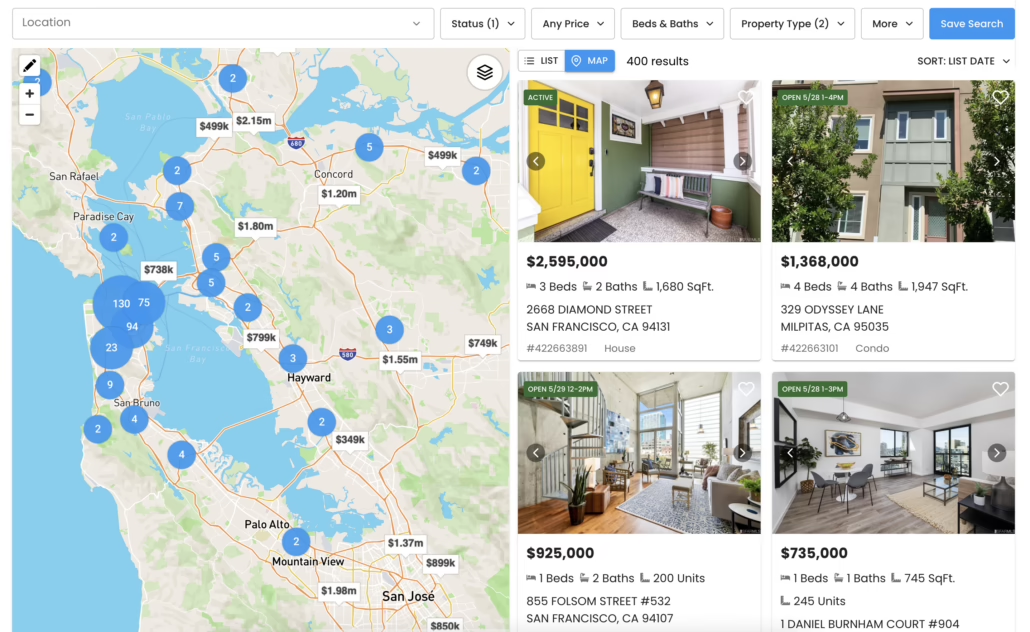
IDX stands for Internet Data Exchange. Under NAR and MLS policy, it is the arrangement that lets participating brokers display other participants’ listings on websites, apps, and other digital services they control. An IDX website is an agent or brokerage site with an MLS-fed property search built into it. The broader design questions, like speed, structure, and how the site earns trust, are covered in our guide to real estate website design. This article focuses on the IDX layer.
Three things are often treated as one, and keeping them apart will save you money:
- The MLS is the local cooperative database. It owns the listing data and sets the rules.
- IDX is the policy and feed that allows approved listings and fields to be shown publicly on participants’ sites.
- The website is yours: the brand, the neighborhood guides, the search experience, the lead forms, and the pages around the listings.
An IDX vendor usually connects the three, handling authentication, data delivery, field mapping, and often the search interface. When a provider quotes you for “IDX,” ask which of those layers they mean. A cheap search widget and a full on-domain listing system both get called IDX, and they lead to very different outcomes.
You are paying for permission and plumbing to show approved MLS listings on a site you control. You are not buying the MLS database, and you are not buying a national feed. No such feed exists.
IDX is also different from a VOW (Virtual Office Website). VOW rules can require visitors to register and may allow more data fields, while IDX display is generally public. Exactly where the line falls depends on your MLS.
One more source of confusion: the acronym is crowded. Search “IDX website” and you will also find Google’s Project IDX, a browser-based cloud development environment that became Firebase Studio in April 2025. It closed to new users on June 22, 2026 and shuts down on March 22, 2027. You will also find a communications firm called IDX that builds corporate websites and investor relations feeds. Neither has anything to do with MLS listings. If you are reading a vendor page or a contract, confirm which IDX it means before you trust its claims.
Your MLS Sets the Rules Before Any Vendor Does
Most IDX problems that look like vendor failures start at the MLS. Eligibility, coverage, display fields, fees, and whether you can combine feeds are all decided locally, and they vary more than vendors admit.
Before you compare platforms, get answers to these questions from your MLS in writing:
- Are you eligible? Some feeds are limited to broker sites. An agent may need broker authorization before any vendor can switch on a feed.
- What’s in the feed? Sellers can opt out of IDX display or hide an address. Some statuses and fields are excluded. One vendor, Diverse Solutions, says its feeds often include over 90% of MLS listings, but that is a vendor claim and coverage varies by area. When a client asks why a home they saw on Zillow isn’t on your site, this is usually why.
- Can you combine MLSs? Sometimes, if each MLS permits it. Agents in California have described multi-MLS sites where listings displayed poorly because each feed formats data differently.
- What must the page show? Brokerage attribution, listing source, disclaimers, and rules on sold and historical data all come from MLS policy.
- Are there fees? NAR’s IDX FAQ addresses whether MLSs may charge for IDX access. Some do. Add that to the vendor’s price.
Security belongs on that list too. NAR policy allows an MLS to require protections such as firewalls and an audit trail of consumer activity when it suspects a breach or a rule violation. Build logging and access controls into the original plan. Adding them after an MLS sends a warning letter is slower and more expensive.
Treat compliance as a product requirement, not a footer disclaimer. Losing feed access takes the core feature of the site offline, however good the design is.
How Listing Data Gets From the MLS to Your Page
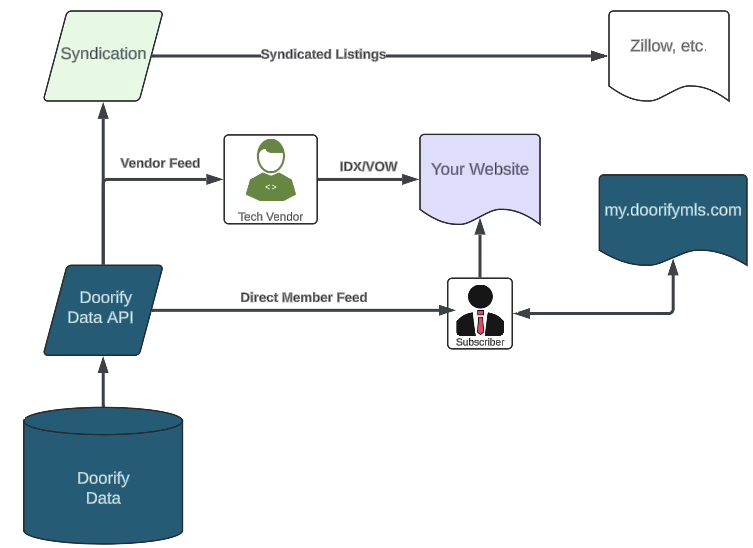
Take one listing: a three-bedroom home in Austin listed by Broker A. A visitor on Broker B’s site sees it as a card in a search result. Getting it there involves several systems, and each one is a place where things can go wrong.
- Broker A enters the listing into the MLS. The record includes price, beds, baths, photos, status, and location. Listing teams often rely on MLS upload and listing tools at this step, and the quality of the source record limits everything downstream.
- The MLS exposes approved data. Depending on the MLS, that happens through the older RETS standard or the newer RESO Web API.
- A vendor or your own middleware authenticates. The system checks that the account is allowed to receive the requested data.
- Fields get mapped. One source calls it “beds,” another “BedroomsTotal.” The integration normalizes records into one format.
- The site requests the data. A plugin, embedded widget, or custom frontend pulls the record from the vendor’s system or a local cache.
- The visitor sees the page. A listing card or detail page renders with the approved photos, price, status, and attribution.
The page your visitor sees is rarely a live view of the MLS. It is a rendered copy of data that has passed through at least one other system, often with caching to make it load faster. That is where stale photos, wrong statuses, and mislabeled fields come from. Refresh schedules depend on the MLS, the vendor, and the agreement. “Live” is a sales word, not a specification. Ask how often records sync, how deletions and status changes are handled, and who gets alerted when a sync fails.
Vendor APIs have limits that matter for architecture. IDX Broker’s RESTful API is available to active Lite and Platinum accounts, but it does not return MLS data directly, except listings that belong to agents on the account. It mainly covers account-level data such as agents, leads, saved searches, and widget URLs. Read the IDX Broker API documentation before you assume one API will cover everything your site needs. Developers who have worked directly with RETS know the other pain point: years of Stack Overflow threads about DMQL query syntax errors in libraries like PHRETS. A direct integration is real engineering work.
Three Ways to Build an IDX Website
You are trading launch speed and a lower upfront cost against control, SEO value, and the cost of changing your mind later. The cheapest path to launch is often the most expensive one to leave.
WordPress with an IDX plugin
For most small brokerages and teams, this is the sensible default. Your team gets an editor it can use, room to publish market reports and neighborhood pages without a developer, and a wide choice of IDX providers. Plugins such as SimplyRETS for WordPress and embeddable widgets such as FlexMLS’s quick search show how common the pattern is.
The tradeoff is that the plugin often owns the listing data model, templates, and URL structure. Before you commit, check whether property pages get real, stable URLs on your domain or live behind the plugin’s search routes. Visual changes are usually easy. Changes to schema, filters, page generation, and lead routing may need workarounds or custom code. Our WordPress development work often starts with exactly that audit: what the plugin controls and what the site controls.
A vendor-hosted search or iframe
An iframe or vendor-hosted search gets you live fastest, because the vendor runs the search interface and most of the data connection. It suits a short test or a site whose only job is giving existing clients a clean search.
Don’t mistake it for a website strategy. The listing pages live on the vendor’s domain or inside a frame search engines don’t credit to you, so the vendor builds authority from your traffic. Custom URLs, schema, and lead prompts are restricted. If you leave, you take almost nothing with you.
A direct MLS API integration
Building against the MLS feed (usually the RESO Web API) gives you full control over URLs, page speed, structured data, filters, and lead flows. It also makes you, or your technical partner, responsible for sync jobs, field mapping, MLS rule changes, and monitoring for as long as the site runs.
Choose this when listings are part of a larger content and search plan, or when you run several markets and the plugin’s limits are already costing you. Choose WordPress with a good plugin when you are still proving that the site has a job.
| Path | Upfront cost | SEO upside | Main risk |
|---|---|---|---|
| WordPress plus IDX plugin | Lower | Moderate, depends on how the plugin handles URLs | Plugin limits on URLs, schema, and data |
| Vendor iframe or hosted search | Lowest | Weak, authority goes to the vendor | Lock-in and little crawlable value |
| Direct MLS API | Highest | Highest control | Ongoing engineering and compliance upkeep |
The IDX choice sits inside a larger platform decision. This WordPress vs Webflow comparison helps frame that, but the MLS connection still needs its own technical review, because it is usually the hardest part of the site to change later.
Why an IDX Website Rarely Produces Leads on Its Own
Agents don’t rate their websites highly as lead sources. In NAR’s 2024 technology survey, agents named social media (52%), their CRM (32%), and the local MLS (26%) as sources of quality leads, well ahead of brokerage websites (20%) and business websites (18%). The 2025 survey showed the same order: social media 39%, CRM 23%, MLS 17%, brokerage site 13%, business site 12%. Read these carefully. They are self-reported, the response rates were about 2%, and “business website” isn’t the same thing as “IDX website.” The direction is still clear.
The buyer data explains why. Zillow’s 2024 consumer report found 94% of buyers used at least one online resource, but 50% named their agent as the most helpful resource, compared with 36% for an app or website. NAR’s 2025 profile found 88% of buyers purchased through an agent. Buyers search on portals and trust agents. Your IDX site is useful when it supports that relationship. It can’t beat Zillow at being Zillow.
Practitioners say it more bluntly. In agent communities, the consensus is that IDX is “a tool, not a lead strategy.” Agents who installed it and waited describe it as “pretty useless” or “a complete disappointment.” One senior broker asked why anyone would spend that much “to advertise other people’s listings.”
Be careful with the numbers vendors use to answer that. The 2023 Bright MLS and Drexel study found on-MLS homes sold for 17.5% more than comparable off-MLS homes, and a 2024 Singapore study found a 4.21% premium for agents using online listings. Neither measures what an IDX website returns. No credible study we know of does.
The uses that actually work
The positive accounts have one thing in common: the agent gives the search a specific job and sends people to it.
- Client service. One solo agent sends active buyers to his own IDX search instead of a portal. They get accurate status, detailed listings, and alerts, and other agents and lenders don’t contact them. His clients liked that last part most.
- Paid search landing pages. Pointing Google Ads at a specific IDX results page (a neighborhood, a price band, a property type) gives the search a steady source of visitors with clear intent.
- Niche audiences. Waterfront condos, acreage, a single school district. A narrow, well-explained search does better than a generic copy of a portal.
IDX also mostly serves buyers. A seller weighing which agent to hire cares about your track record, your marketing plan, and your local knowledge. If the site is all search and no agent, it does little to win listings.
Registration: force it, prompt for it, or leave it open
This is the most argued-over setting on any IDX site. Lead-gen vendors claim 3 to 5% capture with forced registration against 0.5 to 1% with optional sign-up. Those are vendor numbers with undefined measures, not benchmarks. The counterargument is friction: forced walls push people back to portals, and more sign-ups don’t always mean better leads. Many marketers now recommend soft prompts, such as asking for an email to save a search or get alerts after a few listing views.
Test it with your own audience and measure appointments, not form fills. Whatever you choose, the lead has to go somewhere. A registration that lands in a CRM nobody works is a dead end. Connect the site to your CRM, send new sign-ups an immediate and specific follow-up, and have a human reply within hours. The IDX search brings people in. What happens after sign-up decides whether you get a client.
Getting Your IDX Listing Pages Indexed by Google
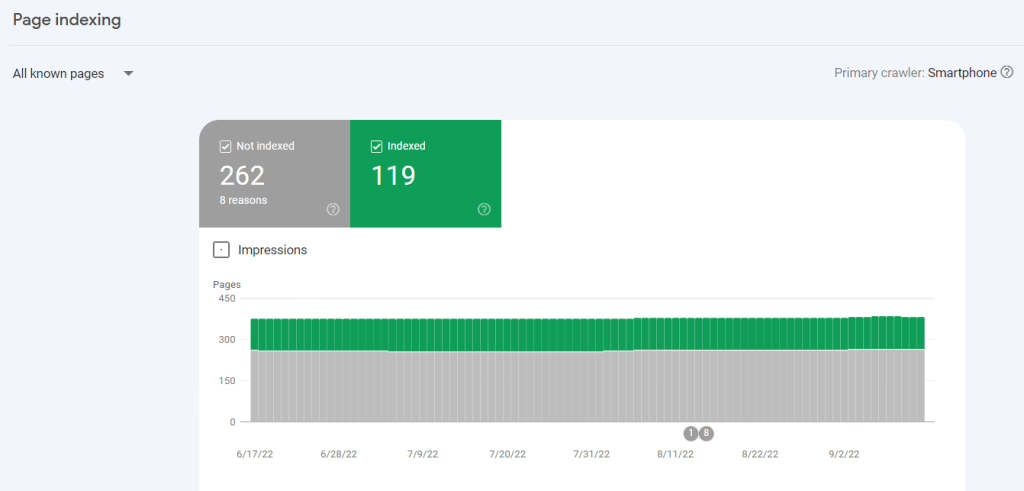
“IDX helps SEO” shows up in nearly every vendor pitch. It depends entirely on how the listings are built. When listings render inside an iframe or on the vendor’s domain, the vendor gets the search value. On-domain, crawlable pages can help, but even then nothing guarantees Google will index them. One agency on X described a client site carrying 400 IDX listings, with zero of them appearing in Search Console. That’s a single anecdote, but it’s a common pattern, and you can check your own site in five minutes.
Make the right pages indexable, and only those
Property detail pages need stable URLs, unique titles, and appropriate structured data. They also share their content with every other agent showing the same listing, so expect Google to be selective. Your stronger ranking assets are usually city, neighborhood, and niche pages that combine a local point of view with a curated set of listings. A page explaining what $600,000 buys in a specific school zone, with live examples, is something Zillow doesn’t publish.
Faceted search creates a huge number of URL combinations. Decide which filters deserve indexable pages and keep the rest for visitors only. Set clear rules for sold, expired, and duplicate listings so old records don’t compete with current pages or pile up as soft 404s.
Compete where the portals are weak
Agents who have tried generic terms like “homes for sale in [city]” mostly report losing to the portals. Hyperlocal and specialist content is more winnable. Pair that with local visibility outside your site. This Google Business Profile guide for realtors covers the map-pack side, which often brings more calls than organic listing pages.
Speed matters more here than on most sites, since 69% of buyers used a mobile device or tablet in their search (NAR 2024). Listing pages are heavy with images, maps, and scripts, so it’s worth fixing Core Web Vitals on listing templates rather than only the homepage. When you review templates with a developer, this SEO cheat sheet for developers covers rendering, canonicals, and schema. The question is simple: can a search engine reach, understand, and trust the pages you want to rank?
Hosting and Operations: The Parts That Break Quietly
An IDX site does more work than a brochure site. Search queries, image delivery, scheduled syncs, and lead submissions all compete for the same server resources. Plan hosting around the feed and search load, not the homepage.
| Choice | Tradeoff | What you’ll notice |
|---|---|---|
| Cheap shared hosting | Little control, shared resources | Slow searches, failed background imports |
| Managed WordPress hosting | Higher monthly cost | Easier caching, backups, updates, and monitoring |
| VPS or cloud setup | Needs technical oversight | Full control over database and sync jobs |
| Vendor-hosted IDX | Less infrastructure work | Less control over speed and data behavior |
Image compression, object caching, and a CDN usually matter more than a host’s marketing claims. Ask who monitors failed imports, how errors are reported, and how fast a stale feed gets fixed. Plugins need maintenance too. Security issues in IDX plugins have been reported in 2026, which is one more reason to budget for updates. Our breakdown of ongoing website maintenance costs shows what that line item looks like in practice.
Vendor Contracts, Ownership, and Migration Risk
In agent forums, IDX complaints are mostly about the vendor, not the technology. Common stories include a site still unfinished a month into a one-year contract, customization that was promised and never delivered, support described as “very bad,” and search displays that look “very 2005.” The fear behind many of them is leaving: losing years of blog posts, customizations, and contacts when switching providers.
Before you sign, ask for:
- A working demo on your MLS, not a sample site from another market with different fields and rules.
- The total cost: setup, monthly fees, MLS charges, design, and anything billed as an add-on. “Free” IDX plugins rarely mean a free IDX website.
- Cancellation terms, including what happens at renewal.
- Ownership in writing: the domain, content, code or theme, and every lead and contact record, plus how you export them.
- Proof of real work: live client sites, not a portfolio of mockups. Agents have reported freelancers with fake portfolios.
What breaks when you switch
Moving IDX providers is a site migration, and search engines treat it as one. The common failures:
- URL changes. New property, city, and neighborhood slugs orphan pages that already get traffic.
- Redirect gaps. Redirect plans often cover blog posts and miss neighborhood pages, agent profiles, and saved-search URLs.
- Schema loss. Structured data disappears even when the page looks the same.
- Data mismatch. Compare a sample of listings before and after: photos, status, price, and attribution.
- Scope creep. Rebranding while swapping the feed doubles the number of things that can go wrong at launch.
We have seen this pattern outside real estate too. When we moved St. Louis Magazine off a legacy CMS, keeping 30,000 articles intact was the visible job. The harder job was protecting the URLs, workflows, and search equity attached to them. For the full checklist, see how to redesign without losing rankings.
Content architecture is the other part people underestimate. Our CRE Daily website redesign, for a commercial real estate news brand with over 65,000 newsletter subscribers, was driven by navigation and archive problems that had made good content hard to find. Agent sites run into the same issue at a smaller scale: the neighborhood guides that could earn rankings end up buried under the search widget.
When an IDX Website Isn’t Worth It Yet
If you don’t yet have a source of visitors, such as an ad budget, an email list, active clients, or a local content habit, an IDX subscription will mostly sit there. In that case, a simple site with a strong agent profile, real reviews, and a few local pages may do more for your credibility. Your brokerage’s site may already handle search for you. Put the money into the channels agents actually rank higher: social, your CRM, and follow-up.
Add IDX when you can say in one sentence what it’s for: “Active buyers get alerts from my search instead of Zillow,” or “My ads land on a waterfront-only results page.” Then compare proposals on what it costs to run and to leave, not just what it costs to launch. Our guide to what a website really costs explains why quotes for the same site can be miles apart.
A good IDX website is one where you settled the MLS rules, the URL structure, the lead flow, and your exit terms before anyone wrote code. If you’re working through those decisions, or trying to figure out why your current site isn’t indexed or isn’t converting, our real estate technology work starts with that audit.
Building a product and unsure what to scope first? Let’s talk. Free 30-minute call, no pitch.

Masoud Golchin is a backend developer at Refact, working on server-side systems, internal tooling, and infrastructure. He builds and maintains the services that support both client projects and the team’s day-to-day development workflow. His work includes backend logic, developer tools, system reliability, and the technical foundations that allow products to scale and operate consistently. At Refact, Masoud focuses on creating practical engineering solutions that help the team move faster while keeping systems organized, maintainable, and dependable.
More from Masoud Golchin
