User Research Methods That Change Product Decisions
Most product decisions get made on evidence nobody would defend in a meeting.


This article is for people who are trying to make a real product decision under real constraints. That means limited time, limited access to users, and stakeholders who want statistical significance from six interviews. The goal is not to teach you every method. The goal is to help you pick the right one for the decision in front of you, run it well enough to be useful, and avoid the traps that make small studies produce big, wrong conclusions.
Start With the Decision, Not the Method
The most consistent finding across primary methodology sources and practitioner communities is unglamorous: method choice is downstream of framing. Rigor comes from how you handle sampling, framing, and evidence quality, not from picking the “correct” technique. The 2026 startup post-mortem synthesis of 1,091 events attributes 42% of failures to no real market need, 29% to cash, and 23% to the wrong team. Almost none of them died because someone used a survey when they should have used an interview.
So before you scroll to the methods, answer four questions:
- What decision are we trying to make in the next 30 days?
- How much time and access to users do we actually have?
- What would change our minds?
- What is the minimum method that could credibly inform that decision?
If you cannot answer the last one, no method will save the study. This is the same logic behind our product discovery process: define the risk, then choose the cheapest evidence that reduces it.
The Three Methods That Do Most of the Work
Industry data through 2026 keeps landing on the same core. Maze, UseHubble, and MockFlow all report interviews at roughly 86% usage, usability testing at around 84%, and surveys near 77%. User Interviews’ 2025 report shows the median researcher runs about 3 qualitative, 2 mixed-methods, and 1 quantitative study every six months. Everything else is specialist work layered on top. If you only ever get three methods right, make it these.
Interviews: for motivations, workflows, and language
Interviews are the fastest way to hear how people describe their own problem, in the words they actually use. That matters because those words are what your landing page, product copy, and sales calls need to echo. Interviews are strongest for early discovery, where the risk is that you have misread the problem.
The failure mode is well documented. People tell interviewers what they think interviewers want to hear. The say/do gap is real. The fix is to stop asking about opinions and start asking about behavior. Replace “Do you like this?” with “Walk me through the last time you tried to do X.” Story prompts produce evidence. Opinion prompts produce noise.
A few practical rules that hold up under pressure:
- Five to eight interviews per segment surfaces the dominant patterns. More rarely changes the picture.
- Recruit people who match the audience, not friends who want to help. Convenience samples are the single most common way to lie to yourself.
- Record with permission and use an interview transcription tool so you can focus on the conversation instead of note-taking.
- Talk less than the participant. If you are speaking more than 30% of the time, you are steering.
When we built Workform, an AI MVP for a project management consultant, the first version of the concept was “an AI assistant for everything.” Interviews narrowed it to a specific job: making a project manager look prepared before a Monday standup. The scope cut came from language people used, not features they requested.
Usability testing: for what people actually do
If interviews tell you what people say, usability testing shows what they do when a task is in front of them. That is a different kind of evidence. A flow that seems obvious to your team can produce a five-second stare from a first-time user, and no amount of interviewing will surface that on its own.
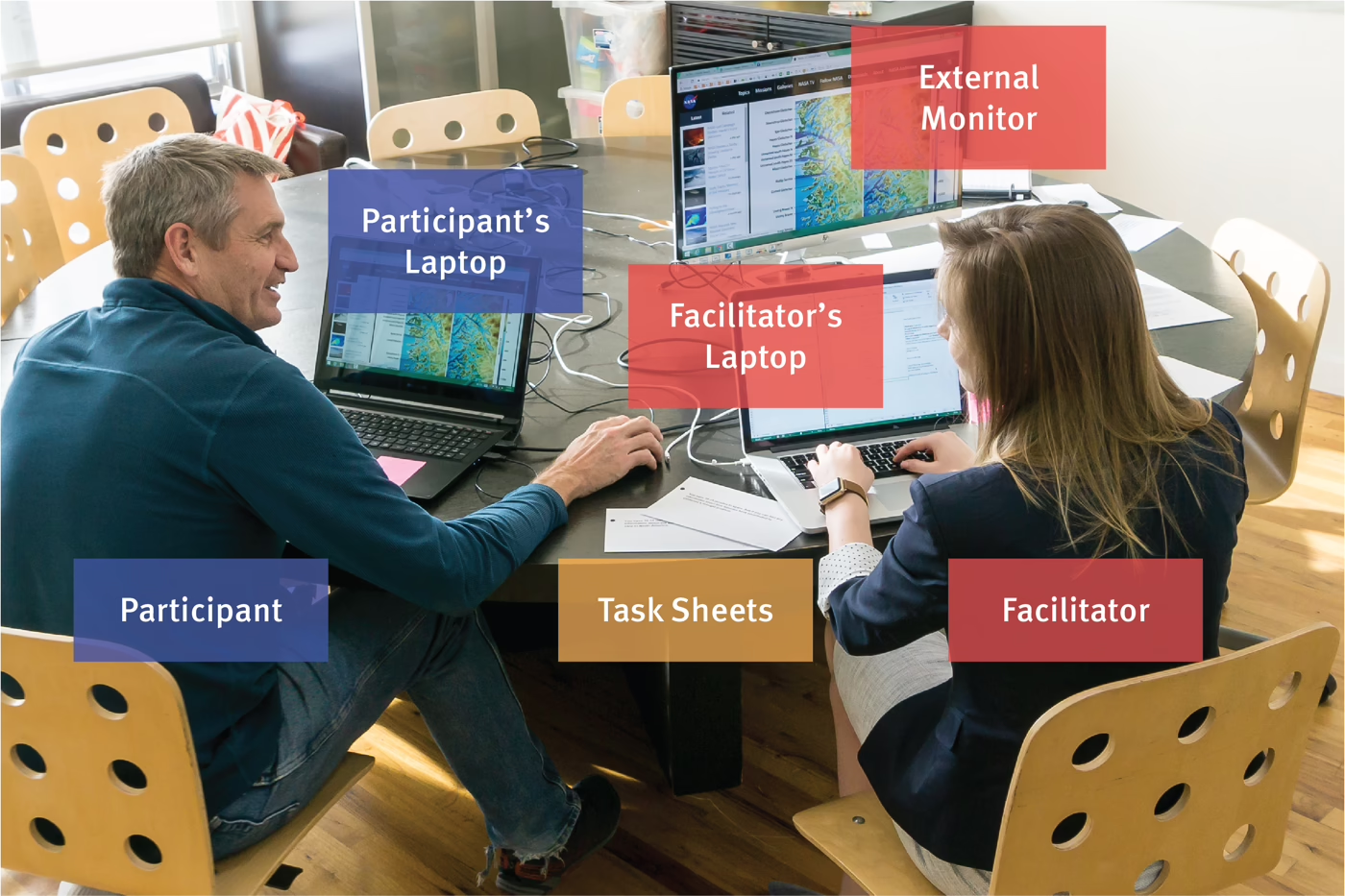
Nielsen Norman Group’s method map places usability testing across most stages of the product lifecycle, from early prototypes to live products, with the exact question shifting as the product matures. Early on, you are testing whether the concept is legible. Later, you are testing whether specific tasks complete without friction. Their guidance on when to use which UX method is worth keeping open when you are building a research plan.
A good session gives users a real task, then gets out of the way. Do not rescue them when they get stuck. The pauses, the wrong clicks, and the moments of doubt are the data. Three to five tasks per session is usually enough. A UX audit often points to where the friction probably lives, and usability testing confirms whether users feel it.
Surveys: for prevalence, not discovery
Surveys are useful when you already have a hypothesis and want to know how common it is. They are weak at explaining why. The MeasuringU 2024 survey of UX professionals found that surveys sit at around 59% usage, well below usability testing at 69%. Backlinko’s 2026 market research statistics show online surveys are still the dominant quantitative tool, used regularly by 85% of researchers, with mobile surveys at 47%. Both numbers point to the same thing: surveys scale, but only after you know what to ask.
The failure mode here is loading a survey with ambiguous questions and treating the result as fact. Keep each question doing one job. Use ranking and rating for prioritization. Follow up with three to five interviews to hear why the top-ranked item is actually top-ranked. Numbers without narrative tend to get misread.
Methods You Reach For When the Core Three Aren’t Enough
The rest of the toolkit is not exotic. It is situational. Pick these when the core three cannot answer the specific question you have.
Analytics and behavioral data
Analytics tells you where users drop off, what they use, and what they ignore. It does not tell you why. Its strength is that it runs continuously. That means it can act as an early-warning system between studies, not a replacement for them.
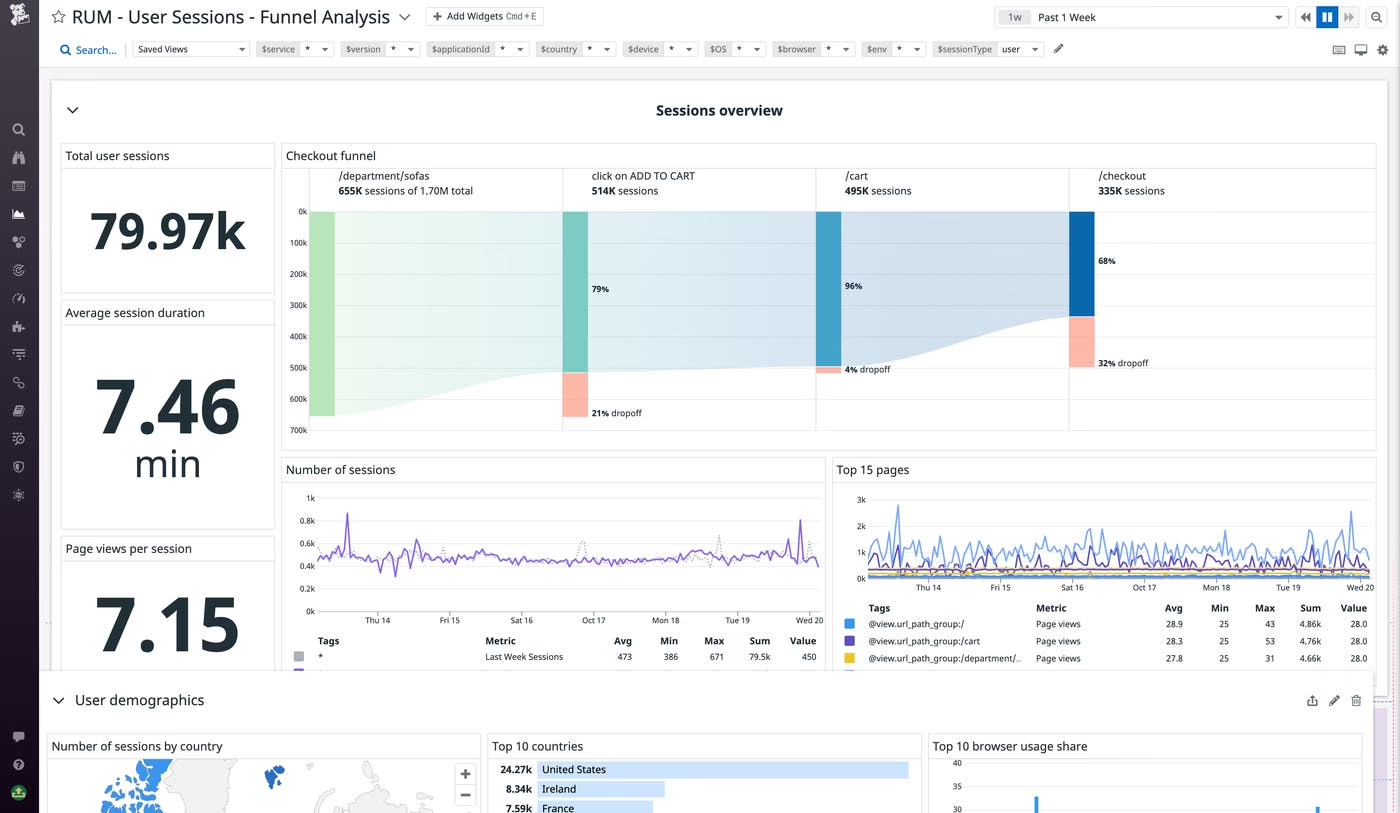
The practical version: instrument the two or three flows that decide the business, usually signup, activation, and either checkout or a core recurring action. Then look for gaps between what analytics shows and what users described. When we rebuilt the NudFud ecommerce experience, funnel data flagged where shoppers hesitated on product pages. Interviews explained why: they needed the nutritional context and certifications before they would add to cart. Neither method solved it alone.
Contextual inquiry and observation
Sometimes the problem never appears in a screen recording because it lives in the room around the screen. Contextual inquiry sits between an interview and an observation session: you meet people where they work, watch them do the task, and ask questions as it happens. Harvard’s user research recommendations for IT place it alongside usability testing, interviews, and click-stream analysis as one of the methods that covers the widest range of discovery and evaluation questions.
This is the right method when your product needs to fit into a workflow you do not fully understand. B2B tools, clinical systems, hospitality operations, and internal enterprise software are the usual candidates. Watch for workarounds. When someone opens a spreadsheet next to your software to make it work, that spreadsheet is the specification for a feature you have not built yet.
Card sorting and tree testing
Card sorting reveals how users mentally group your content, features, or navigation. Open sorts teach you the language. Closed sorts pressure-test a structure you have already drafted. It is a low-cost method with an outsized effect on information architecture, especially in publishing, ecommerce, and admin-heavy SaaS where finding the right place matters as much as finding the right feature.
User Interviews’ 2025 data shows researcher comfort with card sorting at 84% and tree testing at 81%. Comfort is not the same as frequency, though. These are methods people know how to run but rarely reach for. If your team is arguing about menu labels or category hierarchy, it is probably time to.
Jobs to be done
Jobs to Be Done is a framing more than a method. Instead of asking who the user is, you ask what they were trying to accomplish and what made them switch. The interview looks like a normal one, but the questions are anchored around the moment of change: the last time they tried the old tool, the trigger that made them look for a new one, the trade-offs they weighed.
The reason it works is that it surfaces the real competitor, which is usually a habit, a spreadsheet, or nothing at all, not the product you list on a comparison page. Our product discovery techniques lean on this framing when the risk is not “can we build it” but “what job would make someone switch to it.”
Focus groups and A/B tests
Both are useful. Both are misused often enough to be worth a warning. Focus groups tell you what people are comfortable saying in front of others, which is not the same as what they will do alone with your product. Use them for messaging and concept reactions in categories where perception matters, not for feature decisions. A/B testing is powerful once you have traffic and a real hypothesis, but weak hypotheses produce weak confidence no matter how much data you collect. Do the qualitative work first. Then test one thing at a time.
The Traps That Quietly Ruin Small Studies
Practitioner communities on Reddit, X, and elsewhere converge on a shorter list of failure modes than any textbook. If you avoid these, most methods will produce something useful. If you do not, none of them will.
Convenience samples
Talking to internal employees, existing power users, or people from your own network is the fastest way to run a study. It is also the fastest way to confirm what you already believe. In B2B, this problem is structural: account managers gatekeep customer access, and the customers you can reach are usually the happiest ones. Name the constraint explicitly in the write-up. Treat it as part of the evidence, not a footnote.
Triangulation theater
81% of teams in UseHubble’s 2026 data run both discovery and evaluative work, and mixed-methods work is now the default. That is mostly good news. The risk is that different methods answering different questions get presented as “agreement.” A survey about preferences and an interview about behaviors do not corroborate each other. They just cover different ground. Before you claim triangulation, check that the methods were pointed at the same question.
Small samples pushed too far
You will find a pattern in five interviews, but they will not put a number on the share of your market that has it. To deal with stakeholder demands for “statistical significance”, some practitioners will couple a small qual effort with an in-product survey to get a sense of prevalence. Others are more forthright and put their results in risk terms: “there is a repeatable failure in onboarding we have seen that will prevent activation.” That is an honest way to put it; to claim significance from six people is something else entirely.
Research as validation
There is a grievance you will hear in any research community: stakeholders use the work to rubber-stamp a decision they have already made. The remedy is to be blunt about it prior to the study. Ask if the team is willing to alter course on what you uncover. If not, save yourself the trouble and do a cheaper, smaller piece of work or move on to something else. Anything that does not have the power to change a decision is not research, it is just another slide in a deck.
How to Make Findings Actually Get Used
Most research comes to a quiet end in the chasm between conducting a study and actually influencing a call. Some of the better teams have practices in place to bridge that gap without relying on tools.
- Keep decision reports to a page. You want context, a few user quotes and three or five findings with a recommendation. A long report is skimmed; a short one is argued over, as it should be.
- Have stakeholders sit in on sessions. A product manager who has read a summary will haggles over a fix; one who has watched two usability tests will make the case for it.
- Be clear about constraints up front. List who you spoke with and who you did not, and what that says about your confidence in the finding. Booth et al. are right to highlight this as the hallmark of methodical work.
- Make sure every finding has a decision attached. Otherwise leave it as background or drop it. If you present unactioned insights, you only teach your stakeholders to tune out.
Then there is the matter of AI, which has altered the economics of the job. According to Maze’s 2026 figures, 69 per cent of researchers are making use of it on some projects now, a 19 point jump from last year, largely for the like of transcription and first-pass synthesis. Koji puts the figure at 63 per cent for teams that see quicker turnarounds. It is fine for execution but not for judgment; synthetic users remain a topic of debate, not a replacement.
Where Research Sits in a Real Product Timeline
If you are putting together a new product, the formula for something that holds up is fairly straightforward: start with interviews to confirm the problem, run a round of usability on the wireframes or prototype, then follow up with analytics and light surveys once you have some traffic. UseHubble data from 2026 indicates 44 per cent of teams are already doing continuous research via in-app prompts and the like; it is fast becoming the norm.
The ones who ship products worth paying for are not necessarily those with the most advanced methods. They are the ones who asked the right question and let the evidence dictate the roadmap. When you need to know if a decision warrants a year of build time before you commit, Refact’s discovery process is designed to provide that clarity. With that settled, everything downstream from the UX design to the MVP build proceeds with less friction.
Building a product and unsure what to scope first? Let’s talk. Free 30-minute call, no pitch.

Parnia Sebti is a project and account manager at Refact, coordinating teams, clients, timelines, and delivery across the studio’s work. She helps keep projects organized from planning through execution, making sure communication stays clear and priorities stay aligned. Her role connects client needs with the internal team’s workflow, helping turn requirements, feedback, and moving parts into structured delivery. At Refact, Parnia also contributes to shaping the internal tools and processes the team uses to manage projects more effectively and keep work moving with clarity.
More from Parnia Sebti

