How Much Does a Website Cost in 2026?
Three vendors can quote the same website at $2,400, $18,000, and $92,000, and none of them are lying.


A useful working range for a professional small business site in 2026 is $1,500 to $15,000 to build, plus $500 to $10,000 a year to run. WebFX data cited in a 2026 website cost statistics roundup found that 57% of businesses spend between $501 and $10,000 a year on their site. That is a defensible number for a board deck. It is also almost useless as a scoping tool, because it hides the four decisions that actually move the bill: what type of system you are buying, who is building it, where they sit, and what you plan to spend after launch.
Why One Number Cannot Answer This Question
The label “website” now covers a $0 template page, a WordPress marketing site, a Shopify store, and a multi-tenant SaaS portal with authenticated users and a compliance audit. These are different products with different economics. A 2026 cost report from Project Cost Estimator, based on 600+ quotes, put the working range at $300 to $50,000+ for typical builds, with regional multipliers of up to 4.27x and platform-driven swings of up to 1.89x on identical scope.
The rough 2026 bands worth memorizing:
- DIY brochure site: $0 to $500 upfront, then $15 to $150 a month for hosting, plan fees, and apps.
- Small business professional site: $1,500 to $15,000 to build. Practitioner surveys cluster the honest middle at $3,000 to $8,000.
- Ecommerce store: $5,000 to $50,000+, mostly driven by catalog complexity and payment or shipping logic.
- Custom web app or portal: $20,000 to $200,000+. This is software, not a website.
- Enterprise or regulated platform: $200,000 to $2,000,000+, driven by compliance documentation, audits, and non-functional requirements.
If a quote lands more than 40% below the middle of one of those bands, something has been left out of scope. Usually content migration, accessibility, integrations, or post-launch support. That is not a discount. It is a bill that has been moved to next year.
The Number Most Buyers Miss: Five-Year Total Cost of Ownership
Build cost is the down payment. Total cost of ownership over three to five years is the mortgage. A 2026 model for a custom mid-market web application showed a $120,000 build growing to roughly $366,000 in five-year total cost, driven mostly by 20% annual maintenance and dedicated hosting at around $1,500 a month. Across categories, annual maintenance benchmarks land between 15% and 25% of build cost.
A 2025 IT cost survey found that most organizations lack real total cost of ownership data at all, which is why so many sites launch, drift, and then need a rebuild in year three. If the site is meaningful to your revenue, plan for the multi-year number before you sign anything. We wrote more about how those ongoing bills stack up in our website maintenance cost guide.
The practical version:
- Domain: $10 to $30 a year.
- Hosting: $5 to $30 a month for a small site, $150 to $1,500 a month for a real application.
- Care plan or managed retainer: $150 to $400 a month covers hosting oversight, updates, security patches, backups, and small edits.
- Third-party services: analytics, auth, email, payments, monitoring. Small individually, meaningful together.
- Content and iteration: the site changes after launch, or it decays.
What Actually Drives the Number
Page count is a weak proxy for cost. A five-page site with a bespoke design system, custom illustration, and three integrations costs more than a fifteen-page site built on a proven theme. The real drivers are complexity, non-functional requirements, and the team doing the work.
System type over page count
The single most useful distinction: are you buying a website or a web application? A website is presentational. A web application has authenticated users, roles, workflows, and a data model. Portals, marketplaces, member sites, and SaaS products are applications. Pricing them as websites is the most common way to under-budget by a factor of five. If you suspect you are in that category, our web application development guide covers how to scope and stage that kind of build.
Non-functional requirements
Performance, security, accessibility, compliance, and integrations are the quiet cost drivers. PCI DSS for payments, HIPAA for healthcare, WCAG for accessibility, GDPR or CCPA for privacy: each of these adds documentation, audit, and architecture work. In one $62,000 SaaS dashboard build, roughly $14,500 was UX audit and prototyping alone, before a line of production code shipped.
Who is doing the work
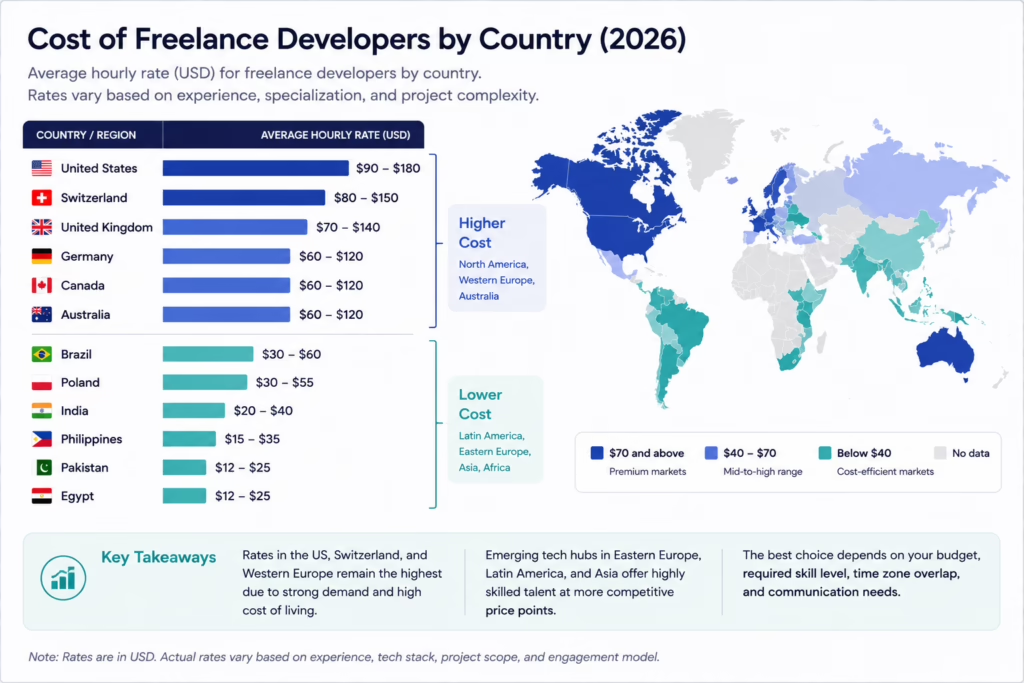
Senior developers in the US and Western Europe bill $80 to $160 an hour. A 2026 rates index from Project Cost Estimator on country-by-country rates put the US at $80 to $150 an hour, the UK at £55 to £90, Western Europe at €60 to €100, Eastern Europe at €25 to €50, and South Asia at $15 to $45. The same brief can vary by 4.27x depending on where the team sits. Cheaper geographies genuinely lower headline cost. They can also increase rework if the collaboration model is weak, so read the total, not the rate.
DIY, Freelancer, or Agency: Three Different Bets
The choice of provider is less about price than about which risks you want to carry.
DIY works when the site is not your business. Wix, Squarespace, or Webflow can produce a credible brochure site for $20 to $60 a month and 40 to 80 hours of your time. The dollars are small. The time and the ceiling on quality are real.
Freelancers generally deliver small business sites for $1,500 to $8,000. The Admin Bar 2024 WordPress agency survey found that 72% of shops charge under $5,000 on average per site, which is a rare independent data point and closer to the truth than most agency pricing pages suggest. One owner, one relationship, fast turnaround. The tradeoff is bench depth. If your one contact disappears, the project usually stalls.
Agencies start higher, usually $5,000 to $30,000 for professional marketing sites, and rise quickly when the work involves integrations, application logic, or governance. What you buy is coverage: strategy, design, engineering, QA, and project management under one roof, with someone accountable when the site breaks at 9 p.m. If downtime would cost you more in a day than the annual retainer, the math tends to land in favor of an agency.
The useful frame is not price versus quality. It is which risks you are qualified to carry yourself, and which ones need to sit with someone else.
Where the Same Scope Bends the Bill
Two quotes can look similar and come from different markets. Geography is one lever. Platform is another.
WordPress is often the cheapest to build and staff for, because the ecosystem is deep and most agencies can operate it. Shopify carries platform fees but simplifies commerce. Webflow adds recurring CMS costs and can hit ceilings on product-scale work. Fully custom stacks on Next.js with a headless CMS involve architecture decisions before design starts, which pushes the front of the bill higher and shifts more cost into ongoing engineering. The 2026 cost report put the platform swing at up to 1.89x on identical scope.
Provider type moves the number too. That same 2026 report found agencies charge roughly 2.4x to 2.7x freelancer prices for the same brief, with median online-store builds around $2,900 from freelancers and $7,000 from agencies. Neither is wrong. They are different products.
The Line Items a Real Quote Should Show
A quote that hides the internals is a quote you cannot compare. Ask for the work broken into six lines, and ask what is inside each one.
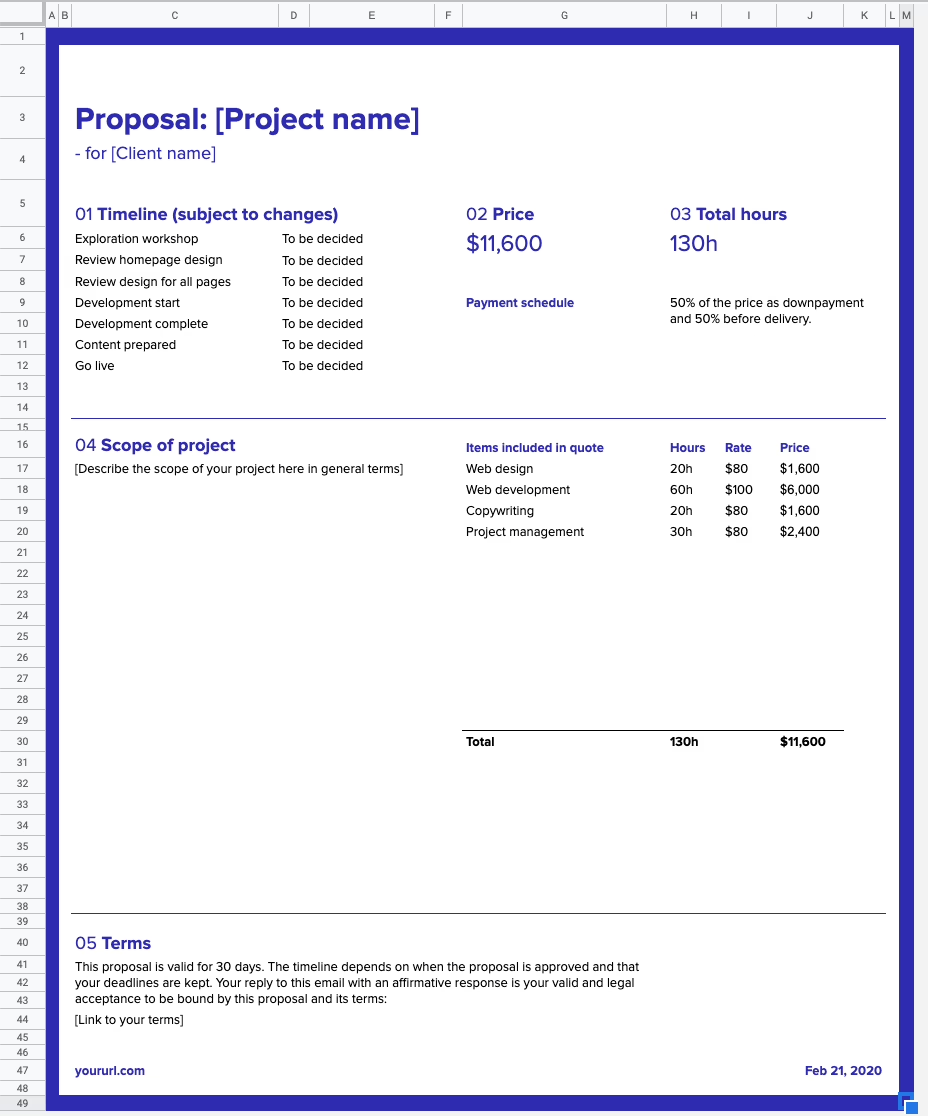
| Line item | Small build | Mid build | Complex build |
|---|---|---|---|
| Design | Light template customization | Custom UX and UI, brand alignment, several mockups | Full design system, multiple page types, iterative research |
| Development | Standard CMS setup, prebuilt templates | Custom components, moderate integrations, responsive QA | Custom architecture, roles and workflows, deep testing |
| Hosting and domain | Shared or managed hosting, basic SSL | Managed hosting, performance tuning, security baseline | Scalable hosting, staging, monitoring, uptime targets |
| Integrations | Forms, basic email | CRM, payment, analytics, marketing automation | Multiple APIs, data sync, custom workflows, webhooks |
| Maintenance | Updates, backups, light support | Ongoing fixes, plugin care, security patches | Dedicated support, release management, incident response |
| SEO | Technical setup, metadata, sitemap | On-page optimization, internal linking, content support | Ongoing technical audits, content planning, iteration |
Some vendors, like Capstacker’s operator plans, price coverage rather than hours. Others, like Captiwate’s traffic-based pricing, tie cost to funnel size. The details differ. The principle is the same: know what you are paying for, not just what you are paying.
Why Cheap Sites Often Cost More
Reddit and Quora threads on website cost include one pattern that shows up again and again: a $300 to $500 site that gets rebuilt inside two years. The rebuild usually happens for one of four reasons. The code is hard to maintain. The SEO foundation was skipped. Security or backups were never set up. Or the site cannot handle the second product line, second market, or second campaign the business tried to run through it.
The 2026 shift makes this worse, not better. AI tools and no-code builders have compressed buyer expectations. A senior agency owner recently observed that small business owners who guessed $5,000 five years ago now guess $500 to $1,000. That does not change what a professional build actually requires. It only widens the gap between expectations and reality, and leaves buyers surprised when a serious quote arrives.
The practical floor for a professional small business site is around $1,500 to $3,000. Below that, someone is either subsidizing the work or skipping something you will pay for later.
The Process That Separates Working Sites From Rebuilt Ones
Research on website project failure has a consistent message: the biggest failures are rarely about build cost. They are about scope, governance, user research, and what happens after launch. The 2025 redesign of the Australian Bureau of Meteorology website is the textbook cautionary tale. A large, bundled program shipped a redesign and platform change together. Expert users slowed down. Radar information became harder to interpret. Trust dropped. The build worked. The system regressed.
Successful projects usually share the same pattern. They define user and business outcomes before pricing. They separate infrastructure changes from front-end redesigns. They release in phases with rollback options. And they treat performance, accessibility, and content as first-class requirements, not last-minute retrofits. When we rebuilt Teton Gravity Research’s platform, migrating thousands of articles off a legacy CMS was only part of the work. The harder job was protecting editorial workflows and cutting features that had stopped earning their keep, before any new engineering started.
The same discipline applies at a smaller scale. On the NudFud WooCommerce build, the hard part was not the checkout. It was making the product content, certifications, and fulfillment rules work as one system so shoppers could actually decide.
A Simple Framework to Estimate Your Own Number
You do not need a perfect quote to make a good decision. You need a defensible range. Work through four questions in order.
- What kind of system is this? Brochure site, ecommerce store, custom web app, portal, or publishing platform. That decision sets the band.
- Who is building it? DIY, freelancer, or agency. That decision sets the multiplier inside the band.
- Where does the team sit? US and Western Europe cost more per hour. Nearshore and offshore can be cheaper if the collaboration model is disciplined.
- What are the five-year running costs? Hosting, maintenance, third-party services, content evolution. Plan for 2x to 3x the build over five years.
Applied to a real case: a 25-page informational site for a regional services firm, built by a mid-tier freelancer on WordPress in North America, tends to land around $6,000 to $12,000 to build and $1,200 to $2,400 a year to run. If your estimate for the same scope is $1,500, you are missing design, content, maintenance, or revisions. If it is $40,000, you are probably buying an application in disguise.
Questions to Ask Before You Sign
Most bad website deals look fine until month two. The homepage looks like the mockup. Then a change request comes back with a surprise invoice, or the vendor stops answering. Ask these before money changes hands:
- Who owns the code, domain, and content? All three should sit with you.
- What is inside the maintenance line? Hosting, updates, backups, security, incident response, or none of the above?
- How are change requests priced? Hourly, retainer, or per-request. Vague answers become expensive fast.
- Who is actually building it? The person quoting the work should not vanish once the deposit clears.
- What is the exit path? If the vendor disappears, can you take the site, the assets, and the documentation and keep going?
- Is there a strategy or discovery phase? A written brief before pricing is the single strongest predictor of a build that ships on scope.
Refact runs a discovery phase with a money-back guarantee for exactly this reason. Buyers who lock scope, structure, and priorities before the full build quote almost always spend less and ship better than buyers who skip that step. The pattern is documented across our own projects and echoes what the broader research on the product discovery process keeps finding.
Your Next Move
In the next week, pull three things together: a one-page brief describing what the site has to do for your business, a shortlist of three to five reference sites you want to learn from, and a hard budget ceiling with a small buffer for the pieces you have not thought of yet. Send that package to two freelancers, two agencies, and one DIY estimate. Compare the responses line by line, not by total.
If the quotes come back within 20% of each other on the same scope, you have a real range. If they vary by 5x, you have five different products, and the next job is to decide which one your business actually needs. Building on WordPress specifically is where a lot of small and mid-market sites end up, and our WordPress development services page covers how we structure that work end to end. If you want a sharper number before you commit to a full build, a short discovery engagement is still the cheapest way to get to one.
Building a product and unsure what to scope first? Let’s talk. Free 30-minute call, no pitch.

Saeedreza Abbaspour is the CEO of Refact, where he works across product, engineering, and sales. He sets the studio’s direction while staying closely involved in the work itself, from shaping product strategy and UX architecture to helping define the technical systems behind Refact’s projects. His role connects business thinking with hands-on product execution, giving him a practical view of how software should be planned, built, launched, and improved. At Refact, Saeedreza focuses on building a studio that can move quickly, solve real client problems, and turn ideas into reliable digital products.
More from Saeedreza Abbaspour

