Website Design Cost: A 2026 Buyer’s Guide
You can put in a request for the same website and get back three very different numbers: $2,400, $18,000 or even $92,000.


The question worth asking is not what a website will set one back, but what it costs to own, operate and alter over a five year period in the way the business is run. This guide is designed with that in mind.
Why the Headline Price Almost Never Tells You What You Need to Know
If you go by the public pricing guides, you will find some general bands. DIY builders are $100 to $400 annually; small business work is $2,000 to $9,000; corporate sites run from $10,000 to $35,000. Ecommerce is anywhere from $5,000 to $55,000 while enterprise custom platforms start at $100,000 and go up. You will see similar shapes from Forbes Advisor, VWO, Phenomenon Studio and DigitalApplied, though they do not agree on where to draw the line since their definition of a website varies.
That is the trap. The term can mean a five page brochure or a subscription platform with a full content operation, billing and permissions behind it. To put a price on those two is like saying a used sedan and a food truck are comparable because they both have wheels.
A better way to view it is as an operating asset. A site that brings in leads, bookings or product signups has a job and a revenue figure tied to it. What you want to pay is the minimum required for it to perform well enough that you are not rebuilding in three years. The cheap option has a way of failing in expensive, unglamorous ways: forms stop working, your editors need a developer to make a change, SEO becomes a problem and every minor ask turns into a support ticket. One studio owner was blunt about it in recent practitioner talks: put off a proper design to save money now and you will be looking at a $50,000 to $100,000 rebuild in eighteen months. Sophisticated buyers know this and price for a seven year lifecycle rather than the launch day.
The Four Things That Actually Drive Your Price
There are four variables at play in most quotes. Be honest with yourself on these before you sit down with a vendor and the proposals will be much easier to parse.
Scope: how much site is there
VWO’s 2026 data has redesigns for 150 plus page sites coming in at $36,000 to $75,000 and that is before new functionality is factored in. A consulting site with five pages is a straightforward job. A publishing platform with tag pages, author archives and gated content is something else entirely. Scope also has to account for the things you don’t see: error screens, templates and the admin views the editor will be in all day.
Functionality: what the site has to do
This is where the budget can quietly blow out. A contact form and homepage are inexpensive. But put in Stripe billing, a booking flow, faceted search, CRM sync or an AI assistant and you are no longer buying pages. You are buying integrations, business rules and the means to handle errors and permissions. Each comes with its own maintenance cost.
Design complexity: template, system, or bespoke
Templates are quick and fine for simple matters. Custom design is pricier because someone has to put thought into the hierarchy and conversion flow for your particular business. In between is the design system. It is a bigger outlay for tokens and components, but for anything beyond a few templates it will more than pay for itself by lowering the cost of subsequent pages. We walk through how that discipline works in a build in our guide to bespoke WordPress website design.
Content: the sleeper cost
Projects move along if you have your copy, case studies and photography ready. If the vendor has to structure and write the message for you, expect to be charged for the work. Saying “we will sort out the content later” is the surest way to put a six week hold on things. And migrating from a legacy CMS is a line item in itself. When we took 10,000 articles off ExpressionEngine for Teton Gravity Research it was an engineering project separate from the redesign.
DIY, Freelancer, Agency, or Studio: What Each One Actually Buys You
Your choice of partner will determine the risk you carry and how many decisions are left to you alone.
| Partner | Typical upfront cost | Best fit | Real trade-off |
|---|---|---|---|
| DIY builder | $100 to $400 per year | Very early stage, temporary presence | Cheapest cash out, highest owner time cost, hardest to migrate later |
| Freelancer | $500 to $5,000 | Tight brief, ready content, narrow scope | One person cannot cover strategy, UX, engineering, and long-term support at the same depth |
| Agency | $10,000 and up, ~$1,500 per page is a common rule of thumb | Marketing sites tied to broader campaigns | Process weight and account overhead show up in the invoice |
| Product studio | $25,000 to $150,000+ for platforms and MVPs | Sites that carry business logic: subscriptions, portals, publishing, ecommerce, MVPs | More upfront investment, in exchange for judgment on what to build, not just how |
The numbers are not clean because vendors work differently. DigitalApplied has Shopify starter builds at $8,000 to $25,000, Plus at $25,000 to $90,000 and headless commerce running $90,000 to $250,000. Our ecommerce website cost guide offers a breakdown by store profile.
When each one is the right choice
For a temporary presence to test an idea, a builder and domain is a fair trade so long as you read the renewal terms. Some hosts will auto-renew at a steep rate after a year and getting off a proprietary page builder is seldom easy. For compact projects a good freelancer does the job well. When the content is in hand and the scope is well defined, a single individual with a robust portfolio in your field will generally outperform a low-tier agency. You will find the same counsel on Reddit practitioner threads: for a $2,000 to $5,000 budget, put that money toward a freelancer who has put work in front of companies like yours, rather than one with nothing but polished template screenshots to show.
An agency justifies its price tag when the site is integrated into a wider marketing effort. You are putting down the cash for project management, staff coverage and process. Without that need, you are simply underwriting overhead you have no use for.
Then there are studios. They come into play when there is business logic at work – be it an MVP with a proper backend, dashboards, editorial workflows or a migration from a legacy system. The worth is in the translation of technical decisions to meet business aims, not in how fast they can produce. Take St. Louis Magazine’s departure from MetroPublisher (https://refact.co/work/st-louis-magazine). The new design was the easy part; the studio work was in moving 30,000 articles while preserving search performance and editorial flow, and making calls on what old CMS logic to discard.
Four Budget Scenarios Founders Actually Bring Us
Numbers are more telling when applied to actual projects. These are the four we encounter most.
The credibility site for a professional service
For an early-stage B2B outfit, a boutique or consultant looking for positioning, service pages, lead forms and a CRM handoff, expect to pay $8,000 to $20,000 for a capable partner. Go lower and you have a placeholder that will not convert. Go higher and you are likely funding a design system or content production you do not yet require.
The scalable ecommerce store
Add in product categories, checkout and shipping rules and the figures become less predictable. A 40-SKU Shopify job and a headless 4,000-SKU catalog with ERP sync are not comparable. Put the platform fees, engineering hours and apps on separate lines.
The membership or publishing platform
Paywalls, roles and a backend an editor can actually operate. This is where the economy option falls down. Content models are architectural matters. On a site churning out hundreds of pieces a year, the editor experience is the product and correcting a mistake is costly.
The first version of a SaaS MVP
Founders will call it “a simple platform” but between the auth, database, billing and admin panels, it is rarely that. To get a first version a customer can depend on, a $25,000 to $75,000 tab is realistic. Much less and you will be short on what makes it run in production.
The Hidden Costs Nobody Prices at Kickoff
Do not be fooled by the launch price. It is the tip of the iceberg; the rest of it determines if the site is an asset or a drain.
Accessibility, treated as architecture not a checkbox
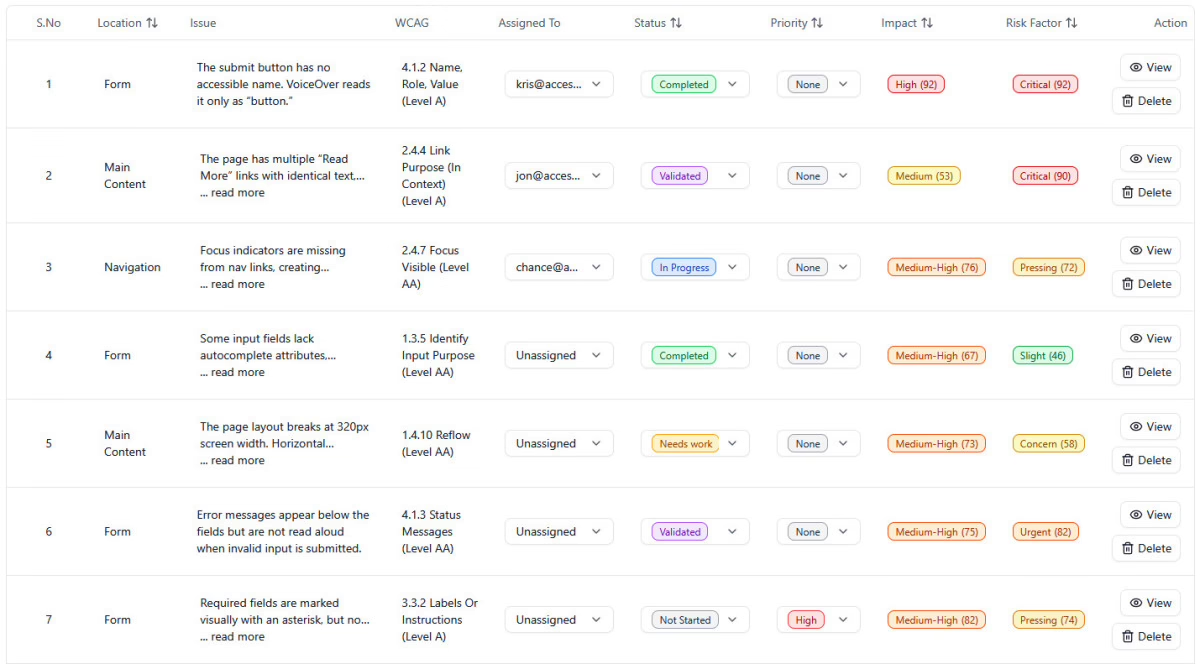
Consider the WebAIM Million 2026 report. Some 95.9% of top home pages do not make the grade on WCAG 2, with an average of 56.1 errors per page, a 10.1% jump from last year. Beyond the legal exposure and compliance, it is a UX failure and evidence of sites growing in complexity but not in usability. Public sector examples show you will pay double or triple to retrofit accessibility later. Make sure your vendor has QA gates for it, not a post-launch cleanup.
Performance, treated as revenue
There is a link between Google’s Core Web Vitals for LCP, CLS and INP and your search rank or abandonment rate. Transactional revenue suffers over small load-time slippage. We like to use a test from Toimi’s 2026 SaaS piece: request Lighthouse scores from before and after on three sites the team has delivered in the past year and a half. If the response is vague, you have your answer.
Maintenance, treated honestly
Maintenance is another line item. Forbes estimates up to $1,200 a year for a small business; enterprise levels hit six figures. But the figure is secondary to what is being done. A retainer of $200 a month with undefined scope is a losing proposition. See our website maintenance cost guide for a sense of fair terms.
The rebuild tax
A templated build with no API layer or extensibility will demand a full rebuild in a few years. Atomic Revenue has put it plainly: a $1,500 site on a rigid platform will set you back $5,000 to $10,000 to redo once the business outgrows it. The point is to spend for the next three years, not the day of launch.
AI Is Compressing Prices at the Low End. It Is Not Free.
You will see some startling figures from solo operators on X. One is billing $9,200 for four sites in a month with tool costs of $40; another ships an $8,000 site in seven hours with Claude Design. For the right person, the compression is there.
What AI does not compress is the review, the integration and the differentiation. Deloitte’s tech trends for 2024-26 note only about 20 percent of firms have mature governance for autonomous agents. In practice, that means a lot of AI output goes live without the necessary brand discipline or performance checks, which is expensive to put right. And generic AI sites all look alike, which is a problem for marketing if not for the technology.
Let us be candid: for an operator with skill, AI is a means of leverage. It does not replace good judgment. The value proposition has changed; it is no longer in the churning out of pages but in determining which ones should be made and making sure what ships meets a certain standard.
A Checklist for Getting Quotes You Can Actually Compare
You will get a vague quote from a vague brief. Approach the process as you would when hiring for a position of consequence. Put these five points on the table in every discussion:
- A single business outcome. We are talking leads, sales, bookings or MVP validation. Not some “modern and clean” aesthetic. An actual outcome defines scope better than any moodboard.
- The non-negotiables. Whatever the business runs on: CRM, Stripe, gated content, dashboards, multilingual support. These features add complexity and with it, cost.
- An inventory of your content. What is there already? What still has to be put to paper and by whom? Is the product data in order?
- Hard constraints. Be clear on deadlines, the compliance profile (be it HIPAA, GDPR, PCI or SOC 2), internal red tape and any integrations that are off limits.
- Taste references. Show us three sites you like and three you do not. Do not just say “premium” or “clean” unless you can point to a URL to back it up.
Should you receive two quotes with a wide disparity in price, resist the urge to ask why one is higher. Instead, find out what each team has assumed in terms of revisions, support, scope and content. You are comparing their assumptions first and foremost.
Questions most founders forget to ask
There are other questions to pose:
- Who is responsible for fixes once we have launched?
- How much effort will it take the internal team to put a finger on key pages?
- What third-party tools and tiers will we be stuck paying for?
- What is left out of this quote?
- Can you put some real Lighthouse scores from your last few projects in front of me?
- Is there anything that might necessitate a migration or redesign within twelve months?
In short, observe how a vendor goes about discovery. If they are making mockups before they have a handle on the goals and constraints, you can let them go. A good partner puts a price on the problem before the build. For teams mulling over a rebuild, our website redesign checklist enforces that kind of discipline.
How to Set a Budget That Survives Contact With Reality
Be open with a range. Concealing a budget only invites padded proposals or some polished fantasy. Telling a partner “we are looking at $X to $Y and these two outcomes matter most” allows them to put together a workable solution while weeding out the vendors who are pricing the ceiling.
We see founders who put together a headline number end up having to buy the wrong site twice. Those who build their budget in four distinct layers have a site they can operate in year three:
- Base build for the design system and core flows.
- Integration scope covering CMS, payments, identity, analytics and CRM.
- Governance and process. In a complex org, stakeholder workshops, training and documentation can run 10 to 30 per cent of the tab.
- Lifecycle. Plan to put money into the site for as long as it is live; maintenance and iteration are part of it.
If the quotes on your desk are at odds, the website redesign cost guide we have published is a fair sanity check.
Ultimately, website design cost is a lifecycle issue in the guise of a launch. Public bands are fine for direction, but read any quote against the total five to seven year cost and inclusions. Refact’s product design and discovery is designed to sort out what needs clarifying before the build begins. We put the risk on ourselves with a money-back guarantee on the discovery phase so you do not have to.
Building a product and unsure what to scope first? Let’s talk. Free 30-minute call, no pitch.

Saeedreza Abbaspour is the CEO of Refact, where he works across product, engineering, and sales. He sets the studio’s direction while staying closely involved in the work itself, from shaping product strategy and UX architecture to helping define the technical systems behind Refact’s projects. His role connects business thinking with hands-on product execution, giving him a practical view of how software should be planned, built, launched, and improved. At Refact, Saeedreza focuses on building a studio that can move quickly, solve real client problems, and turn ideas into reliable digital products.
More from Saeedreza Abbaspour
