Web Application Development: A Founder’s Guide
Most failed web application projects do not fail in the code.


The market is not the issue. The web application development sector was valued at roughly $44.57 billion in 2022, projected to reach $101.99 billion by 2030 at an 11.4% CAGR, according to the web application development market report. Demand is plentiful. What kills projects is the order in which the work is done. This guide is for founders and operators who want to reverse that order: decide the business problem first, pick the smallest useful product, choose technology their future team can actually maintain, and only then write code.
Why Web Application Development Starts With Clarity, Not Code
The first question is not “which framework.” It is “who will use this, and what job will they finish with it that they cannot finish today.” Every downstream decision, from data model to deployment, gets easier when that answer is specific.
Web applications work when they solve a named problem for a named user. Membership operators use them to manage renewals and event access. Real estate teams use them as a shared workspace for listings, offers, and documents. Publishers use them to move content between print, web, and email without rekeying. When the problem stays vague, the build stays vague, and the invoice grows.
Name one primary user, not a market
“Small businesses” is not a user. A consulting firm might serve many audiences over time, but its first web application should be for one person: perhaps a project lead who currently retypes client intake forms into a project brief every Friday. That single description shapes screens, permissions, language, data model, and integrations. Everything gets sharper.
Define the smallest useful release
Define the smallest version that produces a useful result for that user. A property comparison tool may need search, saved listings, and an inquiry form in the first release. It may not need messaging, agent recommendations, or a native app. Cutting scope is not about making the build cheap. It is about separating the essential action from features that can wait for evidence.
If you cannot describe the first successful user session in three sentences, the build is not ready for an estimate.
List the workflows that cannot fail on day one
Write down the actions that must work at launch. For a membership portal that usually means sign-in, payment status, event registration, and account updates. For a publishing platform it may be drafting, approval, scheduling, and search. These lists set the stack, the team shape, the budget, and the delivery plan. They also expose hidden work: data migration, permissions, content preparation, CRM integration.
Clarity is the cheapest accelerator in the process because it removes decisions from later stages, where each unresolved question returns as a change request. Refact’s discovery-first process, backed by a money-back guarantee, exists for this reason. The product discovery process we run with clients is designed to kill weak ideas before development starts.
The Six Stages Every Serious Web App Project Moves Through
Web application projects move through six connected stages. Each has a defined output. Skipping one usually pushes its work into a later, more expensive stage.
1. Discovery
Discovery turns the business problem into user stories, priorities, constraints, and a scope you can price. Skipping it creates false speed. Developers start immediately, but they make assumptions that founders later reverse. In practitioner post-mortems of failed 2024 to 2025 SaaS products, skipped validation is the single most common denominator. One documented case burned eighteen months building for an audience that was never defined.
2. Design
Design turns stories into flows, wireframes, and a reusable interface system. It should answer the questions code makes expensive: what happens when a user has no data, loses access, submits an invalid form, changes role, or needs help. Treating design as decoration is a common failure. A polished screen does not matter if the next action is hidden or the workflow takes eight steps instead of three.
3. Engineering
Engineering builds the agreed features in short cycles, ideally with weekly demos. The output is not only code. It is a working product, automated checks where they earn their keep, documentation another team can read, and a deployment path that survives the departure of any single developer. That last point matters. Failure archetypes from published project autopsies include the Documentation Void, where a single developer’s tacit knowledge disappears and the codebase becomes a black box.
4. Quality assurance
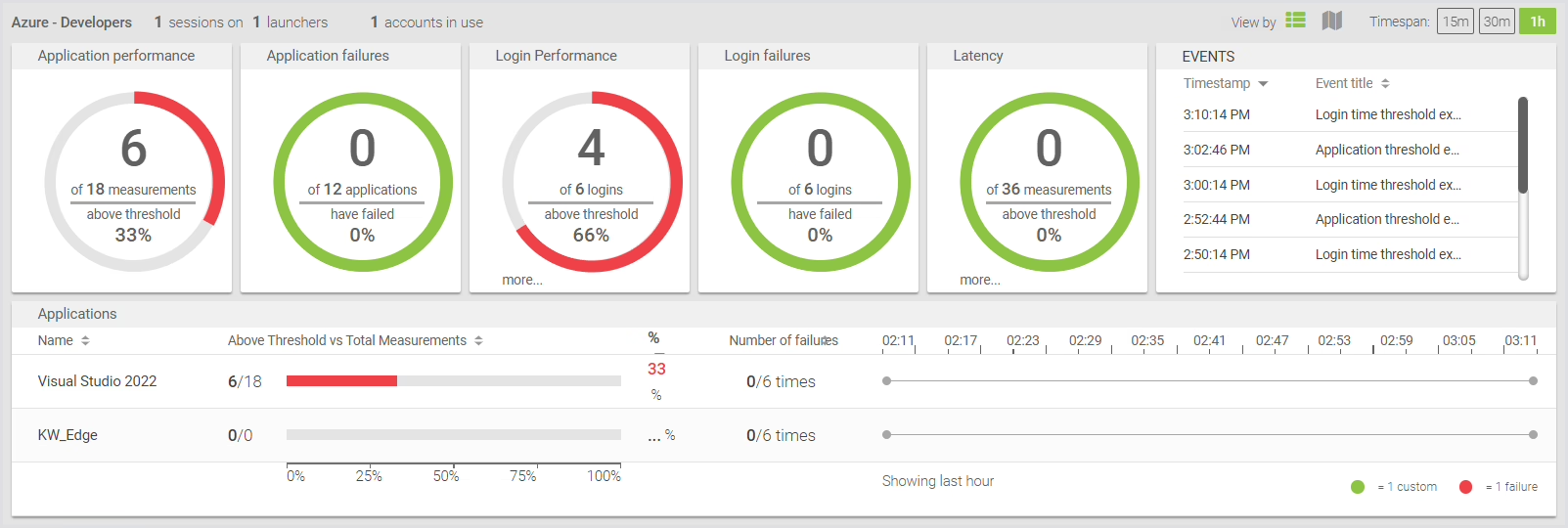
QA verifies more than the happy path. Testers should ask what happens when a payment fails, a session expires, a role changes mid-session, or an external API stops responding. Research on modern testing consistently shows a gap between coverage metrics and real behavior. A hundred percent unit coverage can coexist with production failure because dynamic client state, error paths, and load-driven behavior go untested. Spike and soak tests reveal problems standard load tests miss.
5. Launch
Launch includes deployment, monitoring, error reporting, backups, and user onboarding. A product is not ready because it runs on a developer’s laptop. The team needs to know how it behaves under real traffic, who gets paged when it fails, and how quickly a fix can ship. Practitioner data reflects the cost of getting this wrong: 70% of critical incidents take more than twelve hours to resolve, according to the 2025 DevSecOps state-of-the-industry reporting.
6. Post-launch
Post-launch is iteration, performance work, support, and roadmap. Real users reveal problems no interview will surface. Reserve capacity for this. Launch begins a learning cycle. It does not close the project. For a wider view of how business apps get delivered, a practical roadmap for business app development covers similar planning territory from a slightly different angle.
Choosing a Stack You Can Actually Live With
Your stack should fit both the product and the people who will maintain it eighteen months from now. A technically fashionable choice becomes a liability when future hires cannot work in it, or when hosting demands operational skills your team does not have.
For a focused MVP, Next.js paired with managed hosting is often a strong default for content-led products and SaaS interfaces. Laravel gives small teams a well-worn path through authentication, admin panels, and database-backed workflows. Django suits products with complex data rules. Node.js earns its place when JavaScript on both ends of the stack simplifies hiring and shared code, and we cover the tradeoffs in more depth in our guide to Node.js development services.NET tends to make sense where enterprise systems, Microsoft tooling, or the local hiring pool already point that way.
Compare the whole decision chain, not just the framework
Framework choice shapes deployment. Deployment shapes operations. Operations shape the team you need after launch.
| Stack | Typical hosting | Best fit | Real tradeoff |
|---|---|---|---|
| Next.js | Managed platform or serverless | Content-led products, SaaS interfaces, focused MVPs | Hosting complexity grows as backend needs grow. See our Next.js website guide |
| Laravel | Managed PaaS or cloud VM | Business tools, ecommerce workflows, admin-heavy products | Needs a plan for PHP maintenance and background jobs |
| Django | Managed PaaS or cloud VM | Data-heavy products with complex domain rules | Python expertise must cover operations as well as development |
| .NET | Cloud platform or managed VM | Enterprise workflows, Microsoft-centered environments | Narrower hiring pool in some markets |
| React with a separate API | CDN plus managed API hosting | Rich dashboards, products with multiple clients | More services means more deployment and monitoring surface |
Serverless earns its keep when traffic patterns are spiky and the team wants less server management. Managed PaaS is often the sensible middle ground for growing products. Traditional cloud VMs offer control at the cost of operational responsibility. Kubernetes belongs in the picture when service coordination, deployment control, or organizational scale genuinely require it, not because it appeared in a proposal.
A note on the “modern web” experience: even seasoned engineers describe assembly of a stack as tedious plumbing between services. Andrej Karpathy publicly compared the setup work to IKEA furniture assembly, with hours lost to configuring hosting, auth, storage, payments, monitoring, and CI/CD before writing any product code. That plumbing is real work. Price it, plan for it, and pick fewer services if you can. For a wider view of the skill set behind a full-stack build in 2026, a 2026 view of the full-stack skill set is a useful reference for hiring decisions.
Before accepting any hosting recommendation, compare it against alternatives. Our overview of cloud hosting and shared hosting walks through the operational side. Keep performance visible from the start too. Google’s PageSpeed Insights documentation classifies Time to First Byte below 800 milliseconds as good, 800 to 1800 as needing improvement, and above 1800 as poor. Backend query speed, caching, CDN placement, and origin compute all shape that first response.
Real Costs and Timelines, Not Marketing Bands
A quote is only useful once you understand what it buys. A low number often covers a clickable prototype. A higher number may include discovery, integrations, QA, deployment, monitoring, and a few months of support. The ranges below are planning bands, not promises. Scope, design fidelity, integrations, compliance, migration, and team geography move the final figure.
| Build tier | Budget range | Timeline | What you get |
|---|---|---|---|
| MVP | $25k to $60k | 6 to 10 weeks | One tested workflow, essential screens, core integrations, a launchable first release |
| Mid-market product | $60k to $150k | 3 to 6 months | Broader roles and workflows, stronger design system, integrations, QA, production readiness |
| Full platform build | $150k and up | 6 to 12+ months | Larger domain model, extensive permissions, custom infrastructure, migration, staged rollout |
The biggest schedule risks live outside engineering. Discovery stretches when stakeholders disagree. QA expands when edge cases were never defined. Custom payment, CRM, publishing, or identity integrations create dependencies that a simple feature list hides. A fixed weekly cadence catches these early. Review progress every week, hold demos every fortnight, keep a written decision log. Small feature cuts made in week three cost almost nothing. The same cut in week ten costs a re-plan.
Add a 15% to 25% contingency to any quote. Treat a proposal that skips discovery with extra scrutiny. It is usually pricing an assumption, not a plan.
Our web application development cost guide breaks down build tiers in more detail, and custom web application development covers where custom actually beats a platform. For deeper stack decisions on the first version, MVP architecture for founders is worth reading before you commit.
MVP or Full Build: The Real Question Is Learning
The MVP question is a learning question. You are deciding whether to test one risky assumption with real users, or to act as if market, pricing, workflow, and feature set are already proven.
A minimum viable product is the smallest build that can test one important assumption. It might test whether users will pay for a workflow, whether an organization will adopt a portal, or whether a manual service can become software. It is not a pile of unfinished features.
Choose an MVP when:
- Demand is unproven and you need evidence before committing to more scope.
- Runway is limited and you need feedback before growing operating cost.
- A pivot is plausible within twelve months on customer, pricing, or workflow.
Build a fuller product when the buyer is clear and the workflow has hard constraints. An enterprise buyer may require permissions, audit trails, integrations, and procurement compliance from day one. A regulated workflow can make a disposable first version wasteful. Replacing an existing tool usually demands enough coverage to make the switch worthwhile.
The dangerous middle path is the feature-rich MVP. It takes too long to test the idea and still feels incomplete to the buyer. Pick one direction and write the tradeoff down. Before approving the build, complete a short checklist:
- Name the assumption you need to test.
- Write a one-page test plan.
- Define the user action that counts as useful evidence.
- Set a 90-day learning window.
- Decide what evidence will change the next build decision.
Two examples of this discipline in practice. In our Workform case study, the starting concept was “an AI assistant for project managers that helps with everything.” Through discovery we narrowed the scope to a focused MVP: an assistant that connects data from Slack, email, Asana, and meetings, and produces answers grounded in real project state. The narrowing is the work. Without it, the product would have shipped as a wide, thin tool nobody used. Our MVP web development guide goes deeper on the scope discipline this requires.
What to Look for When Hiring or Picking a Partner
The right partner is not the one with the longest technology list. It is the team that will help you make sound decisions, deliver the product, and stay accountable after real users start relying on it.
| Partner model | Good for | Main tradeoff |
|---|---|---|
| Freelancer | Narrow tasks, fixes, known technologies | You manage product, design, QA, and delivery yourself |
| Agency | Defined projects with a wider service scope | Handoffs can feel impersonal, senior time may be limited |
| In-house team | Long-term control and deep domain knowledge | Higher fixed cost, full responsibility for hiring and management |
| Product studio | Strategy, design, engineering, and continuing product work | Requires a real partnership model and shared decision-making |
Test five things before signing
Relevant experience. Ask for examples close to your domain: publishing, ecommerce, education, membership, hospitality, or real estate. Look at the workflow, not only the visual style. When we rebuilt State Affairs in four months, the visible part was a new interface. The larger job was a custom platform, data migration, and API work that let a state-level news operation scale across markets without breaking editorial rhythm.
Discovery ownership. The partner should lead structured conversations about users, scope, risks, and success measures. If they only ask for a feature list, they are treating you as a requirements document. Refact’s product design service is built around discovery-first work for exactly this reason.
Delivery and maintenance. Ask how the team handles QA, deployment, monitoring, updates, and support. Ask who owns the runbook when something breaks at 2 a.m.
Transparent costing. Require milestones, assumptions, exclusions, and a written process for approving change requests. You should know in advance what happens when a new requirement appears in week six.
Post-launch accountability. Ask who fixes defects, reviews performance, and helps prioritize the next release. Long client tenure is a better proof than a portfolio: at Refact, most partnerships run twelve to twenty-four months, because the work that matters usually starts after launch.
Demand these proposal details
- A written discovery phase with output, schedule, and price.
- Named team members for design, product, and engineering.
- Fixed milestones tied to visible outcomes and payments.
- Code in your repository from day one, not held behind final payment.
- References with clients who faced comparable product decisions.
Warning signs: estimates delivered without discovery, offshore handoffs that quietly replace the proposed team, and contracts that hold intellectual property until final payment. Our guide on software development company selection and our specific playbook for how to hire a SaaS development company go deeper on scoring candidates.
The Risks That Kill Web Application Projects
Most web application projects that fail do not fail because a developer could not write code. They fail because the founder and the delivery team held different assumptions and only discovered the mismatch after time and money were spent.
Scope creep
The founder keeps adding “small” requests. Each one changes screens, data, tests, or integrations. Write a one-page problem statement. Move every new request into a separate backlog. Review the backlog in the weekly meeting rather than acting on messages.
Unclear ownership
Nobody knows who approves a workflow, selects content, or accepts a release. Build a decision list with one owner for each area: product scope, design, technical choices, launch readiness.
Non-engineering work treated as free
Compliance, privacy review, content, data cleanup, security review, and customer onboarding take time. Put them in the delivery plan before engineering starts, not in a “later” column.
A fashionable stack with no hiring path
A stack can look great in a demo and become painful when you need maintenance help. Audit the proposed technologies against your likely hiring pool and hosting skills before you approve them.
Skipped QA and blind spots under load
A product may work for the founder and fail for a customer on a different browser, role, device, or account state. Define the three most important user journeys and test them with realistic data before launch. Behavioral coverage matters more than code coverage. In modern web apps, dynamic client state and error paths often go untested, which is why production breaks under load that never appeared in staging.
No measurement in the first release
If you do not define success metrics before writing specifications, launch feedback becomes opinion. Choose three measures tied to a business outcome. Add analytics and error reporting to the first release, not to a “phase two.”
Launch treated as the finish line
Reserve post-launch capacity for fixes, performance work, support, and the next learning cycle. Technical debt is expensive when it is deferred. Some industry commentary puts its cost at up to 40% of IT budgets in large organizations, and independent WordPress commentary for 2026 discusses how that debt compounds when platforms are chosen without a maintenance plan.
Security treated as a launch checklist
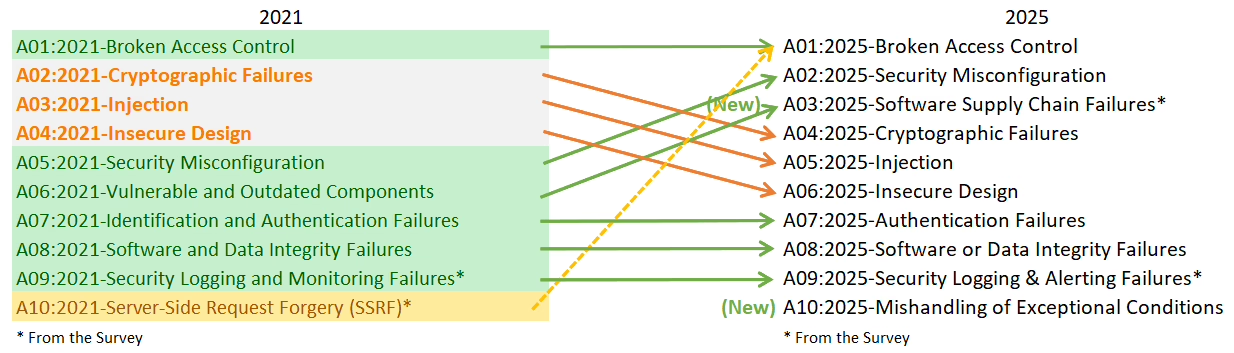
Attack volume against web applications and APIs is now continuous. Multiple vendor reports for 2024 put daily blocked threats in the billions. The details differ by methodology, but the direction is consistent: every external surface should be assumed under automated probing. OWASP Top 10:2025 ranks Broken Access Control at number one and Security Misconfiguration at number two. Check object-level permissions, least-privilege defaults, secret handling, environment separation, HTTP headers, and third-party dependencies as normal delivery work, not a launch-week scramble.
AI-assisted development without guardrails
AI code assistants accelerate boilerplate. They also introduce a documented set of failure modes: collapsing modular architecture into single files, breaking authentication and authorization patterns, hardcoding logic, and optimizing for local tests that pass while system invariants quietly break. A 2026 empirical study of AI-generated web apps recorded security scores dropping from 51 to 5 after AI “fixes” introduced privilege escalation and session forgery. A 2026 industry survey of 871 security and IT professionals found overall confidence in application security at 29%, falling to 15% for AI-integrated applications, per the 2026 Fortinet Web Application Security Report. Use AI as a co-pilot with explicit specifications, validation harnesses that check system behavior, and human review of any change to auth, permissions, or data flow.
The One Next Step, and Where to Start
None of this works as a one-time build. Web applications succeed when the team treats them as continuous engineering across four dimensions: architecture that tolerates failure, security that assumes adversarial load, operations that catch problems early, and product work that stays close to real users. The framework is the smallest of those decisions.
The next useful step is a thirty-minute working session where you fill out a short pre-build checklist: the user problem, the first-release scope, the budget ceiling, three success measures, and the criteria you will use to choose a partner. That checklist is what turns a good idea into something you can quote, staff, and ship.
If you would rather do that work with a team that has run the same process across membership sites, publishing platforms, ecommerce systems, and SaaS MVPs, that is what Refact’s discovery-first engagement is built for. You can also skip straight to a specific service page, whether that is portals and dashboard development or product design. Clarity before code is not a slogan. It is the cheapest thing you will buy in the entire project.
Building a product and unsure what to scope first? Let’s talk. Free 30-minute call, no pitch.

Saeedreza Abbaspour is the CEO of Refact, where he works across product, engineering, and sales. He sets the studio’s direction while staying closely involved in the work itself, from shaping product strategy and UX architecture to helping define the technical systems behind Refact’s projects. His role connects business thinking with hands-on product execution, giving him a practical view of how software should be planned, built, launched, and improved. At Refact, Saeedreza focuses on building a studio that can move quickly, solve real client problems, and turn ideas into reliable digital products.
More from Saeedreza Abbaspour

