MVP Web Development: A 2026 Guide
A first product rarely succumbs to bad code.


We put together this guide for any founder looking to put real money behind a first web product. You will find an explanation of what an MVP truly is, what to expect in terms of cost and time, and the kind of tech stack that leaves your options open. We also address the errors that have a way of quietly inflating the price tag. For a more in depth look at the process, our MVP development process for founders goes into greater detail.
An MVP Is a Learning System, Not a Small Product
The Nielsen Norman Group has a useful definition for a minimum viable product as a learning tool, something you put in front of users to see if an idea holds value. That is a better frame of reference than any feature list. An MVP’s success is not a function of budget or technology but of whether the team approaches the build as an experiment or a mini launch.
You can spot the winners. Column hit $40M ARR in eighteen months on the back of a six week MVP that was nothing more than a narrow legal workflow. Tulip’s journey to a $100M valuation began with a two week effort in one factory. There was no polish at launch; they were simply there to answer if a particular user would do what we thought they would with a particular problem.
The losers are equally predictable. They ship after half a year to a market with no appetite for it, having added a settings page and admin panels nobody wanted. If you read the r/SaaS threads you will find the same lament: “I put in six months for the perfect MVP and the users loathed it.” It was never the code, it was the scope.
Call it what it is: if the first version does not tell you something concrete about demand or willingness to pay, it is not an MVP. Just a small product waiting to be put aside.
The Realistic Timeline and Cost Ranges
In founder circles you will hear figures that are either too vague or overly rosy. But the 2026 agency benchmarks are fairly consistent. Expect four to eight weeks for a simple MVP, eight to 16 for a standard scoped build. Something complex or AI-driven will run 12 to 28 weeks. Yet the typical error is to put 12 weeks of work on a four week calendar. AgileSoft Labs says founders are off by a factor of two or three on timelines.
Costs are shaped the same way. A freelancer or no-code job comes in under $20K. A custom MVP with the works (auth, payments, monitoring) is in the $25K to $55K range. Regulated AI products can top out at $300K. And do not forget regional differences; you will pay 1.5 to 2 times as much for the same scope with a North American agency as you would in the EU or LATAM.
Then there is the post-launch figure that gets overlooked. Put aside another 20 to 40 per cent of your initial outlay for the first six months of iteration or the launch becomes the end of the story. Our MVP development cost guide has the full breakdown.
| Build type | Timeline | Typical cost | Best fit |
|---|---|---|---|
| No-code / freelancer | 4–8 weeks | Under $20K | Portals, forms, simple workflows |
| Scoped custom build | 8–16 weeks | $25K–$55K | Real users, payments, one core flow |
| Complex / AI / regulated | 12–28 weeks | $55K–$150K+ | Heavy logic, integrations, compliance |
For a defensible plan, most will add a paid discovery phase to these ranges. The product discovery process is there to take a hazy notion and give it a scope you can put a price on.
The One-Flow Rule
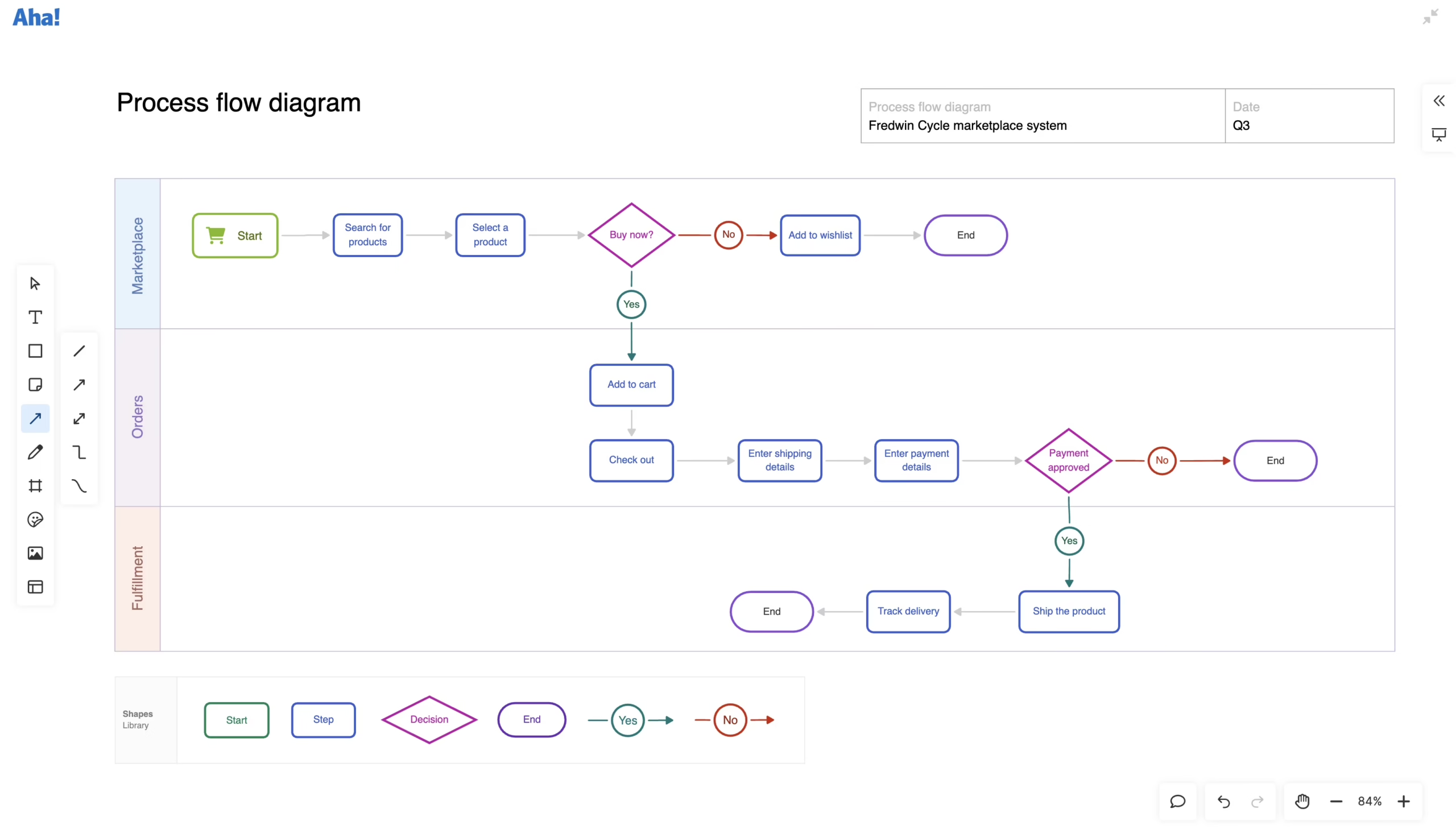
When it comes to outcome and cost, scope is the lever with the most pull. The rule is straightforward: one metric, one flow, one user, one problem.
Take the single most painful part of your target user’s day. Focus on the persona who feels it, not the three you may serve down the line. The product should support one sequence from entry to value and you must decide beforehand what number indicates that worked. Leave the rest for later. Manual onboarding calls or data imports are not a failure in an MVP, they are the economical way to learn what requires automation. As Paul Mit’s checklist puts it: launch to five people, ask for payment and if you get it, you have your MVP.
The CRV MVP methodology guide agrees from the investor side. A free MVP tells you little about willingness to pay. Payment is a far better validation than a sign up or polite interest.
Choosing a Build Path
It is common for a founder to start shopping for a developer before deciding on a path for the product. That is usually the wrong order. There are four ways to go and each has its tradeoffs.
No-code
If the product is largely content, forms or portals, this is the best route. You will ship in weeks and keep costs down. But there is a ceiling. When you need to introduce custom logic or heavy integrations, no-code will either bog you down or require a complete rebuild. ZZBLOCK7ZZ
There is a place for it when the scope is narrow and you can make quick calls, provided you are comfortable with key-person risk. But if the freelancer vanishes or leaves behind code no one else can make sense of, the repair bill is yours to pick up. Continuity is where this approach is vulnerable.
Small in-house team
You will only want to do this if the product is central to the business and you have the means to back the hiring and salary load with validation. For most MVPs, it is not called for yet.
Product studio
A studio puts strategy, design and engineering in the same room. You cede a measure of day-to-day control but are left with better continuity and product judgment on scope, with fewer handoffs. Refact is built on that model; our breakdown of web development services shows how each option fits.
Then there is the matter of speed, control and depth. An honest assessment is that you can have two of the three. Choose the ones relevant to your stage.
The Boring Stack That Wins in 2026
Founders will tell you they have lost two weeks before a line of code is written through analysis paralysis over the stack. The 2026 default is well known and deliberately unexciting.
On the frontend: Next.js (App Router) with TypeScript, Tailwind and shadcn/ui. Backend is Next.js API routes with Zod, or Python if the domain warrants it. Supabase or Firebase for the database and auth, Stripe for payments, Vercel or Railway to host, and Sentry to catch errors.
The point is that none of it is thrilling. Boring tech has the documentation, the hiring pool and the Stack Overflow history to make debugging quick. Go with the commodities. Exotic stacks bring risks in hiring and support that have nothing to do with your product. Custom-build only where you have to.
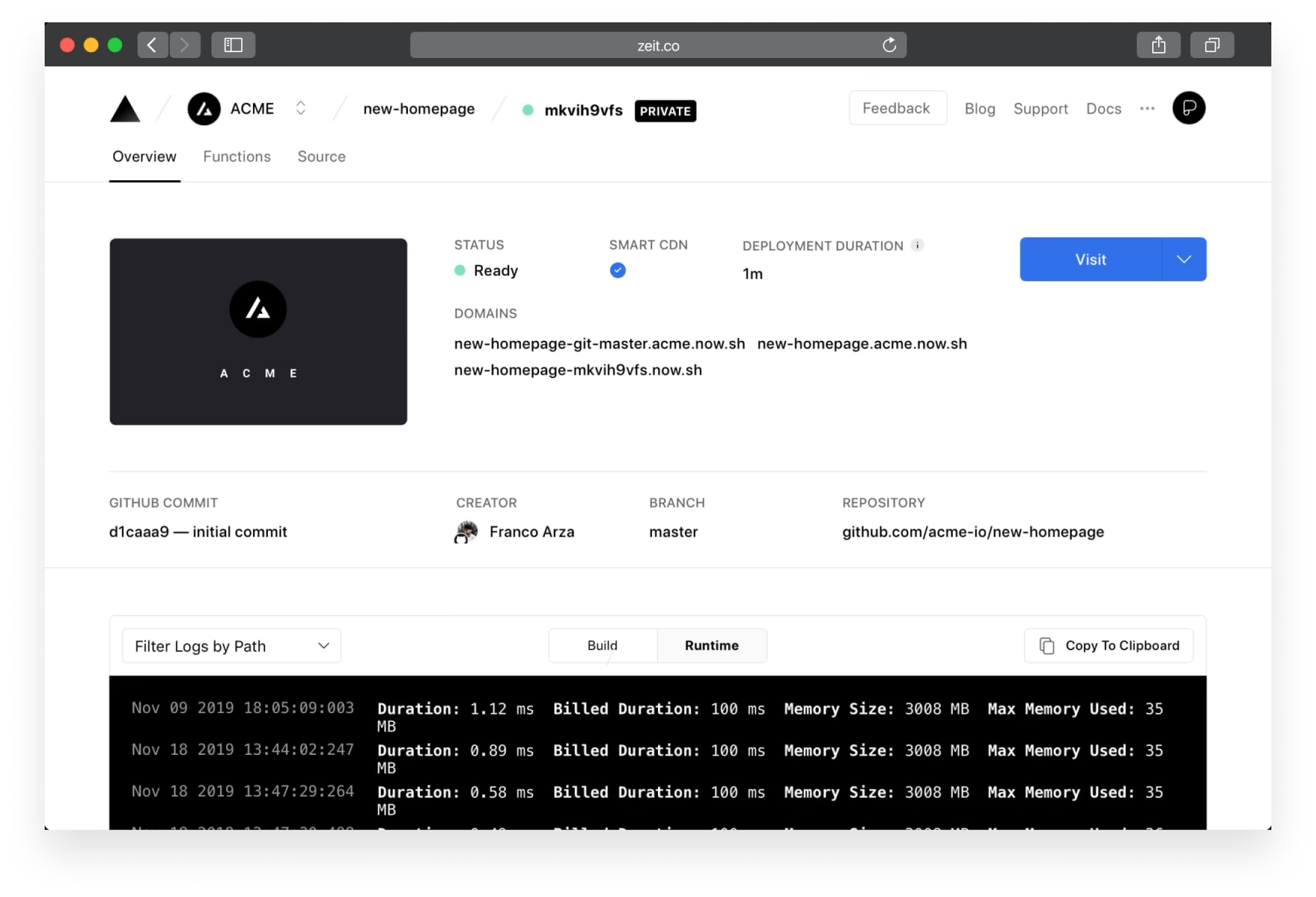
Some integrations demand your attention because mistakes put money on the table. With Stripe you need idempotency keys and webhook signature verification so you do not double charge. Model APIs like OpenAI require rate limiting and cost tracking; a loop bug can eat your budget in a night. Do not be satisfied with screenshots of a dashboard and call it implementation. Read the primary docs.
AI Speeds Up Coding, Not Delivery
AI tools such as Cursor, Copilot and Claude Code offer genuine productivity. Various 2026 figures claim the coding phase is 25-70% faster, though the variance is down to the project and the team’s maturity.
But coding was rarely the bottleneck on an MVP to begin with. Discovery, testing and iteration take up the timeline. The end-to-end gains are not as dramatic as the numbers imply. A founder who has AI write code without a proper requirements document will get something that compiles but does not work. It will look done and solve nothing. Treat AI as an accelerator within a brief, not a replacement for one. We go into what that document should contain in our guide to writing a product brief.
Compliance and Operations Are Not Optional
Compliance cannot be an afterthought. GDPR is in effect from your first EU user. The EU AI Act brings obligations for AI features in sectors like health or employment from day one. And then there are the app store policies. Any real MVP will have a privacy policy, data minimisation and TLS in place.
The same goes for operations. Automated deployment and production monitoring with something like Sentry are not luxuries. If you cannot see when signups fail, your departing users will let you know.
Instrument for One Metric Before You Ship
Tacking on analytics once you have launched will only give you misleading information. Success needs to be part of the build plan. Decide on a core metric ahead of time. Is it activation – the action that shows a user has value? Retention? Payment conversion is best.
Do not be seduced by vanity metrics like downloads or page views. There is a rule of thumb in MVP circles: 10 people in week one, 50 signups and 20 active users by month one, and someone inquiring about payment at month three. If those are not moving, adding features will not help. That is the practical side of how to measure product market fit.
What This Looks Like in a Real Build
It becomes concrete on the ground. Take Workform, an AI assistant we put together. The client wanted an AI to do “everything” for project managers. A six-month job that would have been instructive for no one. In discovery we honed it to a single hypothesis: could an assistant pull from Slack, email and Asana to keep a manager on top of things? The MVP put that to the test with actual users.
With CinemaAssist, an online ticketing system for an independent cinema, we did the opposite. We avoided the “everything” trap with a narrow scope: box office to browser, one flow, real payments. The problem was small so the build was, and the constraint made the product work.
The First 30 Days
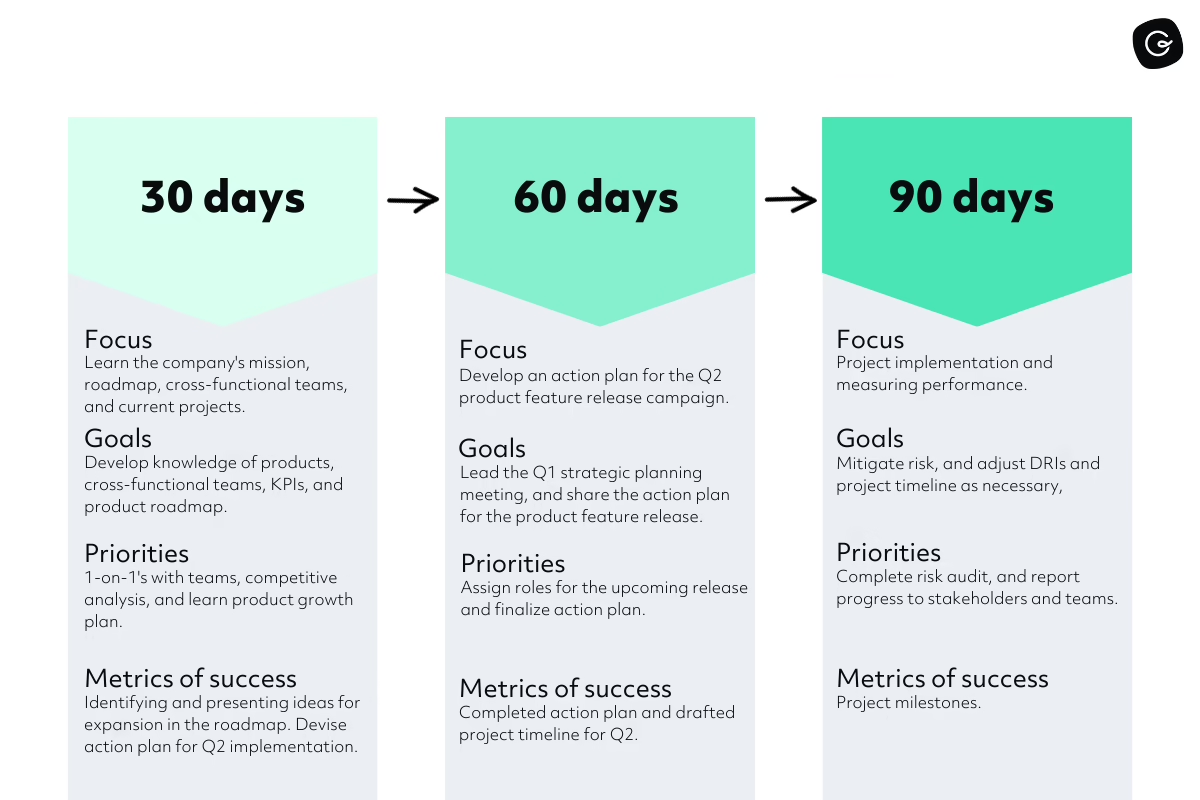
There is no code in the first month for those at the starting line. The objective is to put the build in place.
- Week 1: Put the user problem into a paragraph of plain English. Have 10 or 15 conversations with people living with that problem. Do not make a pitch; simply ask where their current process falls apart and what they are doing about it.
- Week 2: Produce a one-page brief. It should lay out the target user and core problem, the single flow your MVP will handle, the metric for success and an unambiguous list of what is not in v1.
- Week 3: Put that brief in front of two or three teams for estimates. Look at tradeoffs rather than price alone. Make them tell you what they would cut and the reasoning behind it.
- Week 4: Make a call. A real signal means you lock the brief and get to work. If the signal is absent, go back and refine the problem before putting any money into the build.
What This Costs You After Launch
One finds founders preoccupied with launch cost while overlooking the run cost. Then there are the line items for hosting, security, monitoring, analytics, support and the engineering required to iterate. An MVP that is cheap to construct can be expensive to sustain; a brittle stack may look like savings in month one but will have taken it all back by month six. We have a website maintenance cost guide that details the ranges to be had.
For some cost discipline on the matter, the FinOps guide for CTOs is good reading even if the infrastructure is not your domain. The lesson is applicable to any MVP: operational cost is a product decision, not just a receipt, and one should know where the money is going ahead of time.
The Point Behind All of This
In 2026, web development for an MVP is an exercise in restraint. The tools are fine and the stack has converged so shipping is straightforward. The difficult part remains as it ever was: to narrow down the problem, do the talking with users, pare back scope so each feature has a purpose and reserve the budget for post-launch iteration.
Should you need to determine what your first product ought to be solving, or what merits a spot on the “not in v1” list, Refact’s product design and discovery is made for that kind of early work. Clarity before you write any code is more than a slogan. In the end, it is the most economical line item in the budget.
Building a product and unsure what to scope first? Let’s talk. Free 30-minute call, no pitch.

Saeedreza Abbaspour is the CEO of Refact, where he works across product, engineering, and sales. He sets the studio’s direction while staying closely involved in the work itself, from shaping product strategy and UX architecture to helping define the technical systems behind Refact’s projects. His role connects business thinking with hands-on product execution, giving him a practical view of how software should be planned, built, launched, and improved. At Refact, Saeedreza focuses on building a studio that can move quickly, solve real client problems, and turn ideas into reliable digital products.
More from Saeedreza Abbaspour

