Membership Site Examples: What Actually Lasts
A 2025 UCL working paper, based on data bought from Patreon, found that the median creator earning only from Patreon made $55 a month in 2024.
 Saeedreza AbbaspourOctober 9, 2026
Many of the examples here come with numbers. Some come with shutdown notices. Together they show what tends to make a membership last, and what usually ends one.
Four Questions to Ask About Any Membership Site Example
A membership site does three jobs at once. It is a billing and access system, a customer support operation and an acquisition channel. Most showcases only show the sales page, and the sales page is the part least likely to explain why a membership survives into its second year.
So before copying anything, ask four questions about each example:
- What ongoing value does it deliver? A concrete, recurring result, or just a content pile that keeps growing?
- Who carries the operating burden? Live calls, forum replies, payment problems and access tickets all land on someone.
- How resilient are the economics? Does the revenue depend on one market, one sponsor type or one person’s time?
- How much does it depend on a platform? Who stores the cards, who owns discovery, and what happens if the API changes?
Keep those questions in mind as you read. They also explain why benchmarks from one model don’t carry over to another. An association’s annual renewal rate and a newsletter’s monthly churn measure different things. Our companion piece on membership website examples worth studying covers member-area design in more depth. This article covers the business models underneath.
Paid Newsletters: The Clearest Membership Site Examples
Paid newsletters are the easiest model to read, because the promise is simple. Members get a reliable piece of analysis on a schedule they can predict.
Ben Thompson’s Stratechery is the classic single-author version. Free weekly articles bring readers in, and the paid Daily Update holds the value. Members know what they are paying for and how often it arrives, so nobody has to explain the return to a manager approving the expense. The weakness is key-person risk. The audience is buying one voice, so the business cannot easily grow into a team.
The Information runs the same idea at higher prices with a team behind it. It covers a narrow beat of tech, AI and finance. Its Pro tier adds assets members can actually use, such as proprietary databases and org charts. Research-heavy memberships justify premium pricing with tools, not just more articles.
The most useful newsletter examples are the ones that published their numbers after changing platforms. In September 2024, Casey Newton reported Platformer’s first year after moving from Substack to Ghost:
- 190,196 subscribers, roughly 35,000 more than a year earlier
- Revenue up about 11% year over year
- Monthly churn down from 4.19% to 2.7%
- Fewer new paid monthly subscribers
The last point matters as much as the first three. On Substack, many readers already had a card on file, so a $10 trial month took one click. On Ghost they had to find their card and type it in. Newton also listed new costs: Ghost Pro, other tools, a redesign and customer service. Together these cost less than Substack’s 10% share, but they were real. Owning the stack bought control and better retention, and it cost some conversion. It’s one publication’s self-report, and the churn gain can’t all be credited to the move. It is still the most honest public account of the tradeoff.
Thesis Driven, Brad Hargreaves’s real estate newsletter, left Substack in 2025 after almost three years. His reasons were specific. Substack offered no API, webhooks, Zapier integration or SSO. An archive of 400+ letters was hard to browse. The 10% fee was costing thousands of dollars a month. And he needed the newsletter to connect to courses and data products. Billing carried over, but members had to create new Ghost accounts. The site went down for a while, email might be delayed, and the newsletter lost its place in the Substack app.
Refact has seen the same pressure from the other side. When The Hustle launched Trends, its paid newsletter tier, the audience was already there: more than a million free subscribers. What held the launch back was a custom CMS, a payment platform and an email system that didn’t work together. We shipped it in two weeks by treating billing, content and email as one system instead of three vendors. If you’re weighing publishing models more broadly, our guide to reader revenue models compares paywalls, memberships and hybrids.
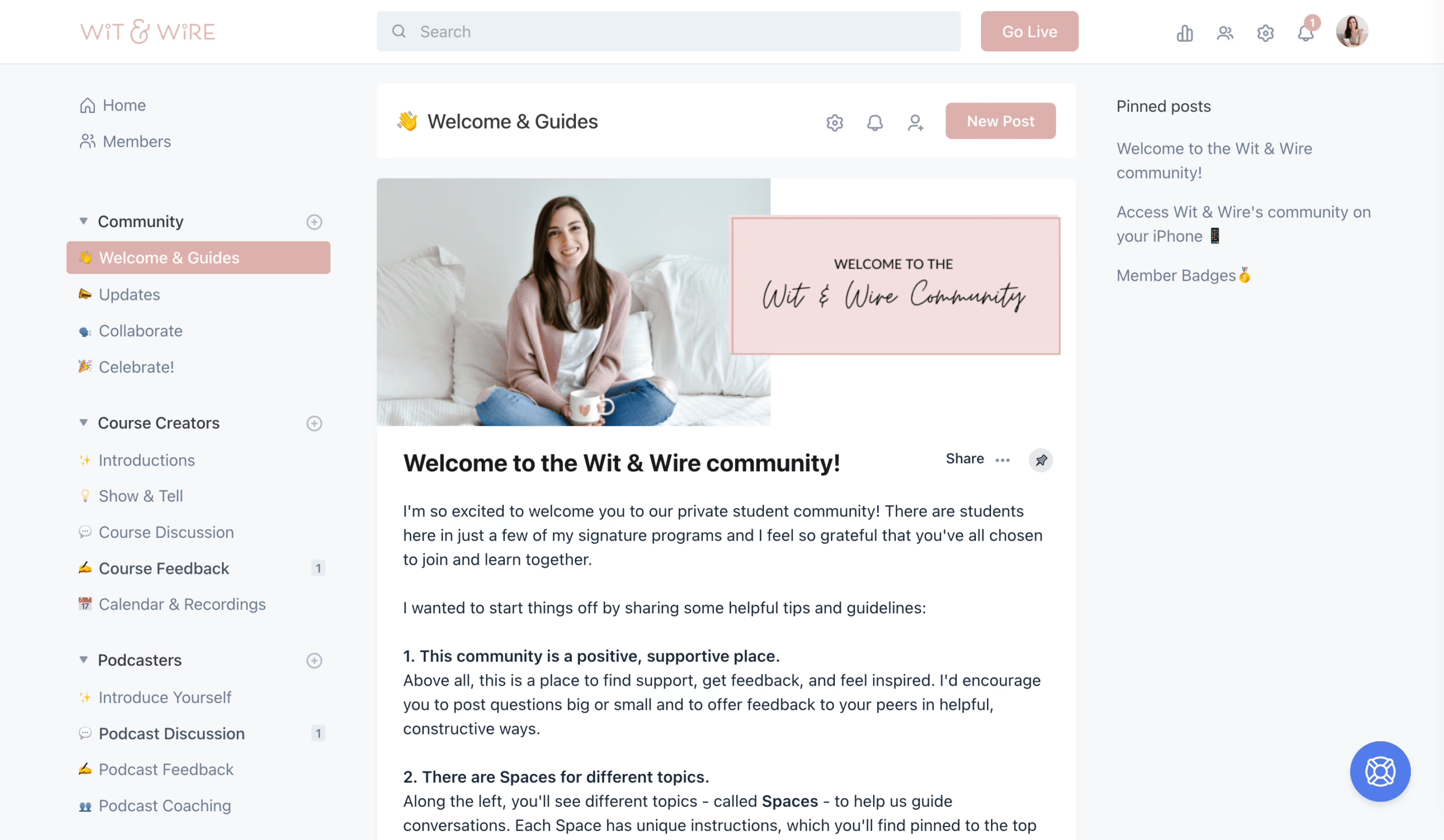
Creator Communities: Small, Paid and Built Around Each Other
Community memberships sell access to people, not just to a creator. When they work, members stay because leaving means losing their peers.
The Curve Investing Club is a good example of audience first. It started as a 30-woman meetup, grew to 250+ people at events, and then built a podcast that reaches 70,000+ women. Uscreen, its platform vendor, says paid members rose 116.2% and monthly recurring revenue rose 176.7% after the club added an app on day one, local-currency pricing and automated abandoned-cart and churn follow-ups. That is a vendor case study with no stated time window. Still, the tactics are sensible: remove friction when people join and when they consider leaving.
Circle’s 2024 data points the same way. Among its top 10% of communities, which it calls “Platinum,” 93% required a purchase and 76% had 500 or fewer members. In 59% of them, more than half of members attended events, against 33% for standard communities. That is a correlation inside one platform, not proof of cause. It does push back on the idea that bigger is better.
Sam Parr, who has run communities for more than 13 years and now runs Hampton, names the mistakes he sees most often:
- Letting sponsors in
- Bending admission rules for money or status
- Growing too fast early
- Centralizing everything instead of letting local groups form
His fix is pure membership fees and a deliberate effort to make early members feel like insiders before scaling.
Now the counter-example. Pete Codes ran a paid community for indie builders at $19 to $39 a month, with weekly Zoom calls. Over about two years it made $4,650.23. Revenue thresholds, time zones and members’ different platform preferences kept shrinking the reachable audience. The model wasn’t broken. The market was too small. Meanwhile, one commenter on a similar thread reported $20K+ in monthly recurring revenue from a software engineer community. They credited free YouTube and LinkedIn content, shareable Q&A recordings and live events as the acquisition engine. Same model, very different results. The difference was how many people could be reached.
Course and Video Memberships Live or Die on Format
A course has a curriculum and an end. A membership promises value that keeps coming. Charging a recurring fee for something that is really a finished course is one of the fastest ways to create churn, because members finish the material and have no reason to stay.
MasterClass handles this by selling one all-access library instead of a list of separate courses, with guided Sessions for people who want structure. It leans on annual billing and puts features like extra devices and offline viewing in higher tiers. That works for premium positioning, but it requires a product that justifies a bigger upfront commitment. Skillshare takes the opposite route: a broad catalog built around project-based classes. A large library means new members rarely hit a dead end. The catch is that a big catalog needs opinionated onboarding. Without it, people browse, bounce and cancel.
Smaller video memberships show what launch-small looks like. Ralph Beaubrun’s dance class membership signed 50 members in two weeks without ads after launching in November 2024. By December 2025, Uscreen reports, it had 5,000+ members and $25,000+ in monthly recurring revenue. A Reddit operator running a training membership with close to 500 members described the cost of that kind of growth: two live calls a week, alternating Q&A and classes, plus ongoing forum support. Live interaction keeps people around. It also ties revenue to the creator’s calendar.
Pricing format matters as much as content format. In a 2018 Warrior Forum thread, the owner of a music-theory site said a $59 lifetime price sold 100+ memberships in five months. When he switched to $10 a month or $97 a year, sales dropped sharply, so he tested $59 for one year instead. That example is old and anecdotal. The lesson still holds: some audiences don’t want another monthly bill, and the only way to find out is to test with your own buyers. For coaches moving from one-on-one work to recurring revenue, this guide to building a coaching membership covers that transition in detail.
Habit and Utility Memberships Earn Renewals Through Use
Some of the strongest consumer memberships barely look like memberships. They sell a tool or a habit, and the content follows.
The Peloton App membership separates digital access from hardware, with tiers for app-only users, app-plus members and equipment owners. Retention comes from streaks, personal bests and programs, not from the size of the class library. Fitness memberships depend on repeat use, so anything that keeps a member on schedule is part of the product.
AllTrails+ is a utility upgrade on top of a free app. The paid layer adds offline maps, wrong-turn alerts and route planning. The paywall feels fair because the paid features lower real risk on the trail. If a paid tier only adds status, people compare it to the price. If it adds utility, they compare it to the problem it solves.
The New York Times bundles news, games, cooking, audio and The Athletic into one account. A reader who stops opening the news app may still play the daily puzzle, so the account keeps its value. The complexity shows up in account management. Frequent promotions make pricing hard to follow, and subscriptions bought through app stores are harder to change later. Publishers copying the bundle need to design accounts as carefully as they design content.
Associations and Clubs Have the Oldest Playbook
Professional associations ran membership businesses long before anyone called it the creator economy, and their benchmarks are the most reliable ones available. MGI’s 2024 Membership Marketing Benchmarking Report, covering 696 associations, found a median renewal rate of 85% overall but 75% in the first year. Only 46% of associations that tracked first-year renewal reported 80% or higher. Year one is where memberships lose people, whatever the model.
FEDESSA, a European self-storage association, worked on that weak spot over more than four years. It shortened its join form, sent one-question polls every two weeks and timed renewal reminders based on how each member actually behaved. Its vendor, ReadyMembership, reports that retention went from 85% to 94%, email clicks rose 320% and staff saved 12 admin hours a week. It’s vendor-published, but the method is worth borrowing: learn about members gradually instead of asking for everything at signup.
Smaller operators show the same pattern at a lower cost. The Louisville Artisans Guild replaced an Excel sheet with a membership tool and, according to its vendor, added 13 members in the first month. Findlay Hats sells a “Hat of the Month” club: an exclusive hat each month at $10 off. It grew slowly from an invite-only discussion list the company had run for seven years. A membership doesn’t have to be the whole business. As an add-on to ecommerce, it can be predictable extra revenue.
The Closures Are Better Teachers Than the Success Stories
Each of the memberships below had real demand. Each still closed. That’s the part a list of winners can’t teach you.
When the operator can’t sustain the work
Growthtrackers had about 50 companies paying $499 a month, and retention was good. The person running it closed it in June 2024 anyway. The workload was overwhelming, and they didn’t want to be responsible for members’ business results. The community lives on as a free Slack with about 100 messages each weekday. Breakthrough Brand’s All Access membership signed 170+ members in its launch week and closed a few months later. Its creator didn’t want to keep selling the renewal or keep giving members direct access to herself. We covered that case in more detail in how to create a membership site that lasts.
When the economics drift away from the community
Elpha served 100,000+ women in tech. It announced its closure on December 27, 2024, and the site went offline after January 9, 2025. The team cited changes in professional networking and the hiring market. A later retrospective argued that a $12,000-a-year B2B hiring subscription tied the business to the hiring downturn. That is outside analysis, not the team’s own post-mortem. REC Philly, a creative community space, opened a 10,000 sq ft flagship in December 2019, got about three good months before the pandemic, then took on a large Miami lease while its membership was underpriced. It closed in December 2025.
Community value and business viability are two separate tests. A membership can pass the first and fail the second.
What Membership Site Examples Never Show: Billing State
Behind every example above is a billing system deciding, every day, who still gets in. Most showcases skip this part. It is also where a lot of quiet churn starts.
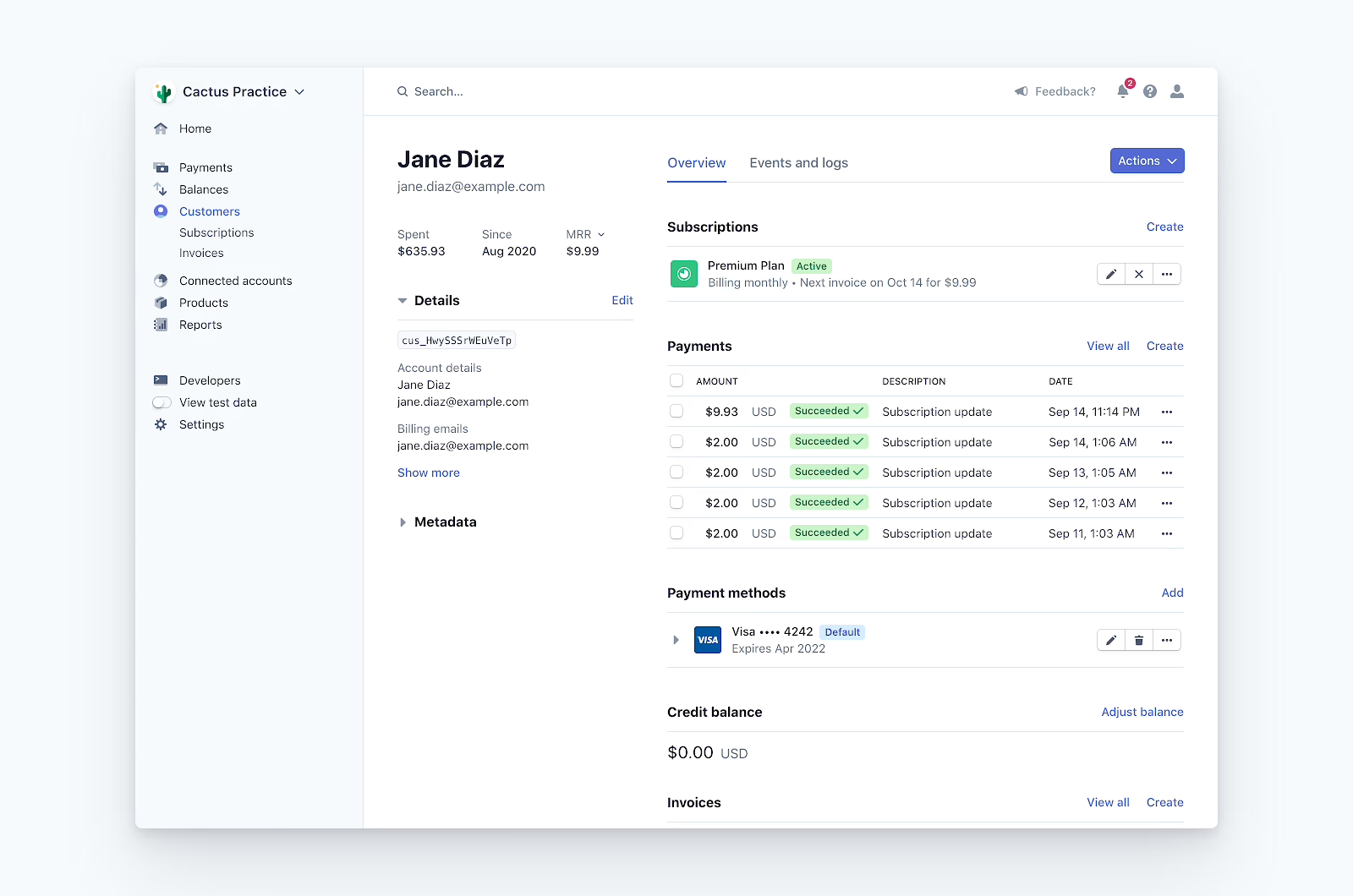
Stripe subscriptions move through several states: incomplete, past_due, unpaid, paused, canceled and active. According to Stripe’s documentation, active does not guarantee every invoice is paid. Stripe recommends revoking access on unpaid or canceled, and notifying customers when a payment fails or needs authentication. Webhook events can arrive out of order and more than once, and live-mode deliveries are retried for up to three days. If a custom build grants access on “checkout succeeded” and never checks the subscription again, it will eventually lock out paying members or let lapsed ones in.
The fix is a simple rule set. Map each subscription status to an access rule. Record event IDs so duplicate events don’t run twice. Re-check the current subscription state instead of trusting the order events arrive in. This is the kind of work our Stripe integration and development team does on membership builds. The hard part is rarely the code. One SaaS operator said building a payment-recovery flow took a day, but agreeing the dunning policy took a week: when to nudge, in what tone, and when someone stops counting as a member. Our guide to choosing a membership platform walks through that policy decision.
Not every recurring arrangement should be a subscription, either. If members pay per session, as many tutoring and lesson businesses do, invoices tied to attendance often fit better than a flat monthly fee. Tools built for that, like attendance-based tutoring billing software, avoid charging people for months they didn’t use, which is a common source of cancellations.
Platform dependence is ongoing maintenance
Hosted platforms aren’t static either. Patreon announced that its v1 API endpoints would stop responding on October 7, 2026, with extensions available through January 20, 2027. Any site built on v1 without an extension has already hit that date. Migration has its own catches. Ghost’s documentation says moving paid Substack members requires connecting the same Stripe account, and Substack keeps taking its 10% on existing paid subscriptions. Paid Beehiiv subscribers are harder to move, because Beehiiv’s Stripe account can’t simply be connected elsewhere. Exporting a list doesn’t move the payment relationships behind it.
Practitioners who helped with the Thesis Driven migration, which took two months, said their main lesson was to stop bundling a new homepage and URL change into the same project, because that made problems hard to diagnose. Test billing continuity on its own. Then separately test logins, archive access, account management and email delivery. If a move is on your roadmap, our website migration work follows that sequence, and the Ghost vs WordPress comparison covers which stack fits which publishing team.
Matching a Membership Model to What You Can Sustain
Here is how the models compare. Use it to shortlist examples, not to predict revenue.
| Model | Examples | What members pay for | Main risk | Metric to watch |
|---|---|---|---|---|
| Paid newsletter | Stratechery, Platformer, Thesis Driven | Reliable analysis on a schedule | Key-person risk, platform fees | Monthly churn, trial conversion |
| Creator community | The Curve, Hampton, Pete Codes | Access to peers and live events | Operator burnout, small market | Event attendance, first 60 days |
| Course or video library | MasterClass, Skillshare, Ralph Beaubrun | Structured learning plus new material | Members finish and leave | Completion, time to first win |
| Habit or utility | Peloton App, AllTrails+, NYT bundle | A tool used weekly | Tier gaps, price sensitivity | Weekly active use |
| Association | FEDESSA, Louisville Artisans Guild | Professional development, network | Weak first-year renewal | First-year renewal rate |
| Product club | Findlay Hats | Exclusive items, discounts | Slow growth | Months retained per member |
A few rules hold across all of them. Sell a result members will still need next month, not access to a pile of content. Greg Isenberg puts it this way: “pay for access to a group” churns, while memberships that bundle community with events, templates, tools or job boards give people more reasons to stay. Validate with a small group who actually pay, not people who say they’re interested. Offer pause and downgrade options. Recurly’s 2025 data, which covers broad subscription businesses rather than memberships specifically, found that pausing retained 51.7% of at-risk subscribers. And track churn and lifetime value from the start. In a 2024 Membership Geeks survey of more than 2,000 operators, 45% didn’t know their churn rate and 60% didn’t know their LTV.
The hosted-versus-owned decision follows from those choices. Stay hosted while distribution and stored cards are worth the fee. Move to an owned stack when integrations, archive control or connected products justify taking on payment states, support and maintenance yourself. Our roundup of the best membership site platforms compares the options at each stage.
Every example in this article came down to the same thing. The memberships that lasted made a promise their operators could keep every week, at a price the market would pay, on a system that knew who had paid. Most of that gets decided before anything is built. If you’re working out which model fits your audience and what it will take to run, that early scoping is what Refact’s membership platform development work starts with.
Building a product and unsure what to scope first? Let’s talk. Free 30-minute call, no pitch.

Saeedreza Abbaspour is the CEO of Refact, where he works across product, engineering, and sales. He sets the studio’s direction while staying closely involved in the work itself, from shaping product strategy and UX architecture to helping define the technical systems behind Refact’s projects. His role connects business thinking with hands-on product execution, giving him a practical view of how software should be planned, built, launched, and improved. At Refact, Saeedreza focuses on building a studio that can move quickly, solve real client problems, and turn ideas into reliable digital products.
More from Saeedreza Abbaspour
