Web Application Development Cost, Explained
Ask five agencies to quote the same web application and the numbers will not agree.


That is the honest starting point for any conversation about web application development cost. Most published price bands are directionally correct but they explain almost nothing about why two projects with identical feature lists end up 5 to 10 times apart on the invoice. This article walks through the real cost drivers, the pricing models that shape risk, and the questions worth asking before you sign.
Realistic Budget Bands for 2026
Across Clutch-based datasets, agency pricing pages, and practitioner conversations, three tiers show up consistently. Designveloper’s Clutch data puts the average custom project at around $66,500 over nine months. Kavara’s dataset puts it closer to $132,500 over thirteen. The wide gap is not noise. It reflects the difference between projects that are well scoped and projects that discover their real requirements while being built.
Use these bands as starting anchors, not predictions.
- MVP or single-feature app: $15,000 to $50,000. Six to ten weeks. One core user flow, off-the-shelf authentication, one or two integrations, minimal admin. The kind of build that answers a validation question, not the kind that carries your company for five years.
- Custom SaaS or mid-market product: $60,000 to $180,000. Three to six months. Dashboards, subscription billing, role-based access, multiple integrations, a real QA and DevOps discipline.
- Enterprise or compliance-heavy system: $200,000 to $600,000 and up. Six to twelve months and beyond. Multi-tenant architecture, audit trails, SSO, SOC 2 or HIPAA controls, migration from legacy systems, ongoing platform work.
These are the bands where credible sources cluster. If you are being quoted well below the floor for your tier, either the scope you described is smaller than you think, or the vendor is planning to make it up on change orders. Both are worth understanding before you sign.
For a fuller breakdown of how these tiers behave in practice, our guide to custom web app development cost walks through the ranges in more detail.
Why Identical-Looking Projects Cost So Differently
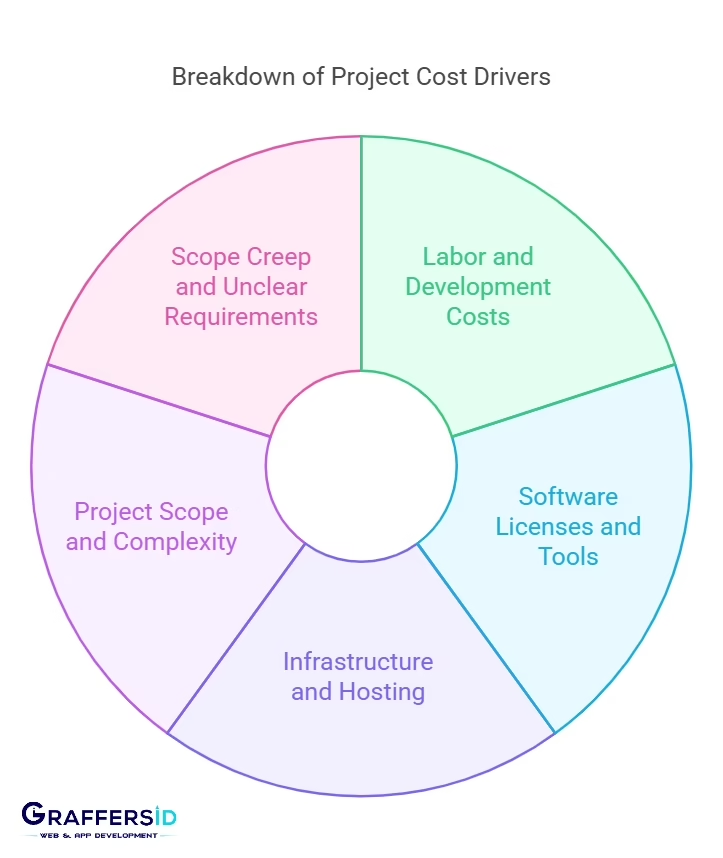
The features you can list on a whiteboard are rarely the reason two quotes diverge. The reasons live below the interface, and there are four of them worth naming.
Requirements Volatility
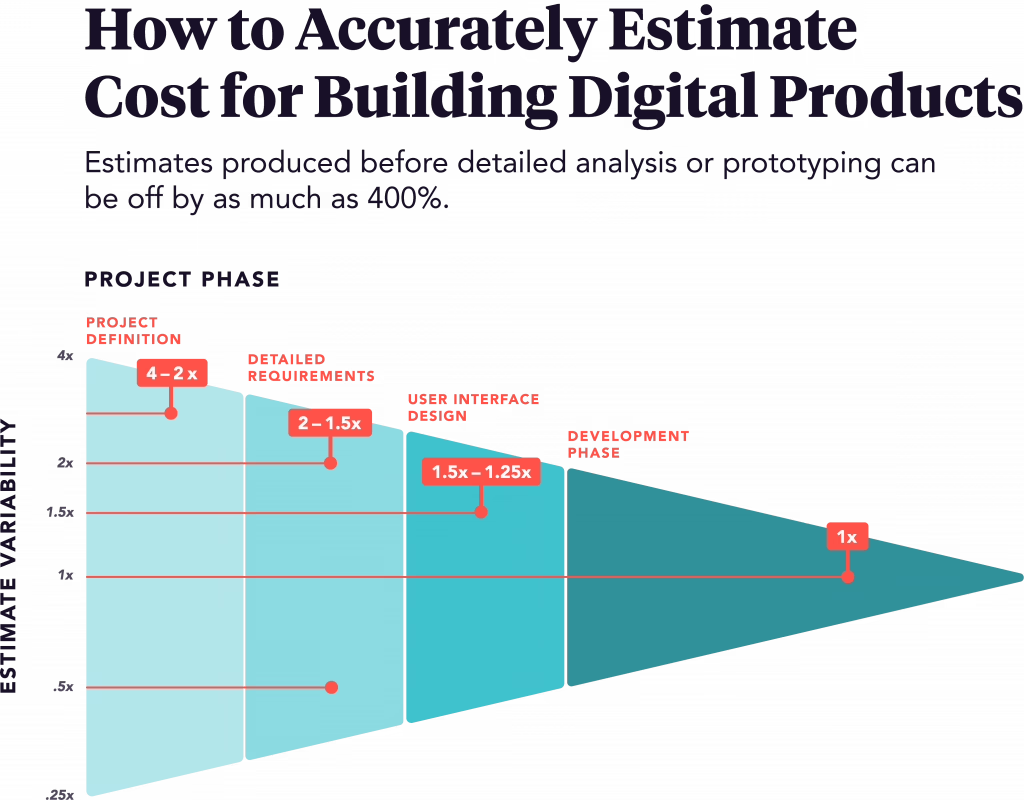
Empirical software research consistently attributes 30 to 50 percent of total project effort to requirements changes, and late changes cost two to five times more than early ones. Projects that arrive at contract sign-off with unclear scope routinely run 60 to 80 percent over their initial estimate. Projects with a stable specification stay under 25 percent variance.
This is why a two-week discovery phase, priced properly, usually pays for itself many times over. Deciding what the product is not, before code is written, is the single largest lever on total cost. We wrote about how to run that step properly in our guide to the MVP development process.
Non-Functional Requirements
Uptime, performance, security, and compliance rarely show up in a feature list, but they dominate architecture cost. A 99.9 percent uptime target is straightforward. A 99.99 percent target changes your infrastructure, your on-call rotation, and your deployment discipline. Adding HIPAA, PCI DSS, or SOC 2 to the same functional scope typically pushes cost 1.5 to 2 times higher, and none of that shows up in the UI.
Integrations and Legacy Data
In enterprise builds, 40 to 60 percent of engineering effort commonly goes into integrations rather than new features. Payments, identity, CRMs, ERPs, mapping, email delivery, and analytics all carry initial integration cost plus a maintenance tail as providers deprecate endpoints or change auth. Two apps with the same screens can differ by six figures based purely on what they have to talk to.
Team, Region, and Seniority
US agency rates run $125 to $300 per hour. UK and EU teams sit at $95 to $225. Nearshore and offshore rates land anywhere from $35 to $95. Rate differences alone can move a quote three to eight times, but the practitioner consensus on Reddit and X is consistent: outcome depends on management and specification clarity more than on the rate itself. A $500 offshore developer and a $300,000 offshore build with no product owner both exist in the wild.
The Cost Nobody Budgets For
Most buyers plan for the build and forget the run. Practitioners in r/SaaS put ongoing costs at $1,000 to $5,000 per month for a meaningful app. Tapflare and GoodFirms data suggest annual maintenance runs 15 to 30 percent of the original build cost, every year.
Then there is the stack. Hosting starts around $20 a month and creeps into the hundreds as usage grows. Email delivery, error tracking, feature flags, analytics, and payments each add $10 to $50. AI APIs can spike unpredictably: one widely shared X example saw a viral vibe-coded site accumulate more than $10,000 in Vercel bills before the developer noticed. None of these are large individually. Together they can pass $500 a month before you have real users.
Andrej Karpathy’s observation about modern app plumbing has stuck for a reason. Even a simple product needs authentication, payments, storage, transactional email, background jobs, monitoring, secrets management, and CI/CD. Managed services like Auth0, Clerk, Stripe, and Supabase reduce the build effort. They do not eliminate the operational surface.
What the Andersen Budget Split Actually Looks Like
A useful reference allocation for a serious custom build:
- Discovery and product analysis: 5 to 10 percent
- UX and UI design: 15 to 20 percent
- Core development: 45 to 55 percent
- QA and security validation: 15 to 20 percent
- Deployment and infrastructure: 5 to 8 percent
- Maintenance: budgeted separately, ongoing
Quotes that squeeze QA under 10 percent to hit a headline number tend to spend that saving twice over on production incidents and rework. Quotes that skip discovery entirely tend to spend it on requirement changes six weeks in. Neither is a bargain.
Pricing Models and Where the Risk Sits
Three models cover almost every engagement. The question is not which is cheapest. It is who carries the risk when reality does not match the spec.
Fixed price works when scope is genuinely locked. It gives you predictability and easy internal approvals. It also puts pressure on the vendor to protect margin, which usually means aggressive change orders and a narrower interpretation of the contract than you expected. Fixed price without a strong specification is the pricing model most likely to produce a bad outcome for both sides.
Time and materials shifts the risk to you but keeps the work honest. It fits products where you expect to learn during the build, want visibility into where hours go, and can afford to stay closely involved. The cost of that flexibility is that you cannot approve one number and stop paying attention.
Retainer works for products that will keep evolving after launch. You get a steady team, a prioritized backlog, and a partner who is compensated for outcomes over eighteen to twenty-four months rather than for shipping a single deliverable. Most of our long-term client work runs this way for that reason.
Our deeper comparison of fixed price vs time and materials covers the tradeoffs in more depth.
What a Realistic Scoping Conversation Looks Like
Before you request quotes, do three things. They cost nothing and they change the numbers you get back.
First, write the one user journey that must work on day one, from the user’s first click to the moment they get value. If you cannot draw it on a napkin, no vendor can price it accurately.
Second, separate the must-haves from the nice-to-haves. Payments, authentication, and one integration usually belong in the first list. Analytics dashboards, admin tooling, and second integrations usually do not.
Third, decide what happens three months after launch. That answer changes whether you should be pricing a project or a partnership, and it changes which pricing model fits.
When we built CinemaAssist for Pruneyard Cinemas, the technical scope was modest by SaaS standards: online ticketing, payments, seat selection, and a lightweight admin. The reason the project stayed inside its band was not the stack. It was that the cinema knew exactly what problem it needed to solve on day one, and everything else was explicitly Phase 2. That kind of scope discipline is what keeps a $40,000 MVP from becoming a $180,000 rebuild.
If you are working through your own numbers, our software development cost estimation and MVP development cost guide walk through the math step by step. For SaaS specifically, this guide to SaaS application development covers the pieces that make multi-tenant products more expensive than they look.
Questions Worth Asking Before You Sign
Vendors who welcome these questions are usually the ones you want. Vendors who deflect have already answered them.
- How are changes to scope handled, and what is the cost profile of a late change versus an early one?
- What does your team look like on my project, and who is the product owner on your side?
- Show me two similar-complexity projects. What did they cost, how long did they take, and what surprised you?
- What is your QA and security process, and what percentage of the budget does it consume?
- What happens on day 91, after launch? Who owns updates, monitoring, and incident response?
- Who owns the code, the design files, and the infrastructure accounts if we part ways?
Detailed hour and role breakdowns, named case studies at similar complexity, and a clear post-launch plan are the strongest signals of a vendor who has done this before. Hourly rate is one of the weakest.
The Number Underneath the Number
The research is consistent on one point: the total cost of a web application is less about what you build and more about how stable the plan is, how many boundaries the system crosses, and how long you intend to keep it alive. Two teams with the same feature list can spend a factor of ten apart based on discovery, product ownership, and post-launch discipline.
If you are trying to decide what needs to be clarified before development starts, that early scoping work is exactly what Refact’s product design and discovery process is built to settle. It is also the cheapest phase of any project to get right, and the most expensive to skip.
Building a product and unsure what to scope first? Let’s talk. Free 30-minute call, no pitch.

Saeedreza Abbaspour is the CEO of Refact, where he works across product, engineering, and sales. He sets the studio’s direction while staying closely involved in the work itself, from shaping product strategy and UX architecture to helping define the technical systems behind Refact’s projects. His role connects business thinking with hands-on product execution, giving him a practical view of how software should be planned, built, launched, and improved. At Refact, Saeedreza focuses on building a studio that can move quickly, solve real client problems, and turn ideas into reliable digital products.
More from Saeedreza Abbaspour

