

A small business website is not going to fall apart on the day it goes live. It will simply drift. The offer gets a little more defined, the staff expands, you put new services in a footer that no one ever looks at. Then comes a Tuesday when a prospect calls to ask if you are still in business because the homepage has the look of something from four years ago. That is when a redesign becomes a priority and, for all the wrong reasons, the project is most apt to be mishandled.
The trouble is that these things are treated as design projects. They ought to be scoped as business ones. Clutch’s 2025 report on small business puts the number of firms that have already gone through a redesign at 81 per cent. And VWO web design statistics for 2026 would have you believe 61.5% of those were prompted by bad UX, not an old look. People will tell you the aesthetics made the difference but it is usually the speed, the SEO, the clarity of the message and mobile CTAs that deliver the gains. This is the kind of outcome this playbook is for.
When a Redesign Is Actually the Right Move
There is a time for a redesign and there is a reason for it. You should be able to point to the friction the present site is creating. “We went from thirty leads a month to twelve” is a valid case. “It is looking its age” is not, standing alone. If the issue is with your positioning or the offer, a fresh layout will not solve it and you will be back at it in eighteen months.
You will see the signs cluster:
- Mobile is where the traffic is, yet conversion is a pittance compared to desktop.
- Your editors put off using the CMS because it is an hour-long job to alter a paragraph.
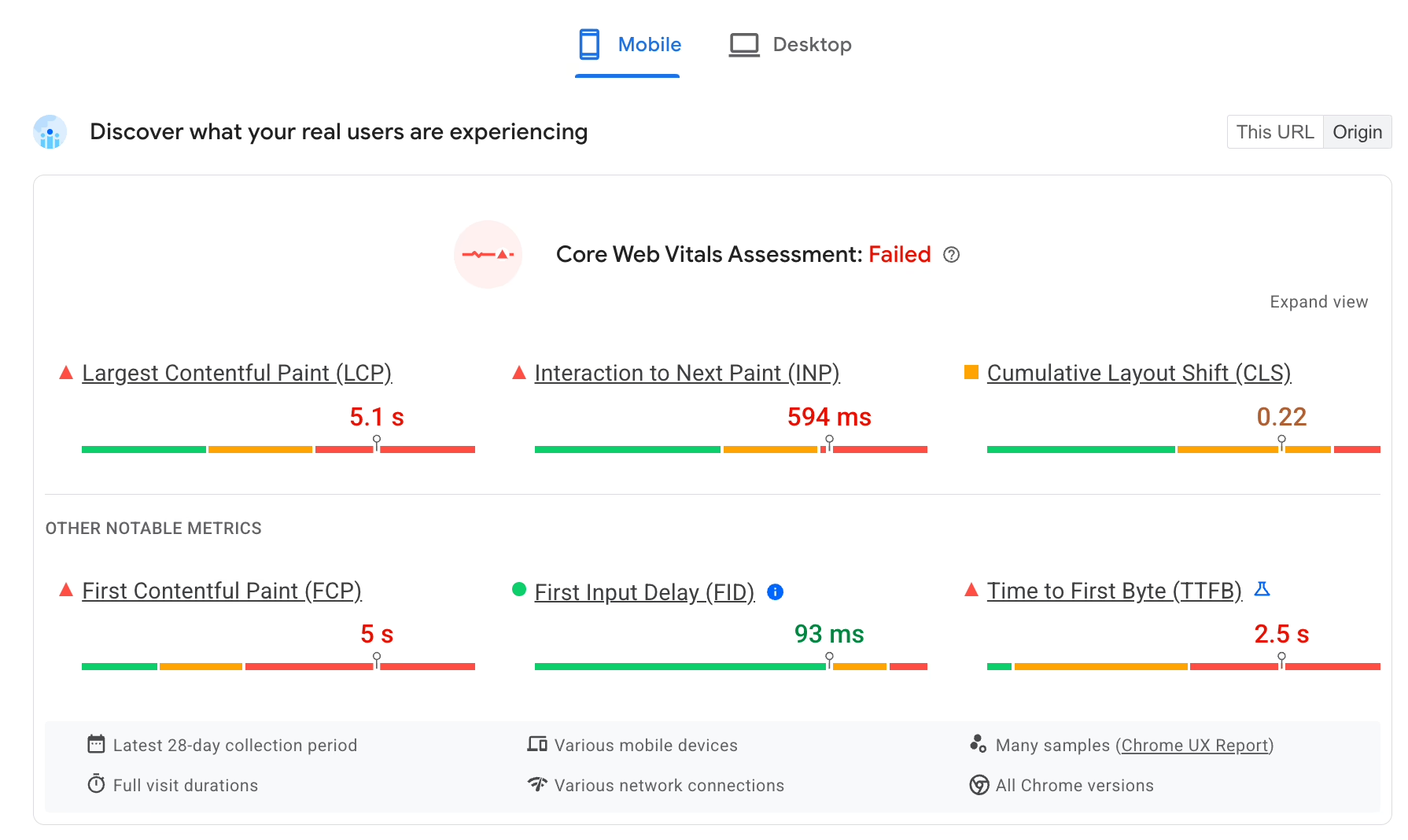
- Core pages lag. Google’s Core Web Vitals are clear: LCP under 2.5s, INP under 200ms, CLS below 0.1 at the 75th percentile. Fall short and your rankings will suffer, appearance be damned.
- The information architecture is out of step with what you are selling; you have old service pages pulling in views for offers you have long since put to rest.
- A rebrand or new revenue stream is in the works and the site as it stands cannot accommodate it.
An Australian survey of 1,600 SMEs reported here shows 42% have a redesign in the pipeline for the end of 2026, up from 31%. We see the same in the US and UK. It is routine maintenance now, not a once-a-decade affair.
The Diagnosis That Comes Before Design
Opening Figma before you have identified the one business constraint the project must address is the costliest error. Once the designing is underway the argument is over layouts, never outcomes. What you end up with is a prettier version of the same thing.
Discovery is how you sidestep that. It is a working document to be had before a pixel is moved, not a workshop for the sake of it. It should answer five things:
- The binding constraint. Is it lead quality? Organic traffic? Pick a primary metric and let everything else rank against it.
- Your baseline. Get the current numbers for monthly leads, key page rankings and Core Web Vitals. There is no way to prove success without them.
- Where the value is. An export from Search Console will show you which two or three pages are doing the heavy lifting. They have to make it through the rebuild.
- The mobile experience. Put a customer to the test on his phone. If he has to dig for the CTA, you have your brief right there.
- Content status. FactoryJet’s data from the UK indicates 75% of projects stall because the copy and imagery are not ready when the designers want to start. Content is the bottleneck, not development.
For a place to begin in an orderly fashion, our website audit guide covers what needs reviewing prior to writing a brief.
What Your Homepage Has to Do in Five Seconds
Put a first-time visitor on your homepage and they should know within five seconds what you do, who it is for and what to do next. If they have to think about it, they are gone before the design can do its work.
In our case studies the winners put the customer’s problem first in the copy. “Award-winning family business since 1992” does not hold a candle to “Emergency plumber in Albuquerque, on-site in 60 minutes.” Let the credentials sit lower down with the proof.
Then there are the rules that move the needle:
- One CTA on the homepage, not five. Make it a call or a quote request and push for it.
- On mobile the contact method has to be at hand on every page. Quake Media put a persistent phone number on their client’s mobile site and saw conversion jump from 0.4% to 3.8%, with leads climbing from 12 to 67 a month. Not much of a visual change, but the result was substantial.
One Page Per Service, Not a Services Bucket
And then there is the tendency to merge several service pages into a single generic “Services” tab for the sake of a neater navigation. It may look tidy but you have just done away with the search intent that was carrying you. Good service pages are problem-focused. Put copy that speaks to the issue at the top, give some context on pricing where you can be candid, and have a CTA that is specific to the service in question. An FAQ is useful for fielding the same questions the sales team gets on a weekly basis. As for testimonials with hard numbers on outcomes, spread them out over the relevant service pages; there is no point in piling them onto a standalone page that sees little traffic.
You will see a lot of DIY redesigns hemorrhage organic traffic by not following this logic. A plumbing company might have separate pages for drain cleaning, water heater repair and emergency work, each with its own ranking. Combine those into one and you have diluted every one of those positions.
Protecting SEO Through the Migration
Whether the team wants to call it that or not, a redesign is a site migration. Tinker with your URLs, templates or CMS without a proper plan and expect to watch search rankings slip for months. The reasons for failure are unremarkable, which is why they go unnoticed: a URL changed with no 301 map, metadata done carelessly, internal links left pointing to old paths, or an agency deciding a page was superfluous when in fact it was responsible for a third of your organic traffic.
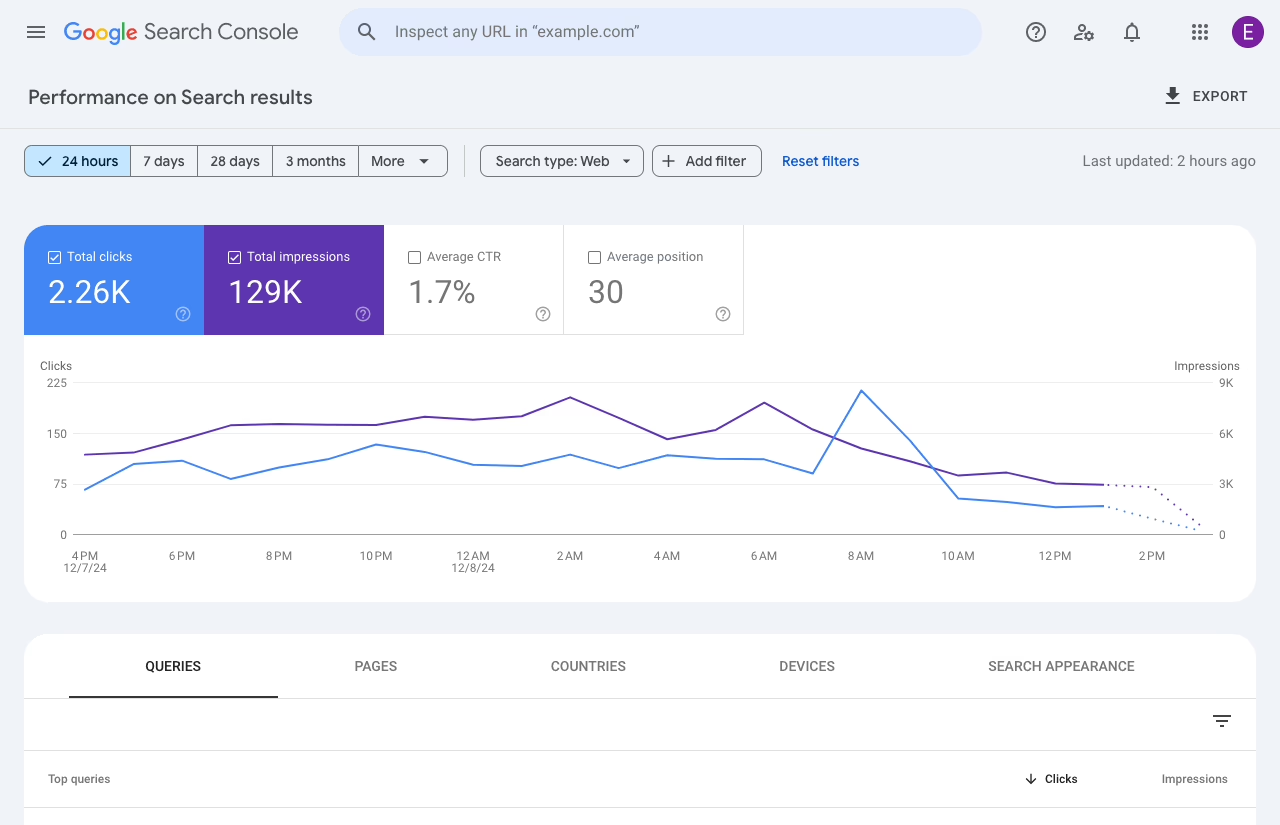
A solid SEO migration plan has to account for all of that. It means a full inventory of URLs, a 301 redirect map on paper, and making sure replacement pages are targeting the right intent. You need to preserve schema markup for Organization, LocalBusiness and FAQ, and do your validation in stages before you go live. Then you monitor Search Console for 30 to 90 days after launch because that is when issues will make themselves known. There is no option but to do so.
We go into the mechanics of how to protect your rankings during a rebuild in our guide on how to redesign a website without losing SEO. For any site with meaningful traffic, it is worth a read before anyone starts sketching out a redirect map on a napkin.
The risk here is real, not theoretical. In the case of the Keck School of Medicine of USC, the visual overhaul was the easy part. We had to move a decade of medical research, thousands of URLs from newsroom and faculty pages and program content without breaking indexed links or losing citations. When you get it right the work is invisible; when you do not, it is a disaster.
Choosing a Platform Your Team Can Actually Run
Choosing a platform is not really about technology. It is a decision on how your people will operate on a week-to-week basis for the foreseeable future. If marketing has to call in a developer to change a paragraph, they will stop putting things out. Give the team a stack they can edit safely and the site will continue to improve post-launch.
For most small businesses the shortlist is limited:
| Platform | Best for | Where it gets expensive |
|---|---|---|
| WordPress | Content-heavy service businesses, consulting firms, publishers, membership organizations | Plugin sprawl and years of patched code create technical debt fast |
| WooCommerce | Small ecommerce shops that also need content marketing on the same stack | Custom checkout logic and integrations at scale |
| Shopify | Focused ecommerce with standard fulfillment | App stack fees and customization limits when your model does not fit the template |
| Headless CMS with Next.js or similar | Custom publishing, unusual product data, or high-performance requirements | Higher setup cost and ongoing engineering; overkill for a five-page brochure site |
Should you be looking at a closed builder or a more open CMS? Our Wix vs WordPress comparison lays out the ownership and SEO implications. Take Fiore Designs, a florist in Los Angeles we did an ecommerce rebuild for. The whole discussion came down to the platform because the standard Shopify checkout would not accommodate their zip-code delivery zones. The business logic had to dictate the choice. That is the kind of detail a good platform selection requires.
Budget and Timeline Without the Fantasy Numbers
In the US you are looking at $3,000 to $15,000 for a typical small business redesign in 2026; in the UK the figures are closer to £1,500 to £8,000. A custom build with some strategy and content work runs from $5,000 up, while a DIY builder will set you back $500. Do not mistake a quote of $75,000 for a small business site; that is enterprise pricing. Our website redesign cost guide puts the various price bands in perspective.
As for timelines, four to eight weeks is what you should expect for a well-scoped project, provided the content is in order. That is where most estimates go awry. The developer is rarely the bottleneck; it is getting sign-off from stakeholders and having the photography and copy finalized.
Then there are two costs that are present in nearly every project:
- Content production. At week one someone needs to be on the hook for writing the case studies and service pages. If not, launch at week six will be put off.
- Ongoing maintenance. A basic site will run you $1,200 a year at the low end, more if you have a plugin stack or transactional elements. See our WordPress website maintenance guide for what that entails.
The Failure Patterns Worth Avoiding
There is a pattern to the redesigns that throw money away. We have documented cases like a $46,000 job that yielded no lift in revenue or leads to prove it.
Some common pitfalls:
- No KPI. The project is delivered and nobody has defined what success looks like, so six months on you cannot tell if it was a hit.
- Scope creep. Add a booking flow or a calculator mid-stream and the timeline will double while quality suffers.
- Doing too much at once. A rebrand, a migration and a redesign are three risky projects. Stagger them.
- The wrong partner. A small business goes with an agency with an impressive portfolio and ends up with something over-engineered and costly to upkeep.
- Treating the launch as the end. No A/B testing, no monitoring. The site is adrift from day one.
Our website redesign checklist covers these and the governance and accessibility items you will not find in most checklists.
Launch Is the Start, Not the End
You will know if the redesign has been worth the investment by the end of the first ninety days post-launch. Start by making sure redirects and indexing are in order during week one. By month one, put the pages to the test to see which ones are merely drawing in visits and which are converting. On mobile, observe where users tend to hesitate and put a stop to minor problems before they become something more.
A successful redesign is an ongoing concern, not a project to be put on a shelf. There is someone tending to content updates and another with an eye on Search Console. Rather than bickering over a homepage animation that goes unnoticed, you have people running an A/B test on your most popular page.
For those undertaking a small business website overhaul, the discovery phase should be resolving any constraints well before development gets underway. That is the purpose of Refact’s product design and discovery process. It provides the kind of clarity needed prior to writing code so that once you launch, your SEO and revenue are unimpaired.

Saeedreza Abbaspour is the CEO of Refact, where he works across product, engineering, and sales. He sets the studio’s direction while staying closely involved in the work itself, from shaping product strategy and UX architecture to helping define the technical systems behind Refact’s projects. His role connects business thinking with hands-on product execution, giving him a practical view of how software should be planned, built, launched, and improved. At Refact, Saeedreza focuses on building a studio that can move quickly, solve real client problems, and turn ideas into reliable digital products.
More from Saeedreza Abbaspour

