Custom Web App Development Cost, Real Ranges
Ask five agencies what a custom web app costs and you will get five different quotes for what sounds like the same project.


That is the real problem with custom web application development cost. It is not a number. It is a probability distribution shaped by scope discipline, integrations, compliance, team model, and what happens after launch. Clutch’s verified marketplace data pegs the average software project at around $132,480 over a 13-month timeline. GoodFirms’ 2026 survey found roughly 66% of mid-sized projects land between $30,000 and $100,000. Those numbers are useful. They are also averages of very different things.
This guide is written for the person who has to defend the budget to a board, a spouse, or their own savings account. It covers what actually drives cost, where quotes hide risk, and how to think about the total number instead of the sticker price.
The Three Cost Tiers That Show Up in Every Serious Source
Almost every credible pricing source clusters custom web apps into three tiers. The names change. The bands do not.
- MVP or focused internal tool: roughly $20,000 to $50,000. A single core workflow, a few user roles, a small integration or two. A 2026 custom software cost breakdown puts simple internal tools starting near $25,000.
- Mid-complexity business application: roughly $50,000 to $200,000, with heavy clustering around $100,000 to $150,000. Multiple roles, real backend logic, three to six integrations, some reporting.
- Complex SaaS or enterprise platform: $200,000 to $500,000, and $500,000 to $1.5M once SOC 2, HIPAA, or PCI enter the conversation. Multi-tenancy, audit trails, and role-based access control are the usual culprits.
One thing worth calling out. Below roughly $15,000 to $25,000, you are almost never buying custom engineering. You are buying template configuration, a no-code build, or a freelancer who will underquote to win the job and cut corners to survive it. That is fine for a prototype or an internal spreadsheet replacement. It is not fine if the app has to hold payments, protected data, or a growing customer base.
The realistic floor for “actually custom” starts around $15k to $25k. Below that, someone is cutting a corner you will pay for later.
What Actually Drives the Number
The instinct is to count screens. Screens are the least interesting cost driver. What moves budgets is what happens behind them.
Integrations, not features
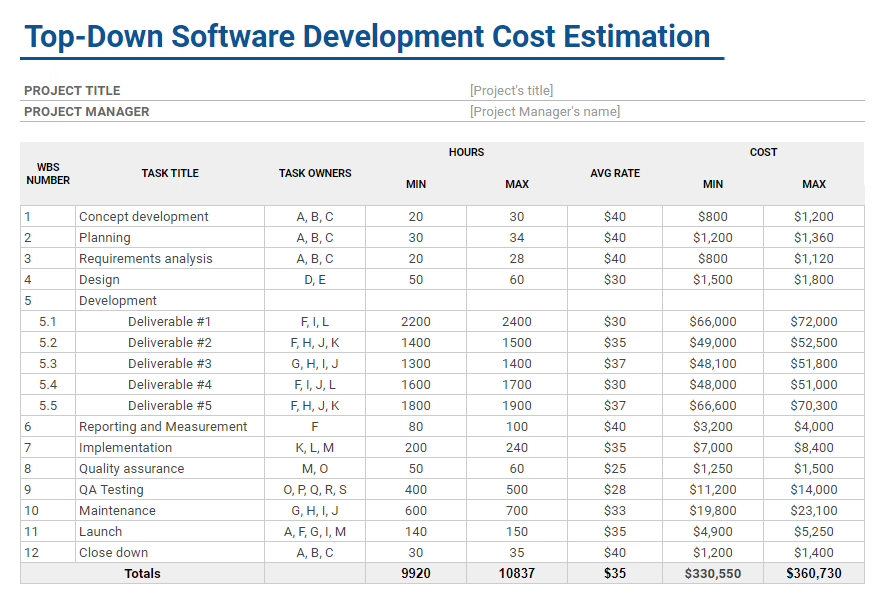
Integrations typically consume 10% to 15% of a project budget, and each one costs somewhere between $3,000 and $10,000. Stripe looks simple in the docs. It is not simple when you factor in webhooks, refunds, disputes, subscription state, tax handling, and the retry logic for the day their API has a hiccup. Multiply that by Salesforce, HubSpot, a KYC vendor, an internal ERP, and you have found where a “$50,000 project” turned into $120,000.
Scope every integration as a line item. If your vendor has not, ask why.
Compliance and security
Regulated sectors add another 10% to 15% for compliance work, and often much more. SOC 2, HIPAA, PCI, and GDPR are not features you switch on. They are structural constraints on your architecture, your data model, your logging, and your operations. The application security market is on track from around $41B in 2026 to $66B by 2031 (MarketsandMarkets), growing at roughly 9.9% a year. That is a recurring cost, not a one-time line.
Maintenance and total cost of ownership
Plan on 15% to 25% of the build cost per year, forever. A $100,000 build usually needs $15,000 to $25,000 annually to stay secure, patched, and adapted to changing APIs. AI-heavy systems trend toward the higher end of that range because models, prompts, and evaluation pipelines drift.
Hidden costs beyond the quoted price typically add another 25% to 50%: hosting spikes, data migration, monitoring, security reviews, content, and DevOps. This is the number most quotes leave out. It is also the number that decides whether the project is worth doing.
Contingency
Around 70% of software projects exceed their initial estimate. Practitioners across Reddit, LinkedIn, and agency post-mortems recommend a 20% to 30% contingency reserve as standard. Not as pessimism. As arithmetic.
Realistic Ranges by App Type
Ranges are only useful if you know which room in the house you are pricing. These are the ones we use when we open a planning conversation.
| App type | Realistic range | Typical timeline | Where budget goes |
|---|---|---|---|
| Focused MVP | $20,000 to $80,000 | 2 to 4 months | One core workflow, one or two integrations, minimal admin |
| Mid-market business app | $80,000 to $200,000 | 4 to 8 months | Multiple roles, real backend, reporting, three to six integrations |
| Multi-tenant SaaS platform | $150,000 to $400,000+ | 6 to 12 months | Tenancy, billing, permissions, onboarding, admin, roadmap beyond v1 |
| Client portal or dashboard | $80,000 to $250,000 | 4 to 8 months | Data cleanup, role-based access, reporting, integrations |
| Enterprise SaaS with compliance | $500,000 to $1.5M | 9 to 18+ months | SOC 2 or HIPAA, audit trails, high availability, security tooling |
MVP does not mean cheap. It means focused. A $30,000 MVP that proves a paying customer wants the product is a better investment than a $120,000 build that hedges across three audiences. The MVP development cost guide goes deeper on where teams save money without cutting quality.
For dashboards and internal portals, the visible UI is rarely the hard part. The hard part is the data model behind it. We see this repeatedly in portals and dashboard development: two weeks of engineering can go into cleaning a “simple” data source before a single chart renders correctly.
How AI Is Changing the Floor (Not the Ceiling)
The AI shift is real for standard builds. Groovy Web reports fintech deliveries that used to run $200,000 to $500,000 over 6 to 12 months coming in at $60,000 to $150,000 in 8 to 14 weeks with AI-first workflows. Solo practitioners on X regularly show $550 builds of things that would have quoted at $4,000 to $5,000 two years ago. Andrej Karpathy has called modern web dev “IKEA plumbing”: auth, database, payments, monitoring, and CI/CD stitched together from off-the-shelf parts.
The catch is that AI raises new ways to spend money badly. Baytech’s Cost to Serve Software (CTS-SW) metric captures the pattern: teams celebrating higher PR counts and more lines of code while hosting bills spike, review queues blow past 24 hours, and “vibe-coded” apps break under real load. A viral launch that lands a $10,000 Vercel bill is not a success story. Neither is auth stored in localStorage or unvalidated Stripe receipts.
The way to actually capture the compression is to change measurement. Measure business outcomes and cycle time to reliable feature, not activity. Keep human review gates. Invest in test automation and observability. AI moves the floor down. It does not lower the ceiling on quality-critical work, and mobile, complex integrations, and compliance-heavy builds still command premium pricing.
Where the Money Actually Goes
A useful budget allocation, drawn from practitioner data:
- Discovery and planning: 10% to 15%
- UX and UI design: 15% to 25%
- Engineering: 40% to 55%
- QA and testing: 15% to 20%
- Contingency: 10% to 20%
The number to protect is discovery. Buyers who invest 10% to 15% of their budget in a proper discovery phase routinely spend less overall than those who skip it. Skipping discovery is the most cited root cause of overruns in every source we reviewed. That is not an agency talking book. It is what practitioners on Reddit, Hacker News, and X all say when they compare projects that shipped against ones that died. Refact’s product discovery process exists for exactly this reason.
Buyers who invest 10% to 15% of their budget in discovery routinely spend less overall than those who don’t.
Freelancer, Agency, In-House, or No-Code
Delivery model changes the number meaningfully.
Freelancers typically deliver equivalent scope at $10,000 to $40,000. The risk is coverage: one person doing product, design, backend, frontend, DevOps, and QA. It works for small, well-defined jobs. It falls over when the project needs simultaneous specialties or continuity across a long timeline.
Agencies price at $20,000 to $150,000 and up for the same scope, because they include product management, QA, design, DevOps, and a delivery process. Whether that premium is worth it depends on how much of your own time you have to give the project and how much risk you can afford. A useful frame here is our guide on outsource web app development.
In-house teams are the highest lifetime cost. A single senior engineer in the US usually costs $180,000 to $250,000 fully loaded per year. Justified when the product is your core business. Overkill when it is one of five things you need to build this year.
No-code is genuinely useful for prototypes, internal tools, and admin backends where scale is bounded. It hits a ceiling once you need custom workflows, non-standard permissions, or performance guarantees. The “build twice” penalty when a no-code app has to be rebuilt as a real application typically wipes out the original savings.
What a Real Project Looks Like

An example from our own work. Pruneyard Cinemas needed an online ticketing platform, but a custom SaaS build with payment processing, seat maps, and showtime management is a $200,000+ project for a single-screen independent cinema. That math does not work. The answer was not to force the wrong scope. It was to structure the product so the underlying platform could serve other small theaters over time, spreading the real cost across more than one operator.
That kind of decision is what discovery is for. Not “how do we build this cheaper.” “Is what we are about to build the right thing at all.”
How to Get a Quote You Can Actually Trust
A few concrete practices that separate a useful quote from a hopeful one.
Get three to five detailed quotes broken down by phase. Not lump sums. Ask each vendor for discovery, design, engineering, QA, integrations line-item, compliance line-item, and post-launch support as separate numbers. Compare where they differ. That comparison teaches you more than the total.
Insist on milestone-based contracts with an explicit change-request process. Not open-ended time and materials. Not fixed-fee for undefined scope. Milestones with per-screen approvals and priced change requests are how projects stay honest.
Ask specifically about integrations and compliance. If the vendor cannot name each API they will integrate and give you a rough per-integration cost, they have not scoped the project. They have guessed it.
Reserve 20% to 30% contingency. Do not tell the vendor about it. That is your reserve for the unknown unknowns that show up in month four.
Budget maintenance from day one. If the proposal does not mention what happens after launch, the proposal is not finished. This is where our guide to software development cost estimation spends real time.
If your app also carries multilingual content, there is another cost layer worth understanding early. This breakdown of translation costs for developers is a useful primer on the CI/CD side of localization that quotes rarely include.
The Cheapest Version Is Usually the Wrong One
The lowest quote is almost always the most expensive project. Not because low-cost vendors are dishonest. Because they are pricing what you said, not what the product actually needs. The gap gets paid for later, in change requests, rewrites, missed launches, and the quiet cost of a product that never quite works.
Controlling cost demands a certain ruthlessness with scope, an honest approach to integrations and compliance, discipline in the discovery phase and a realistic view of what maintenance will entail. In the end, the figure is not as important as having a plan that can stand up to reality.
When it comes time to put a defensible budget around a rough concept, Refact’s discovery process is there to lend a hand with the scoping. Our preference is to be of service in keeping your total spend down rather than simply putting forward the largest number we can.
Building a product and unsure what to scope first? Let’s talk. Free 30-minute call, no pitch.

Saeedreza Abbaspour is the CEO of Refact, where he works across product, engineering, and sales. He sets the studio’s direction while staying closely involved in the work itself, from shaping product strategy and UX architecture to helping define the technical systems behind Refact’s projects. His role connects business thinking with hands-on product execution, giving him a practical view of how software should be planned, built, launched, and improved. At Refact, Saeedreza focuses on building a studio that can move quickly, solve real client problems, and turn ideas into reliable digital products.
More from Saeedreza Abbaspour

