Multi-Tenant SaaS Architecture: A Practical Guide
You will not find the source of most cross-tenant bugs in a SaaS product to be an absent WHERE tenant_id = ?.


Multi-tenant SaaS architecture is an operational discipline as much as anything else; it is not simply a matter of what you do in the database. It is something that should inform every log line, job and request path. We have put together this guide to cover the isolation models and failure modes you will encounter in production, and the kind of thinking required to ensure a shared platform does not turn into a liability after an enterprise customer comes on board.
What Multi-Tenant SaaS Architecture Actually Solves
By definition, a multi-tenant SaaS application serves many customers from a single instance and shared infrastructure while keeping each one’s data and identity logically separate. Microsoft’s Azure Architecture Center is clear on it: multitenancy is about sharing components to support SaaS use cases, and the concept is the same no matter your cloud provider (Azure multitenant solution architecture).
The economics are plain. A 2026 report on SaaS modernization estimates a 30 to 40 percent cut in total cost of ownership for a multi-tenant re-architecture over a single-tenant one. You may see practitioner guides claim as much as 50 percent, but the numbers get thin above 40. What is reliable is the direction; the magnitude is a function of your workload.
Savings come down to having one deployment, one upgrade path and a single incident response process. When you add a customer you are adding rows and config, not another stack to manage. For a wider perspective on where tenancy fits in the product decision-making process, see our SaaS application development guide.
Founders make the mistake of regarding “isolated” as a promise their team can uphold manually. It must be a property the system enforces or it will erode with each merge.
The Three Isolation Models, And Which One To Start With
Isolation is a spectrum. In practice it is discussed in terms of pool, bridge and silo.
- Pool (shared schema): A single database and schema with Row-Level Security doing the filtering at the database level via a
tenant_idcolumn. - Bridge (schema-per-tenant): One database, but a separate schema for each customer.
- Silo (database-per-tenant): A dedicated database for the customer.
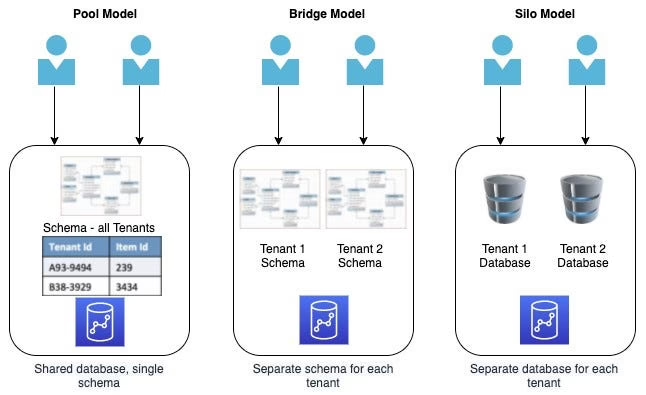
For B2B SaaS, pool is the sensible default. It is how modern platforms operate at scale and is the least expensive to run and migrate. But if your only line of defence is application code, it is also the riskiest.
Bridge may seem tidier but it is not. Migrations become an exercise in going through every schema, reporting across tenants is clumsy and your tooling has to be aware of the split. It is worth it in a narrow band where compliance requires more separation than the ARPU would warrant for a full silo.
Then there is the silo, reserved for whale tenants, white-labels or regulated workloads with contracts that demand a dedicated database. The overhead scales with the number of tenants so you do not scale into this model; you offer it as a tier.
At any real scale the end-state is hybrid. Shopify has some two million merchants on shared, sharded infrastructure. Salesforce puts 150,000 orgs in regional pods with Hyperforce for data residency. Neither is purely one thing or the other; they have put in the work early to create a promotion path. Our multi-tenant architecture guide looks at the revenue and tenant-count thresholds where planning for that promotion is called for. In short, put tenant_id on every business object from day one. Trying to retrofit it later is painful.
Row-Level Security Is Necessary, Not Sufficient
Cross-tenant data leakage is the failure mode everyone talks about. Isolation is left to convention in the app code, a developer omits a filter or a new endpoint is cobbled together from an old one with a bug, and a customer is looking at someone else’s records.
In Postgres the answer is Row-Level Security. Set up a policy to filter on a session variable for the current tenant and let the database do the work. An app bug that misses the filter is rendered a no-op rather than a breach.
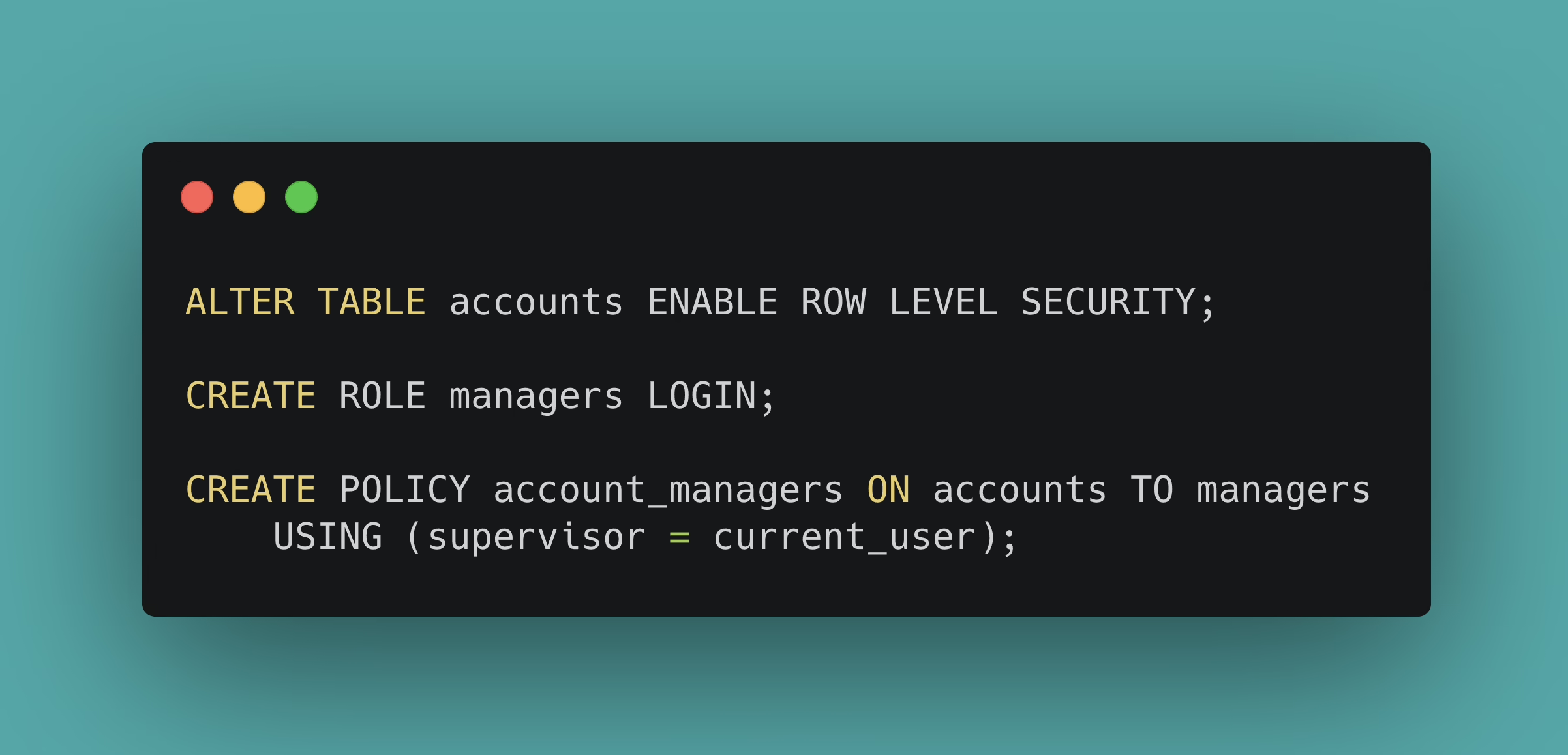
RLS is not foolproof, however. It depends on session state and connection pools will reuse sessions. If a pooled connection brings the last request’s tenant context with it, RLS will be protecting the wrong customer. The remedy is per-transaction context:
SELECT set_config('app.current_tenant_id', $1, true);With the third argument set to
true, the setting is scoped to the transaction and the context is gone when it is done.
Your CI should have integration tests that spin up two tenants, authenticate as one and attempt to read the other’s rows from every entry point in the app. The assertion is that the database gives you nothing. Do not leave this to a quarterly audit. And if you are deciding between Postgres and another engine for the job, we compare how RLS and the tooling around it factor into that choice in our PostgreSQL vs MySQL guide. ZZBLOCK5ZZ
You will find that much of the public discourse on multi-tenancy is limited to the database. But that is not where the bugs tend to be. The more difficult task is to ensure tenant identity stays with a request as it makes its way through your system.
Think of it this way: tenant identity is a first-class domain constraint. It must be put in place at the edge and then propagated from there. WorkOS puts it plainly in its developer guide to multi-tenant SaaS: you make authorization decisions within the tenant boundary, not on a global level.
In production incidents the failure points are always the same:
- Background jobs. A worker may pick up enqueued work hours after the original request has put the tenant in scope, only to do so without the proper context. It can run against the wrong customer or a database with RLS left open.
- Cache keys.
user:42:profileseems fine until you have two tenants with a user 42. You need the tenant in every key, and a helper should enforce that pattern rather than relying on memory. - Object storage. A signed URL that is scoped to a bucket and not a tenant prefix is a leak in the making.
- Analytics. Between extract and dashboard, warehouse pipelines mirroring the OLTP schema have a habit of losing the tenant filter.
- Shared OAuth tokens. Scalekit’s case study tells of an isolation incident from a single GitHub token being used by multiple tenants; they had to put in place tenant-scoped agent identities with IAM to correct it.
Do not trust a client-set header or a URL parameter for the tenant ID. Resolve it once at the API boundary from a JWT claim you can verify and put it in the request context for downstream use. Good middleware will refuse to let a handler run if there is no active tenant, which saves you from having to fix those bugs in production.
Noisy Neighbors Are An Architectural Symptom
Then there is the noisy neighbor. Whether it is a batch import or an integration that hammers an endpoint, one tenant can degrade the platform for the rest. If the plan is to “scale later,” an incident will get to you before the autoscaler does.
Toast ran into this when large restaurant chains put too much load on shared services and took down smaller tenants. They put in per-tenant concurrency limits and circuit breakers to handle it. Shopify has done the same with sharded databases and per-merchant caching to keep a Black Friday surge from stalling the platform. DevOpsSchool covers the same ground in their field notes on designing systems that can take the scale.
Put these controls in place ahead of time:
- Rate limits at the gateway, tiered by plan.
- Concurrency caps for any expensive background workers or endpoints.
- Cache keys with the tenant namespace to prevent one customer’s eviction pressure from flushing another’s hot data.
- Circuit breakers and query timeouts to stop a report from holding a connection forever.
- Composite indexes on
(tenant_id, ...)to keep query plans stable as the big tenants get bigger.
Observability is just as important. An aggregate spike on an incident dashboard is of little use if you cannot tell whether all your customers are affected or just one. Sentry or Datadog can be set up with tenant tagging for that. It also paves the way for usage-based billing down the line, something that is more relevant now with AI agents calling APIs at a pace human users never could.
Migrations And Deploys Are Where Blast Radius Bites
A table lock of two minutes is a minor annoyance for a single customer but an outright outage for a thousand. What distinguishes a mature multi-tenant platform is not some clever architecture but a certain amount of boring deploy hygiene.
- Keep app deploys and schema changes separate. Ship the code that needs the migration only after you have run and verified the migration itself.
- Rely on online DDL. Tools like
pg_repackorgh-ostwill add or modify structure without the long locks. - Blue-green with a side of tenant awareness. Move traffic over in increments, one percent of tenants, then five. Sharded databases and regional pods allow for it.
- Make sure you can reverse course. Every script should have a rollback you have tested. In one PropTech case, a hybrid migration in week eleven brought median API response down from 420ms to 155ms with no data loss after eighteen months of cross-tenant leaks. The safety of the cutover was due to the reversibility of the path.
The same applies to automated provisioning. A control plane with defined states – Pending, Provisioning, Active and so on – is the difference between a support ticket and onboarding a new customer in a matter of minutes.
The Small Things That Cause Big Incidents
Some patterns come up in practitioner forums with enough regularity to warrant a section of their own.
Unique constraints. An early mistake is to put UNIQUE(name) on a table when it ought to be UNIQUE(name, tenant_id). The second tenant will not be able to create a record with a common name. Easy to fix in hindsight, costly after go-live.
RLS role confusion. With Postgres, whether the connecting role is a superuser or has BYPASSRLS makes a difference to how RLS is applied. When a policy is not working, the problem is usually in the role.
In-house billing. The consensus is to leave metering to a specialist like Stripe and instrument your events. Trying to build aggregation, proration and dunning from scratch will eat up more engineering time than most teams think.
Over-customization. Saying yes to every enterprise ask ships a per-customer branch of the product that quietly disables multi-tenancy. The moment the same feature request comes in twice, promote it into a tiered configuration instead of a fork.
Deciding What Your Product Actually Needs
The decision framework is short. Answer these honestly.
- Compliance surface. If HIPAA, PCI, or specific data residency rules apply to a segment of tenants, plan for a silo tier from day one, even if no current customer needs it.
- Tenant mix. A long tail of small tenants points to pool. A short list of large enterprises points to hybrid with promotion criteria written down.
- Customization pressure. If prospects routinely ask for behavior no other customer needs, tiered configuration and feature flags will absorb more of that than a separate deployment ever will.
- Team capacity. Silo tenants demand backup, migration, monitoring, and incident coverage per database. If the team is three people, that math dominates the architecture.
The trap is treating multi-tenancy as a launch decision rather than an evolution. Put tenant_id everywhere on day one. Enforce RLS in your Postgres schema. Propagate tenant context through jobs and caches from the first sprint. Delay hybrid tiering until a real customer justifies it, and then design the promotion path once, cleanly. Faberwork’s field notes on managing technical debt apply directly here: the cost of retrofitting isolation grows faster than the codebase does, and cleanup work rarely gets funded until it is expensive.
Signiant frames the shared-infrastructure benefit as one rollout, one fix, one monitoring surface for all customers (the benefits of SaaS multi-tenant architecture). That is real, but the benefit only lasts as long as every layer carries tenant context faithfully. The moment one layer stops, the savings turn into support tickets you cannot reproduce.
If you are trying to decide the tenancy model before you commit to it, the most useful work happens before the first schema is written. That early clarity is exactly what our SaaS MVP development guide and discovery process are built to settle. Getting the tenant boundary right the first time is cheaper than any rewrite that follows.
Building a product and unsure what to scope first? Let’s talk. Free 30-minute call, no pitch.

Masoud Golchin is a backend developer at Refact, working on server-side systems, internal tooling, and infrastructure. He builds and maintains the services that support both client projects and the team’s day-to-day development workflow. His work includes backend logic, developer tools, system reliability, and the technical foundations that allow products to scale and operate consistently. At Refact, Masoud focuses on creating practical engineering solutions that help the team move faster while keeping systems organized, maintainable, and dependable.
More from Masoud Golchin

