Continuous Product Discovery for Founders
The excitement after a product launch is usually gone within three weeks.


This is what draws startups to the practice of continuous product discovery. They see it as a way to learn what features customers actually need to assist them in making less expensive development bets. Continuous product discovery does not require the creation of a dedicated customer research team. It requires a consistent customer feedback channel and a couple of assumptions that you and your team have to establish collectively. This article will help you understand how to do that.
Why Your Pre-Launch Roadmap Stops Working
Your pre-launch development roadmap was not haphazard. It was developed from interviews with your potential customers, market research, a little bit of instinct, and the hypotheses that you had not validated with potential customers. Within a week of launch, that context shifts: customers surface different problems, use features in unexpected ways, and ignore ideas that seemed obvious on paper.
Most people fall for this trap. As you have learned, shipping something is not the same as learning. A feature should be shipped to enable a learning opportunity. The true learning comes from watching how customers actually use the feature, asking them what happened, and adjusting your next decision based on what you find. After launch, don’t try to answer the question of how fast you can build the next feature. Answer the question of how quickly you can validate your next assumption.
It’s not about drive or speed of development. It’s about knowing which opportunity to select. A weekly discovery loop helps keep that question active. Betting the wrong way is okay since it’s still small enough to absorb. If you’re working through this at an earlier stage, the same suggestions are in our notes about the MVP development process.
What Continuous Product Discovery Actually Means
Teresa Torres popularized the term continuous product discovery, and it essentially means that each week, small chunks of user research are performed by product builders. This replaces one big upfront research phase with a repeatable weekly habit of learning from customers. A product discovery team very likely consists of a founder (or CEO) of the company as well as a product manager, designer, engineer, and/or customer support. For very small two-person teams, it will be the founder and the product builder. For continuous product discovery, check out Maze’s guide on the subject here.
A useful weekly loop has five parts:
- Choose one customer outcome.
- Identify the most important assumption by prioritizing which assumption is the biggest risk.
- Talk to customers or observe behavior.
- Record the signal in one shared place.
- Make a small decision before you add code.
The old process looked like a big discovery project followed by a handoff. A research team would produce a document, deliver it to engineering, and move on. Replace that big discovery project handoff with a rolling conversation and small tasks. The goal is to reach more informed decisions with less wasted effort.
You do not need a perfect research script. You need a reliable cadence and a clear rationale for each conversation. When interviews are not the only valuable signal, our list of user research methods provides other useful alternatives, ranging from usability studies to behavioral analytics.
The Four Risks a Weekly Loop Is Built to Reduce
Every product idea entails many different types of risks. Discovery works when your team helps assess the risks before any code is written, and prioritizes the simplest first check of the riskiest idea. The dual-track agile methodology for this is very deliberate: the discovery track is used to determine if an idea is worth the effort to build it, while the delivery track builds the idea if it is determined to be useful. The four risk types most product teams identify are value, usability, feasibility, and business viability. RoadmapOne and others use a similar framework, and the mechanics are described very well in this 2026 guide to dual-track agile.
| Risk | Example | Lightest signal |
|---|---|---|
| Value | A SaaS dashboard has many charts, but customers only want one alert | Ask users how they currently monitor the problem |
| Usability | Shoppers struggle to complete an address field on mobile | Watch a short checkout test |
| Feasibility | A publishing feature needs a large build before demand is clear | Test the workflow with a prototype or manual service |
| Viability | A popular feature fits one customer but damages the pricing model | Discuss the use case across customer types and plans |
Value risk is primarily concerned with the importance of the problem and whether or not it will lead to behavior change. A dashboard designed with many complex features and technologies can still fail if people never use it. Even a simple conversation with the audience might explain that they want an automated reminder and/or alerts sent to them, not more dashboards.
There is usability risk where people can’t follow through on the steps to achieve the outcome. Identify where people hesitate, and where there are misinterpretations and attempts. For the builder, feasibility is a concern, but it shouldn’t be an excuse to build prematurely. A manual workflow, clickable prototype, or even a fake door can show whether demand exists before the team commits to a large implementation. Viability is the intersection of customer value and the business model. A feature can surprise or delight one power user, but confound the rest of your user base with cost implications and pricing confusion. Your weekly loop should test if your idea works for the business you intend to run, not just satisfy your ‘best’ customer.
A Monday-to-Friday Rhythm for a Two-Person Team
To deliver, a small team needs a tailored process. If discovery spins up a new department, a lengthy research plan, and endless meetings, it won’t survive the next release.
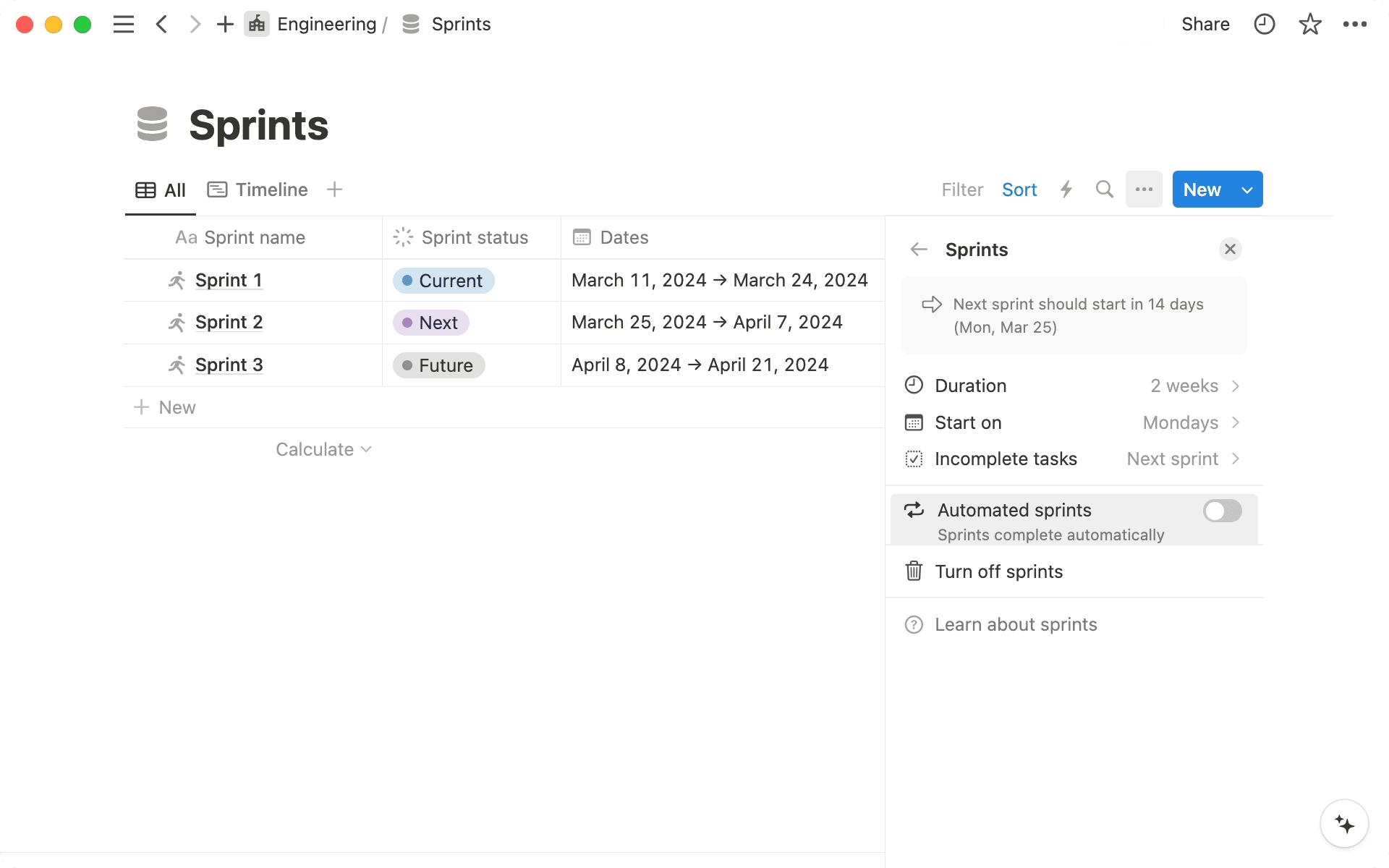
Monday sets the question
Groom a shared opportunity backlog in Notion for 30 minutes, and cap it at 7 opportunities. Tag each opportunity with the assumption it tests, and pick the one most likely to change your next course of action.
Tuesday and Wednesday bring customer evidence
Two conversations, each under 20 minutes. One founder listens. The other takes close to verbatim notes in a tagged document. Ask about a recent event: what prompted the search for a product, or how they tackled the task before. Do not ask if they would use a hypothetical feature. Practitioners follow this rule for a reason. Om Patel, in his write-up about early product mistakes on X, said that talking to ten actual users fundamentally changed the way he thought about the roadmap. Ten is just a warning that talking to people matters more than any survey.
Thursday turns notes into choices
Allot 45 minutes for the group to capture what they heard under the headings value, usability, feasibility, and viability. Review the backlog against those signals. If the discussion runs long, trim the backlog rather than letting the meeting run over.
Friday records the decision
Set aside another 30 minutes for a decision-making meeting. Produce three outputs:
- Keep: continue testing, prepare the item
- Kill: remove the item, evidence was not strong enough
- Reshape: test framed with a different audience, approach, or problem
Conclude the meeting by naming one assumption and what next risks you would test in your product. The single artifact clarifying the week’s work should be a one-page memo with the hypothesis, evidence, decision, and action.
Lightweight Tools by Product Type
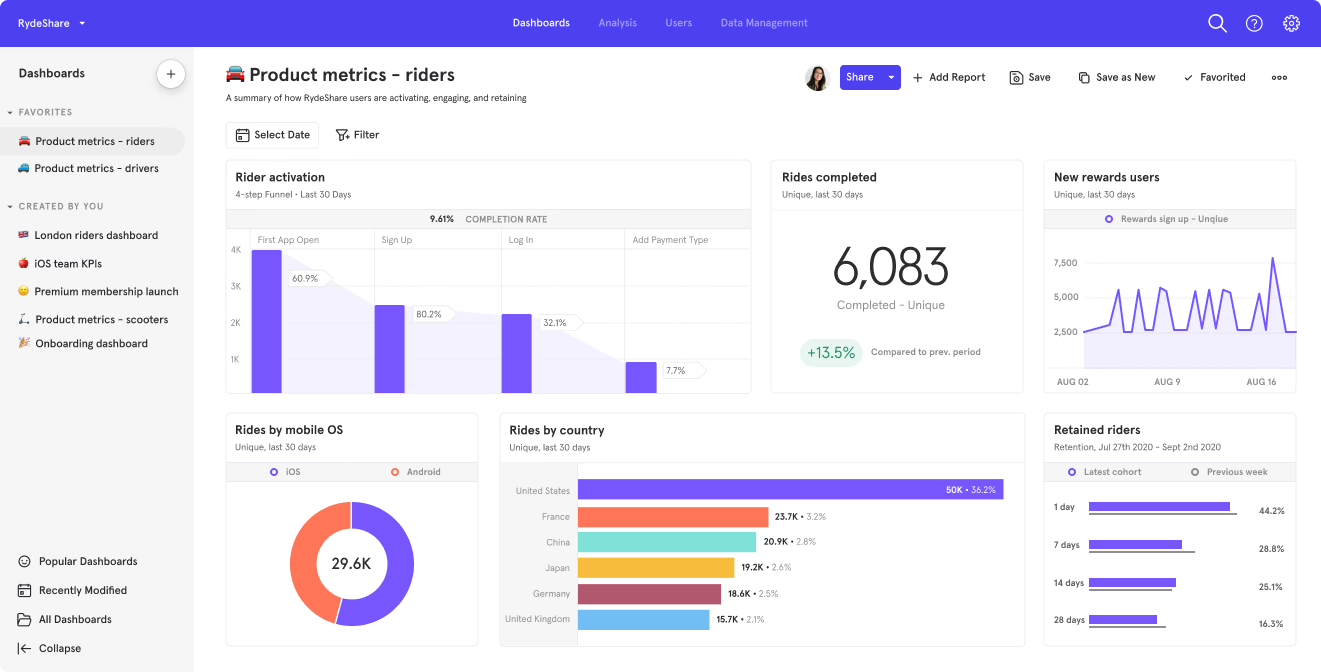
Tools should be matched to the product, and the question. A two-person team will likely need two conversation recording tools, an analytics surface, and one writable artifact. More tools don’t help, they create more black holes for insight to get lost in.
| Product type | Conversation tool | Behavior analytics | Weekly artifact | Recruiting source |
|---|---|---|---|---|
| SaaS | Calendly and customer calls | Mixpanel or PostHog | Notion memo | Active users and support contacts |
| Ecommerce | Customer calls and Hotjar recordings | Hotjar and store analytics | Google Sheet | Recent buyers and abandoned carts |
| Publishing | Typeform and reader calls | Chartbeat or Plausible | Trello board | Newsletter readers and subscribers |
For a SaaS product, connect what you hear in customer interviews to actual product behavior in Mixpanel or PostHog. “I never know what to do next” becomes more actionable if you know where users get stuck. For a deeper look at how to analyze data without allowing dashboards to control the product roadmap, you may want to check out this privacy-first analytics for product managers (see the checklist). For SaaS builds in particular, our SaaS MVP development guide provides more in-depth suggestions for the intersection of analytics and discovery before you build product features.
For ecommerce, session recordings on members’ carts and checkout pages often show confusion that customers can’t express. Use Klaviyo or Customer.io to generate segments for recent purchases. Finally, set a simple Google Sheet that the founders and merchandising staff can view to help deliver the weekly updates. For publishing, Chartbeat or Plausible shows which user behavior requires further examination. Typeform collects survey feedback and a public Trello board lets staff see which user questions are being addressed.
Choose tools based on how they answer your question; don’t choose tools based on how they present a mature process. If you’re still piecing together the money side for your product, the resource for filtering investors by stage and sector can help you focus a wide-ranging fundraising question on something you can actually tackle this week.
Five Quiet Ways Small Teams Break the Loop
Just because something is adopted, doesn’t mean it will be practiced. IdeaPlan’s 2023 report notes just 28% of product managers hold 2 or more customer conversations weekly, in their State of Product Discovery 2023. Perspective AI’s report of 300 teams shares a similar sentiment with regard to intention vs. implementation when describing what 300 teams changed in 2023. The discrepancy is execution, not awareness.
Five patterns cause the loop to fade:
- Interview drift. Signs of this include a growing number of proposed feature requests. Replace the open-ended “Would you use this?” request with “What did you do last time this happened?”
- Confirmation bias. If every conversation is with a happy customer, make a recurring slot to talk with a customer who has stopped using the product or never upgraded the product.
- Memo rot. If no one looks at old memos, cap the active archive at 8 weeks and move the old pages out of the working view.
- Ship and forget. Create a 30-day check-in field in the memo to make sure someone follows up on retention, support tickets, or task completion after the product or feature is released.
- The solo loop. If one of the founders conducts all of the customer interviews, then the other founder should rotate roles each week and both need to talk to customers.
Failure is subtle. The meeting on the calendar may signal progress, but the conversation no longer illuminates a path to making a decision. Learn to spot the gap between contact with the user and the activity with the product. More resources for responsibly honest evidence can be found in our resource on product discovery techniques that have proven useful to real teams.
What Changes When the Loop Actually Runs
When we engaged the project management consultant behind Workform, the original brief was for an AI assistant that helps project managers with “everything.” This framing was eventually discarded during the first iteration of the discovery process. Through the blueprint, we refined the scope to an assistant that processes project information from Slack, email, Asana, and meetings, and keeps project managers updated with context. The team did not build less because the vision shrank. They built less because ongoing customer conversations continually exposed which aspects of “everything” would actually be used.
Smaller changes can also make a difference. A two-person SaaS team replaces a quarterly roadmap sprint with a weekly customer discussion. After three of them, they rewrite onboarding copy so that it aligns with the customer’s first real interaction with the product, instead of the features. This wasn’t a big process overhaul, but rather the team stopping arguments from preference and instead deciding based on new evidence. An ecommerce founder reviews checkout session recordings several times a week, identifies a field for the address that is confusing, addresses it, and then checks if the new design made an improvement instead of imagining it was better.
The practical standard follows from that. Measuring discovery should not be about tallying the notes you have. Building evidence should change what you build, how you define it, and what you check after you release it. Four numbers each week should suffice:
- Interview count. Measure customer contact.
- Size of the opportunity backlog. Ensure that unresolved questions do not disappear.
- Assumption-to-test cycle time. This should measure how long an idea gets stale.
- Share of shipped work tied to a recent customer signal. This is about keeping delivery connected to discovery.
According to RoadmapOne’s guidelines on measuring discovery success, two to three validated ideas per sprint, an initial meaningful validation in 5 to 10 days, and a success rate of experiments in the range of 50% to 70% should serve as reference points. These numbers should be treated as arguments to be challenged and not quotas. A small team should focus on productive decisions rather than aim for a lot of work.
Your First Week With This in Place
Do not alter your entire product development process. Use the roadmap you have and expose the assumptions your current roadmap is built upon.
Monday. Block 60 minutes. Write down the three assumptions behind the next planned feature in plain language. An example assumption could be “New sellers cannot complete setup because they do not understand the import step.” This is testable. Assumptions like, “Users need a better experience,” are not testable.
Tuesday and Wednesday. Schedule two customer interviews. Ask what caused them to act in the first place, what they tried last time, and what made the current approach difficult. Do not push them in the direction of your solution.
Thursday. Place all notes in one shared artifact. Confirm, weaken or mark new assumptions. Give the rationale and evidence. Record the smallest next test.
Friday. Allocate 30 minutes to determine what stays, what changes and what goes during the next build cycle. The output is your decision; it is not another research document.
Book the first conversation today with a recent customer who used the product for the issue the roadmap is addressing. Also, create a “Weekly Discovery Memo” one-pager with four sections: hypothesis, evidence, decision, next action. That is sufficient to commence the activity.
Discovery only saves money when it changes the product that is to be built. If you are trying to figure out which assumption to test before the next build cycle, that early decision is exactly what Refact’s product design and discovery work is designed to achieve.
Building a product and unsure what to scope first? Let’s talk. Free 30-minute call, no pitch.

Parnia Sebti is a project and account manager at Refact, coordinating teams, clients, timelines, and delivery across the studio’s work. She helps keep projects organized from planning through execution, making sure communication stays clear and priorities stay aligned. Her role connects client needs with the internal team’s workflow, helping turn requirements, feedback, and moving parts into structured delivery. At Refact, Parnia also contributes to shaping the internal tools and processes the team uses to manage projects more effectively and keep work moving with clarity.
More from Parnia Sebti
