Proof of Concept vs Prototype: How to Pick
Enterprise teams launched an average of 33 AI proofs of concept in 2023.


That is why the proof of concept vs prototype decision matters. It is not a vocabulary exercise. It is a choice about which risk you are paying to retire first, and it decides whether your next 30 to 90 days produce evidence or theater. This guide is written for product leaders and operators trying to make that call without burning the budget twice.
The Real Difference: Feasibility vs Representation
A proof of concept is a bounded experiment. It answers one technical question under stated conditions. Can this model classify the documents accurately enough? Will this integration handle the load the vendor claims? Does this architecture retire the specific risk that keeps engineering awake at night? The output is evidence for a decision, not a product.
A prototype is a representation. It shows how a proposed solution behaves so people can react to it. That might be a clickable interface, a partial working flow, or a hardware breadboard. The output is a shared understanding of shape, workflow, and interaction, which is much harder to reach through slides and documents.
The confusion comes from polish, but polish is the wrong axis. A proof of concept can be sophisticated. A prototype can be crude. What separates them is purpose. A 2016 software architecture paper frames PoCs as short-term experiments with limited scope, not intended for final product use. A 2016 design research paper treats prototypes as broader representations meant to expose behavior, requirements, and usability gaps. Same lifecycle, different jobs.
A practitioner rule that circulates in engineering forums captures it cleanly: a prototype needs its creator nearby to work. A product does not. If a demo only runs when the person who built it is in the room adjusting inputs and restarting services, you have a prototype no matter what anyone calls it.
What Each Artifact Actually Claims
The strongest reason teams waste money on early builds is that they let one artifact answer questions it was never designed to answer. Reframing each in a single sentence helps:
- Proof of concept claim: under these measured conditions, this specific proposition is feasible.
- Prototype claim: this representation exposes how the proposed solution behaves and where its design or requirements fail.
- MVP claim: real users will adopt or pay for this thing in its current shape.
Neither a PoC nor a prototype supports the MVP claim, and neither is production. That distinction is why teams get burned when a working demo is treated as a foundation. The Codilime engineering team, writing about the same overlap, notes that a proof of concept verifies technical execution while a prototype shows how a product will develop. The line is blurry in practice, but the claims each artifact can honestly make are not.
The old split holds and predates modern software. Early computing history is full of feasibility experiments that were never meant to ship, from early transistor circuits to the first packet-switched networks, all captured in this computing history timeline. The engineers who built them knew what their artifacts did and did not prove. That discipline is what is missing when a startup shows a live demo to an investor and calls it an MVP because it looks finished.
The Sequence Most Teams Should Follow
The default order is concept, then PoC, then prototype, then pilot or MVP, then production. Technology Readiness Levels formalize this: TRL 3 is proof of concept, TRL 4 is lab prototype, TRL 5 is prototype in a relevant environment, TRL 6 is system demonstration. Teams working in software rarely use TRL language, but the underlying logic is the same. Retire the biggest risk first, then move to the next one.
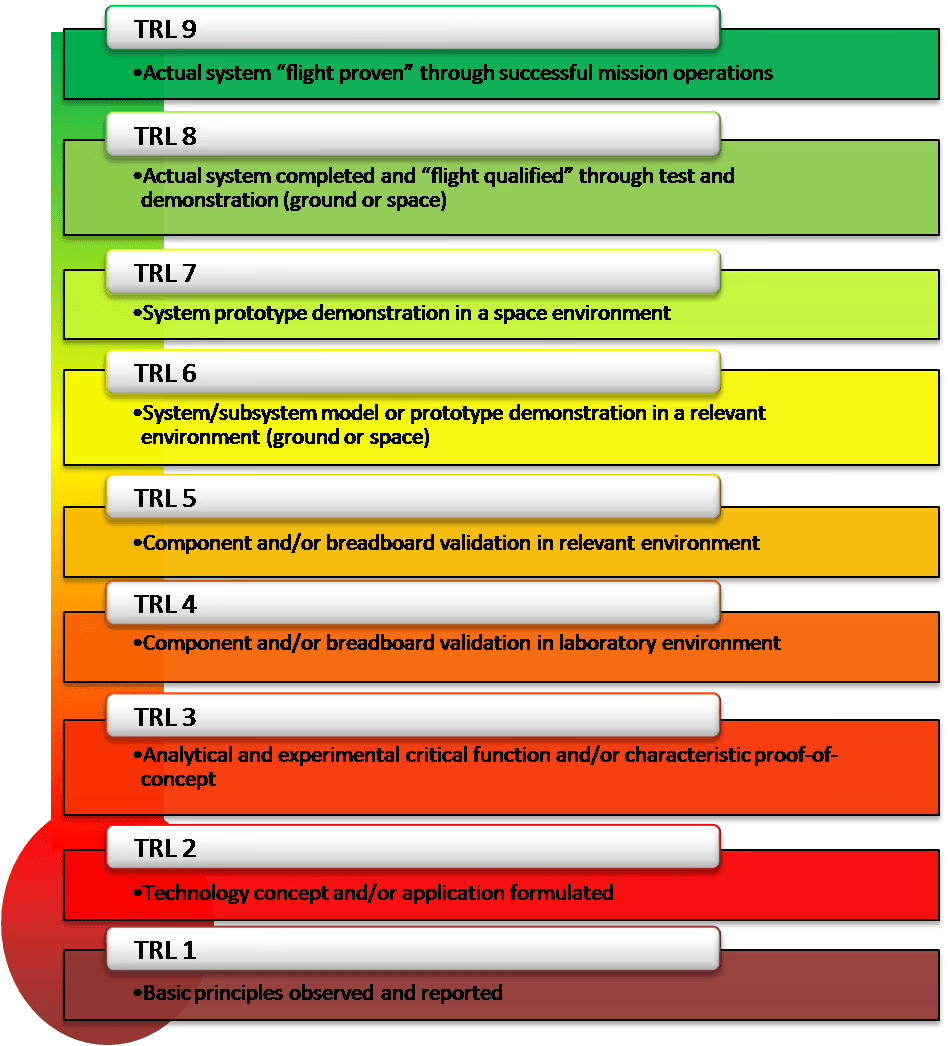
The sequence inverts when user behavior is the dominant risk. If the technology is well understood but nobody knows whether operators will change their workflow, a prototype should come first. Building a technically flawless PoC for a feature people refuse to use is a common way to lose six months. The dominant risk should choose the artifact, not the convention.
A rough decision rule:
- If failure would come from code, integration, or performance, start with a PoC.
- If failure would come from confusion, adoption, or workflow fit, start with a prototype.
- If both risks are material, plan for both, separately, with their own success criteria.
- If neither risk is real and you are testing willingness to pay, you are not choosing between a PoC and a prototype. You are scoping an MVP development process.
Side by Side, Without the Fluff
| Dimension | Proof of Concept | Prototype |
|---|---|---|
| Question it answers | Is this technically feasible under stated conditions? | How does the proposed solution behave for a user? |
| Risk retired | Technical, integration, performance, scientific | Design, workflow, usability, requirements |
| Fidelity | Whatever the test requires, often narrow | High enough to provoke a real reaction |
| Audience | Engineers, architects, technical sponsors | Stakeholders, target users, decision-makers |
| Timebox | Days to a few weeks | One to several weeks |
| Success criteria | Measurable thresholds against a pre-agreed decision rule | Users understand the flow and give evidence about fit |
| Common failure | Works in the lab, cannot survive production constraints | Demo bias hides how the product behaves without its creator |
| Should ship to production? | No, unless engineered for that from the start | Rarely, and only if built as an evolutionary prototype |
For a broader view of how prototyping fits inside a modern product design workflow, Figr’s rapid prototyping guide covers the main modes. Asana’s overview of how a proof of concept is scoped lays out the same feasibility framing from a project management angle. Both are useful references for anyone building alignment across a team where “prototype” and “PoC” mean different things to different people.
Why “Successful PoC, Failed Deployment” Keeps Happening
The most damaging failure pattern in early-stage builds is a PoC that clears its technical bar and then dies on the way to production. The reasons are almost never about the technology.
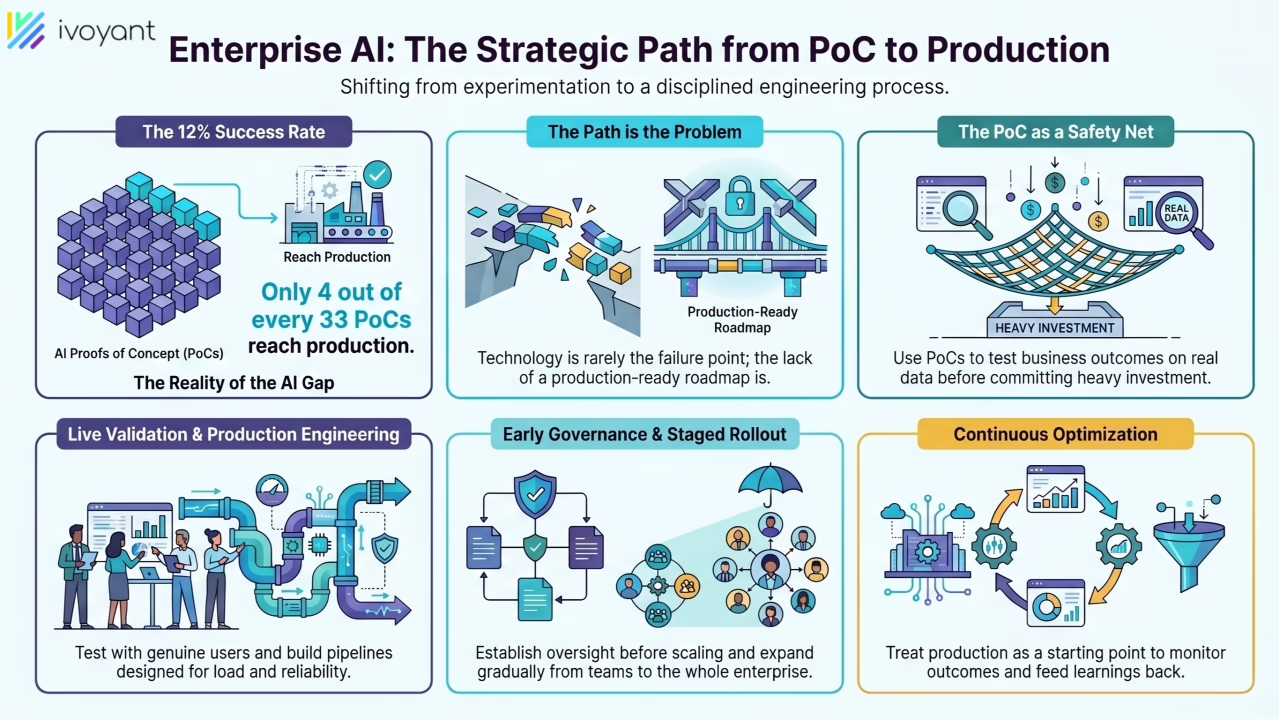
An openPR summary of a 2023 enterprise AI survey reported that 83% of enterprise AI projects that passed proof of concept failed to scale, with the majority of failures attributed to infrastructure and data readiness rather than model quality. That figure lines up with the IDC, S&P, and MIT NANDA numbers cited earlier: the drop-off is real, and it compounds the further you push past feasibility toward adoption and revenue impact.
The common causes are consistent across research and practitioner discussions:
- Environment mismatch. The PoC ran on synthetic data, dev credentials, and unconstrained compute. Production has real data, real identity, real logging, and real latency.
- Hidden human labor. Engineers manually repaired inputs, reviewed outputs, and restarted services during demos. The cost model quietly assumes those humans stay.
- No owner for the second half. Nobody was assigned to procurement, security review, change management, or incident response. The demo works. The operating system around it does not exist.
- Vendor lock-in by accident. The PoC validated one vendor’s specific path rather than the underlying capability, and reversibility was never tested.
- Success criteria that shifted. “Explore AI” or “improve productivity” was allowed to stand in for a measurable threshold. Sunk cost then drove the next decision.
The fix is unglamorous. Before building anything, write a decision rule. Define what would count as pass, what would count as pivot, and what would count as kill. Set a kill date. Assign owners for data contracts, model performance, error accountability, and post-PoC hardening funding. Test the production constraints that could invalidate the result, not the production system itself. A well-run PoC with a “no-go” outcome is a success if it prevents six months of wasted engineering.
How Refact Runs This in Practice
Most projects that come to Refact arrive as a mix of technical and human-centered risk, and the first job is separating them. We ran that separation on Workform, an AI assistant for project managers. The initial concept was broad: an assistant that helps with “everything.” Through discovery, the scope narrowed to a specific feasibility question about ingesting and connecting data from Slack, email, Asana, and meetings. That was a PoC in everything but name. Only after the technical claim held did the work move into a prototype and MVP that real project managers could react to.
The pattern was different for CinemaAssist, an independent cinema ticketing MVP. The technology was well understood. Payment processing, seat maps, and API integration are not the risky part. The dominant risk was operational: whether a small theater team could actually run online ticketing without a support burden they could not staff. That called for a prototype-first approach around the operator workflow, not a feasibility PoC.
The takeaway is not that one project used a PoC and one used a prototype. It is that the artifact was chosen from the risk, and the scope was set to answer one question at a time. If you are shaping this decision inside your own team, our writeup on the product discovery techniques that actually work covers the methods we use to pull the real risk out of a fuzzy idea, and the digital product design process guide shows how prototype fidelity gets matched to the decision at hand.
Practical Rules to Keep the Scope Honest
Whatever you build first, a small set of habits keeps it useful:
- Write the decision before the build. One page. Hypothesis, evaluation method, threshold, timebox, kill date, decision after pass or fail.
- Use real data. Curated sample data will make almost any PoC look good. Real data reveals missing fields, permission problems, and label quality issues while there is still time to react.
- Involve the frontline. Discovery interviews with managers and sponsors produce the wrong bottleneck. The people who actually perform the work know where the exceptions and workarounds live.
- Test the failure paths. Malformed input, timeouts, adversarial input, drift. A demo tuned only for the happy path is not evidence.
- Keep humans in the loop where consequences are real. For financial, legal, customer, or operational decisions, design escalation as a measurable workflow, not a footnote.
- Match fidelity to the risk. A high-fidelity visual mockup tells you nothing about backend performance. A working backend tells you nothing about whether users understand the interface. Build both, separately, when both risks are material.
When to Bring in a Partner
If you are still weighing the proof of concept vs prototype question, do not ask a studio to build “the thing.” Ask them to help you name the risk, choose the artifact, and set the decision rule. That is a very different conversation than a fixed-scope quote, and it is the conversation that saves the budget.
For teams comparing outside help, Moonb’s roundup of Superside alternatives is a useful frame for how design-heavy delivery models differ from product-led ones. When the work needs to move from validation into actual build, our guide on how to hire a product development team covers what to vet, what to skip, and what usually goes wrong. Refact’s own product design and AI development engagements start with the discovery work that decides which artifact you actually need, and that phase carries a money-back guarantee so the first commitment is a decision, not a build.
The reason the proof of concept vs prototype question keeps burning teams is not that the definitions are hard. It is that the pressure to show progress makes it easier to skip the decision and start building. The teams that avoid the trap are the ones who spend a day writing down what would count as evidence before they spend a month producing any.
Building a product and unsure what to scope first? Let’s talk. Free 30-minute call, no pitch.

Parnia Sebti is a project and account manager at Refact, coordinating teams, clients, timelines, and delivery across the studio’s work. She helps keep projects organized from planning through execution, making sure communication stays clear and priorities stay aligned. Her role connects client needs with the internal team’s workflow, helping turn requirements, feedback, and moving parts into structured delivery. At Refact, Parnia also contributes to shaping the internal tools and processes the team uses to manage projects more effectively and keep work moving with clarity.
More from Parnia Sebti
