How to Hire Virtual Assistants in 2026
Most owners mistakenly assume that hiring a virtual assistant is a sign of business growth.


The cheap hires and failed VAs of 2018 failed for the same reasons they fail today. The old advice does not apply to the new landscape of the virtual assistant market. The strongest predictor of a successful hire has less to do with the candidate, and more to do with whether you have clearly defined workflow instructions. This article will describe how to outline what workflows you should consider delegating, where to source those assistants, how much you should expect to pay, and how to keep your new hire from becoming a second full-time job for you.
Hire the Workflow, Not the Person
Most failed VAs are the result of the same operations. An entrepreneur opened a marketplace, someone posted an unstructured support position, and a candidate was hired. Three months later the founder was doing more work than before because they now spent half their week rewriting instructions the VA could not figure out on their own.
The pattern happens among different accounts. On X, entrepreneur Alex Hillman noted in late 2025 that he spent well into the five figures on unsuccessful VA hires before finding a system that yielded roughly a 10x return. He did not consider this finding the “right person.” Hillman’s conclusion was that process is actually the prerequisite to hiring, not the other way around. Another poster with a failed VA outreach hire put it more impolitely like this: “the system was the problem, not her.”
This is move one. Before posting a job or opening an agency intake form, document the workflow first. If you can’t express a task in plain language, a person and software will fail to perform the task consistently. The reason to hire is that you have a documented, repeatable task that is consuming time you could potentially be using to sell, work on the product, or hire more.
Working rule: A task that doesn’t need your judgment, relationships, or signature falls under the delegation list. If it’s not documented, it’s not ready to be delegated.
The market has developed in that direction. Wishup’s report on the 2026 Virtual Assistant industry estimates that the VA services market, driven by administrative, executive, and specialized functions, will grow to around $5.3B in 2025 and to $6.5B in 2026. Independent outsourcing benchmarks in Virtual Assistant VA’s 2026 guide indicate the same core use cases: email, calendar, CRM, research, customer service, bookkeeping, and content drafting. It is no longer an alternative or edge case. This is now well-established business technology, and the mistakes are well documented.
Decide AI, Human, or Both Before You Hire
For 2026, the question is not, “Should I hire a VA?” The question is, “What should be done by AI software agents, and what by a human.” If you skip that question, you will end up spending $500 for work that can be done by an AI for $30, or asking an AI to exercise judgment that, when done incorrectly, will result in losing customers.
The honest answer is that tasks involving clear inputs and/or rules, like inbox sorting by label, data entry from filled-in forms, extraction of data from invoices and content drafts, are handled best by software. Examples of tasks that should be handled by a person are judgment, exceptions, relationships, oversight, and AI output. Traditional VAs are being replaced by “AI operators” or “workflow orchestrators,” and training companies like MyOutDesk have adjusted their training to reflect that.
A position worth evaluating holds that an affordable VA at around $19/hour can be better than AI tool spending for most small operators, particularly with a messy workflow. This is understandable when work tasks are more spread out, and the owner has not mapped out the workflow. In those cases, a VA will absorb the mess more cheaply than automation would.
To see when the AI-first route actually justifies a small business operator’s spending, you can read our AI automation for small business guide that discusses the pursuit of high automation for a carved-out workflow and the measurement that’s required before scaling. This guide aims to help you with the same decision you are currently making.
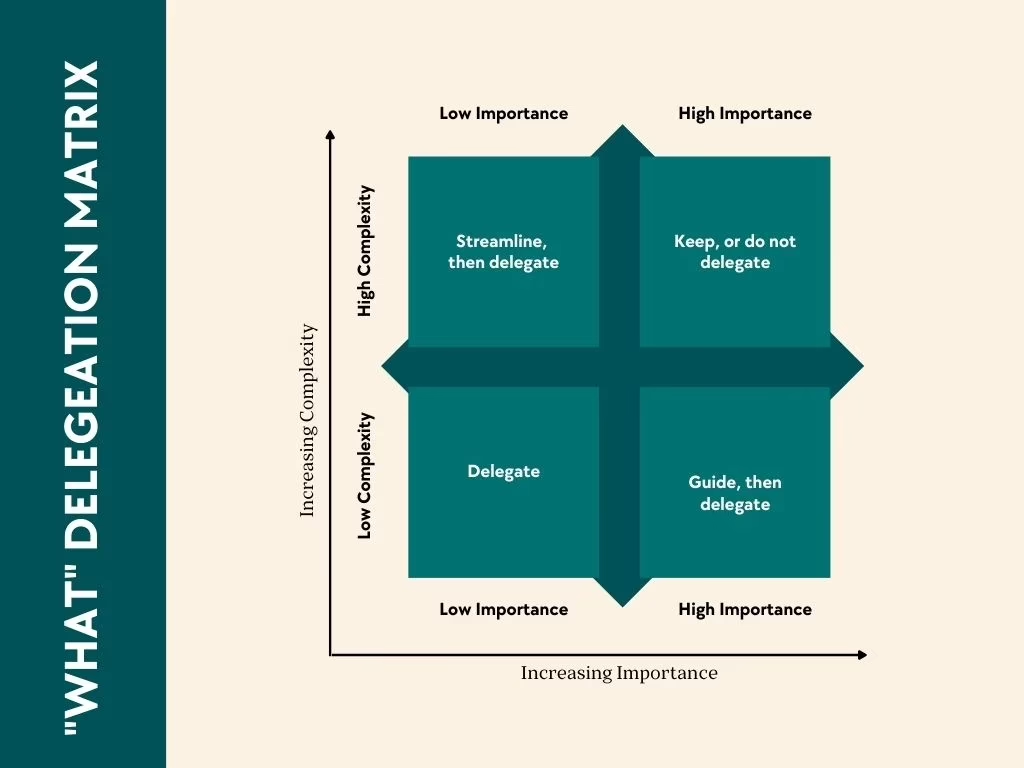
A Simple Filter for What to Delegate
Take the recurring tasks and separate them into columns. Be honest.
- Automate: the task runs the same way every time, the inputs are structured, and a mistake is easy to catch. Inbox tagging, calendar link responses, receipt capture, spreadsheet updates, standard reporting.
- Delegate to a VA: the task needs judgment or a human tone, the inputs vary, or the work involves a customer or a partner. Support triage that requires context, calendar management with rescheduling, invoice follow-up that needs a real conversation, CRM cleanup where records conflict.
- Keep: the task carries legal, financial, or relationship risk you personally own. Contracts, hiring decisions, key customer calls, anything that would embarrass the company if handled by the wrong voice.
We’ve written about eight workflow automation examples that work and include the kind of things that break the pursuit of straightforward automations after six months. You should read it before you make a purchase.
Write the Role Like a Real Operating Job
Spend an hour on the role spec. That hour does more for hiring success than any job board choice, because it forces you to describe the work in language a candidate can act on.
There are five components to a tight spec: scope, tools, time-zone overlap, primary KPI, and two supporting KPIs. Do not include “help with admin.” The specificity is not for the candidate. It is for you. If you cannot write it, you do not know what you want.
Owner filter: if you cannot name the first three tasks the VA will own on day one, you are not ready to hire. Close the tab and write those three tasks first.
KPIs should be measurable in a week, not a quarter:
- Inbox triage: messages sorted and assigned before end of day. Supporting: fewer missed replies, fewer follow-up pings from you.
- Calendar management: meetings scheduled without conflicts, time zones handled correctly. Supporting: fast rescheduling when plans change.
- Customer ops: requests acknowledged within a target window and routed to the right owner. Supporting: clean CRM notes, fewer “what happened here” questions later.
- Bookkeeping support: invoices and expense entries posted on time. Supporting: fewer missing receipts, fewer corrections from your accountant.
Add guardrails for anything that touches money, customer data, or sensitive records. Say what the VA can approve, what needs sign-off, and what stays with you. This is not paperwork. It is the difference between delegation and exposure.
Where to Source Without Burning Time
Pick your sourcing channel by how much of the hiring management you want to own, not by hourly rate. That single reframe cuts the search short.
Adoption of virtual assistants is high. Use of virtual assistants (VAs) is reported to be 54% among small to medium-sized businesses (SMBs) and accounts for 44% of all outsourced administrative services in VA Masters’ 2026 report. With the Philippines constituting a large portion of the global VA workforce, it’s no surprise that the Philippines and India are the most popular offshoring locations, as indicated in most practitioner accounts, due to their English language proficiency, flexibility in time zones, and a record of work that can be checked. In recent years, Latin America has begun to gain market share for US customers interested in not having to bridge the time zone for day-to-day work.
Three main sourcing avenues are available to the majority of customers:
| Channel | Vetting | Time to start | Best for |
|---|---|---|---|
| Freelance marketplaces (Upwork, OnlineJobs.ph) | Mostly on you | Fast if you screen hard | Owners with time to filter and a specific role spec |
| Dedicated VA agencies | Stronger upfront, replacement built in | Moderate | Owners who want less churn and clearer escalation |
| Curated networks and referrals | Mixed, usually better than raw marketplaces | Fast to moderate | First-time hires who want a managed trial |
Marketplaces have the most flexibility, but you are responsible for replacement risk. Agencies pass on the cost of churn. Curated networking services cost more than a marketplace but less than an agency. These are good first options.
To learn more about the implications of outsourcing and how it balances cost versus the amount of control you maintain, take a look at our article about managed services vs staff augmentation. The same reasoning applies to a virtual assistant hire.
For US and Canadian business owners who want a reliable, nearshore service, check out LatHire, which publishes its prices and guarantees time zone overlap. However, if you haven’t written a job description, nothing will magically fill in the blanks.
Curious whether your site is citable by AI assistants? We run a readiness check that shows what they can and cannot read. Run the check.
Screen for Proof, Not Polish
Treat screening like a funnel. Bad hires aren’t caused by lying. They occur because the process lacks structure.
The data surrounding structured screening is stark. From one large network, eVirtualAssistants (eVA) placed only about 1 in 708 applicants in 2026, and it took on average 24 days to place an applicant after the application was submitted and only 2 days from the time the contract was signed to the time the applicant was onboarded. That funnel takes more than luck. It is the result of a consistent and reliable filter. Yours should be the same.
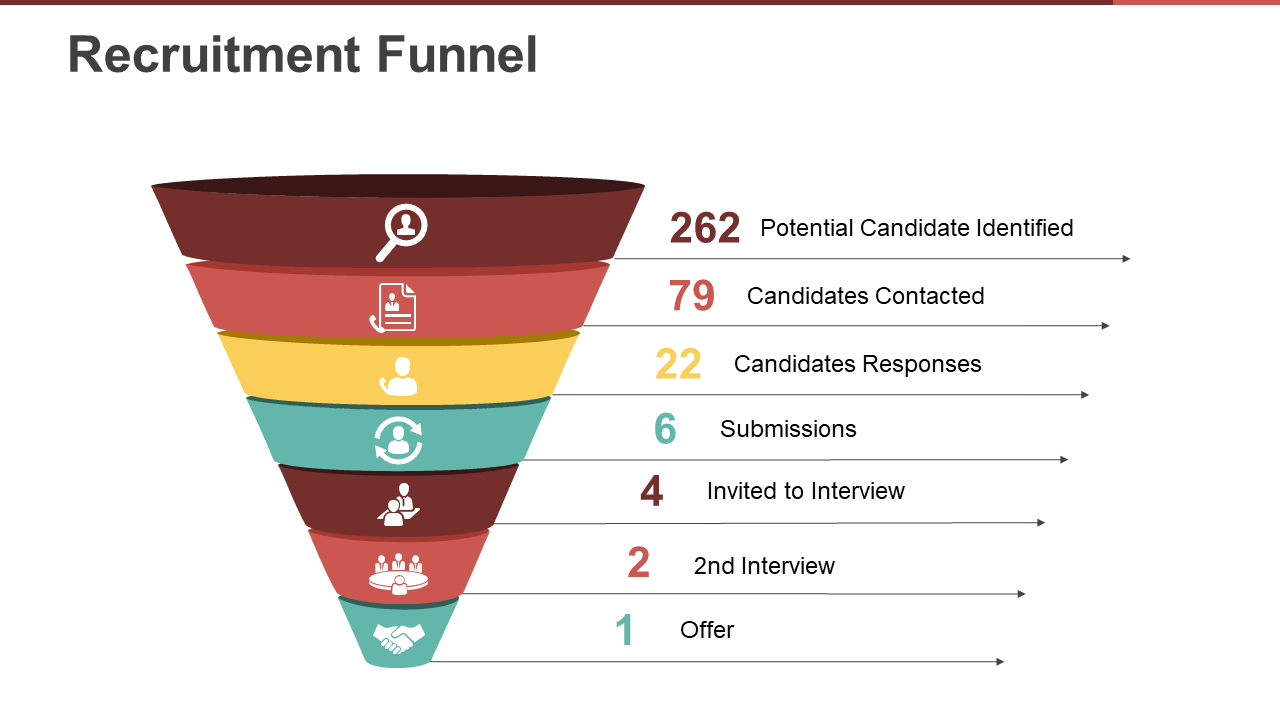
A working funnel has four stages:
- 10-minute resume screen. Ignore the polished profile if the last three roles do not show the core task. Rank by output evidence, not adjectives.
- Async video answer. Ask four questions: a specific mistake they caught in past work, how they triage an inbox, how they handle a vague instruction, why they left their last role. Score against the role spec, not gut feel.
- Paid 90-minute trial. Real work only. Clean a sample inbox with red herrings. Draft a reply to a difficult customer message. Update a CRM from a spreadsheet with duplicate rows. Pay even if you reject them, because pay is what buys honest effort.
- Reference check with one specific question: “What kind of oversight did this person need, and how did that change over time?” Vague answers are a signal.
Create a rejection reason template. The second hire is easier since you are now remembering why you rejected the first.
Pay for Quality, Not for the Hourly Rate
Set the rate band before you interview. Once a candidate is in front of you, you will negotiate against your own urgency and pay too little or too much.
The market spread is real, and cheap is expensive. VA Masters’ 2026 data reports offshore roles at a median hourly rate of roughly $5, whereas onsite administrative positions in the US commonly command a median of $15 an hour, about 3x higher. This means assistants located offshore earn just one-third of what their onsite admin counterparts earn. Practitioner voices on X are noisier: many have stopped hiring at $3 an hour, post-rework, citing a true cost near or just over $19 per hour, a threshold cited by Codie Sanchez as an estimate.
The tradeoff is less about ethics and more about efficiency. An employee who often requires corrections may in fact end up costing the owner more time than an employee who requires little to no guidance. The right number depends on the task, the region, and the level of oversight one wishes to maintain.
Put the agreement in writing. Scope, deliverables, working hours, confidentiality, IP assignment, a 2-week notice and a 1-week kill fee in the event of a mismatch are all things that need to be agreed upon in advance. It is also recommended that the payment be made through a compliant payroll partner (Wise, Deel, or the agency’s rails), and not through a private PayPal account, to keep taxes, FX and ownership in order. If the VA will be in a customer-facing or finance position, a background check may also be in order. That is trust design, not paranoia.
The cost of getting this wrong is not just the hourly rate. According to the Virtual Assistant Institute, the average cost of a bad VA hire is around $8,400 in productivity and replacement. The Institute cites 12-month retention at 74% with agency matching and structured screening versus 31% with unstructured freelance hiring. Structure is not overhead. It is the retention strategy.
Run the First 90 Days Like an Operating System
The first 90 days should not be viewed as a probationary period. Rather, they should be viewed as a paid developmental period to construct the operating role around the position. This nuance will help the VA become operational much sooner.
Days 1 to 30: Access and Shadowing
Set up a lean handbook in Notion or a doc. Include brand voice, approval thresholds, password hygiene, and five to seven Loom walkthroughs of your recurring tasks. Use a lean stack of tools: one task management tool, one communication channel, a password manager for limited sharing, a time tracking tool, and one source of customer data. Everything else will be a distraction in the first month.
Days 31 to 60: Ownership Under Review
The VA should now own the routine tasks while you review on a weekly basis. Review the work completed, errors, and turnaround time as compared to the KPIs from the role spec. This is where documentation will be your friend as you will be reviewing against a documented standard as opposed to remembering what you were probably thinking at the time of writing.
Days 61 to 90: One Workflow, End to End
By day 90, the VA should own a complete end-to-end workflow. This could be managing a customer inbox, following up with customers, or even preparing invoices. This needs to be a complete workflow as opposed to a series of disjointed tasks. In the meantime, implement a 10-minute daily check-in in an async communication tool with a Friday metrics review. If the VA has been successful in managing the end-to-end workflow, begin to remove the SOPs as they will have become routine.
Good onboarding turns your VA into part of the system, not a person you keep rescuing.
Scale the System, Not the Headcount
Your first VA will act as a prototype. The real value is in the tool you built around it: written SOPs, a repeatable task management system, cadenced reviews, and a clear escalation process. If this system works, the second hire becomes a lot easier and a lot more cost-effective. If this does not work, the second hire will just be a compounding issue.
When your first VA is stable, give the second person a different parallel workstream. By the third or fourth hire, it starts to make more sense for a team lead to own QA and scheduling. This also tends to be the time when the decision of AI versus human comes into play. Some of what the first VA does can probably be handled by an automation that is overseen by the VA. In an example of our automated news pipeline builds, one client had an editorial team that spent several hours at the beginning of every day going through 30+ news sources by hand. Automating that pipeline with supervision restored their morning hours and moved the editorial focus from collector to curator. This is also applicable to workflows that are owned by VAs. Once the workflow is documented, it is worthwhile to revisit what is worth keeping as a human activity every couple of months.
Keep an eye on three metrics on a rolling six-month basis. The first is turnaround time; the second is error rate; and the third is the actual hours of ownership that have been shifted off your calendar. If the metrics are positive, then maintain the structure. If the metrics are negative, then the role, tools, or sourcing model should be adjusted in that order.
When to Get Help Designing the Layer Around the Hire
Defining workflows and determining ownership (person vs. agent) is the area where most owners find automation roadblocks. Solving for where you should automate, where ownership should lie with a human, and where the handoff should happen most efficiently is one of the hurdles you will most likely face before you make a hire. Refact’s automation and integration work is actually designed for considering these early-stage decisions. This is where the real ROI for hiring a VA is actually found.
Trying to work out where AI actually fits in your stack? Let’s talk. Free 30-minute call, no pitch.

Saeedreza Abbaspour is the CEO of Refact, where he works across product, engineering, and sales. He sets the studio’s direction while staying closely involved in the work itself, from shaping product strategy and UX architecture to helping define the technical systems behind Refact’s projects. His role connects business thinking with hands-on product execution, giving him a practical view of how software should be planned, built, launched, and improved. At Refact, Saeedreza focuses on building a studio that can move quickly, solve real client problems, and turn ideas into reliable digital products.
More from Saeedreza Abbaspour

