Managed Services vs Staff Augmentation
When it comes to deciding on managed services or staff augmentation, price is seldom the deciding factor.


We put this together for those looking at two offers that may sound alike but are in fact very different ways of operating. At Refact we use the following framing to help a client determine if they should buy hands, buy an outcome, or do some of both. Our 12 years of experience running products in over 200 engagements, typically spanning 12 to 24 months, has shown us where model drift tends to set in.
The Real Dividing Line
There is a clean distinction between the two. With staff augmentation you are renting individuals to work within your process and under your direction, using your tools and backlog. You retain ownership of the delivery risk, the review, the priorities and the architecture. A managed service, by contrast, is a contract for an outcome. The provider is responsible for the execution, the staffing and the operating model itself. As you will see in practitioner writing from Insight Global and others, this is what tells you if an engagement is going to succeed.
It is not about cost, nor is it about control; a properly run managed engagement affords you plenty of steering via governance and shared observability. What matters is where the responsibility for execution lies. Miss that and you get the worst of both worlds: a managed contract that is micromanaged like staff aug, or augmented engineers making architectural calls with no contract to answer to.
In staff aug the execution is part of your operating model. In managed services they build one alongside yours.
What Each Model Actually Costs You
Rate cards can be deceptive. An augmented engineer in a given region might come in at $60 to $120 an hour. A mid-market managed retainer will read higher, say $5,000 to $20,000 a month. But there are parts of the equation that do not show up in a quote.
With augmentation you incur management overhead. Your team has to write the tickets, do the code review, sort out architecture and onboard new faces when the vendor rotates them. One Reddit thread from engineering leaders put it plainly: after bringing on six augmented engineers, internal velocity stalled for a month or two because the leads were too busy onboarding and fielding questions to ship anything. When your product lead is already at capacity, adding headcount cuts into throughput. This is why DORA metrics have become the truer test of augmentation.
A managed service wraps that overhead in the fee. The premium covers the on-call rotation, the incident response, the tooling and the monitoring you would otherwise have to put in place. It also puts a price on the things you ought to push back on, such as standardized tools you did not pick or the risk of “SLA theater” where the provider meets every contractual metric while your customers suffer in ways the SLA does not capture.
Do not compare quotes, look at fully loaded costs. Before putting pen to paper on either kind of contract, we would recommend our piece on fixed price versus time and materials for a clearer picture of how these commercial structures work.
Side by Side, Honestly
| Dimension | Staff Augmentation | Managed Services |
|---|---|---|
| What you buy | Individual capacity | An outcome under an SLA |
| Who owns execution | You do | The provider does |
| Pricing shape | Per person, per hour or month | Retainer or SLA-based fee |
| Hidden cost | Internal management overhead | Tooling lock-in and exit friction |
| Best fit work | Core, differentiating, fast-changing | Standardized, reliability-critical, non-differentiating |
| Fails when | Internal leadership is saturated | Scope cannot be defined clearly |
| Accountability if it breaks | Sits with you | Sits with the provider, within SLA scope |
Treat this as a diagnostic rather than a scorecard. The important rows will vary with the job. If you are doing a payments integration that must hold 99.9% uptime in perpetuity, then “who owns execution” is paramount. For a six-week feature push on an unformed product, hidden cost and best fit are what count.
Three Scenarios That Show Up Repeatedly
An MVP with no technical lead
The danger with staff augmentation is that it looks good on paper: direct control and a lower hourly rate. In reality, an MVP without a technical lead leaves nobody to tell the extra engineers what to build. Augmented developers are fine with execution but not so much with ambiguity. You end up paying for hours while the product side stands still.
A managed product team with a discovery phase is often the wiser choice. We run discovery at Refact with someone on our side owning the scope and the hard decisions, and we put a money-back guarantee on it because the work has to justify itself before any code is written. See our guide to consulting and IT services for how that early stage plays out.
Scaling a live SaaS with an existing team
Then again, augmentation is the right call here. The backlog is solid and the internal lead has a clear idea of what done means. Tacking on two or three vetted engineers gives you the capacity you need. The only risk is to your throughput; if the internal lead is maxed out, more engineers will only make it worse. Make sure you have the product owner and QA capacity in place first. In our dedicated development team engagements we see a certain pattern: headcount is less important than the make-up of the team.
A CMS migration with a live audience
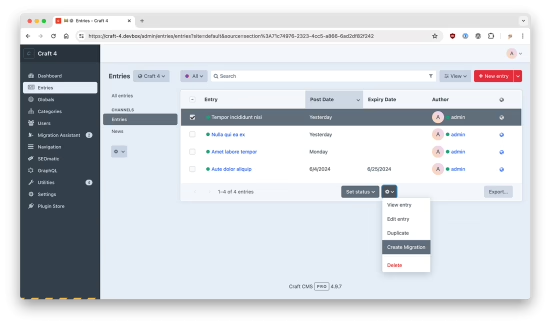
Then there are migrations, and this is where you see why managed services command what they do. You have to deal with cutover timing, SEO, content, redirects, editorial workflow and integrations. The failure modes are not only visible to the user but difficult to put right. It is best to have a single provider on the hook for the plan, the runbook and any response if the schedule goes off the rails. Relying on staff augmentation here makes you the integrator; when your people are also running the business that is a recipe for trouble. We often find our ongoing website maintenance and support work has its roots in a migration, since that is merely the first act.
The Failure Modes Nobody Warns You About
It is not model choice that sinks an engagement so much as model drift. In Kanerika’s retrospectives one can spot a familiar trend: things come to an end at about ninety days because an augmentation has become de facto outsourcing with no change to the contract, or a managed arrangement is being micromanaged as though it were staff aug. The result is invariably high cost and little reliability.
With augmentation, be on the lookout for bait-and-switch. You will get senior types in the sales cycle and mid-level developers on the project, or unannounced rotations that mean starting onboarding all over again. The consensus on Reddit and Quora is quite uniform on this. Put named resources in the contract with substitution clauses that need your sign-off, and judge their seniority in a technical conversation rather than from a resume.
For managed services, ignore the SLA theater. A vendor can close out tickets while your customers are in the middle of an outage the metric does not capture. As one CIO was quoted in a practitioner forum: “you measured uptime, we cared about customer experience.” Insist on SLAs tied to real outcomes like deployment frequency or change failure rate, and make sure both sides have shared observability of the telemetry.
Knowledge loss is another way to fail. An augmented contractor may end up with sole ownership of your pipelines; a managed provider will have opaque runbooks. Either way you are left with a black box once the engagement is over. Documentation should be part of the definition of done. Have an internal anchor team small enough to be nimble but able to validate the provider and rebuild institutional memory.
What to Ask Before You Sign
All vendors sound much the same on an initial call. Ask the right questions and the differences are plain.
Ownership. When a release breaks at 2am, who is answerable? What is the path for escalation? Vague answers mean you are being rented people, proposal or not.
Resource stability. If you are doing staff augmentation, will the engineers be named in the contract? What is the lead time for a replacement if you want to rotate someone?
Scope and SLAs. With managed services, how do your metrics map to the customer’s actual experience? And how is anything “out of scope” priced?
Exit. Say we part ways in a year. Who has the runbooks, the automation scripts, the monitoring set-up? If the answer is some kind of multi-year exit project, then the lock-in is more of an issue than the SLA.
Security and compliance. How are access controls enforced on augmented staff? For a managed service, how is the evidence for compliance put together for an audit?
Most Mature Setups Are Hybrids
The ones we see operating without a hitch after 12 to 24 months tend not to put all their eggs in one basket. They augment for change and put the run in the hands of managed services. Core product and IP-sensitive items are kept close by embedded talent under internal direction. The plumbing that must not fail – backups, 24/7 coverage, security monitoring – is handed off with clear SLAs.
It works because the two offset each other. Managed services let your leadership focus on directing the augmented teams to do the work that sets the business apart. At the same time, the augmented side keeps the operating model flexible enough to respond to market shifts. One model alone cannot cover both.
To divide the work properly requires a frank look at three factors: the scope you can define today, your available leadership bandwidth and where the operational risk lies. Without that assessment you will apply a single model across the board and invite the drift described above.
How to Move From Here
Should you be deciding between two proposals, take a moment before putting pen to paper. Add in the internal cost you would have to bear for both. Classify the work as either change or run, commodity or differentiating. Make the ownership questions above a requirement in the RFP response, not something for a discovery call.
If you are at the stage of turning a rough concept into something you can evaluate, that is what our product design and discovery process is for. Founders concerned with the broader build risk might find our guide to outsourcing SaaS development useful for a deeper look at governance and contracts.
Do not go with the cleaner rate card. Pick the model that is right for the work, the team and the risk.
Building a product and unsure what to scope first? Let’s talk. Free 30-minute call, no pitch.

Saeedreza Abbaspour is the CEO of Refact, where he works across product, engineering, and sales. He sets the studio’s direction while staying closely involved in the work itself, from shaping product strategy and UX architecture to helping define the technical systems behind Refact’s projects. His role connects business thinking with hands-on product execution, giving him a practical view of how software should be planned, built, launched, and improved. At Refact, Saeedreza focuses on building a studio that can move quickly, solve real client problems, and turn ideas into reliable digital products.
More from Saeedreza Abbaspour

