AI Systems Integration: A Practical Guide
Summarizing a customer thread, drafting a product description, or answering a policy question – all things an AI demo can do in seconds.


This gap is what AI systems integration is about. In 2026, the differentiator will not be the model or the prompts. It will be the engineering of the model. It will be the model’s data access, the means of interaction with model tools, and the assessment of the model’s outputs. It will be who is held responsible for model failures. This guide presents some of the challenges faced by teams and how to sequence work to complete an AI project that moves beyond the demo stage.
Why Most AI Projects Never Leave the Pilot
A polished demo rarely runs against the messy real world. Production runs against the sales CRM the team has mostly abandoned, a shared drive nobody has cleaned in years, and permission rules that were never written down. The model behaves the same as it did in the demo. The system around it behaves completely differently.
The readiness gap is real. Serious Insights posts its update on The State of AI 2026, and reports that 71% of organizations are either active users or are piloting AI, and only about 30% are prepared to operationalize AI end-to-end. The difference is readiness. It is where the majority of projects die.
Several practitioners noted the same failure modes. Design teams hurry to develop multi-agent hierarchies when single-agent designs would suffice. Errors tend to accumulate in multi-step solutions, meaning that a ten-step system in which each step delivers results with an 85 percent level of accuracy would end up yielding a result with a final accuracy of only about 19 percent. ‘Silent failures’ are the worst of these failure modes. An agent that does not fail yields incorrect results, with the result being adopted by a user. This may only draw attention much later when the user generates several support tickets.
Refact’s buyer’s playbook on AI integration services addresses the same issue from the delivery side. In most cases where a project stalls, a weak model isn’t the real cause. More often the scope was too broad, the data wasn’t ready, or nobody redesigned the workflow to fit the AI.
‘Clarity before code’ means describing the decision, the data, and the system to be modified, and the owner of the outcome.
What AI Systems Integration Actually Means
Integrating AI systems means embedding a model in the software, data, and workflow that your team already uses in order to allow the AI to access the data it needs, operate on the required system, and await the intervention of a human.
An example: a support agent creates a new ticket and views a recommendation built from the customer’s order history, order conversation data, and refund policy. The recommendation cites its sources. The agent edits the recommendation, sends the recommendation to the customer, and closes the ticket. The AI never left the support tool itself. No information was copied into ChatGPT. This is integration.
This example is built on four components.
- The system of record: the CRM, ERP, ecommerce platform, CMS, or portal that owns the data and the workflow.
- The connection layer: APIs, Webhooks, Event Streams, or Scheduled pipelines which move information between systems.
- The AI capability: a model, a retriever, a classifier, a recommender, an agent. These are now usually encased in a framework that manages memory, calls to other tools, evaluation, and constraints.
- The action: the drafting of an answer, a notification, a work item being assigned, a workflow action being taken.
Architecture Patterns and When to Use Them
A simple test is to look at where the AI shows up in the user’s day. If it lives in a separate browser tab, it’s just an AI tool. If it shows up inside the order review, the editorial queue, or the support view, it’s an integrated AI system, and only that second kind actually changes how the work gets done.
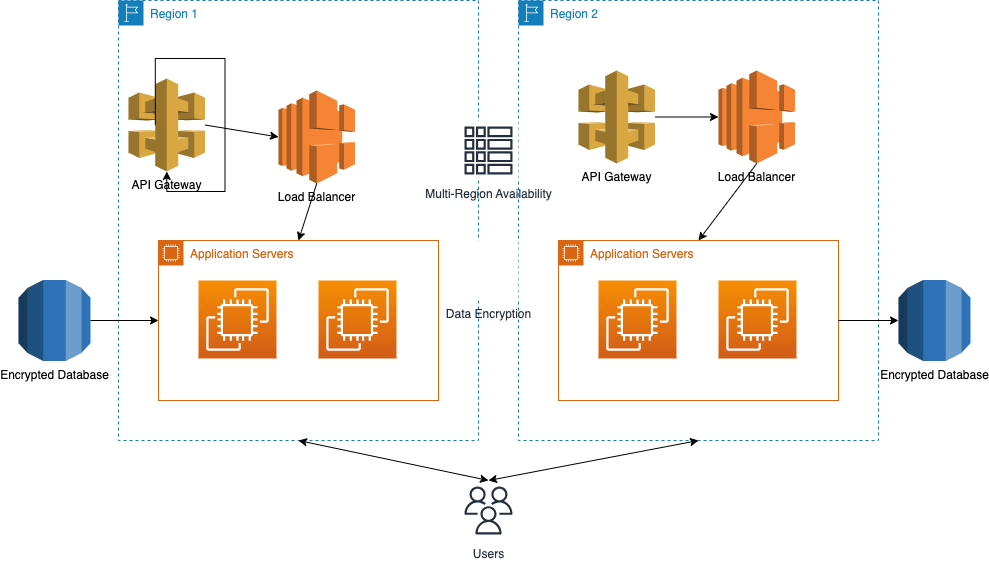
An API-first approach describes a request-response model. An application calls a model or agent only when needed and waits for a response. This philosophy allows the application to focus on features such as generating a product description or ticket summary. There is a runtime dependency on the provider and pricing that adjusts with usage.
An Event-driven approach is similar to a background worker. An AI task is initiated by a business event. This approach is more appropriate for tasks that are not time critical. The team must also manage retries, duplicate events, and failed jobs. The automated news pipeline for a daily newsletter built by Refact is a good example of this solution. The editorial team had to check thirty websites manually every day for stories, which was very time consuming. The integration set up a scheduled task that ingested the sources and a list of recently covered stories, deduplicated them, and sent the results to the editorial team.
Embedded ML puts predictions directly alongside records. Examples include a fraud score on an order or a churn score on a customer record. This directly benefits the user, but also requires managing data quality over time to counteract model drift.
Microservices offer a way to divide a product into modular and independent services. This method will be very helpful for larger products with multiple AI capabilities, although it will also increase the overall operational surface area. CloudCops’ microservices architecture guide offers a good starting point for your team, specifically for the point that states architecture will not remedy organizational issues. If teams don’t have end-to-end ownership of the service, breaking the monolith will only result in a more decentralized distribution of failures.
| Pattern | How it works | Best for | Watch out for |
|---|---|---|---|
| API-first | App requests an AI result on demand | Focused user-facing features | Provider limits, pricing, availability |
| Event-driven | Business event triggers AI work | Background jobs, batch enrichment | Retries, delays, duplicate events |
| Embedded ML | Prediction shown inside an existing view | Recommendations, scoring, classification | Model drift, stale data |
| Microservices | AI runs as an independent service | Multiple AI capabilities at scale | Deployment, monitoring, on-call load |
The correct approach for this decision doesn’t hinge on which design pattern is more modern. The real question is, which of these design patterns will the team be able to operate on Tuesday at 3am? If the response is unclear, that design pattern is incorrect. Teams that are considering design patterns that involve calling tools and making decisions should read Refact’s guide on building AI agents that work before committing to such a framework.
Data Pipelines, Retrieval, and the MLOps Layer
An AI system is only as good as the pipeline backing it. A data pipeline extracts records from source systems, performs cleansing and transformations, and delivers the data to the model or retrieval layer in a usable format. When this pipeline is unstable, the AI will continue to answer, but the answers will be wrong.
Retrieval-augmented generation is especially dependent on this. The EnterpriseRAG-Bench project examined retrieval across approximately 500,000 documents, nine different enterprise sources, and 500 questions across ten categories. The dataset includes Slack, Gmail, Jira, GitHub, and Confluence reflecting the messy nature of business knowledge. The EnterpriseRAG-Bench paper is worth reading for its account of how quickly retrieval quality breaks down when documents disagree, metadata is missing, or the source of truth is unclear.
In simple terms, this means an assistant needs multiple layers (retrieval, grounding, and validation), in addition to an endpoint. Besides identifying the source of an answer, the assistant must be able to identify and interpret conflicting documents as well as provide a simple mechanism to correct errors without creating a formal support request.
All of this falls within the scope of MLOps. This includes the ability to set and manage parameters for versioning, rules, and prompts for both retrieval and models. In addition, this includes the ability to set rules to alert and manage silent model regressions and to set a path for rolling back model versions in order to restore prior functionality. In the absence of this level of control, multiple unexplained issues may occur; the team will be unable to determine if performance has changed due to a model, data, or permission issue.
A reasonable operating checklist:
- Data freshness. What is the data retention interval, and what happens when a data source becomes unavailable?
- Source authority. In the case of a conflict, which source takes precedence?
- Version tracking. Each of the components (models, prompts, rules, etc.) must be versioned.
- Feedback Loops. Provide a mechanism for capturing feedback that is structured rather than sending feedback via unstructured communication channels (e.g. Slack).
- Failure alerts. The pager is claimed by the owner when a retrieval fails or an action does not complete.
Curious whether your site is citable by AI assistants? We run a readiness check that shows what they can and cannot read. Run the check.
Security, Governance, and the Silent Failure Problem
Integration of AI becomes a risk-based decision the moment AI interacts with client data, financial records, or autonomous actions. Though these are simple questions, they are often left unanswered: with whom can AI interact, what tools can be utilized, what is logged, and what happens if AI acts on outdated information.
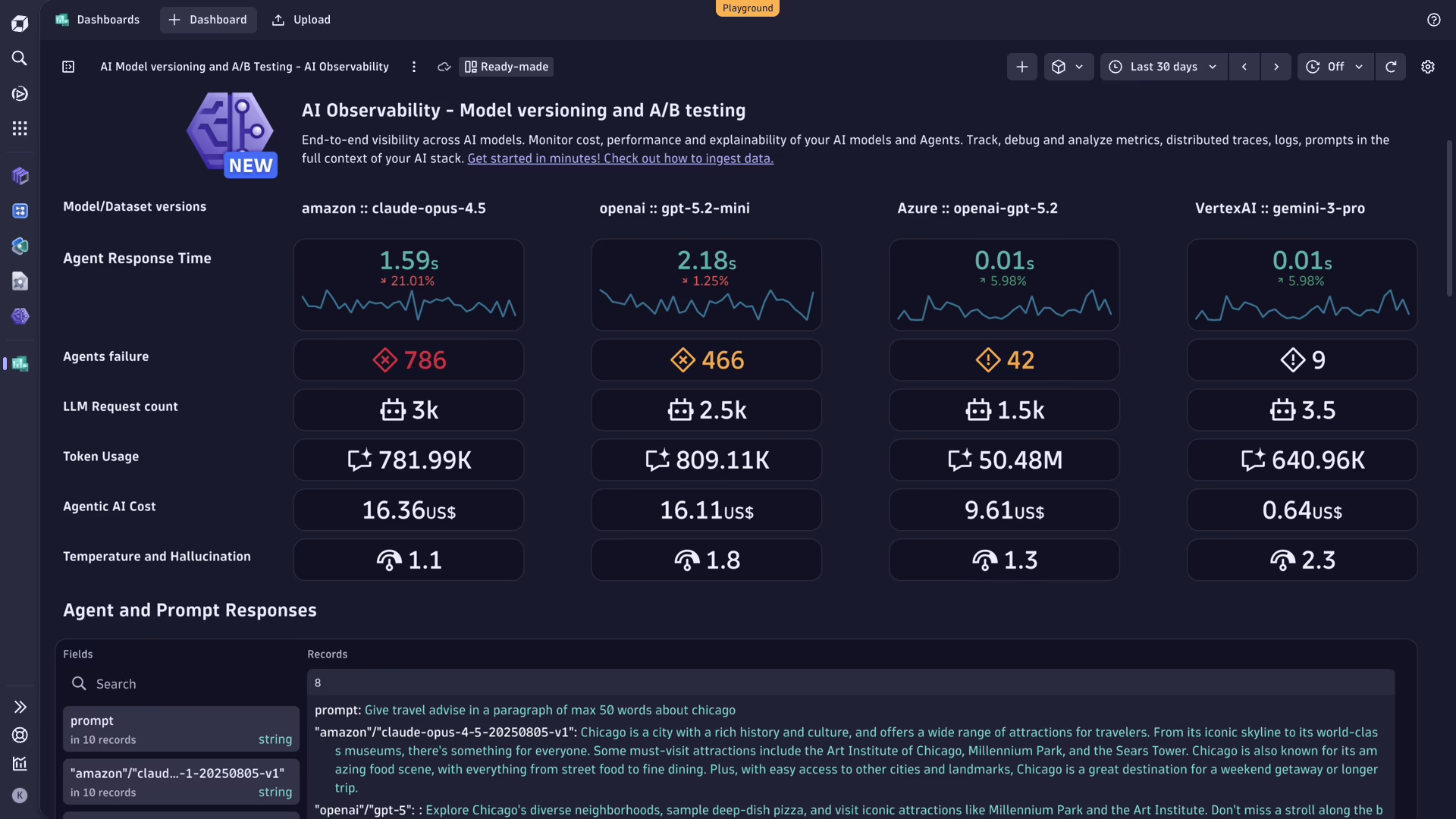
Governance becomes increasingly important as agents are able to operate without needing a human to validate each step of the process. Deloitte’s State of AI in the Enterprise report found that only about one in five companies has a mature governance model for autonomous agents, and named workforce readiness as the biggest barrier to embedding AI into existing workflows. Practitioners tend to agree: the model isn’t the problem, the organization around it is.
Silent failures are the specific cases of governance that need to be addressed. There are seven distinct types of failures that occur in production: silent errors in tools, context rot, working memory limits, poor step handoffs, model drift, insufficient observability, and poor error handling. None of these throw an exception – the system looks perfectly healthy while quietly producing the wrong answer.
Boring countermeasures like tool input/output schemas, sanctioned sandboxes, backoff, and checks against domain rules and outputs are some of the most frequently skipped patches. Likewise, inserting or embedding checks that allow humans to analyze reasoning, tool operations and their latency, and finally, errors that occur are frequently skipped. The most undesirable output of skipping security measures and concerted effort is the erosion of trust. Worst of all, just one unreliable release teaches users that the feature can’t be trusted. Erosion of trust leads to the underutilization of a product or service.
Trust erosion is the hidden cost of skipping this work. One unreliable release teaches users that the feature isn’t dependable. Adoption flattens. Even when the team fixes the underlying issue, the users who got burned don’t come back to check.
Build, Buy, and the Honest Middle
Buy when the workflow is common, the vendor genuinely supports your systems, and speed matters more than long-term control. Build when the workflow is core to your product, your data rules are unusual, or you need control over how the system behaves a year and a half from now.
| Question | Buy an existing tool | Build a custom system |
|---|---|---|
| Workflow | Common, well-defined | Core to your product |
| Control | Accept the vendor’s limits | Own the behavior and interface |
| Time to first value | Weeks | Months |
| Maintenance | Shared with vendor | Your team owns it |
| Governance | Review vendor controls | Design controls into the system |
Often, the best course of action lies between the two. Buy the model and the required infrastructure, but build the logic and the workflow. This is where your domain expertise and real-world system integration come into play. Refact’s automation and integration practice encapsulates this approach.
Measuring What Actually Matters
A product can be bad and a model can be accurate. Users wait too long. The agent calls an extensive number of tools. Each operation or retrieval is three dollars. Measurement needs to cover the whole workflow, not just the model itself.
The authors of the CLEAR framework paper support their claims with data. They analyze 300 tasks across six enterprise verticals and decompose latency into planning, execution, and reflection stages. Thereafter, they explain how in most cases, the cost of orchestration is greater than the cost of inference. If you only evaluate model latency, you have no idea where the majority of the time is actually being spent.
A reasonable dashboard tracks at least:
- Latency. Evaluated at the granular level as model retrieval, model invocation, tool invocation, policy check, and review.
- Cost. Per workflow, per customer, per model, and per retry. Not a fixed monthly cost.
- Efficacy. Whether the intended task was completed, not just the correctness of the output.
- Assurance. Permission checks, citations, refusal behavior, approval rules.
- Reliability. Failed calls, incomplete actions, repeated attempts, unavailable resources.
Testing must also account for the “ugly” cases of incomplete records, conflicting resources, attempts to inject prompts, system outages, etc. Once the system is live, review real samples of system output on a weekly basis. Despite the availability of test data, users will try to game the system in ways that test data will not cover.
A Practical Sequence for Getting to Production
Focus on a concrete use case for a specific workflow rather than an abstract goal. Publishers may want to automate a process for sourcing stories, e-commerce teams may need help with drafting, or membership organizations may need to summarize renewal calls. The use case should have a clear goal, known data input, and an output that can be evaluated.
A workable sequence:
- Capture process. Who initiates the process, what systems are used, inputs and outputs required.
- Analyze data. Missing entries, duplicates, contradictory inputs, permission gaps. Address all these issues before you use any models.
- Choose the smallest useful scope. Draft, classify, summarize, or recommend before letting the AI touch important records.
- Set review benchmarks. Explicit approval, rejection, or escalation criteria and audit logging.
- Test the end-to-end process. Unhelpful inputs, confounding cases, broken systems, requests repeated ad nauseam.
- Ship after two to four weeks, measure, then decide. Saved hours, errors, and a user correction metric all affect the decision on process scope.
The same sequence works across industries, though the controls should scale with the level of risk. Publishing needs source citations and editorial review. E-commerce inventories need to sync with order states. Membership systems need to enforce permissions and data boundaries. In another vertical, the smart building integration case study published by Faberwork shows the same. What makes an AI system valuable is how well it connects to real operational systems, not how sophisticated the underlying model is.
Refact’s work with multi-channel publisher Estate Media illustrates the same principles. The team was interested in consolidating newsletter, podcast, and video content on a single hosted platform, without editorial oversight. The integration was designed to source content from all streams, automatically transform the content for web publishing, and prepare content for the publishing process for all content streams. Creators were able to continue using their established tools, and the publishing system was able to manage content publishing for itself. This is what an integration’s scope looks like when properly constrained.
Refact’s AI automation guide for small businesses is worth a read for insights on how to properly constrain project scope for smaller teams.
Where to Start This Week
Choose a workflow. List inputs, systems, risks, approval stages, and result. That description is more important than a pile of model comparisons because it encourages you to ask the questions that models and vendors will not answer for you.
If you want to choose the workflow that requires that significant initial investment of a year to support and build around it, that early choice is what the Refact discovery process aims to help clarify. In this specific instance, clarity before code is what makes the difference between a production-ready AI system and a demo that will be quietly retired.
Trying to work out where AI actually fits in your stack? Let’s talk. Free 30-minute call, no pitch.

Asghar Mirzaei is a backend developer at Refact, focused on the APIs, integrations, and infrastructure that power the studio’s products. His work spans data pipelines, third-party services, backend architecture, and deployment systems, helping ensure that products are stable, scalable, and ready for real-world use. Asghar works closely with the team to connect product requirements with reliable technical foundations, especially in systems where performance, automation, and integration quality matter. At Refact, he contributes to the engineering work behind the interfaces, making sure the products the studio builds can run smoothly and dependably
More from Asghar Mirzaie

