Legacy Application Modernization Strategies
You do not have to look far for examples of what happens when a legacy application modernization plan, which made sense on a slide deck, goes wrong.


Most teams draw the wrong conclusion from these headlines: they think to shun modernization altogether. The better takeaway is to steer clear of the pattern that invariably makes the news. It is a familiar one: too much being changed in a single cutover with no rehearsal and nowhere to go if you need to roll back.
We have written this for the decision maker who has to determine what gets modernized next, in what sequence, and how to see that revenue does not suffer in the process. We want to get at the choices that make a difference to the outcome as opposed to those that only seem to, and the order of operations that will keep a program from stalling out.
Modernization Is a Portfolio of Decisions, Not a Single Strategy
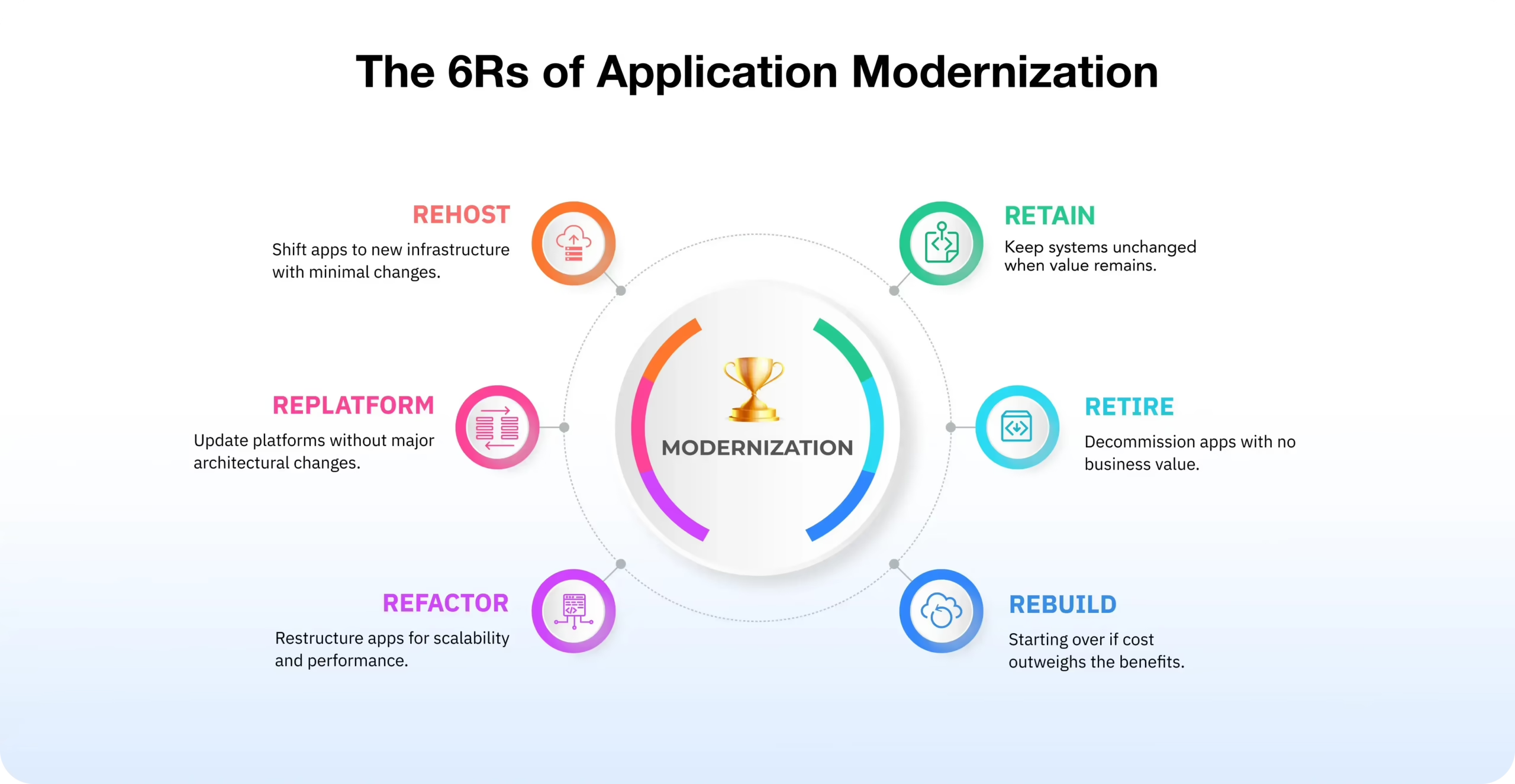
To start with, it is a mistake to view “modernization” as a monolith. Microsoft, AWS, IBM and Red Hat would all tell you it is a matter of options applied to each workload, often referred to as the 6 or 7 Rs.
- Rehost. Put the app on new infrastructure without much code change. Quick and inexpensive, but the technical debt comes with it.
- Replatform. Trade in a database or runtime for a managed service. Better economics for a small amount of rework.
- Refactor. Do some housekeeping on the internals. Good for when the code is still salvageable but in the way.
- Rearchitect. Alter the system’s shape, say by breaking a monolith into services.
- Rebuild. A ground-up redesign within the same scope.
- Replace. Go with an off-the-shelf or SaaS product.
- Retain / Retire. Or just leave well enough alone.
A few vendors might use the term “Encapsulate” for putting an API in front of a legacy system, but the substance is the same.
The point is not to commit the list to memory. It is to resist the urge to pick one R and apply it across the board. One system seldom has a single answer; a checkout service may be a good candidate for refactoring while its reporting counterpart should be retired and the CMS around it replatformed. That is how you stay financially honest about the work.
According to Red Hat’s state of application modernization survey, 85% of applications are modernized in two or three iterative steps, with 78% of organizations turning to AI for support. The industry has long since given up on the idea of a heroic, one-off push to solve the problem.
Why the Big-Bang Rewrite Keeps Failing
There is an emotional appeal to the rewrite – it is also the priciest option. It holds out the promise of a tidy codebase and the death of everyone’s pet hate of a ticket. In practice it rarely meets the schedule anyone agreed to.
Three things will undo it.
Dormant code. You have old branches in the system that run under undocumented conditions. At Knight Capital, a flag was flipped during a deployment and eight-year-old logic came back to life, with the trading engine buying and selling against itself.
Untested load. TSB’s new system was fine for the demos and functional tests. It was not fine for 1.9 million customers on a Sunday.
Lost edge-case knowledge. Legacy code is full of quiet accommodations for things the original spec did not cover. As many on X will tell you, the battle-tested system has value precisely because the bugs have already been found.
A rewrite is only justified when the business model has evolved to the point where the old data and workflows no longer reflect reality. If the issue is really a tangled subsystem or a hosting headache, fix the frustration and not the entire product.
Choose the Strategy by the Constraint, Not the Trend
Let the tightest business constraint dictate the right R, not the technology that is most interesting.
| If the tightest constraint is | Usually the right move | Why |
|---|---|---|
| Time to market | Rehost or replatform | Least code change, fastest to prove out |
| Operating cost | Replatform | Managed services cut infrastructure and ops overhead |
| New capabilities blocked by code | Refactor or rearchitect a slice | Clears the specific bottleneck without a full rebuild |
| Business model has changed | Rebuild the affected domain | Old data model no longer describes reality |
| System has no unique value | Replace with SaaS | Buying is cheaper than maintaining commodity software |
| Cost of maintenance exceeds value | Retire | Some systems are worth more turned off |
Business value is the first filter, technical health second and age last. A system of twenty years’ standing that puts money in the bank and does not break is not on the table. A three-year-old service that is blocking releases is.
That is the enterprise IT view as well. AHEAD’s structured modernization path advises mapping dependencies and working on what gives the highest return, using incremental patterns to lower cutover risk. For founder-scale portfolios with tighter budgets, our legacy software modernization guide goes through the same tradeoffs.
The Strangler Fig Pattern, and What It Does Not Do
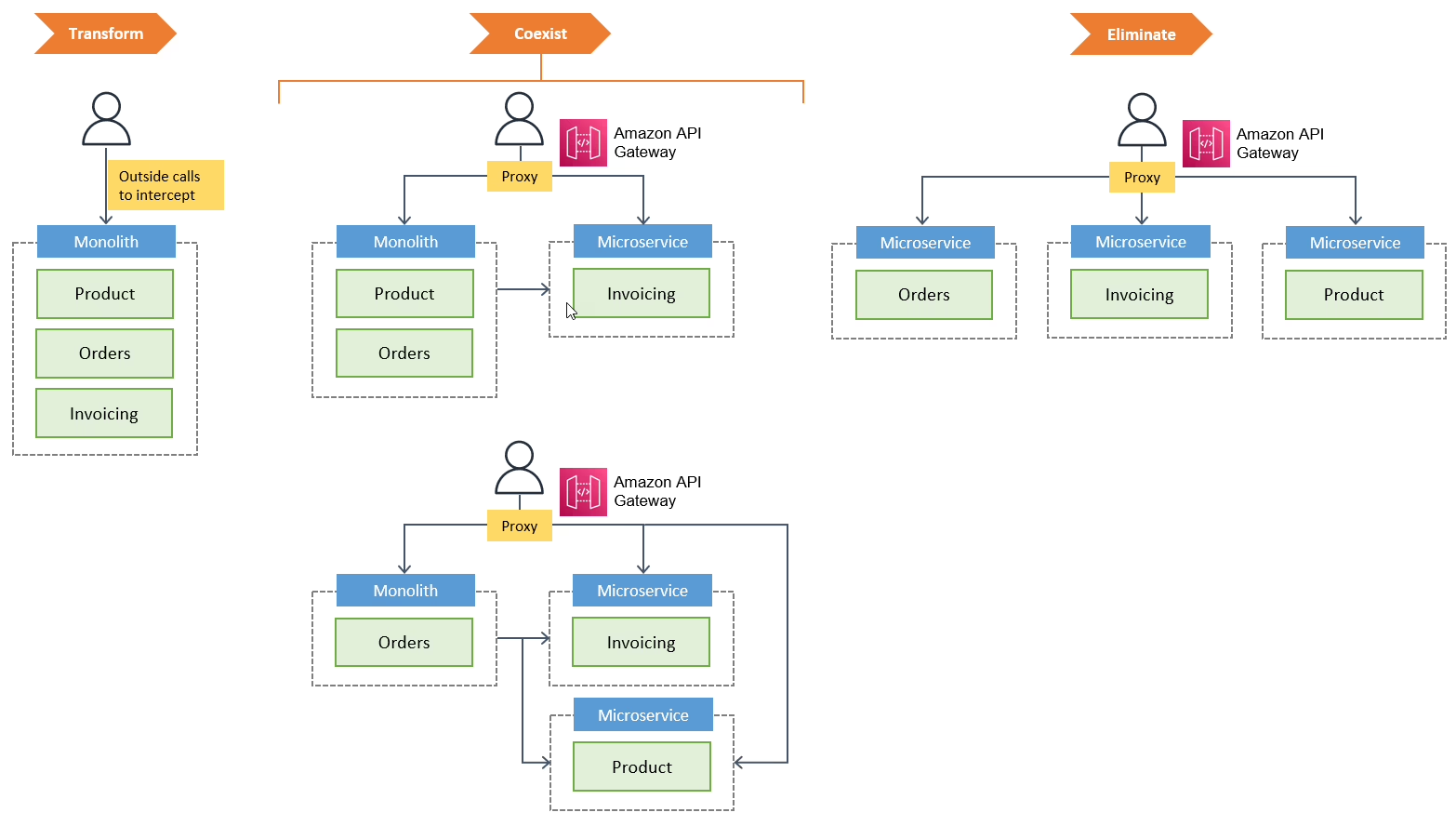
You will see the strangler fig pattern in almost every phased modernization done well. Place an API or facade before the legacy system and route a portion of the traffic to the new implementation. Old and new coexist until the former can be switched off. Rollback is as simple as a config flag.
It is a sound approach, but there is a catch. Routing the traffic will show you the new path is operationally healthy. It will not tell you it is correct. You can have a new service that is quick to respond and spits out 200s, yet the results are not quite the same as the old one. Perhaps the currency conversion has a different way of rounding, or a null is rendered as a zero. There may be an edge case in a discount rule that the legacy code was quietly minding on its own.
There are two ways to guard against such discrepancies.
For one, do not consider the new path proven until after deployment; until then, the legacy system is your source of truth. You can let reads move over early enough, but writes carry risk. That is why you use dual-write and reconciliation: to put real traffic through both and spot any semantic drift before it becomes a matter of refunding a customer.
The other is to plan for rollback from the start, not as some kind of fire drill. If the team cannot put together a story for how to send traffic back to the old system in fifteen minutes or less, there is no phased migration. It is a slow big-bang at best.
Data Is Harder Than Code
It is common to see modernization plans with careful budgets for engineering and a more casual approach to data. The numbers should be the other way around.
The hidden calendar is in the data work. One has to document where the source of truth really is when three services all say they own the same customer record. Or find every read and write path in the old system, even those nobody can recall putting in place. And make sure the new schema is semantically identical, not just in structure.
Take the Teton Gravity Research project. Rebuilding their publishing platform meant moving 10,000 articles from an old ExpressionEngine setup, certainly, but the bigger task was to bring three decades of editorial quirks and user-generated content into a modern model without making the editors relearn what they do. We had to reconcile custom fields and flags in a way that previous efforts had failed to do.
We saw a similar dynamic with Trends by The Hustle. The technical side of the migration was done in days. The difficulty was in deciding which record was authoritative when you have a custom CMS, a payment platform and an email system that were never designed to converse with one another.
Our data migration service page will give a better sense of what a proper workstream entails, and for the vocabulary founders tend to need in these discussions, we have a database migration guide.
Planning a move of your own? Our Migration Blueprint maps the content, redirects, and risks before anything is touched. Get the blueprint.
Foundations Before Waves
Experienced teams already follow the sequence that independent research on phased legacy modernization puts forward: identify the critical parts, map the data, then run the new and old in parallel until cutover is safe.
But first you need foundations that most legacy environments lack. A cloud landing zone with actual security guardrails. CI/CD that does not require a human to click through a checklist to deploy. Observability in the form of logs and traces so one can tell why a system is acting up. And reproducibility, so a fix in staging holds in production.
Without them, a migration wave grinds to a halt. Regressions go unfound for days and rolling back means calling a change-management meeting. The team begins to fear deployments and batches them, and the big-bang risk comes in through the side door. Foundations are not very glamorous, but they allow the rest of the work to be done safely and repeatedly.
Measure Success in Operations, Not Slides
Do not lead with cost savings or headcount reduction. They are lagging indicators and will have one optimizing for the wrong things. Operational metrics are what show modernization is having an effect.
- Release frequency. The rate at which a change can be put out without incident.
- Defect escape rate. What portion of what is shipped ends up broken in production?
- Rollback simplicity. Is it a matter of minutes or a meeting?
- Migration throughput. How many workloads the pipeline is churning per quarter.
- Time to detect regressions. The interval between a bug going live and it being noticed.
Vendor case studies illustrate the potential. Swedbank put in 40 hours of maintenance on a modernized system where they once put in 150. Intesa Sanpaolo went from monolith to services and saw release frequency triple while regression testing was cut by a quarter. Then there is Experian, which used AI to refactor 687,600 lines of .NET code and brought a 15-sprint plan down to eight with an 80% automation rate. Take those as self-reported and directional rather than hard benchmarks, but the improvement is there.
Where AI Actually Helps, and Where It Does Not Yet
AI has its uses in modernization. It is good at reading legacy code and making plain what it does, or for generating test cases and dual-run harnesses. But it is not to be relied upon for an autonomous end-to-end migration, nor does it absolve one of the unglamorous foundational work.
In the case of Experian, the results are as quoted, though it is worth noting how often that particular example is cited. Think of AI in this context like a very able junior engineer with a perfect memory and no opinions. Put it to work on the repetitive translation, but do not hand over the cutover plan.
The Modernization Readiness Check
Four questions call for an honest answer before one commits to a modernization program.
Data architecture. Where is the source of truth for each business object? If “customer” is claimed by two systems, that sort of thing must be put to rights before the migration gets underway.
Codebase and dependencies. One has to ask whether the documentation or production logs are sufficient to piece together what the system is actually doing today, as opposed to what some original spec might have called for.
Team readiness. A phased migration will have to be done in concert with day-to-day operations. The question is whether the present team can handle that or if outside assistance is required to keep things moving. You cannot run a modernization on short sprints of enthusiasm; it demands sustained focus.
The business case. What is the compelling reason to put this workload in front of you now instead of in half a year? “It is old code” does not cut it. “This is blocking a revenue stream” is a valid answer.
Do not mistake weak answers for a reason to cancel the project. It simply means the scope must be reduced until those answers are more solid.
What a Good Starting Point Looks Like
Start by validating the pattern rather than embarking on a rewrite or an exhaustive portfolio audit. Find a single workload that has visible value and the political backing to weather an initial setback, and one with a dependency footprint you can manage. There you can put the strangler fig approach, the dual-run and rollback procedures, and your observability stack to the test. Once you have something that works, you can industrialize it for the next project.
Those who forgo this step often find themselves putting in double the time down the road to reverse-engineer a process from three concurrent migrations that each took their own shortcuts. Refact’s discovery process is designed to help with the early decisions on which workload gets the first go and what needs to be put in order before any development starts. We offer a money-back guarantee because clarity ought to precede the writing of code.
For those at the stage of vetting partners, our guide on selecting a software modernization company will address the kind of questions that distinguish a planner from a mere executor.
At its core, modernization is a business decision that calls for some careful engineering, not a technology project with a business case tacked on. Make data and rollback a priority and get the sequencing right, and the rest of the technology choices will fall into place.
Migrating off a legacy CMS? Let’s talk. Free 30-minute call, no pitch.

Masoud Golchin is a backend developer at Refact, working on server-side systems, internal tooling, and infrastructure. He builds and maintains the services that support both client projects and the team’s day-to-day development workflow. His work includes backend logic, developer tools, system reliability, and the technical foundations that allow products to scale and operate consistently. At Refact, Masoud focuses on creating practical engineering solutions that help the team move faster while keeping systems organized, maintainable, and dependable.
More from Masoud Golchin

