Ecommerce Web Development Services: A 2026 Guide
The 2025 checkout benchmark from the Baymard Institute is telling: 62% of ecommerce sites do not put guest checkout front and centre


When you are in the market for a build partner, this is the problem to be solved. One does not simply buy a website; one is purchasing a slate of decisions on SEO, mobile behaviour, integrations, checkout and the extent to which your own team can make changes without having to open a ticket. Make the wrong call and the store will be presentable on demo day but will be quietly bleeding money for the next two years.
We have put together this guide for business owners and operators with an eye on spending once rather than three times over. It is an attempt to clarify what these services really entail, where the cost comes from, how to choose a platform and identify a partner of value eighteen months post-launch.
What Ecommerce Web Development Services Actually Include
You will see most guides put it in terms of design and a shopping cart. That is why so many stores end up looking good but converting badly. A proper ecommerce build has to straddle five areas: product structure, the front-end, back-end logic, measurement and integrations. Neglect one and the rest are hamstrung.
The market has evolved to reflect such complexity. According to WiseGuyReports, the global web development service market will hit USD 48.2 billion in 2025 and is on track for USD 85 billion in 2035, with ecommerce taking a large slice. Dataintelo and Mordor Intelligence have their own figures for ecommerce-specific services in the 10 to 15 billion range for 2025, growing at 9 to 12 per cent a year. The precise sum is debatable, but the trend is clear: buyers are putting more money into the systems behind the storefront.
The customer-facing layer
UX and UI dictate how a customer will navigate and check out. On mobile alone, Statista says 80 per cent of retail site visits are made. There is little room for friction there. If a hero image relegates the buy button below the fold on an Android phone, that is a conversion issue, not a matter of taste.
The front-end developer has to make those decisions tangible. In 2026 that entails server-side rendering for any heavy JavaScript to get content to users and crawlers in short order, sensible Core Web Vitals and a design system with components that are accessible in production, not merely in Figma.
The operational layer
Where you find the hidden expense is in the back-end and its integrations. You have inventory rules, tax, ERP sync, CRM handoff, subscription billing and fulfillment webhooks. Taken individually they seem minor. In aggregate they determine if your operations staff is merchandising or spending the week manually reconciling orders.
For those with legal or logistical hurdles – firearms, alcohol, age-restricted products – the store and your operations are one and the same. Our practical guide on setting up a WooCommerce store for regulated goods shows how the cart and checkout become the compliance layer.
The part that is not on the proposal
Launch is hardly the end. Afterward the work changes to nipping in the bud the edge cases real customers will find, tidying up product data and rolling out incremental improvements. Should the build contract expire on go-live, there is no one to own that work. That is where revenue goes missing.
What Drives Real Cost (And What Quietly Doubles It)
It is not uncommon to see a 10x variance in proposals for the same brief. Three quotes of $3,000, $28,000 and $140,000 for the very same store? Nothing dishonest about it. It is a question of what is being priced in. We detail the bands in our 2026 guide to ecommerce website cost, but it helps to know the logic before you review a proposal.
For non-enterprise builds you will generally see three tiers:
- Starter ($10k to $25k): A clean catalog and standard checkout for a business with a straight-forward line that wants to prove demand.
- Growth ($25k to $75k): This adds custom design, some flexibility for merchandising, perhaps a CRM or fulfillment integration and the beginnings of retention flows.
- Complex or headless ($100k+): Unusual buying flows, decoupled front ends or deep back-office work. Only at this level does a headless ecommerce CMS justify the outlay.
Page count has little to do with the price. A store with five variants of a single item is inexpensive. Put in wholesale pricing, B2B credit terms and NetSuite sync for those same five and the bill rises.
> Your store does not get expensive because you add a page. It gets expensive when you need your data and systems to act in a custom fashion.
NIX United has chronicled this in their replatform post-mortems time and again: a $250k project that bloats to $430k over two years thanks to a handful of oversights in production – a broken pixel, an untrained ops team, an unmapped redirect – each of which takes weeks to put right. There is no need to put a high price tag on any of them at scope.
Choosing a Platform: A Decision, Not a Debate
You will often hear platform choice put forward as an argument, but in practice it is a tradeoff between control and the cost of operations. For the most part, operators are making their pick from one of three: a custom or headless build, WooCommerce on WordPress, or Shopify. We get into the details in our Shopify vs WordPress comparison, but here is the summary.
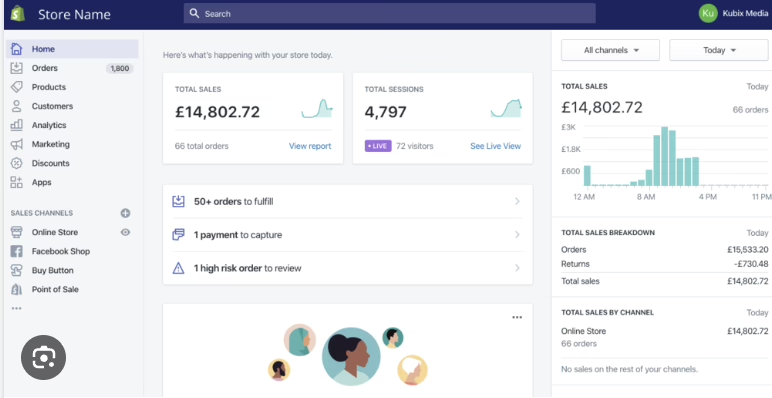
Shopify when speed and simplicity matter
What you get with Shopify is its set of opinions. Should your business conform to what the platform was made for – a standard catalog, typical checkout and fulfillment, marketing apps from the ecosystem – then you will be out the door faster and with lower maintenance bills. Control is the concession. Unusual pricing or a non-standard flow will put constraints on you down the line. And do not think accessibility is a given; WebAIM figures indicate the platform is not a free pass, so the build team has to do the testing.
Then there is the advice from Reddit that bears heeding: it is cheaper to stay on Shopify and put in better help than to leave. A small operator would be hard pressed to find a more costly decision than to rebuild a functioning store just to get off a $79/month plan.
WooCommerce when content and commerce live together
WooCommerce is the logical move if commerce is only one of several revenue streams and your business is driven by content in the form of editorial, community or membership. You have true command of your data and content, but that flexibility is something you have to own. Someone is going to have to be on top of security, updates and plugins. Once the operation outgrows what is off the shelf, custom WooCommerce development becomes worthwhile for things like subscription logic and integrations.
We saw this with our work for NudFud, the plant-based snack brand. The checkout was not the issue. It was getting the merchandising, product structure and certifications to make sense to the shopper before they put anything in the cart.
Headless or custom when the storefront is the product
The case for headless comes up when the platform’s way of doing things is an impediment to what the storefront must do. That could be for performance, a shared front end for multiple back ends, or buying flows that are not the norm. Crystallize has a good technical read on modern ecommerce development for why teams are focused on Core Web Vitals and server-side rendering in these instances. But the rub is that the composition is now yours to handle. Your team, not the vendor, is left to manage the seams between search, PIM, CMS and checkout.
It is not something most stores require. Only those where the storefront is a real competitive advantage, as opposed to a box to be ticked, will see the benefit.
Wondering how your store shows up in AI search? We put together a short visibility snapshot. Get the snapshot.
Where Ecommerce Projects Actually Fail
Failure patterns are as repeatable as they are dull. Read enough post-mortems and they come down to a short list.
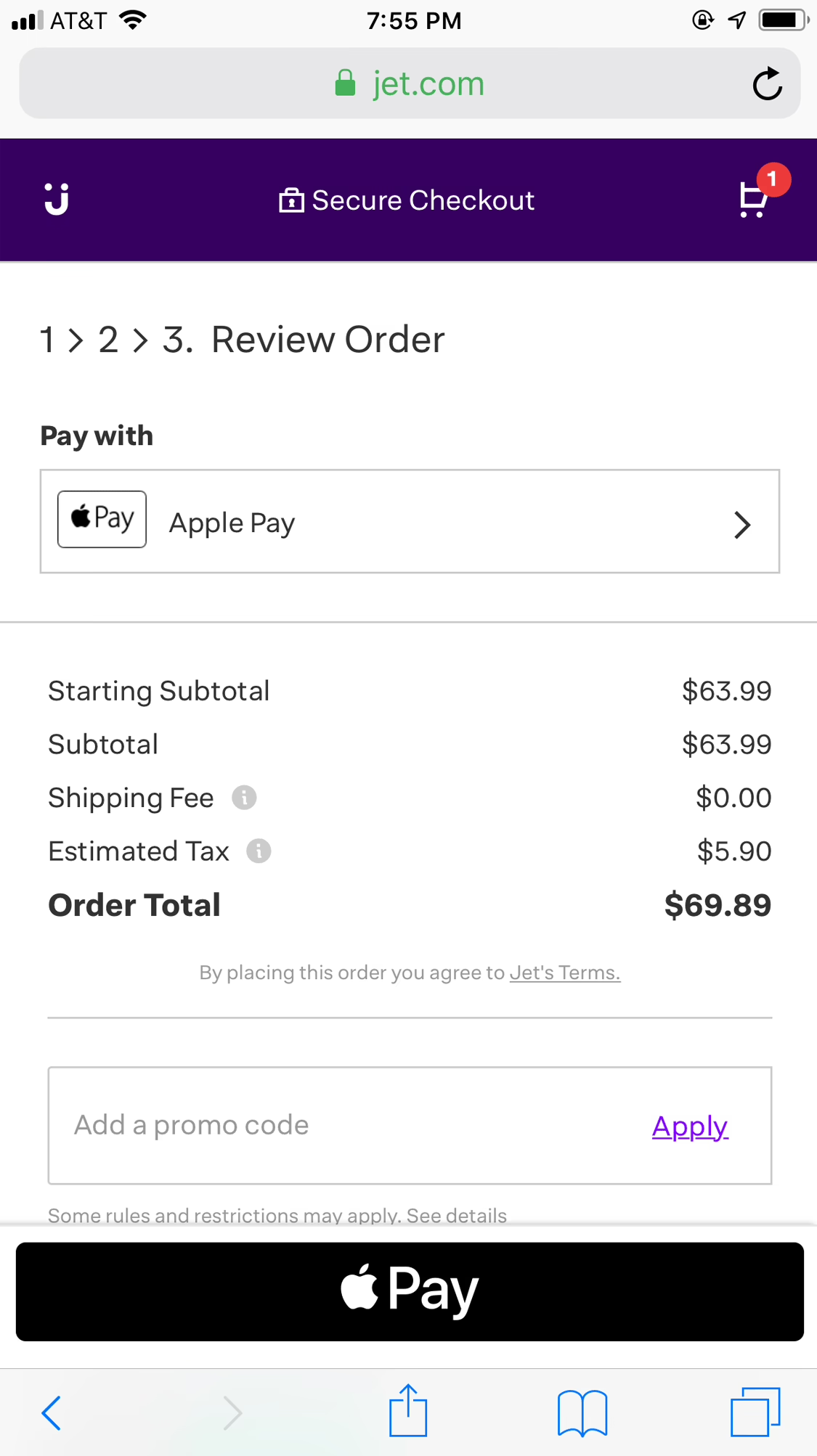
Checkout defects. Baymard’s 2025 numbers tell the story: 94 percent of sites have no adaptive error messages, 52 percent are missing shipping options in the UI, 65 percent have passwords that are too strict. These are fixable. Yet many build teams will not look for them because “the checkout works” is good enough for them.
Tracking errors. One Shopify operator on X put down a 50 percent drop in sales to a pixel misconfigured to fire on the wrong event. The site looked fine, but the analytics were at odds with the bank statement for weeks.
SEO regressions in a replatforming. If you do not have 1:1 URL mappings and proper redirects, you will wipe out years of organic revenue. A “successful launch” can become a bad quarter in a hurry.
Custom code that is not documented. The plugin powering your renewals that no one recalls installing will fail in silence during a migration and the ops team will be none the wiser until month end.
Bundled hosting and design. Reddit has little patience for this. What you end up with is a store that looks acceptable but was cobbled together quickly by whoever was on hand, with no one to answer for it after launch.
These are not exotic issues. They happen when the store is not treated as a system.
How to Evaluate a Development Partner Without Getting Burned
A project rarely fails for want of coding ability. More often the working relationship is flawed: no plan for the eighteen months post-launch, a vague scope, no one to hold accountable. Our guide on selecting an ecommerce website development company is comprehensive, but the point is to ask questions that make a team think rather than recite their pitch deck.
Put these four on the table:
- “Walk me through a project where the scope shifted. How did you handle it?” You will see how they deal with uncertainty, and where the money goes.
- “What are you advising us not to do, and on what grounds?” A team with judgment has an opinion on what not to build. Those without will agree with you right up to the invoice.
- “Who can update the content and products without having to call in?” An unclear answer means you will be dependent.
- “If we want changes three months down the road, what is the process?” That is the difference between a vendor and a partner.
The ANA and 4As note that integrated full-service agencies average a client tenure of 7.3 years versus 3.7 for media-only outfits. It is a reasonable benchmark for your shortlist. Longer tenures are a signal that the agency has to keep earning its place and is more invested in the outcome.
You will see this pattern in our own projects. Take Broya, the Canadian D2C brand, for instance. We have been at it for five years with their Shopify store. When we came on board the site was up and running and pulling in traffic, so there was no question of a rebuild. Instead we put in the steady work of improving conversions across product pages and collections and the subscription checkout. We also put in place the retention flows that make a first order a second, or a tenth. A long relationship is meant to be about that sort of compounding.
What to Do Before You Ask for a Proposal
Before you put pen to paper on an RFP, do the one thing with the most leverage: write down your business. I am not talking about a spec sheet. Make it a one page that answers five questions:
- What is on offer now and what could be in twelve months?
- On day one, which systems (be it payment, ERP, CRM, tax or subscriptions) have to be talking to each other?
- Once you are live, who on the team is updating the content and promotions and how technical are they?
- Define success at the six month mark with a hard number for revenue, conversion or repeat rate.
- What would have you regretting the build? Perhaps a slow site, some missed integration or being too dependent on the agency for a rebuild down the line.
Be honest in your answers and it will alter the tone of every conversation from here on out. You will not be paying a vendor to “discover” what you already know but have yet to commit to writing. Proposals will be read with more speed and any vagueness will stand out for what it is.
Should your thinking still be clearer in your head than on the page, then you need the kind of service Refact’s ecommerce development practice provides. We are in the business of making a build plan out of a business before any code is written and then taking care of the product once it is launched. For us clarity before code is not something we put on a poster. It is why we measure client relationships in years rather than months.
The good decisions in ecommerce are made well before the first commit. That is when you set the scope and cost and avoid future headaches.
Building or replatforming a store? Let’s talk. Free 30-minute call, no pitch.

Saeedreza Abbaspour is the CEO of Refact, where he works across product, engineering, and sales. He sets the studio’s direction while staying closely involved in the work itself, from shaping product strategy and UX architecture to helping define the technical systems behind Refact’s projects. His role connects business thinking with hands-on product execution, giving him a practical view of how software should be planned, built, launched, and improved. At Refact, Saeedreza focuses on building a studio that can move quickly, solve real client problems, and turn ideas into reliable digital products.
More from Saeedreza Abbaspour

