SaaS Application Development: 2026 Founder Guide
There is a tendency to market SaaS application development as a matter of technology, but it is not.


The hard part is what lies outside the code. You still have to contend with validating that someone will open their wallet, making sure tenant isolation is ironclad from day one, or seeing to it that unit economics do not suffer when AI features start to inflate your API bills. And you must ship something with so little friction that a customer does not leave after the trial period.
Do not mistake the market for an issue. Statista’s SaaS market overview puts annual revenue in the hundreds of billions; IDC has SaaS accounting for over 40 per cent of public cloud outlays in 2024. The real question is if your idea warrants a custom build and what choices will make or break the product by year two.
Start With Whether You Should Build At All
You do not need to write production code to vet a first-time SaaS concept. If the workflow can be managed with a shared inbox, a Zapier flow and a spreadsheet, that is your MVP. Make use of it and charge for it. Rebuild in software only after you have seen what breaks under actual conditions.
The ones worth building are generally unremarkable. Think regulated workflows, approval chains that fail in email, or some narrow industry task that horizontal tools do poorly. A 2024 review of over 10,000 posts on r/SaaS and r/indiehackers turned up the same thing: the product is the easy bit. Founders stall when they try to get people to use it. If you cannot put the pain, the buyer and the workflow into a single sentence, you are not ready.
Paying commitment is the only true signal. Enthusiasm is not demand, nor is a “this sounds useful” comment. A wire transfer or a signed pilot agreement is. Refact has a writeup on product discovery techniques that outlines the tests needed to tell the difference between intent and politeness.
Validate The Idea Before You Write Production Code
Trying to sell a bad idea before you build it is the most economical way to put it out of its misery. Get face to face with the people who do the work, not just the one signing the check. Find out what they have tried, the cost of their current workaround and what they would pay to end the problem. Pay more attention to their actions than their words.
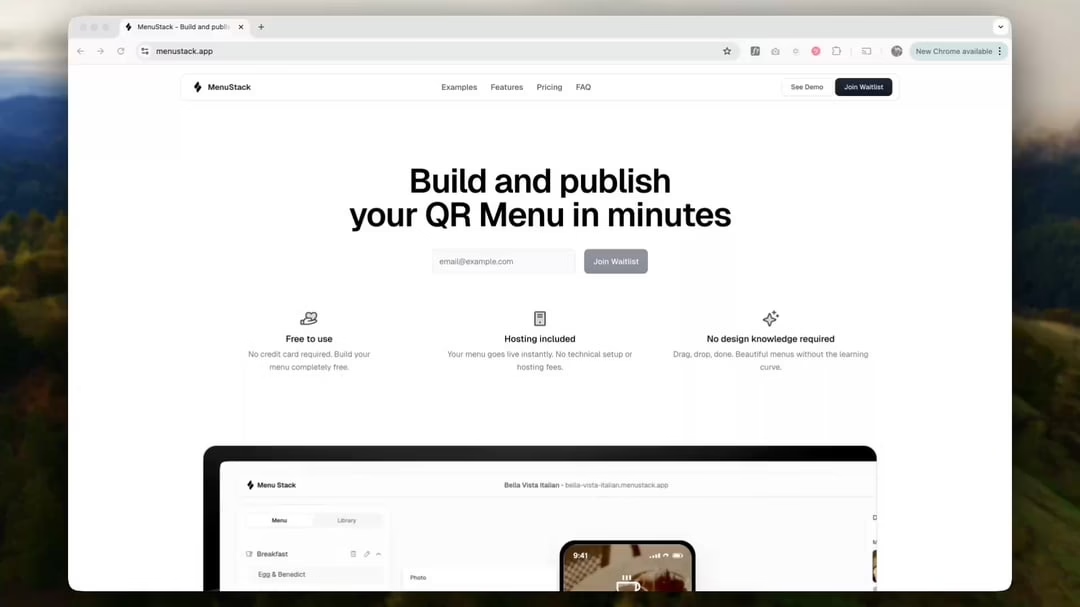
Then put it to the test with a landing page. Should a straightforward description of the problem and outcome fail to put names on a waitlist or book a demo, the offer is weak. Some will set a hard line at cost-per-email for a niche B2B tool; anything over $8 for a qualified signup calls for a rethink.
Be wary of AI-generated concepts. You will see accounts on Reddit and X of founders who have churned out three or four ChatGPT-invented SaaS products with no traction to show for it. The lesson is to talk to ten people, secure a financial commitment and run a small paid test on a landing page before you touch any backend code. Our SaaS MVP development guide goes into the details.
Tech Stack: Pick Boring, Pick What Your Team Knows
If you look at the 2026 SaaS stack, it has settled down more than the debates would have you believe. Developer surveys show TypeScript is used in nearly 69% of large web apps, with many Fortune 500 platforms making the move. For transactional data, Postgres is the safe bet. Add in React, Node and a managed cloud and you have the rest. It is boring because it is effective.
In a young SaaS, novelty is a liability. A framework with a Discord channel and three plugins will not serve you well at 2am when something goes wrong and there is no one to call. The consensus on Hacker News is that stable tech ships faster than what is trending on Twitter.
The only architectural change to plan for is an API-first approach. Enterprise buyers want their systems to integrate with yours and the new breed of AI agents require a clean interface. Having a UI for the human and an API for the agent is standard fare for 2026, not some moonshot.
Multi-Tenancy Is A Security Boundary, Not A Schema Choice
This is where money is lost down the road. Multi-tenancy is too often reduced to a database decision of shared schema or otherwise. That is the wrong way to view it. It is a security boundary you have to police in every subsystem, from authentication and caching to background jobs and admin tools. Cross-tenant leaks are the SaaS equivalent of Broken Object Level Authorization, the number one API vulnerability in the OWASP Top 10. You will find the failure modes to be as repetitive as they are dull. An endpoint here has no tenant filter, a Redis key is not scoped to the right tenant, a reporting query has joined across them all, or some admin tool in support lets staff look at any account with no audit trail to show for it.
The rule of thumb is to have multi-tenancy in place from day one, even in an MVP. Trying to put it in afterwards is no simple refactor; it is a rebuild that will have you reworking auth, data, billing, jobs and infrastructure all at once.
| Isolation Pattern | Best For | Real Cost |
|---|---|---|
| Shared DB, shared schema with tenant_id | Early-stage products, SMB and mid-market buyers | Every query, cache key, and job must be tenant-scoped. Discipline is the whole game. |
| Shared DB, separate schemas | Growing products with some noisy-neighbor pressure | Migrations and reporting get harder. Some ORMs make this painful. |
| Database per tenant | Regulated buyers, strict residency, large enterprise contracts | Operational overhead grows with every tenant. Only worth it when the contract pays for it. |
Unless a regulation or a particular buyer demands otherwise, go with a shared-schema approach. Do not let yourself get cornered, but there is no need to over-engineer for enterprise customers you do not yet have.
What A SaaS Build Actually Costs
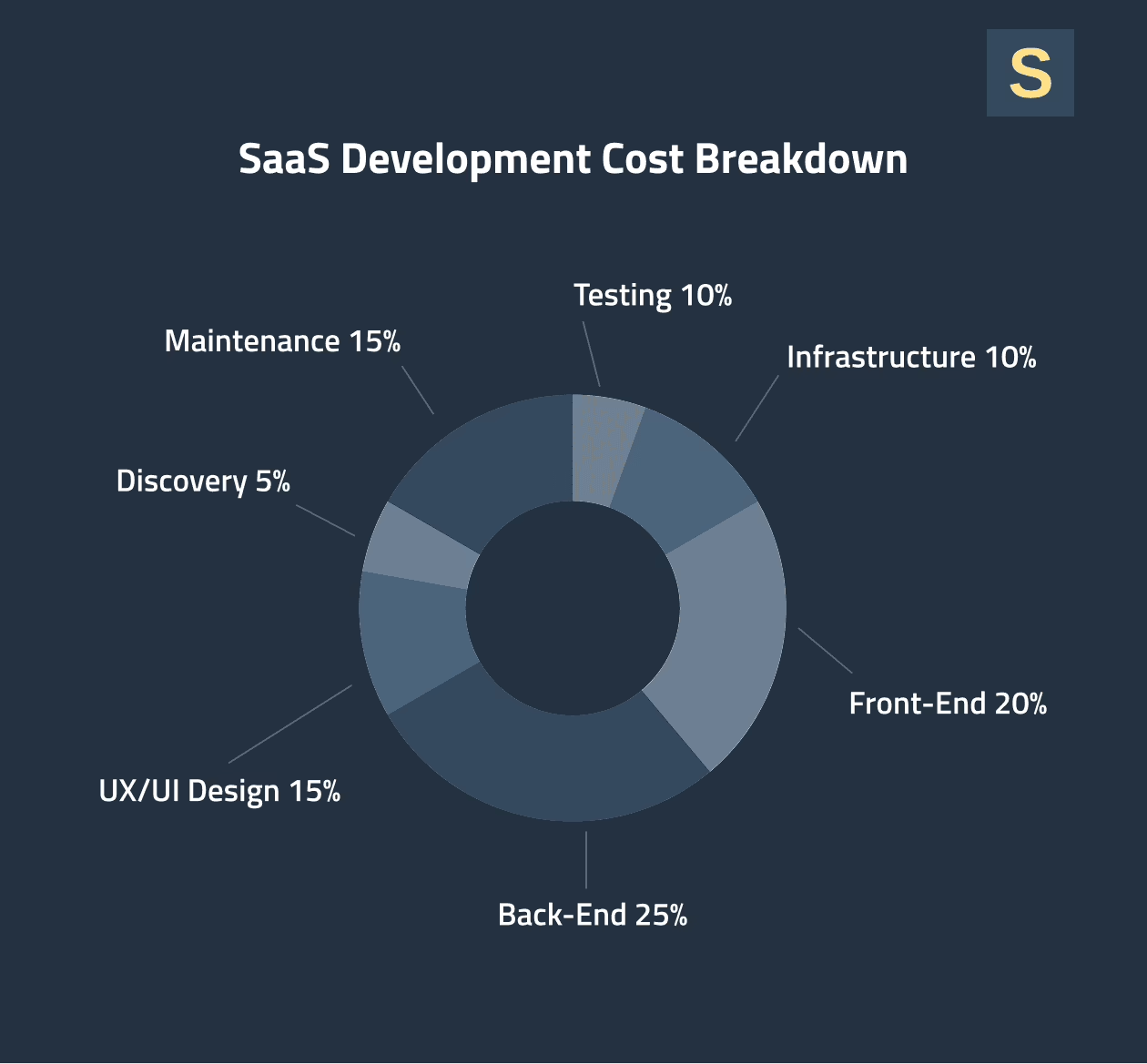
It is hard to pin down a cost for a SaaS build given how much the scope can differ. A workable MVP will run you $30,000 to $150,000. But factor in compliance, integrations and the like and you are looking at mid six figures. Then there is the annual overhead for maintenance and support, generally 15 to 30 percent of what you put in up front. AI can make those infrastructure numbers jump if you are not metering API use by tenant.
What founders tend to underprice are not the code itself but the work surrounding it:
- Support and onboarding. In B2B particularly, the human hours required to get a customer live are an ongoing expense.
- Compliance. You will spend months and hard cash on SOC 2 Type 1 before the first enterprise deal comes through. HIPAA and GDPR are more of the same.
- Nonlinear infrastructure. A per-tenant queue or analytics warehouse is cheap with ten tenants and expensive with a thousand.
- AI costs per tenant. Let LLM calls go unmetered and your gross margins will vanish. Put a cap on them from the start.
Pricing is another matter. The 2025 Monetization Monitor has 59% of software firms anticipating growth in usage-based revenue, an 18 point increase since 2023. IDC figures in the report indicate buyers have moved on from seat subscriptions to prepaid-plus-postpaid models. Usage pricing puts your revenue in line with your cost curve; seat pricing does not.
How To Choose A Build Partner Without Getting Burned
When it comes to building, you can put together an in-house team, hire freelancers or engage a product studio. Any of them will do, provided they fit your rate of learning.
Freelancers are good for defined tasks where the architecture is already decided. If you can afford to hire well and the product requires internal ownership, in-house is the way to go. A studio is often the best middle ground when you want engineering, design and strategy in one room. Refact has a guide to outsourcing SaaS development and one on hiring a product development team that cover the vetting in more depth.
We have seen this play out. With Workform, an AI MVP for project managers, the brief was initially “an assistant for everything.” Some discovery work with Workform put us on the right track to a product that would answer specific questions by pulling from Asana, email and Slack. It saved us from months of building something nobody wanted. Or take CinemaAssist, our independent ticketing platform. We had to figure out the commercial viability of serving one theater while making the system reusable, all while dealing with the technical realities of payment integration and showtime loads. The business model and the build were done in tandem.
Ask any potential partner this: “Tell me something you told a client not to build.” If they cannot give you an honest answer, they will bill you for features you do not need.
The Non-Code Work That Decides Whether The Product Survives
After the software is out the door, other issues come to the fore. Distribution is the great underestimator for founders. A Reddit analysis put it at the top of the pain points and suggested you halve your time in engineering to double down on outbound and partnerships. Consider it a reallocation of the founder’s calendar rather than marketing.
Churn is equally worthy of scrutiny. A look at a thousand cancellations on Reddit shows users walk away due to mental overhead, not the price tag. Complex setup and feature bloat are worse offenders than a lack of features. Look at the likes of Notion, Figma or Stripe; they employ sane defaults and progressive disclosure so a new user has value in the first session. If your onboarding involves a call or a checklist, you are doing too much.
And then there is the enterprise gate. Start selling above the SMB level and SSO, SCIM, RBAC and audit logs stop being extras and become deal breakers. BetterCloud’s 2024 SaaSOps report makes plain that procurement will ask for these controls and their absence will kill a contract you thought was closed. Put the controls in early if you plan to court the mid-market.
What To Do This Week
For those further along the path than this piece presumes, three things will do more for your odds than any technology:
- Sit down with five actual users. Put the workflow and the pain in plain English. If you cannot, you are not ready to build.
- Make a one-pager from those notes. One problem, one user, one job to be done.
- Find a team for a strategy session that will push back on the scope instead of simply nodding along.
By 2026, SaaS development is an endeavour for the operator, not the enthusiast. The answers to engineering problems are there to be had; it is on the commercial and operational front that one makes or loses money. Refact has put in place a discovery process to see that the necessary decisions are made before any code is written and the budget starts to run. We will have that early work done right. And should the clarity we provide not be worth the cost of the discovery phase, there is a guarantee you will have your money back.
Building a product and unsure what to scope first? Let’s talk. Free 30-minute call, no pitch.

Saeedreza Abbaspour is the CEO of Refact, where he works across product, engineering, and sales. He sets the studio’s direction while staying closely involved in the work itself, from shaping product strategy and UX architecture to helping define the technical systems behind Refact’s projects. His role connects business thinking with hands-on product execution, giving him a practical view of how software should be planned, built, launched, and improved. At Refact, Saeedreza focuses on building a studio that can move quickly, solve real client problems, and turn ideas into reliable digital products.
More from Saeedreza Abbaspour
