Strapi vs Sanity: Which CMS Fits Your Team
The choice between Strapi and Sanity is not as binary as it seems.


They are both top-tier headless CMS offerings in 2026 and have been proven at scale in production. What matters is which operating model fits your team. We put together this Strapi vs Sanity comparison for the one who has to put a signature on the contract and justify the cost on the roadmap. (And if you are yet to be convinced on headless altogether, we have our thoughts on headless CMS vs traditional CMS.)
The Real Question Behind Strapi vs Sanity
Take Strapi. It is an open-source Node.js CMS you host yourself on a SQL database of your own making. You define the content types and it will auto-generate the REST and GraphQL APIs. There is no licensing fee because the operations are on you.
Then there is Sanity, a proprietary managed service. Your JSON is in their globally replicated Content Lake, edited via the React-based Sanity Studio and queried with GROQ. You do not have to run any infrastructure, but you do have to make peace with usage-based billing and a certain level of vendor dependency.
From that architectural divide comes every downstream estimate, cost curve and complaint. An agency like Octahedroid, which puts work in production on both, would tell you the real distinctions only become apparent once the ink is dry. That is the honest way to look at it.
How This Choice Usually Arrives
One does not usually consider a CMS in the abstract. Some editorial group is chafing at publishing friction, or there is a legacy platform to be left behind. When we put Teton Gravity Research through the process of moving 10,000 articles from ExpressionEngine, the tech was not the issue. Ensuring the new system suited how their editors worked was. That is the perspective we apply here.
How the Two Platforms Are Built
It is worth going a bit deeper than the marketing copy to see where the architecture forces its hand.
Strapi: A Framework You Own
In many ways Strapi is more of a backend framework. You install it and set up your content types in config files or the admin, and the endpoints are yours. Extensions are plain Node.js. But that freedom has a price. Upgrading is no small matter; one team made public that they put in 40 hours to get from v4 to v5, running into some 50 breaking changes and “countless undocumented gotchas.” The plugin ecosystem is not as deep as what you find with WordPress or Drupal, and community plugins can go quiet. Successful teams treat major upgrades as a framework migration and keep third-party add-ons to a minimum. See our piece on Strapi as a product backbone for the engineering side of things.
Sanity: A Managed Content Backend Plus a Programmable Studio
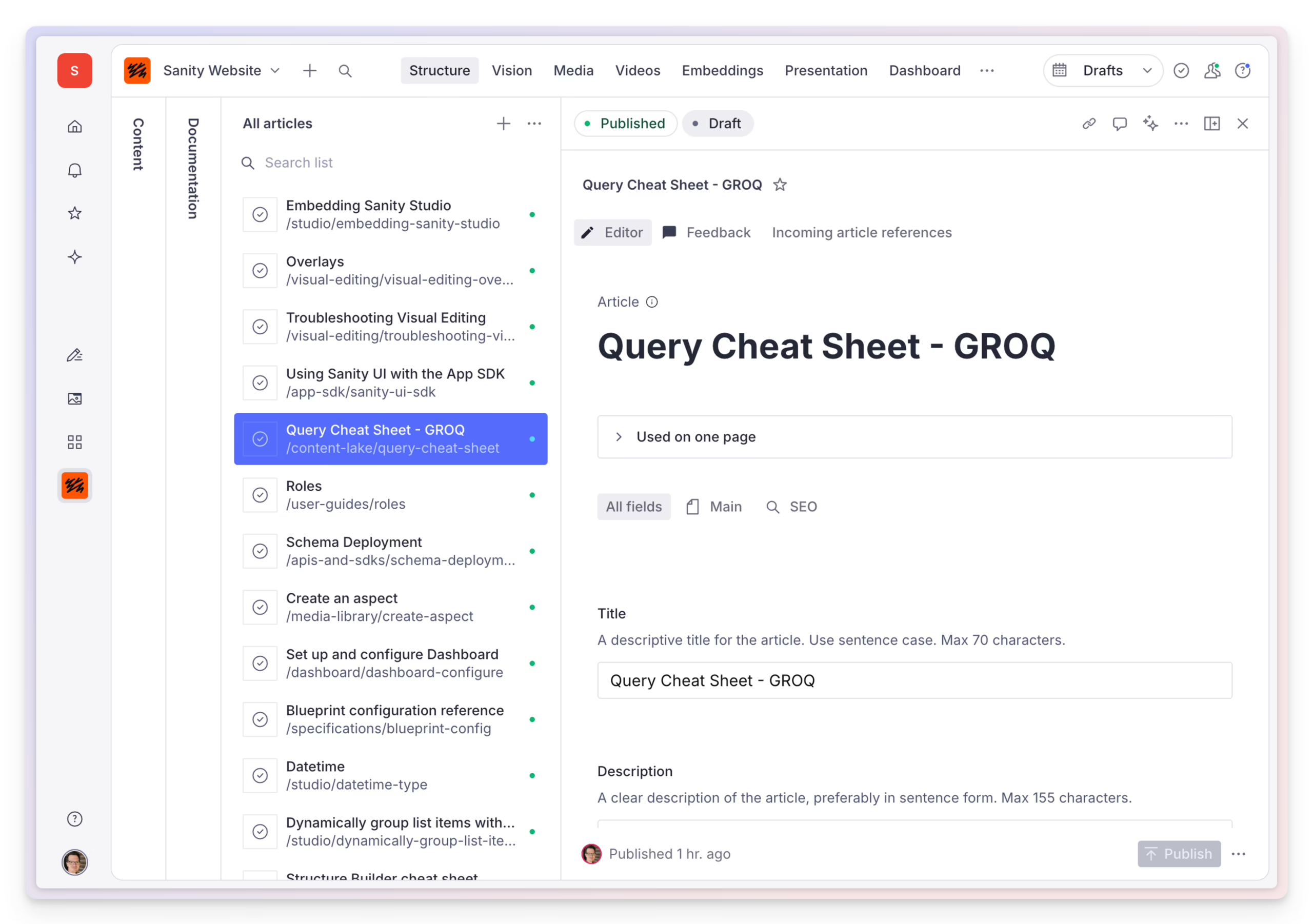
Sanity is really two parts. You have the managed store of the Content Lake and the Sanity Studio, a React app you can shape into whatever interface is needed. Content is versioned in your repo like any other code. With GROQ you can filter and project in a single query, joining references with ->. The Live Content API is the reason Sanity’s UX tends to score higher in independent reviews; G2 has them at number one out of some 85 products.
The rub is that the reference syntax and Studio customizations are all of Sanity’s design. Should you decide to leave, you start from scratch.
Where Editors and Developers Actually Live
You will know which CMS is better on a random Tuesday afternoon, not on kickoff day.
The Editor Experience Is Not Close
With Sanity you have first-class Content Releases for scheduling, Portable Text for rich text and presence indicators so editors can co-edit and see who else is in the document. No need to call in engineering.
Strapi’s form-based admin is functional enough, with role-based permissions and a preview. But there is no native co-editing and multi-stage workflows require some custom work. For non-technical staff it is usable, if not exactly pleasant. If your marketing team is in the CMS daily, that difference adds up. On a rebuild such as the one we did for St. Louis Magazine, the editor workflow was the main determinant of satisfaction. It almost always is.
The Developer Experience Splits Along Ownership
A local Strapi install is quick work; npx create-strapi-app and you have an admin and API in minutes. Any Node.js developer can extend it. What is paid for down the line is the rest of it: the patching, the query tuning, the backups and the hosting.
Sanity hands that weight to the vendor. There is no CDN to put in place, no database to scale and no upgrade window to worry about. Developers will come to regard GROQ as an essential skill and a Studio codebase that is at home only in Sanity. There is nothing wrong with either; they are simply the nature of the work.
What It Actually Costs
When it comes to choosing a CMS, public pricing is what sways most decisions even if it is not the most compelling aspect of the process.
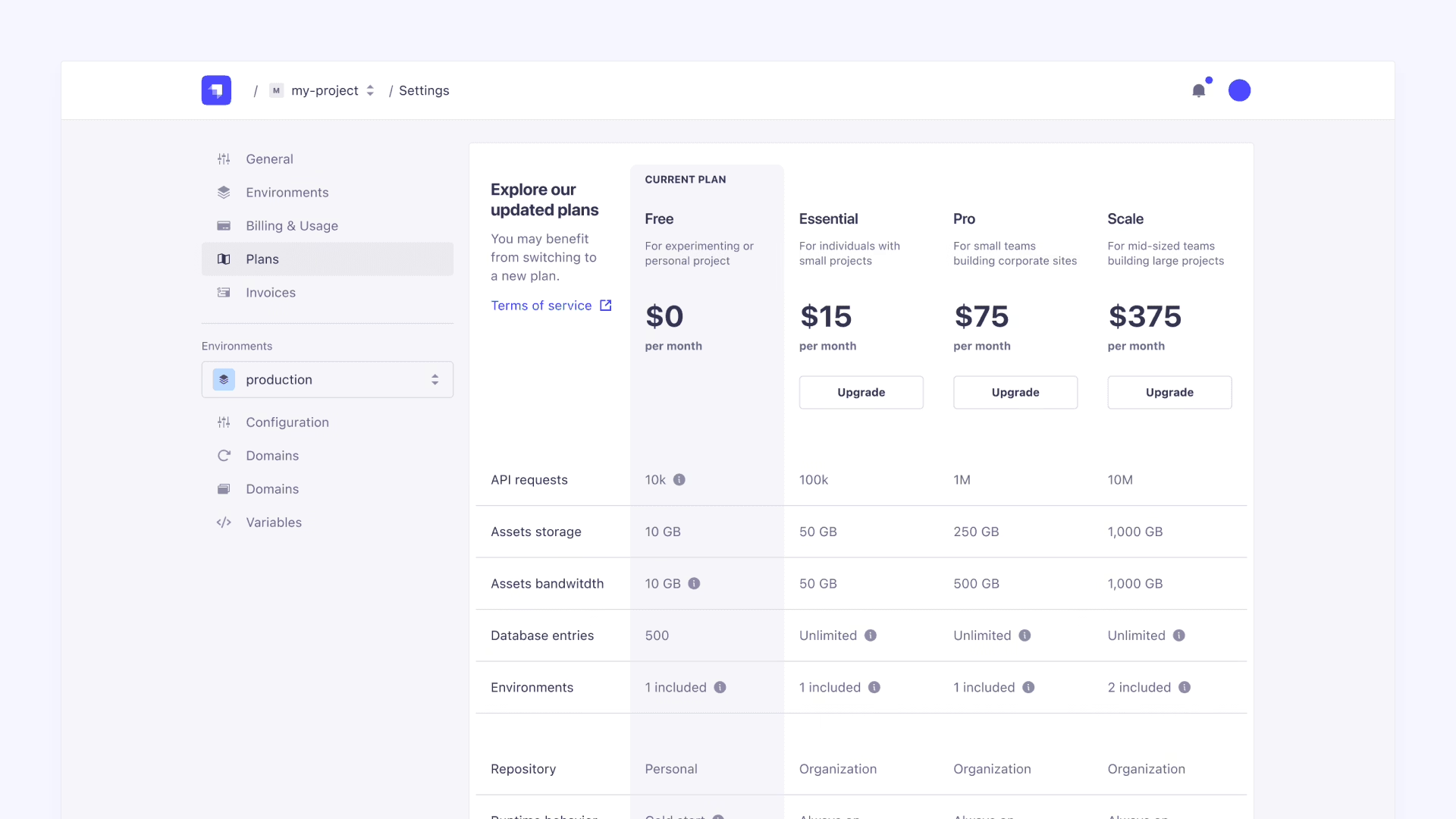
Sanity has its tiers laid out on the Sanity vs Strapi comparison page: you have a free option, enterprise plans for custom roles and higher seat counts running $949 a month or more, and a Growth plan in the vicinity of $99. But since Growth is usage-based, there is room for unexpected costs. We have seen teams in practitioner forums put in a quote for the $99 plan and find themselves over $400 per month after a few months of genuine document volume and traffic.
Then there is Strapi Cloud at $15 to $29 a month, or self-hosted Strapi which carries no license fee. Someone still has to man the servers though. If you factor in engineering time, uptime and the odd upgrade project, the annual tab for enterprise self-hosting maintenance on Strapi is commonly put at between $20,000 and $80,000.
You will see an inflection point in most comparisons in the $400 to $600 range. Under that figure, Sanity tends to be the better value. Over it, a properly run self-hosted Strapi is cheaper, provided one is being honest about “properly run.”
| Cost dimension | Strapi | Sanity |
|---|---|---|
| License | Free self-hosted, $15+/mo Cloud | Free tier, $99+/mo Growth, $949+/mo Business |
| Ops burden | High self-hosted, medium Cloud | Low, managed by vendor |
| Cost shape | Predictable subscription plus labor | Usage-based, per-seat, scales with traffic |
| Typical 2-year TCO | $55K–$210K self-hosted, $30K–$75K Cloud | $30K–$65K |
| Where it hurts | Engineering time and upgrades | API call volume and role tiers |
To read the table with any honesty, one should not conclude that one is cheaper than the other. What it shows is how the two platforms allocate cost across your P&L. The question is which column you can justify.
Performance, Reliability, and the Lock-In You Do Not See
Performance Depends On Who Tuned It
In terms of performance, Sanity’s managed Content Lake puts median API TTFB at 80-150 ms, with independent tests showing P95 uncached latency near 87 ms. Strapi’s API is infrastructure dependent and can be anywhere from 50 to 300 ms. With the right caching and indexes on Postgres, a well-tuned Strapi will put up better numbers; leave it as is and it will be worse.
Reliability Is Not As One-Sided As Assumed
There is a tendency to think managed SaaS is more reliable than what you host, but 90-day monitoring data does not always bear that out. In one recent 90-day period, Strapi Cloud had 100.00% uptime and no incidents. Sanity was at 99.19% with 8 minor ones. That is hardly a final word; ninety days is a short time and an average self-hosted Strapi will not keep pace with hardened SaaS. Still, it serves as a reminder of the failure modes of centralization: an incident with Sanity is a single event that ripples through every app tied to it.
Lock-In Is Real, But Manageable
Porting Sanity’s data model, Studio work and GROQ queries is not clean. Strapi’s own migration guide is instructive on the matter: you have to manually map every schema and turn reference joins into populate parameters, while GROQ becomes REST filter parameters such as filters[field][$eq]=value. For anything complex, practitioners will tell you to budget 2 to 6 weeks of engineering.
Strapi offers less lock-in at the query level given that REST and GraphQL are portable, but your custom plugins and controllers do not move by themselves. You can look at our CMS migration services page to see how we scope that kind of work. There is no free lunch, only a matter of which one you prefer to put down for.
Which One Fits Your Team
Four factors dictate the answer: the strictness of compliance, who is running the infrastructure, who is editing content and the predictability of your traffic.
- Strapi is the choice when you have DevOps to spare and want predictable licensing rather than bills based on usage, or where data residency is non-negotiable (finance, government). This is where you find case studies like PostHog, Tesco and Airbus Space Digital.
- Sanity is for when you need to get going fast with little DevOps overhead and want real-time collaboration for editors who are key stakeholders. PUMA and Figma are examples.
- Do a spike first. Put three or five real content types on each platform and let your team use them for a week. Most of the regret we see could be sidestepped here.
Without that step, the failure is rarely picking the “wrong” CMS. It is adopting an operating model the team cannot sustain. A Strapi without the DevOps to back it is a maintenance tax; a Sanity without discipline is a schema swamp and a bloated invoice. Our headless CMS comparison for founders goes into more detail on where WordPress and Contentful stand.
A Quick Reference For Different Team Shapes
A lean team with a marketing site and daily editor activity? Go with Sanity. Regulated industry with on-prem needs? Strapi. A product with a portal and dashboards is likely Strapi given you probably have a Node backend in place. For a multi-brand publisher, either will do; it is a matter of whether you value editorial collaboration or content sovereignty more.
How to Move Forward Without Buying Regret
It is not a decision you can easily reverse, so make it count. The teams that do it right will spend a week testing and give their content model the same attention as a public API. Those that do not usually made up their minds in a meeting following a good demo.
When it comes to a live project and the question of Strapi or Sanity, there is value in having a partner who will align that choice with your editors, developers and budget before any code is put down. Our headless CMS development team at Refact does just that. We have a track record of delivering production work on both Strapi and Sanity, for publishers and media teams for whom editorial workflow is paramount.
For those looking for a more in depth perspective from the developer side, we would point you to an honest 2026 side-by-side on the DEV Community; it is a good companion piece to this and lays out the trade-offs as a practitioner would see them.
Ultimately, the CMS is an operating model. So make of the decision what you will, but be sure to put some teeth into governance and do a hard spike prior to committing. Choose which trade-off one is prepared to contend with and move forward from there.
Building a product and unsure what to scope first? Let’s talk. Free 30-minute call, no pitch.

Saeedreza Abbaspour is the CEO of Refact, where he works across product, engineering, and sales. He sets the studio’s direction while staying closely involved in the work itself, from shaping product strategy and UX architecture to helping define the technical systems behind Refact’s projects. His role connects business thinking with hands-on product execution, giving him a practical view of how software should be planned, built, launched, and improved. At Refact, Saeedreza focuses on building a studio that can move quickly, solve real client problems, and turn ideas into reliable digital products.
More from Saeedreza Abbaspour
