Strapi vs Contentful: Which One Fits Your Team
The demos always look great.


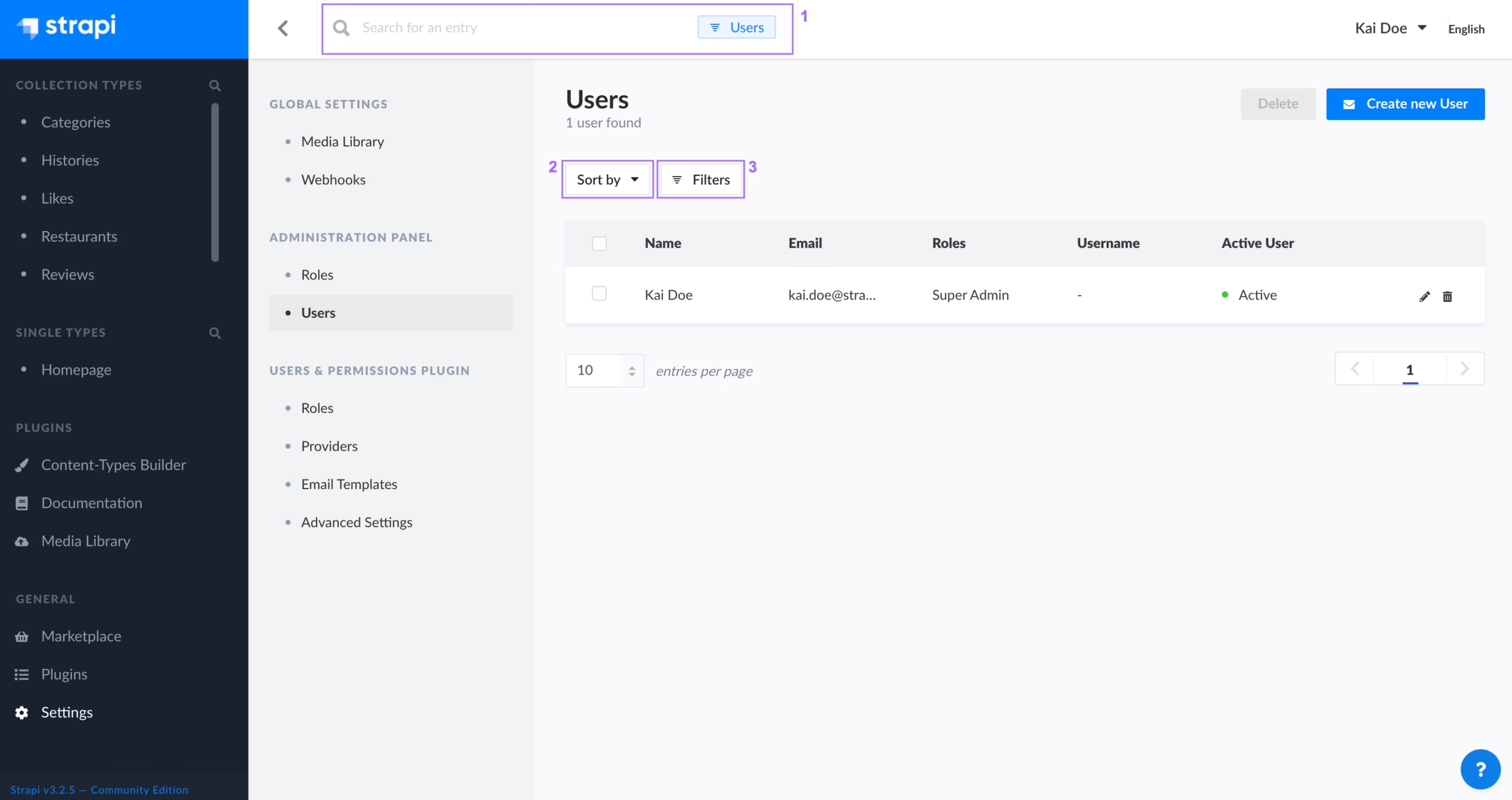
That is the real Strapi vs Contentful choice. Of the two, Strapi gives you a CMS that you are in control of, and as a tradeoff, asks your team to operate it. Contentful removes a majority of the operational work, but also charges you for a managed service, where the upper constraints of the plan will dictate the cost as your project grows. Comparing feature lists will not lead you to an answer for which of those trades your team will accept. This article is about how to make the decision based on the best evidence available, and the patterns we see in production.
The Question Behind the Comparison
After the initial excitement from a good demo, the question should not be which CMS has more features. The more important question is which one will your team be able to run in month seven without any unexpected costs or operational debt. APIs, plugins, roles, previews, and localization all play a role. However, the operating model is what is most important.
Strapi is a Node.js CMS that your team installs and controls. You have control of the application code, database, storage, the deployment pipeline, and the deployment process. This is well suited for organizations that can dedicate an engineer to the platform. Even with an open source product, you have to do upgrades, code fixes, monitor the product, backups, and have a recovery plan if a failure occurs.
As a managed SaaS, Contentful takes care of the business and platform operations, delivery layers, and updating, which essentially enables your team to have a faster operational start with less worrying at night. Although this is the case, limits and budgets are still imposed on plan usage of users, locales, roles, API calls, and bandwidth, which affects publishing. According to independent 2026 pricing research, the starting price for Contentful’s first paid plan is around $300 per month. The free plan has limitations that are determined by the source, so you should definitely read the Contentful plan and licensing brief before signing on for anything.
If you are still not sure about the difference between headless and traditional CMSs, our headless CMS versus traditional CMS guide provides information about the distinction in architecture and explains it in a non-technical way.
Pick the CMS that your team can maintain on a bad day, not the one that looks best in a sales presentation.
How Each Platform Actually Works
Contentful was founded in Berlin in 2013 and currently serves thousands of customers, including a significant proportion of the Fortune 500. Contentful’s company history on Wikipedia provides the outline of the company’s story. In 2015, Strapi’s open source project began with an API-first and developer-centered approach. The open source movement informed the positioning of both companies. Contentful offers enterprise composable content, while Strapi provides content ownership and flexibility.
Strapi is a Node.js application that you deploy as you see fit. You can deploy it to your cloud, a container platform, or on-premise deployments. Your team can choose the database, the way assets are stored, how backups are done, and the way the application is deployed from staging to production. Developers do not have to wait for a vendor to expose something they can change. Developers can extend controllers, middleware, plugins, and workflows. This kind of freedom leads to an operational burden that is always present. This burden includes upgrades, patching, monitoring, scaling, access control, and responding to incidents.
Contentful alleviates nearly all of that burden from your team. Editors work in the Contentful application. Websites and product surfaces consume content via Contentful’s REST and GraphQL APIs. You cannot self-host Contentful, and you cannot manage the underlying runtime.
| Dimension | Strapi | Contentful |
|---|---|---|
| Operating model | Open-source, self-hosted or Strapi Cloud | Fully managed SaaS |
| Hosting | Your cloud, containers, or on-premises | Vendor-hosted only | tr>
| Core stack | Node.js | Vendor-managed platform |
| Infrastructure control | High | Low |
| Maintenance owner | Your team | Vendor |
| Customization | Application code, plugins, middleware | APIs, webhooks, apps, supported integrations |
| Lock-in | Lower platform lock-in, migrations still cost | Higher dependence on vendor pricing and APIs |
| Best fit | Engineering-led teams that need control | Teams that need managed operations |
The difference is ownership. Strapi gives your team the ability to change nearly everything about how the CMS behaves, but the team must keep the service running. Contentful gives your team the ability to spend nearly all of their time away from the infrastructure. Neither is better than the other. The right one is determined by who is staying up to answer the phone when the application(s) break.
What the Cost Actually Looks Like
Setting up a CMS tends to have more costs than just a license. Using Strapi’s self-hosted core means you avoid a license fee, but there are still costs associated with hosting, databases, file storage, backups, monitoring, security, and owning the on-call rotation. Contentful charges for one of their managed services, so their bill will reflect the number of users, locales, roles, and volume of their API and content delivery network (CDN) bandwidth. Governance features may also be added. A basic prototype will fit in the free tier, but a multi-market publishing solution with a translation workflow will not.
Currently available comparison documents place the starting price for Contentful around $300 per month. Limits within the free tier seem to vary across sources. One states that the free tier supports 5 users, 2 locales, and 1,000,000 API calls per month. Others claim the free tier would support 10 users, 2 roles, 2 locales, 100,000 API calls per month, and 50 GB of CDN bandwidth. Make sure you understand which plan actually applies to your situation before you draft a budget.
Before you make a final decision, create a budget worksheet with the following sections:
- Platform costs. Subscriptions, paid hosting, databases, storage, backups, monitoring, CDN.
- People costs. Setup, upgrades, security, modeling, editing, on-call.
- Change costs. New locales, workflows, integrations, traffic increase.
Considering most projects hinge on the allocation of funds, having a Node.js engineer versed in operations and adaptability makes potential savings from a Strapi license real savings. Without that engineer, the savings you achieve from a reduced license cost will be spent on contractor hours, and likely more than expected. Take a look at how we broke down the costs associated with Contentful and Strapi for products for further reading.
Developer and Editor Experience
Strapi comes with familiarity to a team of Node.js engineers. Developers can work in a codebase with the tooling they know. The admin panel provides a lot of functionality for content modeling which can be used out of the box. Default behavior can be extended through custom code. Practitioners online in 2026 have been particularly vocal about how quickly a client-ready admin panel can be built. One freelancer even built a panel for service business administration in as little as two to three hours. Another freelancer built a full salon site using Next.js 14, Strapi, and Tailwind. Site administration, services, sections, blog posts, images, and pages could all be managed by the site owner without any developer interaction.
With that flexibility comes a high cost that is felt at the most inconvenient times. Your team is the one responsible for remaining up to date on dependencies, as well as plugins, database functionality, caching configuration, and the tuning of a production environment. While the editor experience does improve over time, it relies even more heavily on developers rather than a mature SaaS admin.
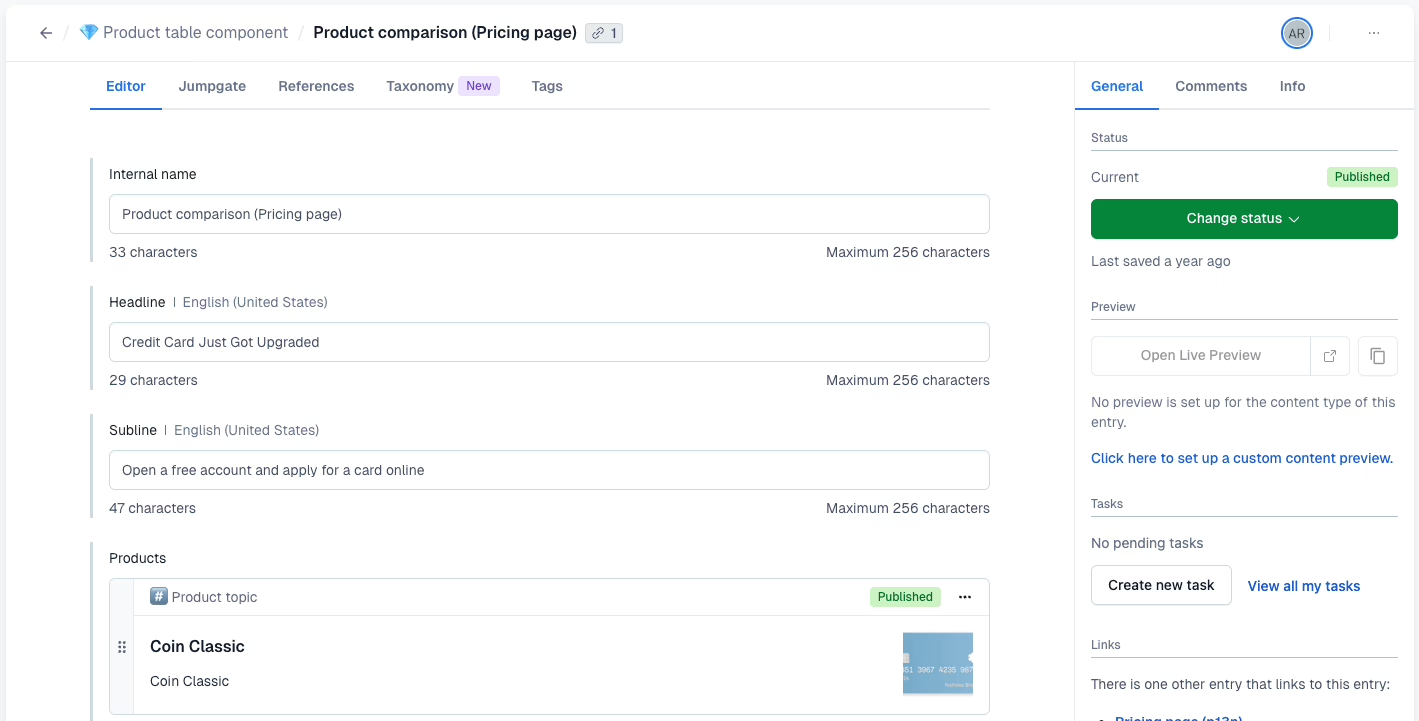
Developers with Contentful do not have to deal with a backend runtime. Tools like REST and GraphQL APIs, SDKs, webhooks, and apps help with automation. Editors get field structure, preview, schedule, and localization control as well as workflows and permission models. The platform supports enough functionality to avoid deep runtime changes, ensuring that no one accesses the database at 2 am and no admin rewrites occur.
Contentful and most other solutions score well for performance, but which is faster depends on how either solution is operated. In an Independent 2026 Benchmark Comparison of Contentful, it took Contentful around 26 ms P50, and around 48 ms on a self-hosted instance of Strapi. Contentful was found to be two to six times faster in the tests. The same report noted that the Strapi results were significantly affected by the hosting, caching, and deployment options. As noted in the report, what matters most is not which CMS is the fastest in a given benchmark. It is which one you can maintain as the media, integrations, localizations, and request volume grow.
Where the Broader Market Fits
This is a significant oversimplification when considering the competitive landscape in 2026. Real world evaluations for 2026 include Sanity, Payload, Directus, and Cosmic besides Contentful and Strapi. If your primary consideration is an open source CMS, compared to Strapi, our Directus vs Strapi comparison is a helpful read. A more curveball approach covers multiple platform headless CMSs like Strapi and Sanity, Contentful, and WordPress in our headless CMS comparison on cost, risk, and team fit.
There are two relevant trends from the market that are worth naming here because they come up in discussions, albeit indirectly, of Strapi vs. Contentful. First, organizations are using Strapi to fill the gap that was previously filled by WordPress, shipping a site that the client can manage themselves. The Next.js combined with Strapi stack has become a repeatable solution in multiple service verticals like salons, restaurants, clinics, hotels, and small agencies. Second, Strapi is in a state of flux. The community has been very active on GitHub and has been having candid conversations about the future of Strapi. Additionally, there are gaps in the documentation between version 3 and version 4. This transition will introduce a lot of cool features. However, teams building on the platform should expect to experience some growing pains. Neither of these reasons should discourage teams from evaluating Strapi. Both should encourage potential customers to ask during their evaluation, who will be responsible for managing the platform and staying on top of the changes.
Where Each Platform Fits
Media and publishing
Start with the editorial workflow, not the design of the homepage. If your organization is more complex, and if a small technical team is able to manage complex schemas, Strapi is a great option. On the other hand, if editors do not want to be responsible for managing the operations of the CMS, then Contentful is a better option. Teams working across multiple markets should evaluate Contentful. Strapi is a great option for clean, custom editorial content and look books.
Ecommerce
Most teams working in the content and eCommerce space fall somewhere in the middle of these two solutions.
SaaS marketing
Choose Strapi when marketing shares elements with the product and engineering has flexibility to maintain the stack. Choose Contentful when the product team requires more development time for the application rather than for the CMS.
Nonprofit and education
Strapi is usually the more budget friendly and hosting flexible solution. Organizations with significant audit, compliance, or data residency obligations should evaluate Contentful’s plan-specific controls early on rather than assuming a lower cost license will resolve the requirements of the project as a whole.
Migration, Security, and Compliance
Whichever way you jump, treat migration as a product undertaking, not a database export. Strapi’s dynamic zones and reusable components do not align well with Contentful references and rich-text fields. In the opposite direction, Contentful’s localization, asset types, and publishing workflows require modeling in Strapi.
First conduct a content audit. Capture types, fields, references, assets, locales, redirects, and permissions as well as publication statuses. Run both in tandem for a sufficient length of time to examine the content in both systems and the final output on the front end before routing traffic to either system.
A workable migration plan covers:
- Think about schema mapping. Think about how components, references, and rich text will change in both systems.
- Transfer assets, then validate references, transformations, and permissions.
- Create new redirects to preserve important URLs and document changes.
- Restrict access. Review roles, tokens, SSO, and editorial permissions.
- Validate the new content model against the website in tandem before making the switch.
Teams looking to use this content migration playbookwill find it useful for a more comprehensive checklist. If the migration portion of the project is the biggest concern for you, check out our CMS migration work.
Ownership tends to vary across platforms. With Strapi, your team is responsible for a variety of tasks including ongoing platform costs – device patching, threat detection and prevention, rate limiting, SSL configuration, backups, access logging, and incident response. In contrast, with Contentful, your team is responsible for managing API keys, and editorial access rights and permissions to content, and Contentful manages compliance.
How to Decide, and What to Do Next
If you have an engineer that can manage the long haul on infrastructure, security, and platform upgrades, and self-hosting, data control, customization and behavior, or freedom from hard SaaS quotas is critical, Strapi is a fit. This Strapi development page provides more information on the projects that are a good fit.
With Contentful, if your team is small, or if your focus is publishing, and if managed uptime and operations coupled with a fast-start is a priority, then Contentful is the likely choice.
| Signal | Pick Strapi | Pick Contentful |
|---|---|---|
| Team has infrastructure experience | Yes | Not required |
| Data residency or self-hosting matters | Yes | No |
| Editors need managed workflows | Possible, with more setup | Usually the easier fit |
| You need deep backend customization | Yes | Limited to supported extension points |
| You want the vendor to run the platform | No | Yes |
| Many content types or locales | Flexible, infrastructure becomes the ceiling | Map needs against plan limits |
| Little maintenance capacity | Risky | Better fit |
There are decidedly messy middle options. Contentful can manage aspects of editorial operations and provide custom product surfaces, and Strapi can power the same type of custom surfaces. With these setups, you’ll need to do integration, permissions, and monitoring, so choose this option only if there are truly separate responsibilities and the business supports this additional complexity. This website builder and CMS overview has a good overview of website builders and CMS if you’d like to get a bigger picture around this.
Three things to do before placing build requests and signing contracts:
- Define a two-week content model spike in both systems. Use real articles and media, some relationships, localization, and publishing workflows.
- Define the operational ownership for hosting, patches, backups, security, and editor support.
- Estimate the cost for migration, new locales, integrations, permissions, monitoring and the plan tier you’ll end up on AFTER the six month launch.
The most substantial part of the Strapi vs Contentful dilemma is not the platforms. It’s the selection of the technology before the operating model has been formed. If you’d like to move beyond this portion of the work, this is the type of prior work that Refact’s headless CMS development services are ideally suited to assist with, before coding begins.
Building a product and unsure what to scope first? Let’s talk. Free 30-minute call, no pitch.

Saeedreza Abbaspour is the CEO of Refact, where he works across product, engineering, and sales. He sets the studio’s direction while staying closely involved in the work itself, from shaping product strategy and UX architecture to helping define the technical systems behind Refact’s projects. His role connects business thinking with hands-on product execution, giving him a practical view of how software should be planned, built, launched, and improved. At Refact, Saeedreza focuses on building a studio that can move quickly, solve real client problems, and turn ideas into reliable digital products.
More from Saeedreza Abbaspour

