Law Firm Website Design Cost in 2026
Three quotes for the same law firm website can come back at $4,000, $18,000, and $65,000.


That confusion is the real subject of any honest conversation about law firm website design cost. The dollar figure is downstream of a scope decision most firms have not made yet. This guide walks through the price bands that actually exist in 2026, the line items that move them, and the spending mistakes that keep showing up in firms that later rebuild within 18 months.
If you are weighing proposals right now, the goal is not to find the cheapest one. It is to figure out which scope your firm needs over the next three years, then judge each quote against that.
What a Law Firm Website Actually Costs in 2026
Across agency pricing pages, legal consultants, and practitioner discussions, the numbers cluster into four bands. They line up with firm size and market competitiveness more than they do with visual quality.
- Solo or basic brochure site: $2,000 to $6,000
- Small firm, two to five attorneys: $5,000 to $15,000
- Mid-sized firm or competitive metro: $15,000 to $30,000
- Bespoke build in NYC, LA, Miami, or similar markets: $30,000 to $40,000+
UK ranges map closely: £2,500 to £6,000 at the entry tier, £7,000 to £18,000 in the middle, and £20,000 to £50,000+ for bespoke work. Specialist legal agencies often price in productized tiers, with simple packages near $3,000, guided builds near $6,000, and custom projects starting around $10,000. Clio’s breakdown of attorney website costs reports that custom sites with bar-compliance features, secure portals, and accessibility work typically land between $12,000 and $25,000, and that those compliance and accessibility line items can lift a budget by 15 to 30 percent on their own.
If a firm needs something beyond a marketing site, the math changes entirely. A custom client portal with intake automation, case status, and document exchange is software, not a website. Initial builds run $150,000 to $500,000, and complex AI-assisted systems pass $1 million. Maintenance for those systems sits at 30 to 50 percent of the build cost per year. Five-year totals reach $750,000 to $2.5 million.
There is a specific failure band in the middle of that range. Custom legal systems attempted at $50,000 to $100,000 routinely fail in production or require rework inside 18 to 24 months. The ambition is product-grade. The budget is brochure-plus. The result tends to be neither.
Law firm website cost is not “how much does a website cost.” It is “what level of business outcome am I trying to buy, and what scope of work does that require.”
The Number Most Firms Miss: 5 to 15 Percent
The build is the loudest line item. It is also the smallest one over time.
Run the math on a serious three-year plan. A $10,000 build, $75 a month for hosting, $400 a month for maintenance, $2,000 a month for content, and $3,000 a month for SEO works out to roughly $200,000 over three years. The build itself is around 5 percent of that. Even for a leaner firm spending $500 a month on content and SEO together, the build rarely exceeds 15 percent of the three-year total.
This is the single most useful frame for budget conversations. Firms that optimize hard for build cost while ignoring the recurring stack tend to launch a site that ranks for nothing, captures nothing, and gets rebuilt before its third birthday. Firms that overspend on the build and skip the recurring stack get the same outcome at a higher price.
If you only have so much money to spend, the better question is rarely “how do I save $3,000 on the build.” It is “what is the smallest competent build that lets me commit to 24 months of content, SEO, and intake work.” A practical breakdown of what that ongoing layer should cost sits in our website maintenance cost guide.
What the recurring layer actually includes
- Hosting and technical maintenance: $150 to $500 a month for most firms; $100 to $300 for solos
- Legal SaaS bundles (LawLytics, Clio Grow, etc.): $100 to $300 a month
- Content production: $500 to $2,500 a month, depending on cadence
- SEO retainer or in-house work: $500 to $5,000 a month for growth-oriented firms
- Intake automation and CRM hygiene: often missed entirely, then added as panic spend
The Seven Drivers That Move a Quote
When two vendors quote the same firm at $8,000 and $26,000, the difference is rarely “one has nicer designers.” It is almost always one or more of these seven scope variables.
1. Design choice and page count
A semi-custom theme with a strong information architecture is dramatically cheaper than a fully custom design system. Page count then multiplies every cost on top of that. Each attorney bio, practice area page, FAQ, and city page adds design hours, copy hours, QA, and review cycles. A 20-page custom legal site complete with copy and SEO setup commonly lands between $8,000 and $25,000.
2. Copy and content strategy
Copywriting is usually quoted around $300 per page up to roughly 1,000 words. Five to ten pages of bar-appropriate, conversion-aware copy lands between $500 and $2,500. Full content strategy with practice area depth, blog architecture, and FAQ research can reach $6,000. Cheap quotes that exclude copywriting are not cheap quotes. They are partial quotes.
3. SEO setup, schema, and Core Web Vitals
Basic on-page SEO setup runs $300 to $800. Technical SEO with schema markup, internal linking, and Core Web Vitals tuning runs $1,500 to $4,000. LegalService schema is no longer optional for firms that want visibility in AI Overviews and zero-click results. The practical Core Web Vitals benchmark for a 2026 law firm site is a sub-two-second mobile load. Sites that load in five or six seconds because of heavy hero videos and image sliders measurably lose calls and form fills.
4. Intake integration and CRM
Wiring forms to a CRM and case management system runs $500 to $3,000. That sounds optional. It is not. A firm we talked through last year was generating about 150 leads a month and burning 37 to 75 paralegal hours every month on manual vetting. The labor cost was around $925 to $1,875. The bigger number was the lost cases: three qualified matters lost per month to slow response, worth $12,000 to $18,000 in fees. For higher-value practice areas, that figure climbed to $20,000 to $42,500 a month.
5. Compliance and accessibility
State-bar advertising rules, ADA accessibility, secure intake forms, and disclaimer placement all add scope. Most pricing pages bury this. Done well, it adds 15 to 30 percent to a build. Done poorly or skipped, it turns into a remediation project later, usually at a worse hourly rate.
6. Hosting, maintenance, and team quality
Hosting setup is small money: $100 to $300 once. The recurring number is what matters. Production-grade WordPress hosting with staging, backups, and managed updates lands between $200 and $500 a month for most firms. The cheapest hosts are cheap because they are not really maintaining anything.
7. Who is doing the work
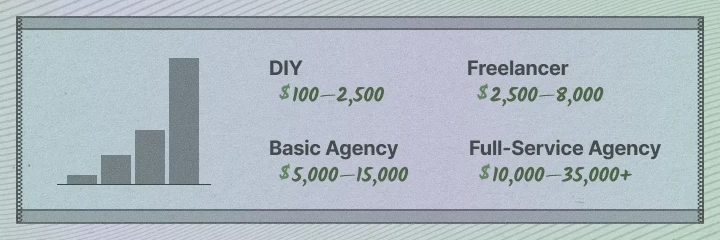
The same scope priced by a DIY platform, a freelancer, a generalist agency, and a legal-specialist agency comes back as four different numbers, often by a factor of ten. None of those four answers is automatically right.
Solo vs. Growing Firm: Two Real Scope Pictures
The bands above are useful, but most firms still have trouble locating themselves in them. Two short examples make the choice more concrete.
The solo family law attorney in a secondary market
The competitive set is small. Most cases come from referrals, the local bar, and a Google Business Profile. The website’s real job is to confirm credibility for someone who has already heard the attorney’s name, and to make contact frictionless.
Reasonable scope: a homepage, three to five practice area pages, a clear attorney bio, FAQs that answer the questions that come up on every intake call, a contact form wired to email and to a basic CRM, schema markup, and competent local SEO. A budget of $3,000 to $6,000 with $200 to $300 a month for hosting and care is appropriate. Spending $20,000 here buys diminishing returns. The money is better spent on Google Business optimization, review collection, and a steady trickle of locally relevant content.
The four-attorney personal injury firm in a competitive metro
The competitive set is brutal. Every paid result is bought. Every map pack position is contested. Intake speed decides which firm signs the case. Generic positioning loses.
Reasonable scope: structured practice area architecture by case type (motor vehicle, premises liability, workplace injury, etc.), full attorney pages, jurisdiction-specific landing pages, a fast mobile experience, LegalService schema, multiple redundant CTAs on every page, progressive-disclosure intake forms, CRM integration with same-day routing, call tracking, and analytics that report on cases signed rather than form fills. A budget of $15,000 to $30,000 for the build is normal, plus $2,000 to $5,000 a month in ongoing SEO and content. Spending $4,000 here is not frugal. It is a decision to lose to the firms that did spend.
The mistakes are symmetric. The solo overspends on design polish before proving that anyone is finding the site at all. The growing firm underspends, then discovers six months in that the architecture cannot hold the next two practice areas or the next two hires. Both end up in a redesign conversation faster than they should have.
Where the Money Should Actually Go
One pattern shows up across consultants, practitioners, and the agencies willing to be honest about it: most lawyers overpay for design and underpay for the activities that actually generate clients. The visual asset is a small input. The system around it does the work.
A site built as an intake engine, with clear specialization, fast mobile performance, structured schema, redundant CTAs, and analytics tied to signed cases, tends to lift qualified leads by 40 to 60 percent inside six months of launch. The same investment poured into a beautiful brochure with no intake plumbing usually does not move the needle at all. Lazarev.agency and several legal-specialist studios report similar lift figures from this exact set of behaviors.
That is the part the price tag does not predict. A $2,000 site with clear positioning, real local SEO, and competent intake will out-earn a $30,000 site that ignores any of those three. The reverse is also true: a $30,000 site with strategy, performance engineering, schema, intake automation, and ongoing iteration will out-earn a cheap site in any competitive market.
For firms publishing real content, structuring multiple practice areas, and planning to grow, WordPress remains the practical default. It rewards SEO discipline, supports the schema work that matters in 2026, and gives a firm full ownership of its content and data. Our take on what a serious build looks like sits in our custom WordPress website design guide, and our WordPress development services page covers what we build into a project by default.
Choosing a Partner: DIY, Freelancer, Agency
You could say AI builders have put a new spin on the entry-level discussion. These days a solo attorney with some skill can put together a respectable Squarespace or an AI-made site in a matter of a weekend for a couple of hundred bucks. And you will see designers on X make the case that the client who turns down a $12,000 plan for something at $1,000 is apt to return when the cheaper thing falls apart, and end up paying triple. Both are true.
But here is the plain truth:
- DIY (Squarespace, Wix, the AI tools): $200-$4,000 out of pocket. It is good enough for a solo in a market with little competition and a solid referral book, provided your Google Business Profile is in order. But it is a hard ceiling if you want to compete on search.
- Freelancer: $2,000 to $8,000. Fine for a well-defined, small scope. The problem is key-person risk; you will not find one person who is equally adept at design, dev, SEO, compliance and support after launch.
- Generalist agency: $5,000 to $20,000. You get process and bench strength, but their grasp of legal intake and compliance can be hit or miss.
- Legal-specialist agency: $6,000 to $40,000 and up. They bring industry context and templated playbooks, and you pay a premium for it.
What matters is not so much the category as what they are unwilling to be vague about. Insist on a breakdown of deliverables: who is writing the copy, how many revisions you get, the cost of post-launch edits, and what is being done for SEO and compliance. Make sure the firm has ownership of the domain, hosting and admin access. If a vendor is evasive there, he is selling you lock-in, not a website.
If you want an outside perspective on legal demand gen that does not get lost in design theater, we find this guide for B2B legal marketers to be a good read; it puts the emphasis where it should be, on pipeline behavior.
Red flags worth walking away from
- Guarantees of “number one on Google”
- A line item that lumps strategy, design and SEO into a vague whole
- Hosting you cannot get out from under the vendor
- Pricing all about the look-and-feel while saying nothing of analytics or schema
- No straight answer on content ownership should things go south
How to Read Your Three Quotes
When a firm has three proposals in front of them it can feel like a budgeting exercise. Don’t let it be. It is a scope exercise that dictates the budget.
There are two questions that settle the rest. One: over the next 24 to 36 months, is this site to be a brochure, an intake engine or a platform for clients? Two: what is the most modest build you can put in place that won’t make you wince at month nine when it comes time to commit to the recurring costs of hosting, content and SEO?
Once you have those answers the figures above make sense. A solo with a referral-driven practice can walk away from the $3,000 to $6,000 mark without any pangs. A firm in a competitive metro will accept $15,000 to $30,000 as table stakes and not bother haggling. If you need a portal, you know you are buying software and you price it as such.
At Refact we do our early discovery work with operators to get that scope in the open before a proposal is even written. We did it with media operators such as Stacked Marketer to ensure the build was right for how the business would run in two years’ time, not just what a pretty mockup suggested. That clarity is what makes a budget defensible; otherwise a quote is just a number.
So if you are looking to size the right partner and the right plan, our discovery process is made to put those decisions to rest.
Building a product and unsure what to scope first? Let’s talk. Free 30-minute call, no pitch.

Saeedreza Abbaspour is the CEO of Refact, where he works across product, engineering, and sales. He sets the studio’s direction while staying closely involved in the work itself, from shaping product strategy and UX architecture to helping define the technical systems behind Refact’s projects. His role connects business thinking with hands-on product execution, giving him a practical view of how software should be planned, built, launched, and improved. At Refact, Saeedreza focuses on building a studio that can move quickly, solve real client problems, and turn ideas into reliable digital products.
More from Saeedreza Abbaspour
