How to Create a Membership Website That Lasts
You will not find a membership site that has failed on account of the wrong plugin.


To put it plainly, if your goal is a site where people are still paying in month three and beyond, you do not start with tooling. You start with a few hard decisions on price, onboarding, offer and audience, long before a line of code is put down. The numbers don’t lie: memberships that have an audience in place at launch will best their competition on almost any metric you care to measure. And a site with an actual community area will see churn at about two-thirds the rate of one that is nothing but content. Everything else in this guide follows from those two facts.
Start With the Business, Not the Plugin
The error most operators make is to think of a membership as a gated content library. It is a comfortable way of looking at it because it makes a business problem into a matter of shopping for a plugin and theme, uploading some video and calling it a day.
But renewals have a way of showing you the truth. If all the member has is “read these articles” or “watch the lessons,” they will take what they need and cancel. With 94% of marketers now planning to put AI to work on content (per HubSpot’s 2026 State of Marketing), so-called exclusive content behind a paywall is starting to look like a commodity with an arbitrary gate. People do not keep paying because information is in short supply. They do it for the credentials, the feedback, the tools, or the community.
So forget the question of which platform to use. Ask yourself what a member is paying to be or do here that he cannot get for free with a good search engine.
Validate before you build
If you want some figures, Paid Memberships Pro has crunched the research from Sell Courses Online and Membership Geeks to show that 79% of memberships with a pre-launch audience are better on revenue, engagement and retention than their peers. A sizeable gap and the best evidence there is in the category.
There is no need to make validation complicated. In practice it is:
- A waitlist of 200 to 1,000 names who put up their hand to be told when you are live.
- Having 10 or 20 talks with the kind of person you intend to serve, not some adjacent type.
- Selling a founding cohort or paid pilot before you have built anything.
- Running a manual concierge version of the thing over email or in a private group to confirm people will use what you plan to automate.
If you can’t put the member outcome in a sentence and get twenty people to agree with it, you are not ready to build. There is a certain economy to a proper product design and discovery process; it allows you to say “we do not know yet” without feeling like you are stalling.
Define What Members Are Actually Paying For
Founders will tell you they are selling access. They are not. Access is merely the means; what they are selling is a result, a relationship, or some sense of forward motion.
That distinction dictates the product. Your onboarding, your pricing, your community – it is all downstream of the promise you make. Do not try to be all things to all members or they will not know where to stand.
Pick one primary promise
The ones that last tend to be built around one of these:
| Membership type | What members are really buying |
|---|---|
| Content library | Faster learning or saved research time |
| Community | Peers, support, and belonging |
| Tools or templates | Better output with less effort |
| Expert access | Feedback, accountability, direct answers |
| Status or network | Proximity to a group they want to be part of |
You can mix them in later. But one has to be in the lead to begin with. Churn is hiding in the space between why someone joined and why they stayed, and you do not want those to be two different stories.
Community is now the retention lever, not a nice-to-have
Look at the aggregate data and you will see that a dedicated community area brings monthly churn down to 6.12%, compared with 9.26% for the content-only crowd. Put in some Slack or Discord and engagement can hit 46%. Over the course of a year that adds up to an entirely different kind of business.
It does not call for a big forum, just a reason to return other than another lesson. Some office hours, peer introductions, a structured cohort. Jay Clouse of The Lab puts it well. With some 340 members and $500K in ARR he is focused on making “villagers, not consumers,” putting connection ahead of information. His retention stats bear it out.
Try saying this out loud: “People join this membership so they can ______.” If it is thin, your site will be too.
Price for the Renewal, Not the Sale
A lot of pricing pages put the onus on the member to do some studying. They should be self-evident.
Clouse has the right idea when he says to price for the renewal, not the sale. When the novelty wears off in year two and the member has had his fill of the obvious value, does the price still feel fair? If it only holds water because of launch fever, you have not priced it right.
Realistic bands
What SamCart is recommending in 2026 is in line with what you will see most operators charging:
- $9 to $29 a month. The volume play for content or community. You need high acquisition efficiency and low support costs to make it work.
- $49 to $149 a month. Where the hybrid memberships live. You get enough per member to warrant some real service, but not so much that every sale is a coaching session.
- $200 to $500+ a month. For masterminds and the like. This is sold on outcomes, not the size of the library. You will find the same two anti-patterns in nearly any practitioner’s post-mortem. The first is underpricing. There is no virtue in a cheap membership; it breeds disengaged members and an unprofitable operation, and you can’t just raise the price later without some loss of goodwill. Then there are lifetime memberships. Hardly an operator has put one on the table who doesn’t have regrets to tell about. They are a permanent support burden with no revenue to offset it, and they tend to draw in the very members you have the most trouble keeping content.
Keep tiers honest
Your tiers ought to be based on how people actually use your product, not for the sake of marketing symmetry. Put these questions to yourself before you set the prices in stone:
- Can a new visitor put the difference between tiers into words in one breath?
- Is there a real usage pattern behind each tier that you have observed?
- Will someone on the higher tier know what to do in their first week?
- Or does the premium option just add more of the same instead of solving something more urgent?
If you are not sure, pare it back to a single tier. I have yet to see a founder regret shipping fewer options.
Choose the Tech Path That Matches the Next 12 Months
And then the platform talk begins. WordPress and its plugins, a hosted all-in-one, or a custom build. You would think there was a right answer from the way people argue.
There isn’t. What is right depends on your team, your stage, and what you have to put to bed in the next year. But if you look at the long view, everyone is heading toward an owned platform. X and the community feeds in 2025 and 2026 are full of operators who have had enough of algorithm or policy shifts on rented land and have made the move to a WordPress stack so they can call the shots on their member list and content.
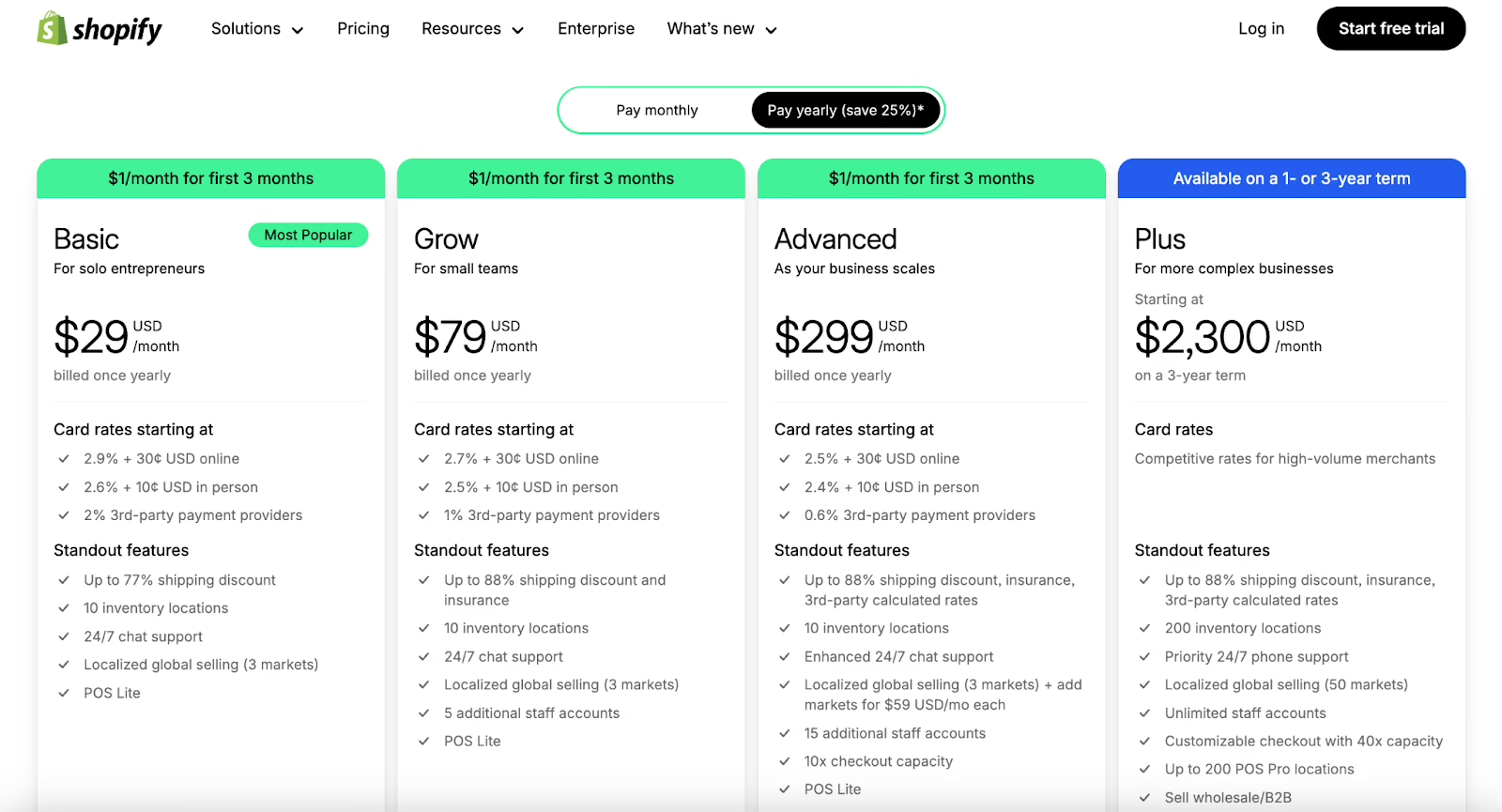
All-in-one platforms
With Circle, Kajabi, Teachable, Thinkific, Podia or MemberStack you get hosting, billing and content delivery in one package. They are fast. A paid newsletter or coaching group can be up and running in days.
But you will hit a ceiling. When you need analytics that go deeper than the template allows, or some non-standard onboarding logic, you end up working around the platform. And the exports are not always even. Do yourself a favour and ask how you are going to get your data and payment history out when you are done.
WordPress with membership plugins
For those who want control but don’t want to go full custom, WordPress with a plugin like Paid Memberships Pro or MemberPress is still the way to go. It is the middle path. You get your gated pages, your email integrations, your community tools in a stack you own.
It makes sense when you need to dictate the SEO and branding, or when you plan to tinker with your offers as you go along. The catch is maintenance. Caching can let private content slip through if you are not careful, and plugins have their conflicts. You have to be the one to watch over the site’s technical health, the plugin author won’t do it for you. We have a guide to the best membership site platforms if you want to see the trade-offs laid out by profile.
Custom development
Custom is only warranted when the membership is the product itself. We are talking unique dashboards, publishing workflows and a portal that defies standard behaviour. This is where a partner justifies his fee; it is less about the code and more about getting the identity and access modelling right from the off.
Take the work we did on the tech for the premium newsletter for The Hustle. On the surface it was a paid content tier. In reality we were replacing a hodgepodge of a custom CMS and a bolted-on email system with an integrated stack the editorial team could run. The paywall was simple. Getting the billing, publishing and access to play nice with one another was the job.
Don’t pick your path for the dream version three years down the road. Go with what the next twelve months require. You can migrate later, most do.
Model the Membership as a State Machine, Not a Page
What nobody talks about enough is how billing and access can get out of whack and sink a membership. A trial is up but the member is still in. A card declines and they are still being emailed like they are good for it. A coupon mucks up the renewal math. A webhook goes quiet and you don’t notice for a week.
The solution is to stop viewing a member as a row in a database and treat them as a state: trial, active, grace, suspended. Each has its rules.
In the build, that means:
- Reconcile bill and access status on a schedule. Don’t rely on webhooks, they fail.
- Let a dunning sequence handle failed payments. An automated retry and a clear grace period are better than a founder manning the support inbox.
- Put your edge cases on paper (the refund after renewal, the mid-period plan change) before you have to debug them in production.
- Keep your access rules in one place as policy, not as conditionals in your templates.
A well set up Stripe integration will take care of most of this for a WordPress membership, as long as you let Stripe be the source of truth and don’t try to mirror the state locally.
Design the First 30 Days as a Product
You either make or break retention in the onboarding phase. SamCart has an onboarding model that is worth taking a page from; it is in line with what you will hear from Circle and any operator who means business.
- Day 0: A welcome that tells them why they are here and gives them one next step. Don’t put on a feature tour.
- Days 1 through 3: Give them a quick win, something unambiguous. An exercise, a tool, a piece of content or prompt – anything they can look at and think “just for that, it was worth it.”
- Days 4 to 7: Make a community connection. Put them in touch with a veteran member or offer a low-stakes way to get introduced.
- Days 8 to 14: Show them the road ahead. The ninety-day arc, when the next live session is, what is in store.
When a new member feels adrift, they won’t hold themselves to account. They will fault the product, and rightly so. We have an MVP-focused build approach for a reason: to compel you to do this kind of design work while it is still inexpensive to put right.
Instrument the Funnel From Day One
There is a common thread among memberships that don’t make it: the operator doesn’t have an answer to the basics. What is your activation rate? Where do you lose people in the first month? What does the churn curve look like by cohort? And which channel is bringing in members who actually renew as opposed to just signing up?
The numbers tell the story. For most operators email is the main acquisition channel (31%), followed by content (24%) and social (15%). Social is good for the top of the funnel but email is where you close. You see operators put too much stock in social because it is out in the open and neglect the channel putting money in the bank. If you have a newsletter or put out content, our guide to reader revenue models will show you how those channels compound.
At the very least you should be tracking signup source, payment failures, and retention at thirty and ninety days, along with activation (the first thing of substance they do). If you can’t produce those figures, then making them is job number one.
Governance Before It Becomes a Crisis
Support capacity can not keep up with a growing community. It is a foregone conclusion: by month three all is well. Come month nine you have a conflict in your inbox at 11 p.m. and nothing in place to handle it. Fast forward to eighteen months and you will find moderation fatigue is what puts the nail in the coffin of an otherwise fine membership.
It is better to put down your rules of engagement and escalation procedures in advance. Even a light form of advisory-board governance is less costly than the other option. This is the sort of boring work that separates a membership you are happy to run in year three from one you come to loathe.
Where Refact Fits
The founders we deal with in membership platform development rarely want us to tell them which plugin to use. They need someone to help make a vague offer into a clear one, to get the billing and access modeled right off the bat, and to put together an experience for the member that can stand up to the reality of month nine after the launch hype has died down. In some ways it is more like running a small institution than shipping a product, and clarity comes before code.
If you are trying to figure out how to put together a membership site and would like a thinking partner before you commit to the build, have a look at our approach. You can get to the plugin choice next week. Right now you should be focused on the audience and the first thirty days.
Building a product and unsure what to scope first? Let’s talk. Free 30-minute call, no pitch.

Saeedreza Abbaspour is the CEO of Refact, where he works across product, engineering, and sales. He sets the studio’s direction while staying closely involved in the work itself, from shaping product strategy and UX architecture to helping define the technical systems behind Refact’s projects. His role connects business thinking with hands-on product execution, giving him a practical view of how software should be planned, built, launched, and improved. At Refact, Saeedreza focuses on building a studio that can move quickly, solve real client problems, and turn ideas into reliable digital products.
More from Saeedreza Abbaspour

