10 New York City Media Companies to Know
New York City holds 14.4% of all U.S. publishing jobs and 14.9% of film and TV employment
 Saeedreza AbbaspourNovember 19, 2026

This guide covers ten companies, ordered by who they serve and how they earn money, not by revenue. It’s for publishers studying their peers, operators looking for media partners, and writers and producers deciding where to pitch or apply. After the list, we cover what the sector’s failures, traffic losses and AI experiments mean for anyone who works in New York media or with it.
How Big New York City Media Is Depends on Who’s Counting
There is no single reliable size for the industry. The Center for an Urban Future counts 326,093 creative workers across 10 industries, including freelancers. NYC Economic Development Corporation reports 505,000 jobs “supported” across 14 industries. For film and TV alone, the MOME film and TV industry study found the sector supported about 185,000 total jobs and $18.1 billion in wages in 2019, a figure that includes supplier and spending ripple effects. These numbers measure different things. Adding them together, or comparing them directly, produces nonsense.
The concentration is the part everyone agrees on. New York held 19% of U.S. advertising employment in 2022 while accounting for 2.9% of total U.S. employment, a location quotient of 6.6, per the Comptroller’s creative economy spotlight. Ad sales, audience development and media buying people cluster here because the publishers are here.
The direction of travel is also clear. Advertising employment fell to 67,500 in August 2025, down 10% from 2022. The Comptroller’s 2024 economic report found motion picture and sound recording averaged 37,800 jobs in the year ending October 2024, down nearly 18,000 in two years. One post-production worker on Reddit described about 18 months of slow work after the strikes and taking a job at roughly half their usual rate. Meanwhile, creative-sector self-employment is up 10.3% since 2019, and only 45% of media workers were in the office every day in 2025, the lowest share of any major industry.
Read that together and you get a sector with deep talent and shrinking payrolls, where more of the work happens on contract. That shapes every company below, and it is why the ones holding up have something in common: a direct relationship with an audience that pays. We cover that pattern in more detail in our piece on publisher revenue strategy.
The National Publishers: Scale Built on Access
The first seven companies sell access in some form: subscriptions, bundles, data products, professional tiers. They are worth studying for structure and worth pitching for reach. They are usually a poor template for a ten-person newsroom.
1. The New York Times Company
The clearest commercial success in New York media, and the most useful case study of a legacy newspaper rebuilt as a subscription product company. The Times ended 2024 with 10.82 million digital-only subscribers, 5.44 million of them on the bundle or multiple products. It added about 1.4 million more in 2025, and digital-only subscription revenue grew 14.3% to $1.43 billion.

The bundle is the lesson. News, The Athletic, Games, Cooking, Audio and Wirecutter give a subscriber several reasons to come back, and bundle subscribers grew while news-only subscribers declined. Daily habits from Games and Cooking protect the news subscription from churn.

What it’s good for: national story placement on policy, business and culture, and studying how a publisher spreads revenue across products. Freelancers should read the bylines in their field for two weeks before pitching. You’ll learn which editor owns the beat.
Where it falls short as a model: a 2023 paper in Social Problems argues the Times was uniquely positioned to adapt to platform-era advertising, and that its success widened the gap between it and everyone else. A smaller outlet can copy the logic of giving readers more than one reason to pay. It cannot copy the scale. If you’re weighing your own approach, start with the paywall models for publishers that fit a smaller audience.
Website: nytco.com
2. Condé Nast
A global publisher with New York roots and a portfolio that includes Vogue, The New Yorker, GQ, Vanity Fair, Wired, Architectural Digest and Condé Nast Traveler. Each title keeps its own editorial identity across print, digital, video, audio and social.
The more instructive story is behind the scenes. According to AWS case studies, Condé Nast consolidated its data infrastructure across more than 800 properties and 22+ brands. Before that work, some brands tracked only page views while others captured deeper engagement, so cross-brand comparisons meant manual extraction. The fix was standardized event schemas, schema validation, consent management and central governance. A shared data warehouse alone did not make the numbers comparable.
Its contracts workflow shows the same discipline. Rights contracts, some hundreds of pages long with handwritten notes, are split into chunks, matched against templates, and routed to exception analysis when they don’t match well. A person validates the output before it reaches the rights system. These are vendor-published case studies with no accuracy figures, so read them as workflow designs, not proof of results.
How to approach it: pitch the title, not the company. A note to “Condé Nast” goes nowhere. A note to one editor at one brand can land. Expect a slow cycle, because contributors go through brand-level contracts.
Where it falls short as a model: a multi-brand publisher needs one shared content model with separate front ends per brand, which is the shape of a headless CMS build. Most independent publications don’t need that complexity and shouldn’t pay for it.
Website: condenast.com
3. Hearst
Hearst runs magazines, newspapers, television stations and information businesses from its New York base, with operations in 40 countries. Hearst Magazines carries brands including Cosmopolitan, Esquire, Good Housekeeping, Men’s Health and Road & Track. The wider company includes Fitch Group, Hearst Health and transportation data businesses.
That mix is rare, and it changes how you approach the company. Each division hires, buys and budgets differently:
- Magazines for lifestyle, service and brand journalism.
- Newspapers for regional news desks.
- Television for broadcast and video work.
- Information businesses for healthcare, finance and transport data products sold to professionals.
The data businesses are easy to overlook. They keep their own research and editorial teams with their own budgets, and a contact at Cosmopolitan cannot get you into a Fitch desk. They also tend to be more stable. Professional subscribers pay for information they need to do their jobs, which is a sturdier revenue line than print advertising.
Where it falls short: the right contact changes completely by division. One pitch sent to four teams lands nowhere. Before you apply or sign a contract, confirm which division pays for the role.
Website: hearst.com
4. Vox Media
Vox Media owns New York Magazine and its digital verticals, The Cut, Vulture, The Strategist, Intelligencer, Curbed and Grub Street, plus Vox, a podcast network, Vox Media Studios and an advertising business. It serves culture readers, service-journalism shoppers and podcast listeners.
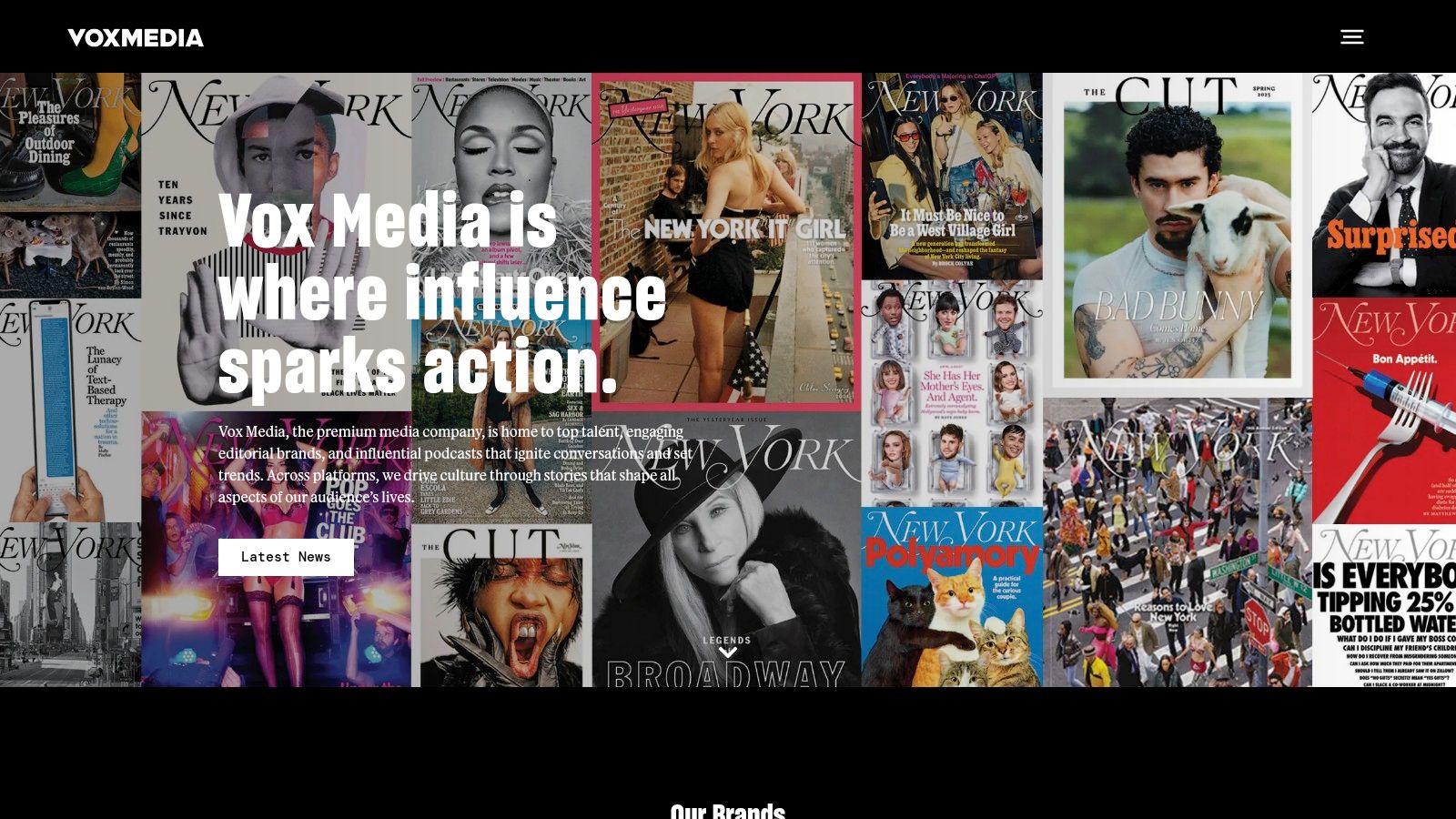
Match the vertical before you write the subject line. A product pitch belongs at The Strategist, an entertainment story at Vulture, a reported feature at Intelligencer.
Vox Media also shows where ad money is moving. Streaming could take roughly half of all upfront advertising dollars, about $12 billion, with an estimated rise to $14 billion in 2026, according to Digiday’s upfront coverage. Buyers in that report pointed to cost, measurement and transparency as the limits. For a publisher, pageviews alone will not win that meeting. First-party audience data and cross-platform measurement will. In practice that means one event schema for impressions, video starts, completions, subscriptions and churn, wired to a dashboard the sales team can actually open.
Where it falls short: brands sit inside different entities than their names suggest, and access options vary by publication. Check who owns what before you quote a rate or sign.
Website: voxmedia.com
5. News Corp and Dow Jones
News Corp’s New York operations include the New York Post and Dow Jones. Dow Jones publishes The Wall Street Journal, Barron’s, MarketWatch, Investor’s Business Daily, Mansion Global and Financial News, and sells business intelligence, investment data and newswires alongside them.
This is New York’s business-news factory. If your expertise is markets, corporate strategy or commercial real estate, the specialist desks are more reachable than the general desks at bigger brands.
Think of it as two doors. Consumer journalism takes features, explainers and reported pieces. Professional products cover data, licensing and research, and those buyers check credentials first. The newsroom and the data team answer to different budgets, so find out which one your project touches before you write the proposal.
Where it falls short: many products sit behind professional or corporate tiers a general reader will never see, and access models differ by brand.
Website: dowjones.com
6. Bloomberg
Most publishers sell attention. Bloomberg sells a workflow, and the newsroom feeds it. The media side runs digital publishing, newsletters, video and broadcast. The professional side sells the Terminal that analysts and traders use all day.
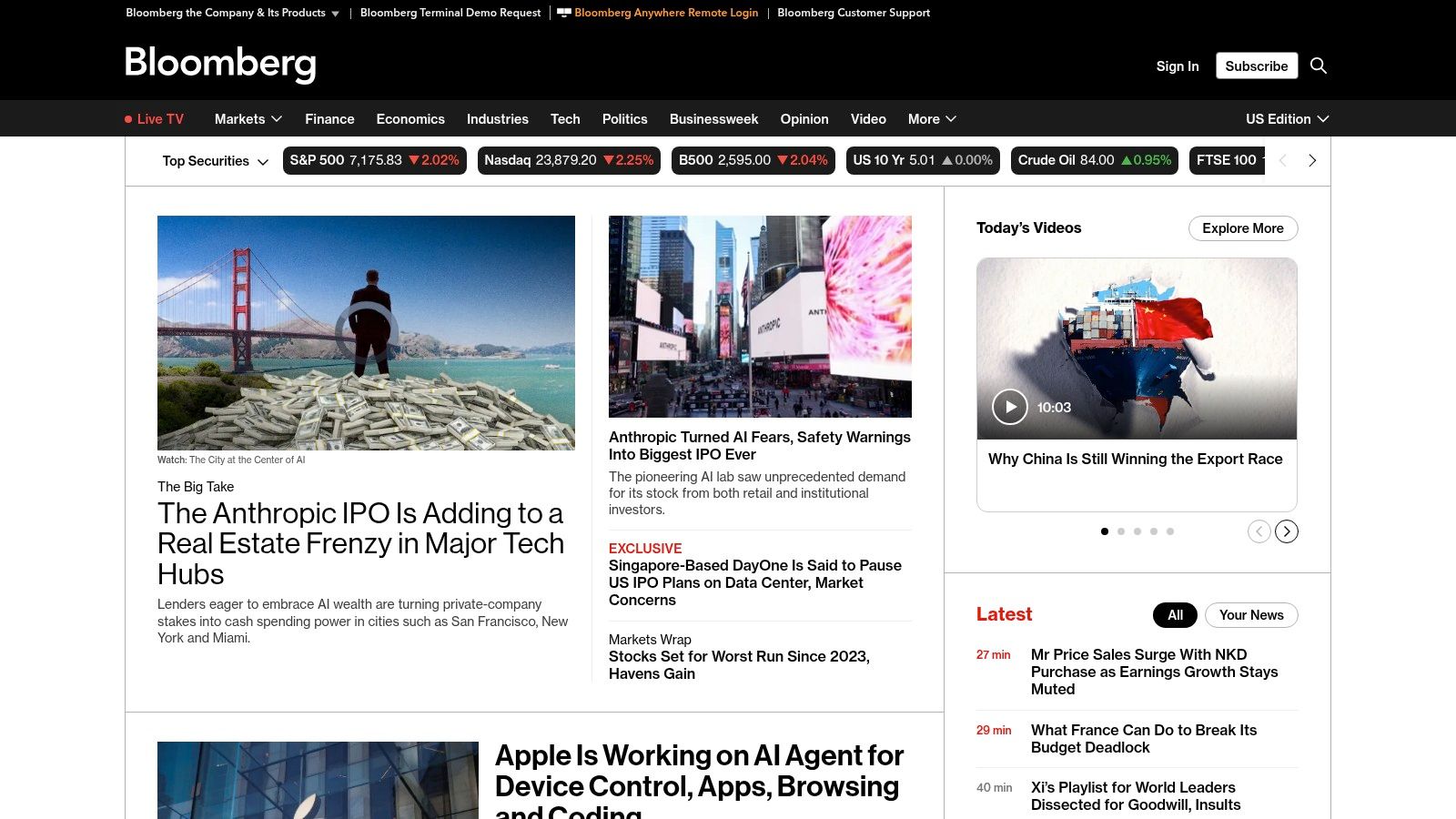
Bloomberg is also the most careful AI adopter on this list, at least in what it publishes. Its 2024 paper in AI Magazine describes six narrow research areas, including headlines that update as stories evolve, chart summaries and defenses against manipulative input text. Automated stories go through testing for factuality, fairness and robustness, an editor signs off before release, and the team corrects even a single faulty data point after publication. Terminal news stories now carry three-bullet AI summaries evaluated by subject experts.

The headline work shows the level of detail involved. When a story changes, the system compares the old headline and article against the new version, keeps what is still true, avoids changes for their own sake, and starts a new story version when the facts shift substantially. That’s the real work in newsroom AI: scoping and release rules, not model choice. Bloomberg doesn’t publish error rates, so outsiders can see the design but not the results.
Where it falls short: it isn’t a general-interest outlet, and a small newsroom can’t match either its data operation or its price points. What transfers is the principle that structured data needs editorial rules before it gets published.
Website: bloomberg.com
7. TIME
A global media brand with a New York presence and one of the few magazine companies here that also makes film and television in-house, through TIME Studios. Journalism, print, events and digital products sit under one name.

Production capacity changes what a publisher can sell. A newsroom that can turn reporting into video gets licensing and streaming conversations a text-only outlet never has. The city’s production base made that easier for years: 80 series were shooting in New York City in the 2018 to 2019 season, a 34% increase from 2014, according to the Comptroller’s creative economy report. That base has shrunk since 2022, which makes in-house capacity more valuable, not less.
How to use it: pitch reported stories with a clear visual spine, because editors think in packages. If you have an audience but no newsroom, events are the partnership door. If you run a magazine, study the product mix for revenue beyond display ads. Teams moving a magazine off a legacy setup should read our guide to choosing an online magazine platform before picking software.
Where it falls short: global focus means little neighborhood-level New York coverage, and magazine and website access are sold separately.
Website: time.com
The Local Outlets: Smaller Budgets, Closer Readers
The last three companies run on belonging more than access. Listeners, members and neighborhoods fund them. They sit closer to the daily reality most publishers face, and they are much easier to reach.
8. New York Public Radio
A listener-supported nonprofit that runs WNYC, WQXR, Gothamist, WNYC Studios, New Jersey Public Radio and The Greene Space. That puts radio, local journalism, podcasts and live events under one roof.
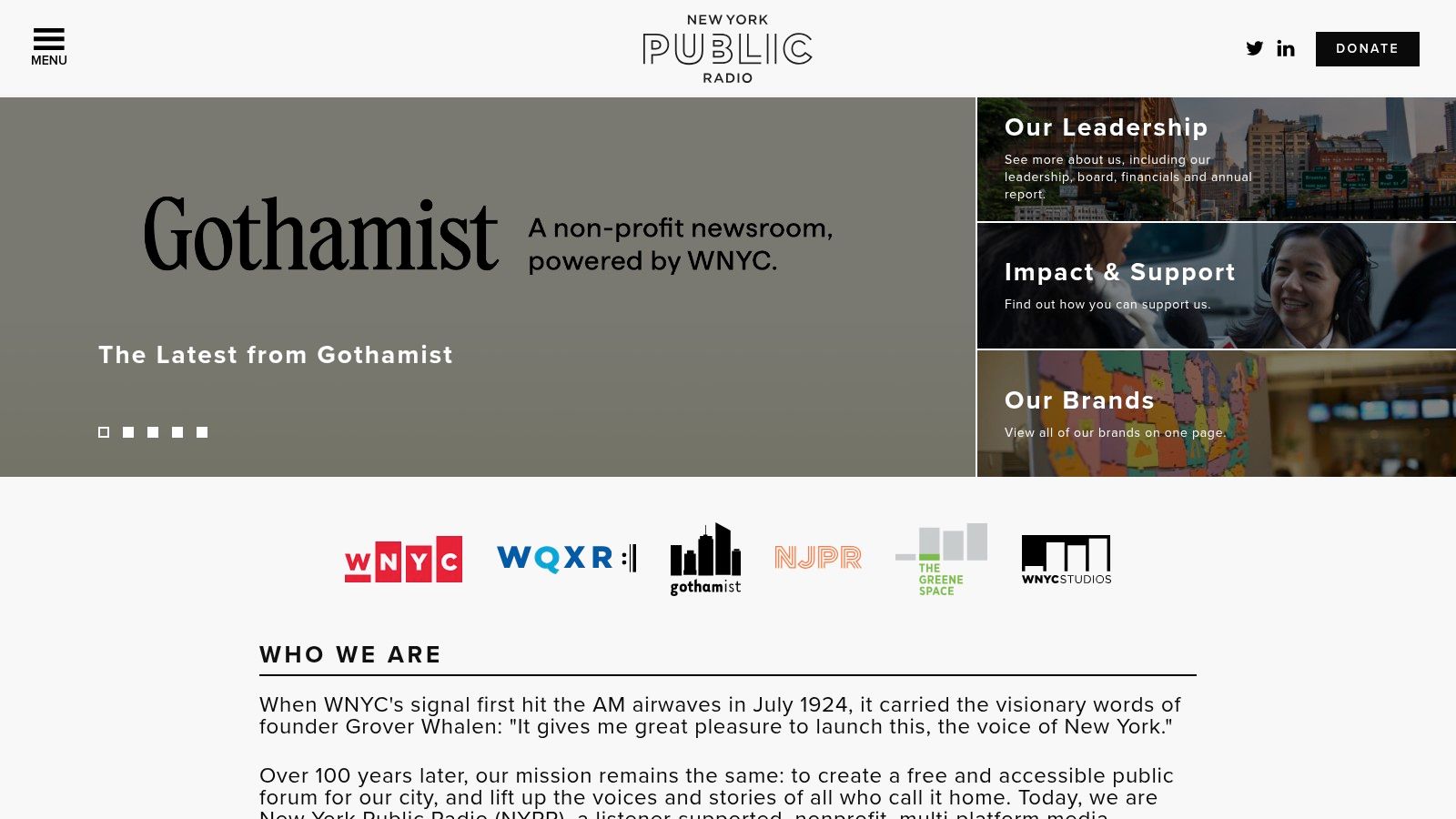
Its recent results are the strongest local evidence for email. In its FY2024 report to the Corporation for Public Broadcasting, the organization said email subscribers doubled to nearly 200,000, and Gothamist repeat visits doubled, mainly because of the email strategy. Local reporting gets reused across Gothamist, broadcast, newsletters, social and the NYC Now podcast, which reached 20,000 weekly listeners. These figures are self-reported, but the logic holds. A newsletter turns a one-time search visitor into a reader who comes back on a schedule. We explain how to design for that in our piece on treating newsletters as a product.
Where it’s strongest: local radio and podcast production, civic and cultural coverage, and live events at The Greene Space for launching a book, report or campaign. Freelancers who want a local byline and real editing have better odds here than at the national desks.
Where it falls short: priorities follow a civic mission, and the budget depends on members, donors and sponsors. Budget cycles can be tight.
Website: nypublicradio.org
9. Schneps Media
For a dentist in Queens, a Brooklyn preschool or a Bronx real estate office, Schneps Media is often the shortest route to nearby readers. It runs community newspapers, magazines, digital properties and events across all five boroughs, Westchester and Long Island, including QNS, Brownstoner, amNewYork, Brooklyn Paper, New York Family, Gay City News and Bronx Times. It also serves Latino and Caribbean audiences.

The value is geographic. National brands give you scale. This network can put a story or an ad in front of one borough, one neighborhood or one parent audience. Judge each title separately, because Gay City News and Brooklyn Paper serve very different readers.
Public policy matters more to outlets like this than most outsiders realize. City rules require agencies to spend at least half of their advertising budgets with community and ethnic media. The CUNY Center for Community Media found more than $72 million flowed to these outlets over five years, but also flagged uneven compliance and weak transparency. For a local publisher, that revenue is real and unpredictable at the same time.
Where it falls short: coverage is regional by design, and editorial focus varies widely between titles. Owners consolidating several titles onto one platform carry most of their risk in the migration. Redirects, archives, media files and bylines all have to survive the move, which is why CMS migration work starts with a URL inventory, not a design.
Website: schnepsmedia.com
10. Hell Gate
A subscriber-funded, worker-owned newsroom covering New York City. The journalists own and run the publication, and reader memberships pay for the reporting.
That structure changes the pitch. There is no outside owner to please and no single advertiser to protect, so the coverage can be sharper than what a chain would publish. It also means a small team and limited budgets. The site publishes pitch tips, and its free newsletters are the best way to learn the voice before you send anything.
Judge a newsroom by who pays its salaries. When readers pay, the reporting answers to readers, and you can feel it in the coverage.
Where it falls short: rates and volume are limited. If you need a large feature budget, look elsewhere. For a small outlet like this, the platform choice matters more than the design. Our guide to CMS options for local newsrooms is the practical place to start, because the membership flow and a searchable archive are usually the first things to break. If you’re comparing membership tools, our piece on choosing a membership platform covers the billing and access decisions that come first.
Website: hellgatenyc.com
Also worth knowing: THE CITY
THE CITY, a nonprofit local newsroom, is worth studying for one reason: it measures what works. It holds “Open Newsrooms” in neighborhoods, sends QR-code postcards to targeted blocks, and turns residents’ questions into explainers and investigations. Its executive director told WAN-IFRA in 2025 that the postcards drove 7 to 8 times the click-through of paid Meta ads. It reports about 1 million monthly users, 83,000 newsletter subscribers, and $4.1 million in 2024 revenue with 27 staff. Ahead of the June 2025 mayoral primary, explainer videos made with the local creator account The Pigeon Post averaged 147% more reach than its 2024 baseline. The figures are self-reported and the sample is small, but the method of testing channels and counting conversions transfers to any publication.
How the New York City Media Companies Compare
Use this table to build a shortlist, not a ranking. Ownership and revenue model tell you more about how to approach a company than its size does.
| Company | Primary focus | Ownership model | Main revenue logic | Best for |
|---|---|---|---|---|
| The New York Times Company | National and international news, plus lifestyle products | Public company | Digital subscription bundle | National placement; studying subscription strategy |
| Condé Nast | Fashion, culture, design, technology, travel | Global multi-brand publisher | Advertising and subscriptions by title | Specialist editorial brands; multi-brand data practice |
| Hearst | Magazines, newspapers, TV, information services | Diversified private company | Mixed, with professional data businesses | Division-specific pitches and roles |
| Vox Media | Culture, news, podcasts, events | Multi-brand media company | Advertising, subscriptions, podcasts, events | Vertical-specific pitches and partnerships |
| News Corp / Dow Jones | Business and financial news and data | Global media parent | Consumer subscriptions plus professional data | Business expertise; data and licensing work |
| Bloomberg | Business, finance, global markets | Private financial data and media company | Professional Terminal subscriptions | Studying data-led journalism and AI governance |
| TIME | Journalism, magazine, film, TV, events | Media brand with in-house studio | Subscriptions, events, production | Visual stories; event partnerships |
| New York Public Radio | Local news, radio, podcasts, culture | Listener-supported nonprofit | Members, donors, sponsors | Local bylines; audio; live events |
| Schneps Media | Borough and community news | Local media company | Local advertising, events, legal notices | Neighborhood reach for local businesses |
| Hell Gate | New York City journalism | Worker-owned newsroom | Reader memberships | Sharp local reporting; city-specific pitches |
Two patterns stand out. The national players earn money by selling access, while the local ones depend on readers who feel they belong. Both groups are betting on a direct relationship with the reader, and the next section shows what happens to companies that skipped that step.
The New York Media Companies That Didn’t Make It, and Why
Three recent cases show the opposite pattern, and all three are New York companies.
The Messenger launched in May 2023 with $50 million and about 300 employees. It generated roughly $3 million in revenue and closed on January 31, 2024, about eight months later. It had large pageview numbers, but they never turned into ad revenue, and its high volume of sensational stories reportedly put off brand-safety-conscious advertisers. Staff learned of the shutdown from outside media reports. Spending and headcount went ahead of a proven way to earn money.
Vice went bankrupt in 2023 and was acquired for about $350 million. In February 2024, several hundred people were cut and the company stopped publishing on Vice.com in favor of a studio and partner-distribution model. A 2024 retrospective in The Verge, based on former staff and executives, describes weak financial controls, confusing budgets and unclear strategy. Whether the pivot works is still unproven.
BuzzFeed is the subtler case. It reported $5.5 million in positive adjusted EBITDA in 2024 and cut debt by more than $150 million, while revenue fell 18%. Ad revenue dropped from $205.8 million in 2021 to $91.7 million in 2025. One improving metric is not a recovery. Revenue, cash, retention and profitability have to move together.
The shared lesson is plain. Traffic is not a business, and headcount should not run ahead of the revenue model. If you run a publication, the cheapest time to test how readers will pay is before you hire for scale.
Falling Search and Social Traffic Is the Risk Every Company Shares
Every company on this list faces the same distribution problem. Chartbeat data across more than 2,500 sites, cited in the Reuters Institute’s 2026 trends report, shows Google search referrals to publishers fell 38% in the U.S. between November 2024 and November 2025. Facebook referrals dropped 43% and X referrals 46% over about two and a half years. The 280 news leaders Reuters surveyed expect search referrals to fall another 43% over the next three years. These are international and national figures, not New York-specific, but New York publishers are not exempt.
The cause is partly AI. Search and chat products summarize reporting without sending the reader to the source. A 2024 study in Digital Journalism, based on 121 interviews at 33 publishers in the U.S., U.K. and Germany, found AI tends to deepen publishers’ dependence on platforms rather than reduce it.
This changes what distribution work is worth. Pushing every new article to every social network is now a solved, cheap problem. Tools like social posting automation for newsrooms can share stories from your CMS on a schedule without an editor touching them, and that is a sensible use of staff time. But automating posting to platforms that send less traffic each year does not fix the underlying risk. The audience you own, through email, apps, events and memberships, is the one platform changes can’t take away. That is why the Times bundle, Gothamist’s email list and THE CITY’s postcards keep showing up as the success stories.
AI at New York Media Companies Is Narrower Than the Headlines
AI is a priority almost everywhere and a proven win almost nowhere. In the Reuters Institute’s 2026 survey, 97% of news leaders said back-end automation was important. Only 13% called their current AI projects transformational, 42% said results were limited, and 67% reported no jobs saved so far.
That doesn’t mean jobs are safe. A roundup of March 2026 layoffs describes New York firms in finance, legal and media citing AI tools and workflow automation when cutting staff. Industry commentary points to routine tasks like transcription, earnings summaries, sports recaps and structured-data stories as the first to be automated, with rewriting and aggregation roles most exposed. No New York-specific displacement data exists yet, so treat individual layoff announcements as signals, not a measured trend.
The useful evidence comes from the companies that document their builds. Bloomberg, Condé Nast and the New York Times R&D team all point to the same lesson. The hard part isn’t generating text or images. It’s narrowing the task, keeping data consistent, building a reference archive that represents the whole business, sending uncertain cases to a person, and gating what gets published. Condé Nast’s contract extraction improved when its historical contracts covered brands and regions evenly. The Times’ Gaussian splatting work produces scenes that are “perceptually accurate” but are not measured geometry, so its team warns against using them for forensic claims.
We’ve seen the same thing on a smaller scale. For a daily newsletter publisher whose curator was manually checking more than 30 websites several times a day, we built an automated news pipeline to collect and deduplicate stories. The value came from clear rules about sources and duplicates, with editors still choosing what ran. For a wider look at what large publishers are testing, see our overview of AI in newsrooms.
Working for or With These Companies: Judge the Team, Not the Logo
If you’re looking at these companies as an employer or client, practitioner accounts on Reddit are consistent on a few points. They’re anecdotal, and some threads are years old, but they line up.
- Hiring runs through connections. One commenter described 50 to 100 competing résumés per opening. Internships are often unpaid or barely paid, but they produce contacts and job tips. A producer with 13 years in New York described a friend’s one-off video gig growing into three days a week, then a full-time job.
- Hours vary widely. Production assistants report 12-hour days and 65 to 75-hour weeks. An agency senior producer described anywhere from 35 to 100 hours a week depending on the client, with extra hours often unpaid.
- Payment terms matter more than prestige. Freelancers describe rates disputed and paid months late, and booked projects pulled without warning.
- The same brand can be two different employers. At Vice, freelancers reported late payments and lowball offers, while a unionized Vice production was described as well paid with roughly eight-hour days.
The practical takeaway: before you commit, ask about the specific team, client, rate, hours and payment schedule. A famous masthead tells you very little about any of those. If the work dries up, adjacent fields are a real option. One publishing worker on Reddit moved into medical communications and earned a living wage using the same skills.
What This Means If You Run a Publication
The New York media companies holding up in 2026 have three things in common. They know exactly who their reader is. They own a direct channel to that reader. And their technology was built around how the newsroom actually works, not bolted on afterward. The failures got at least one of those wrong.
For most publishers, the bottleneck turns out to be less editorial and more operational: a membership flow that loses readers at checkout, an archive buried four clicks deep, a CMS nobody wants to touch. When we worked with St. Louis Magazine, the job was to get a regional publication off MetroPublisher without losing what it had built. That meant moving 30,000+ articles to WordPress with URLs and media intact, plus fixing a newsletter workflow that needed workarounds to approve content. The St. Louis Magazine migration shows that protecting the archive and the editors’ daily routine is most of the work.
The New York lesson applies well beyond New York: earn the reader relationship first, then scale what it pays for. If you need to work out which parts of your platform are holding that relationship back before you spend on a rebuild, that diagnosis is where Refact’s web development for publishers starts.
Publishing at volume and hitting the limits of your platform? Let’s talk. Free 30-minute call, no pitch.

Saeedreza Abbaspour is the CEO of Refact, where he works across product, engineering, and sales. He sets the studio’s direction while staying closely involved in the work itself, from shaping product strategy and UX architecture to helping define the technical systems behind Refact’s projects. His role connects business thinking with hands-on product execution, giving him a practical view of how software should be planned, built, launched, and improved. At Refact, Saeedreza focuses on building a studio that can move quickly, solve real client problems, and turn ideas into reliable digital products.
More from Saeedreza Abbaspour

