

You will find that the majority of advice on putting together a subscription website is little more than a tooling exercise. The prescription is simple: install a plugin, connect Stripe, put a gate on a few pages and you have a product. You do have a site, but not a business.
A subscription website is an operating system in its own right. It is an offer, a billing loop, an access model, an way to onboard and retain – all of it interdependent. Make one part wrong and the rest will begin to fail in quiet ways.
There are good reasons to put in the work. Subscribers are worth three or five times as much over their lifetime as a one-off customer, and Juniper Research puts the global subscription economy at over $1.5 trillion by 2033. Then there is the other side of the coin. Failed payments ran to $129 billion for subscription firms in 2025 and 41% of consumers are talking about fatigue. This guide is for those who intend to build a subscription business regardless and want to know where the hard part is.
Decide What People Are Actually Subscribing To
Put aside the question of platforms or payment tools for a moment and answer three things in plain English: what is being sold, to whom, and why they would part with money again next month.
It is easy to say these are obvious. In reality, this is where most projects go off the rails. A team will claim they are building a member platform, which could be anything from a paywalled library to a SaaS tool with tiered access, or a coaching program. Those are four separate products with different pricing and different points of failure.
The best offers have a single value metric. For a publisher it is exclusive reporting; for an education product, structured lessons and community; for software, it is seats or feature access. Look at some of the membership websites that are worth your time and you will see the winners are not the ones with the flashiest design but the clearest promise. Trupeer has a good take on Patreon, defining the whole business in one sentence as an exchange of ongoing support for ongoing value.
Price around the buyer, not the feature list
Calling a plan “Basic” or “Premium” is not very informative. “Solo,” “Team” or “Research Pro” tells the buyer who it is for. Before you set your tiers, do some due diligence:
- If a buyer cannot tell you the difference between plans in a sentence, you have too much feature clutter.
- Make sure each plan corresponds to an actual user type rather than an arbitrary set of limits.
- Keep your billing rules simple. Complicated pricing makes for complicated code and a lot of support tickets down the line.
You should design in annual plans from the outset. They can boost revenue per user by 50 to 60% and stem the kind of low-engagement churn that is fatal to monthly-only offerings. Weekly plans are popular with apps, making up 47% of in-app revenue, but the churn is higher. It comes down to how often your product shows its value.
The First Ten Minutes Decide the Next Twelve Months
Those who have run these operations at scale will tell you retention is really an onboarding issue. What happens in the first two weeks of a new member’s tenure is a better predictor of her staying power than any winback campaign you might devise later.
Take a visitor who comes to you via a podcast. She hits “Join,” is met with a form demanding information she is not ready to give, pays and is shown a confirmation page that does not mean much. She closes the tab. Later she tries to log in, can’t find the link, has to reset her password and is still uncertain of what her plan entitles her to. Chances are she will not renew.
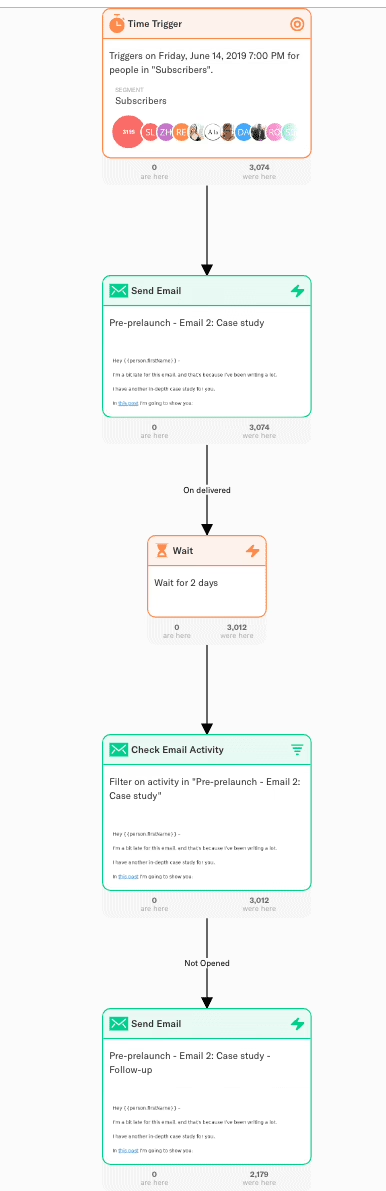
The post-purchase page is where you will lose most of your first month of retention if you are not careful. Do three things quickly: confirm the purchase, point the member toward a first win (a starter module or an article) and show them where to manage their account. Back it up with an email sequence that is short and to the purpose. A welcome note that makes the purchase feel like a commitment to a goal. A message in the first week on how to use the product to form a habit. One on what to expect at 30 or 60 days. And a testimonial for proof. None of it should send them to a marketing page.
To the team it is a minor hiccup at signup. To the new member it is enough to make him wonder if he should have paid in the first place.
Do not let account management become a silent killer of retention. A member ought to be able to change plans, download an invoice or cancel without having to write to support. If your inbox is doing the job of the account page, then the page is broken.
Pick a Platform Around the Product, Not the Other Way Around
In the end, the choice of platform is between a quick start with familiar patterns and something more custom. Content-led businesses will generally look to WordPress; for product-led ones, a headless approach with Next.js and a separate CMS is more common.
WordPress is the way to go when publishing is the product and editors want an admin they know. But try to force custom product behaviour onto a CMS not built for it and you will feel the strain. When your subscription is more like software than a magazine, with unusual access logic or a front end that needs to be faster than a plugin stack can provide, headless is the answer. ZZBLOCK5ZZ
You can find a more complete tooling comparison in our piece on the best membership site platforms, where we break down the tradeoffs by product. Take The Hustle, for instance. In helping them put their premium newsletter, Trends, in front of an audience, we let two things dictate the platform: the editors had to be able to put out copy every day on their own, and the paywall needed to sit comfortably with billing and email systems. Any other stack would have put a few months on the launch timeline. As it was, they were live in two weeks; the product eventually factored into HubSpot’s decision to acquire The Hustle.
Billing Belongs to Stripe. Access Belongs to Your App.
There is a tendency among founders to think the payment tool ought to be the arbiter of what a user can see. That is not how it should be done. A well-ordered subscription architecture has a division of labour: the payment processor tells you if the customer was charged, your application determines what that customer is entitled to use.
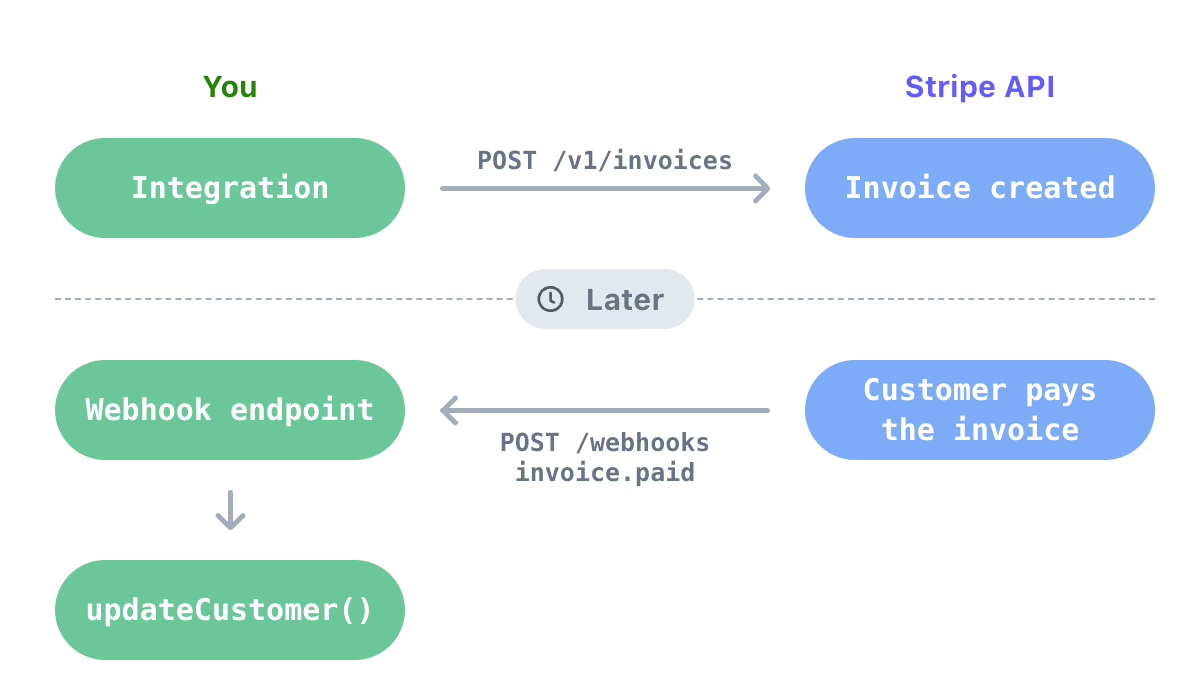
We see this as a matter of having a webhook-first approach. Let Stripe, Recurly or Paddle do what they do best: store the card, make the charge and report back. They will send a webhook to your app on any event of note, and your app can then update the entitlements record. When you are serving a gated page, your access rules consult that record, not the payment platform. It is the same pattern we employ on client projects for Stripe integration and one that is well covered in this SaaS subscription architecture guide.
There are some ground rules to maintaining a healthy setup:
- Do not let your internal plan names be the same as the processor’s. A rename in Stripe should not cause your app to falter.
- Make add-ons stand alone as subscriptions. If you bundle them with the core plan, the logic for upgrading or downgrading will become a headache within six months.
- Put dunning in as a feature from the start. Most involuntary churn can be put right with good retry logic and clear messaging from the customer. In 2025, failed payments were a $129 billion issue and much of it was addressable.
- Let members pull up their own invoices. Your support team is not an accounting layer.
Once you hit a certain volume, particularly with free-trial consumer subs, chargebacks are a cost you cannot ignore. Manual handling does not scale, which is why specialist tools like Disputely are in vogue. For a full run-through of the common failure modes, have a look at our payment gateway integration guide.
The question for your billing system is a simple one: was this customer charged? Your product has a different job: to decide what they are allowed to use.
Measure What Predicts Cancellation, Not What Looks Good
Do not mistake traffic for a subscription metric. At best it is a proxy for revenue. The numbers that tell you if a business is going to make it are far more specific: LTV, CAC, payback period, cohort churn and the like. You want to be looking at activation in the first 14 days, month-1 engagement and whether there is a second purchase or session.
These subscription commerce statistics put it at 70 per cent of revenue coming from existing customers, so that is where product time is best spent. Industry-wide acquisition has levelled off at about 3 per cent, so trying to wring more from the top of the funnel yields diminishing returns. Focus on the first 30 days and the sixth month and the returns compound. Our post on what churn rate means for SaaS goes into the definitions and benchmarks if you want to get under the hood of those figures.
Put your analytics to work on three questions:
- Is the signup process stalling at the pricing page, the checkout or the first login?
- What is it that a returning member is actually using in terms of content or reports?
- Are there signs before a cancellation? A failed payment a fortnight back, low logins or an onboarding step left undone?
Retention Is Built, Not Persuaded
A member will not remain with you simply because you were polite at renewal. They stay when they encounter value, over and over. The way to ensure that is to make the value at hand easy to come by, not to ship an endless stream of new features.
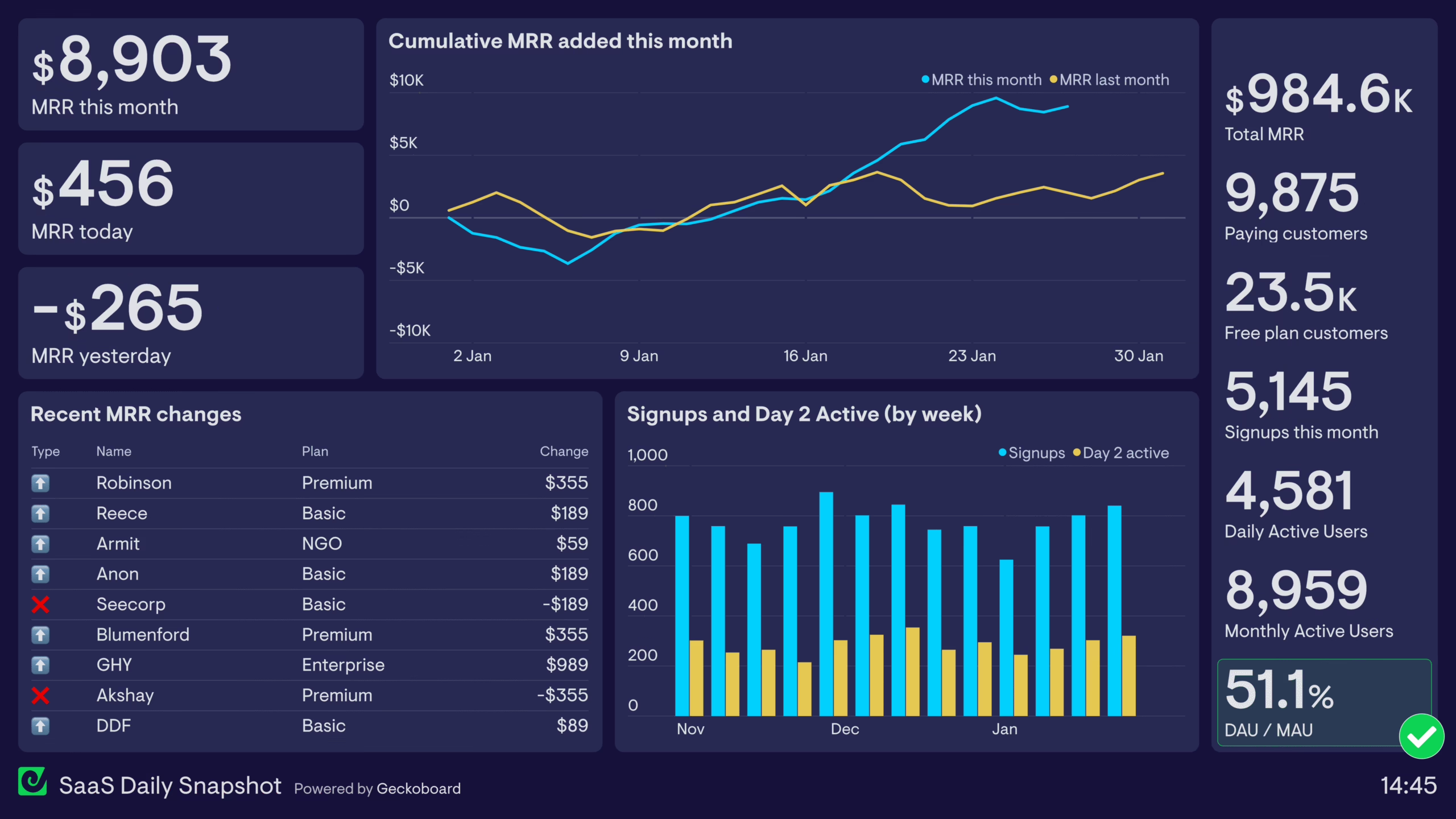
Some approaches are proven to make a difference:
- Put progress on display. A dashboard with usage counters or a “what’s new” section reminds the subscriber the service is working for them.
- Make email part of the product. A sound email strategy brings people back with something of use, rather than promotional noise.
- Find out why they leave. An exit survey will reveal weak onboarding or confusing pricing faster than any winback campaign.
- Put a new face on the offer. Whether it is new tooling or clearer rules, give a long-time member a reason to renew.
And do not make it hard to go. Aggressive save attempts and phone-only cancellation are the stuff of consumer complaint threads and can draw regulators in. A straightforward path to cancel, along with that brief exit survey, gives you honest data and takes the load off support.
Where Publishing Subscriptions Are Different
When the subscription is built on content, the architecture changes. You have editors publishing daily, paywalls coexisting with ad-supported pieces and newsletters. Migrations are high-stakes affairs since thousands of URLs and taxonomies must be preserved. We saw that with St. Louis Magazine. Moving them from a legacy CMS was only half the technical challenge; the rest was in safeguarding 30,000 articles and the editorial workflow of three decades, along with the integrations that put money in the till, all without missing a day of publication.
You will find the pattern holds. In truth, a subscription publisher is no more a website than it is a publishing operation with a billing loop in tow. The build must be made to accommodate both.
Where to Start
When one is in the early stages, the most cost effective work has nothing to do with technology. Put pen to paper and define your offer, the types of members you have, your pricing and what a customer’s experience should be in the day, week and month following payment. Go over that list and put a mark next to anything you are merely guessing at; those are the elements liable to fail when scaled up.
It is for this reason we have put together Refact’s product design and discovery process, to resolve such matters before a line of code is put down. Most subscription outfits do not require a larger site so much as they need a better defined product, which is why we do membership platform development. If there is an advantage to working it out on paper rather than on a live system with actual customers, then so be it. That is the object of the exercise.

Saeedreza Abbaspour is the CEO of Refact, where he works across product, engineering, and sales. He sets the studio’s direction while staying closely involved in the work itself, from shaping product strategy and UX architecture to helping define the technical systems behind Refact’s projects. His role connects business thinking with hands-on product execution, giving him a practical view of how software should be planned, built, launched, and improved. At Refact, Saeedreza focuses on building a studio that can move quickly, solve real client problems, and turn ideas into reliable digital products.
More from Saeedreza Abbaspour

