Product Roadmap Template: 10 Practical Picks
Most product roadmaps don’t fail because the template was wrong.


A product roadmap template is a starting scaffold, not a strategy in itself. A good template helps identify missing elements of the strategy, as well as assigned outcome owners. A poor template becomes a wish list disguised as a plan. This document provides some convincing descriptions of practical roadmap templates and outlines steps for transforming any template to one that the team actually finds useful. However, you might prefer to start with some of the underlying principles first, which you can find in Refact’s roadmap best practices.
Pick the Format Before You Pick the Tool
We all have access to tools that can create a bad roadmap. The methodology/process you choose is by far more important than the tool you choose. The following formats address the needs of most real-world scenarios.
You would use timeline roadmaps when you have questions about scheduling, dependencies, and checkpoints for releases. If you’re moving a publishing platform or launching an ecommerce site tied to a season, then you would need timelines with a critical path. Outcome-based roadmaps are useful when you don’t want teams arguing about features, but instead having a goal argument. This could include things such as onboarding, activation, retention, and expansion of revenue. The things on the roadmap are changeable, but it’s the goal that is not changeable. Now, Next, Later applies when uncertainty is high and dates would create false confidence, so you want to avoid locking the team into work that hasn’t been validated yet.
Now, Next, Later is a good default choice for most early-stage MVPs, but for the vast majority of more mature SaaS teams, an outcome-based approach is more appropriate, perhaps with a rolling timeline. Publishing and ecommerce teams that have hard external deadlines often need a timeline and outcome layer for things that are not date-related. Based on this choice, pick a format, and choose a tool that supports that format best.
1. Aha! Roadmaps
Aha! Roadmaps is for teams that want to implement some formal line from strategizing to completed work. There are templates for roadmaps and strategic timelines, as well as planning that can include roadmap items linked to initiatives, OKRs, and releases. There are also integrations for Jira, Azure DevOps, Rally, and Salesforce.
Its strength is traceability. A leadership team can begin with a business goal and find relevant work and initiatives underneath it. This can bridge the gap for consistent need-to-know reporting for a multi-team, SaaS portfolio. Aha! offers a 30-day free trial with a pre-filled template.
The tradeoff is weight. For a solo operator with one MVP, Aha! is heavier on governance than is warranted. It scales well with additional elements of the Aha! suite, which, unfortunately, increases cost and time of implementation.
Choose Aha! when strategy to delivery traceability is important and you can afford to wait to have a working board.
2. ProductPlan
ProductPlan specializes narrowly in roadmapping rather than broader project management. They offer roadmapping in many different formats, templates, and even offer a built-in gallery of roadmaps developed within the software to aid in presentation-ready formats.
This specialization makes ProductPlan great for audiences such as executives, investors, sales, and customer success. When explaining product direction to that audience, you don’t want to expose every open engineering ticket. A SaaS team can structure their roadmap around the concepts of acquisition, activation, retention, and expansion, and, with a little configuration, deliver an executive-focused view while allowing for a more detailed view of the roadmap for its team. The visual representations can be related to OKRs for meaning beyond a colored bar.
Pricing requires talking to sales first, which slows down anyone who just wants to try the tool out. Be sure to keep your roadmap distinct from your specifications. A roadmap serves to define a direction for a project; a specification document provides the details. For a product brief, Refact has a great resource that can be found at this product brief writing resource.
3. Strategic Roadmaps by Tempo (formerly Roadmunk)
Strategic Roadmaps by Tempo are built for planning and communicating in polished timeline and swimlane interactions. Their templates provide product and portfolio views as starting points and allow the addition of views to support rollup and filter communication.
This shape is appropriate when managing multiple products, regions, or workstreams. A publishing company is able to show different lines for their efforts to modernize their publishing platforms, editorial workflow, audience features, and commercial activities. With this example, leadership can see the portfolio view, but a product lead would see this view filtered down to just one of the initiatives. Integrations with Jira and Structure make it easy to connect the planning surface to delivery.
Pricing now sits inside Tempo’s sales process, so a small team has to put in more effort to evaluate the fit. For many, the roadmap tool of choice during early discovery is still a whiteboard.
4. Productboard
Productboard makes it easy to display how customer evidence informs the structure of your roadmap when that is important to you. Roadmaps can be displayed in a variety of views, including timeline, grid, and column, and can even be published externally for customers or partners.
The connection of feedback, insights, and prioritization of planned work is where they create the most value. This helps distinguish important customer pain points from feature requests. You can use Productboard to display different views of initiatives, define the supporting evidence for the outcomes, and make products and evidence visible to engineering and customers.
The challenge is that a tool alone can’t build the habit. If nobody is actually talking to customers, a discovery-shaped roadmap will still end up full of items nobody validated. In this case, the templates are only guideposts. Refact’s guide on continuous product discovery is a great place to start here.
5. Atlassian Jira Product Roadmap
This template is designed for teams that use Jira to manage their work. It integrates with Jira issues and gives real-time engineering status. This template allows for Now, Next, and Later planning and timeline views.
For an MVP, keep Now limited to just the next major release, put validated follow-up work under Next, and save Later for ideas that still lack evidence. A SaaS team can also use this structure for their outcomes. Further, a publishing team can use this for their editorial work and distribution work.
The drawback is the overall quality of the presentation. Other standalone roadmapping tools allow for better executive-level roadmap presentation. Jira’s strength is keeping the focus on the tasks and requirements close to the delivery without too many disruptions. Keep major milestones and outcomes at the roadmap level and let the delivery board manage the detail on each task.
6. Asana
Asana’s Product Roadmap template is great for teams that need a more general plan, but don’t need a full product management system. This option also includes timeline, board, and customizable views that include features, launches, and milestones.
For coordination-based problems, a roadmap can be created and overseen by a domain expert to allow for planning and involvement of all stakeholders, even without a substantial training effort. The initiative management and reporting systems roll work up for management without forcing every stakeholder into delivery-level detail.
Asana works great for an ecommerce team preparing a launch. With Asana, roadmap items can be grouped by customer experience, catalog, checkout, fulfillment, and marketing segments. Asana’s delivery layer will track tasks within each segment. However, Asana may have depth issues. It was not built for discovery, advanced prioritization, or thick connections between user insights and results.
7. Airtable
Airtable’s Product Roadmap base is a great option when your roadmap has to adapt to your business. The base allows structured records while including views for a calendar and timeline, as well as for a kanban board. The base includes fields for strategy, scoring, and release windows.
The model is very flexible, so it is great for teams who like customizing to fit their needs. A good example would be an MVP team. They can add fields for customer problem, evidence, and the decision status. A publishing company can add fields for audience, content, dependency, and of course, the migration status. Ultimately, you are not restricted to a vendor’s idea of what a roadmap should look like. Stakeholders can submit ideas, and the interfaces are very flexible.
Design work is the cost. Airtable gives you the building blocks, but not an executive-ready roadmap. Someone has to define the relationships of the records, the importance of the fields, and which views answer which questions. Otherwise, the base evolves into a flexible backlog of tasks.
8. Miro
Miro’s product roadmap templates are designed to be used by teams that need to operate collaboratively to make a product choice before they select a delivery method. The templates include a shared board that can be used for an idea sorting exercise, establishing priorities, mapping dependencies, and making a choice on the most important problem that needs to be solved.
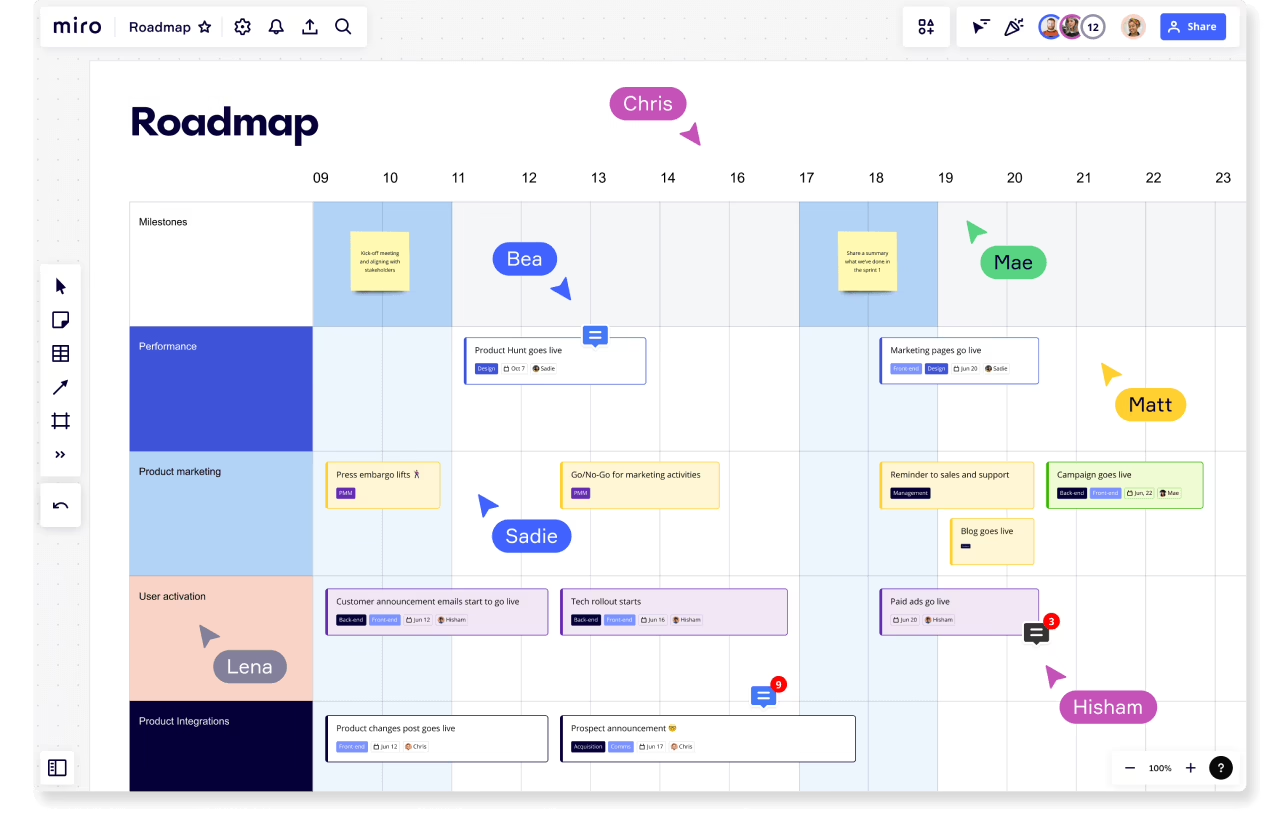
Adapt the board after making a decision. A SaaS team, for example, can organize items around a customer outcome and add a timeline only once release assumptions are firm. Meanwhile, an MVP team can organize their work based on the Now, Next, and Later frameworks, and move work placed in Later to a separate, far away spot. An initiative planning board can be used by publishing teams for audience planning. Ecommerce operators can organize initiatives around the buying journey, seasonal peaks, or other operational constraints.
Miro works best when you are figuring out what should be built. It is not the best tool for deciding which ticket should come next. After the workshop, assign someone to carry the agreed-upon initiatives over into Jira, Asana, or wherever delivery work lives, and note the link between the board and the plan.
A polished board doesn’t tell engineers what to build. Add outcomes, owners, assumptions, and a clear route into delivery, or the board ends up as nothing more than decoration.
9. FigJam
FigJam’s Product Development Roadmap template is for teams that use Figma for design and collaboration. Their templates are for product direction with sticky notes and real-time discussions that focus ideas and suggestions on a roadmap.
FigJam works best for product roadmaps that require stakeholder collaboration. One product-focused design team has the ability to address user problems on one design canvas and house product-related ideas, research, and findings. Product stakeholders that do not have design or product management backgrounds will not need to worry about product management frameworks, which, as a result, enables productive planning. Integrations with tools like Jira, Asana, and GitHub connect planning to delivery, though that connection is looser than what a dedicated delivery roadmap provides.
When building an MVP, use FigJam to capture the product problems and the outcomes of the first product iteration. For visibility, a defined list of outcomes should also be drawn to define the boundaries of the first product release. Do not consider the canvas the single source of truth.
10. monday.com
monday.com’s Product Roadmap board template is for product planning and roadmaps within a work management system. The template is equipped with linked goals and PRDs, dashboards for portfolio-level roll-ups, and product management guidance including RICE prioritization.
The breadth of monday.com means a growing company can keep its product, marketing, operations, and leadership under one roof. An ecommerce team can link roadmap tasks with campaign work, supplier tasks, launch preparations, and support updates. This eliminates the need for multiple status reports. monday.com has a marketplace where new workflow integrations can be added to the system as the business grows.
The more users, boards, and capabilities a system has, the harder it gets to come up with reasonable pricing and packaging. And the default system usually requires configuration to mirror an actual product process. monday.com makes sense for a company that wants one general work management system, but it’s a weaker choice when discovery, customer evidence, or engineering traceability is the main priority.
Top 10 Product Roadmap Templates Compared
| Tool | Core features | Best for | Strengths | Tradeoffs |
|---|---|---|---|---|
| Aha! Roadmaps | Template library, OKR links, deep integrations | Enterprise teams needing strategy-to-delivery traceability | Governance, traceability, extensive templates | Heavier; best value inside the wider Aha! suite; 30-day trial |
| ProductPlan | Visual formats, portfolio views, strategy module | Executive-ready roadmaps | Presentation quality, OKR linkage | Sales-assisted pricing |
| Strategic Roadmaps (Tempo) | Timeline and swimlane views, portfolio rollups | Multi-product portfolios and executive comms | Strong visual filters and rollups | Pricing under Tempo, less transparent |
| Productboard | Outcome-oriented boards, external sharing, discovery links | Discovery-led teams working from customer evidence | Tight discovery-to-delivery link | Free tier limited; full value at paid tiers |
| Jira Product Roadmap | Native template, Now/Next/Later, live issue sync | Teams already shipping in Jira | Live delivery status, no tool switching | Less polished presentation layer |
| Asana | Prebuilt fields, timeline and board views | Cross-functional teams without a PM specialist | Low learning curve, fast to set up | Lighter on prioritization and traceability |
| Airtable | Customizable base, calendar/timeline/kanban, scoring fields | MVPs and teams needing flexible workflows | Highly flexible, extendable, free starter | Requires modeling work; not a specialist PM tool |
| Miro | Visual templates, collaborative canvas | Early planning and stakeholder workshops | Great for consensus and storytelling | Not a delivery system |
| FigJam | Roadmap templates, real-time canvas, tool integrations | Design-led facilitation and workshops | Familiar Figma UX for design teams | Needs pairing with a PM tool for execution |
| monday.com | Board template, dashboards, marketplace | Teams wanting one work OS | Broad reach across functions | Complex pricing; needs configuration to fit PM |
Why Most Roadmaps Fail (and What Fixes Them)
The practitioner discussion around roadmaps in 2025 and 2026 is loud and is sadly not about tools. An example of this is Aakash Gupta’s Truths, which is a list that includes, among other things, one item on every roadmap that everyone knows is a lie, priorities change mid-flight, every organizational restructure consumes one full quarter, and no one opens, let alone reads, the accompanying documentation before the meeting starts. Aaron Levie makes a related point: AI is making engineers two to five times more productive, which is expanding roadmaps rather than shrinking them, and shifting the pressure from just shipping features to adoption and quality.
Both of these examples are really the same thing. The problem is not the template. The document has to hold up under stakeholder pushback, validation, and change. When it doesn’t, a handful of failure patterns tend to show up again and again.
The PowerPoint roadmap
A fully constructed deck will skip the engineering, sales, and design stages and go directly to leadership for approval. During implementation, everything will result in pushback and delays. The team’s trust will begin to erode. To avoid further issues, stakeholders will first need to address the outcomes that are important to them on the roadmap. The roadmap should reflect an outcome like, “tackle and close deals 50% faster,” rather than address the priorities of the product team. Early objections should be seen as critical feedback to help figure out where plan execution will fail.
Zero-clarity kickoffs
Kickoffs move forward with no decisions, roles, and shared documents. The roadmap begins on a sideways trajectory and issues begin appearing later. An easy-to-distribute checklist that covers decision owners and working documents will help greatly to reduce the number of failures that occur before a template is even opened.
Skipped validation
The majority of roadmap additions are caused by someone demanding/asking for it rather than warranting it. Most product practitioners have developed a relatively methodical validation sequence. This includes spotting real user problems, reviewing existing solutions, determining potential user interest, estimating the size of the opportunity, defining a small but significant angle, and testing the idea manually before writing any code. Refact has developed a useful resource on the critical layer that sits below this: Prioritizing Product Features.
“Add an AI feature” thinking
In the past, bolting an AI feature onto an existing product was a fairly safe line item to add. In 2026, that’s not necessarily the case. AI Integration is at the center of Linear’s 2026 public roadmap, implying automation will not be an afterthought. This type of roadmap suggests how product design should be centered around agents, rather than integrating AI into existing features. That is a major design choice with far-reaching effects.
Turn the Template Into a Decision Tool
A roadmap should be used as a tool to assist your team in addressing crucial product-related questions. What is the most important problem we are solving? What must we know before we can begin to build it? What should we hold off on, given the lack of evidence or issues with dependency?
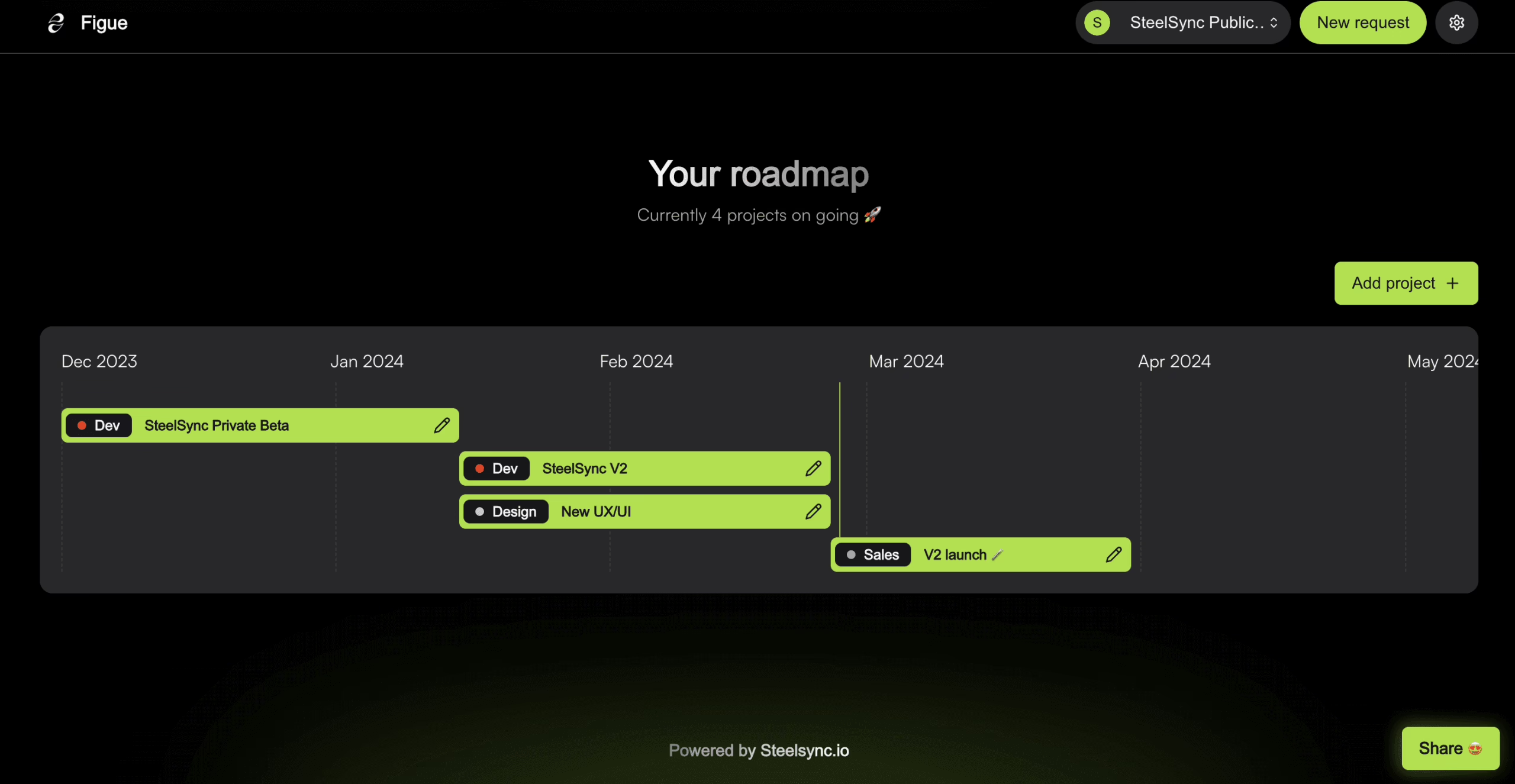
To begin defining the product outcome, take a step back and think about the MVP. How do we ensure one user can complete one valuable task? Maybe it’s an activation rate of 40% in the first month of a SaaS product. Maybe it’s cutting the time from draft to published, with cleaner distribution to email and social. Maybe it’s an improved path to purchase from the category page for an ecommerce site.
Pick one format and stay consistent. Use a timeline when sequencing and dates are what really matter. Select outcome-based for prioritizing end results. Select Now, Next, Later for when you are not certain. Restrict initial visibility to the next important planning level. Add item owners, assumptions, dependencies, and a summary of evidence for each of the major items.
Test the format before expanding it: use the roadmap to make one real priority call. If it doesn’t help your team decide, cut fields instead of adding more.
Set your review cadence to match how quickly the product actually changes. Update the roadmap whenever customer insight, capacity, or market conditions shift, and explain what changed and why. For AI-driven products, define outcomes that account for both human users and AI agents, and build in short refresh cycles, task success metrics, rates of human intervention, and a clear checkpoint for deciding whether to keep investing or stop. Mural’s product roadmap template is one lightweight starting point that supports this kind of shared planning without heavy tooling. Product School’s 2026 trends gives further insight into the mentioned shift.
What This Looks Like in Practice
Two examples from Refact’s work show how the roadmap format evolves with the product.
The task for The Hustle’s Trends premium newsletter could not be a long, formal document. A CMS, payment, and email systems were broken and the business goal to launch a paid offering was time-constrained. The plan included precise owners for each system and strict timelines with hard checkpoints. It took two weeks to launch and eventually contributed to the acquisition of HubSpot. A Now, Next, Later framework would have concealed the sequencing risk.
For Workform AI assistant MVP, the roadmap was drafted as an outcome and an action validation sequence, and not a list of tasks. An AI assistant to manage “everything” was the initial concept for this task. Using a blueprint process, we narrowed the concept down to a focused MVP built around one clear outcome: understanding a project by pulling in data from Slack, email, Asana, and meetings, then keeping the manager up to speed on it. A task-list-based roadmap would have pursued the original goal. Instead, outcome-centered roadmap prioritization was done before code was written and it cut the original goal in half.
Choosing With Confidence
A template can’t salvage a plan that skips stakeholder validation, but a good template does something helpful consistently. It brings assumptions and outcomes together with clear owners, and this is where decisions get made. Most of the tools covered here can do that. A few of them make it harder than it needs to be.
Choosing a roadmap solution hinges a lot on who will be reading your roadmap. For investors, sales, engineers, and a few other key stakeholders who’ll be reading your roadmap, Aha!, ProductPlan, or Productboard would be a solid choice. For those who’ll be reading your roadmap alongside the work being shipped, Jira is probably the best fit. If you’re looking for a roadmap that captures ideas within the context of a workshop, Miro or FigJam are in a class of their own. Airtable is great if you’re looking for a blank canvas. For company-wide alignment, Asana, monday.com, et al., might be a good choice.
Discovery work is the foundation for this. If you are asking what should be placed on a roadmap and you haven’t built a team to perform the work, then that is what Refact’s product design and strategy phase is built to address, and a money-back guarantee is tied to that particular phase.
Building a product and unsure what to scope first? Let’s talk. Free 30-minute call, no pitch.

Parnia Sebti is a project and account manager at Refact, coordinating teams, clients, timelines, and delivery across the studio’s work. She helps keep projects organized from planning through execution, making sure communication stays clear and priorities stay aligned. Her role connects client needs with the internal team’s workflow, helping turn requirements, feedback, and moving parts into structured delivery. At Refact, Parnia also contributes to shaping the internal tools and processes the team uses to manage projects more effectively and keep work moving with clarity.
More from Parnia Sebti

