Digital Transformation Examples That Actually Work
By 2027, the world will have put some US$4 trillion into digital transformation.


A PwC survey of operations leaders puts a finer point on it: merely 4% of firms can claim they have fully transformed their operating model, AI capabilities and results to any rigorous standard.
You will hear plenty of digital transformation tales told as brand highlight reels. Nike’s digital pivot, the app from Domino’s, the new loyalty tier at Starbucks. These are fine narratives if you want to look at the logo, but to be of any use one has to study the pattern behind them. What problem were they after? What did they sequence first and what did they leave alone? We go through the examples our research keeps turning up to show how a smaller team can get similar results without a nine-figure war chest.
When faced with a stalled migration or a broken workflow, the question of which tool to buy is seldom the right one. It is about which decision needs to change first.
Why Most Digital Transformations Underperform
Let us have a reality check before we get to the case studies. Mooncamp’s 2026 statistics roundup has the numbers: close to 90% of organizations are at work on some form of digital transformation. Yet Boston Consulting Group looked at 850 companies and found two-thirds do not make the grade. Only about 35% hit their stated objectives, and that failure rate has been stubbornly flat for years despite the spending.
Our primary research points to three reasons for the underperformance:
- It is the integration, not the tool. Those who do it well see an ROI of 10.3x on their transformation spend. For the rest of them it is 3.7x. The difference is in the data plumbing.
- Data quality is a hard cap. Eighty-seven per cent of leaders say poor data is holding back value, while only 30% have made headway. Any AI you put on top of that is going to inherit the same limitations.
- New tools get swallowed by old models. As one person noted on X, you have teams putting 2026 technology to work in 2016 processes. A new CRM over a broken sales process is just a pricier version of the same thing.
The following are worth a look because each one shows a team that got at least one of these right before they scaled.
1. Nike: Owning the Customer Instead of the Storefront
People like to talk about Nike’s move as a channel play. In truth it was a data play. With its membership, apps and commerce stack, Nike put itself in direct contact with the customer and then put that data to work on inventory and product development. By 2022 the company had steered well over 30% of its revenue through digital and was moving business away from wholesale.
What you should take from it is not the app, but the fact that Nike made digital its operating spine rather than a marketing surface. First-party data informed merchandising and the system tied together commerce and feedback.
What a smaller company can copy
Do not go trying to match Nike’s scope. Emulate the sequencing.
- Own your channel. Find one where you can capture the behaviour you are currently renting from a marketplace.
- Make it part of the core business. A website that cannot see your CRM or orders is nothing more than a brochure.
- Think about the second purchase. If you are after recurring revenue, the mechanics are more important than the brand story. You will find our guide on subscription websites covers the onboarding and billing that will determine retention.

2. Walmart: Turning Physical Assets Into a Digital Advantage
Then there is Walmart. They had no intention of out-Amazoning Amazon. Instead, as Amplitude’s breakdown would have it, they put their existing assets to work. They put money into supply chain automation and analytics to turn the store network into a fulfillment one. Things like in-store returns for online orders and same-day pickup are competitive advantages a pure-play does not have.
It is an old-school lesson in transformation. When you treat 4,600 US stores as a clean, queryable inventory graph, the cost of running digital experiences drops considerably.
What a smaller company can copy
Whether it is a warehouse, a member directory or a publisher workflow, that is not something to be carried around as baggage. More often than not it is the differentiator you are not making use of. Put every physical and human asset on the map and see which one gains strength when tied to a live system. The MDS write-up on omnichannel retail strategy makes for good reading on the distinction between parallel silos and having the customer at the centre of a single flow.
3. Domino’s: When the Ordering Flow Is the Product
Domino’s offers one of the clearest cases of what we call “lighthouse sequencing” in the research. They made ordering a product in its own right instead of a mere checkout path. They took a high-frequency workflow and removed the friction from it.
Now the CEO can say with some justification that he runs a tech company that sells pizza. Be it voice, app or watch, the order tracking and one-tap reordering are all designed to one end: to make the next purchase easier than the last. ZZBLOCK7ZZ
A weak core offer is rarely why a business loses customers. More often it is the friction in the buying path that drives them away. Take the workflow your customers use most, be it for reordering, quoting, booking or renewing, and apply three fixes:
- Make the first action simple. Let a prospect get going without needing a login they do not have, a sales call or a spreadsheet.
- The second should be even simpler. The system should already know who a returning user is so they can skip the usual steps.
- Keep state intact. Status, history and preferences must carry over from one session or channel to the next.
Practitioner-level workflow automation will deliver results here, provided there is clear ownership of the workflow once it is live.
4. GE Healthcare: The Legacy Problem Nobody Talks About
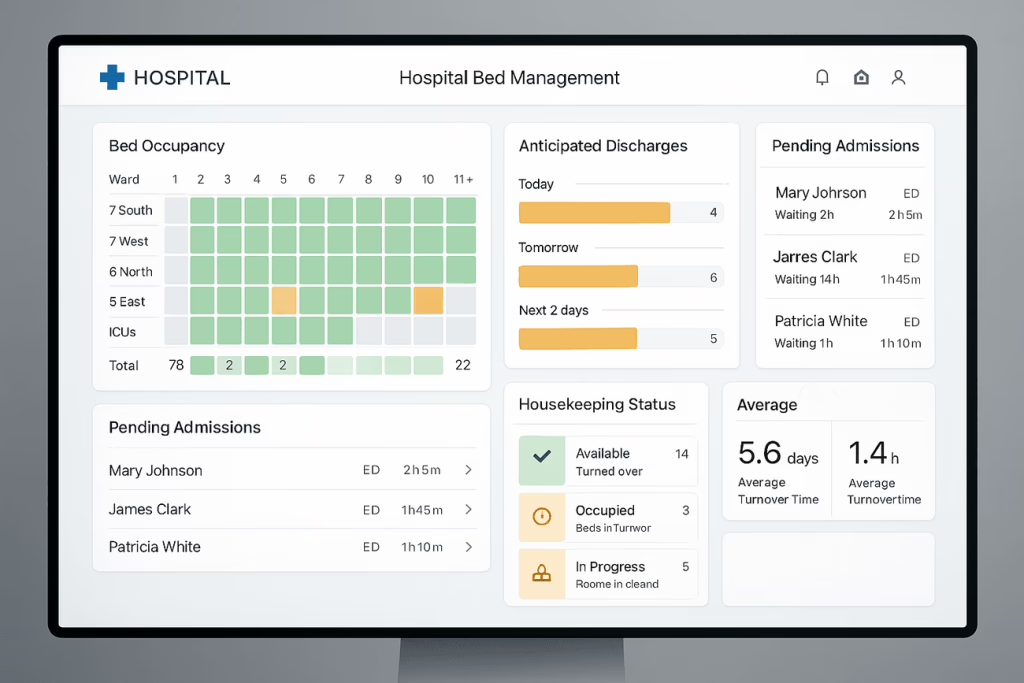
In healthcare you see what true transformation entails when data is under regulation, systems are antiquated and errors are costly. GE Healthcare is the usual example of a move from on-premise to cloud analytics and connected devices, yet the destination is less interesting than the cost of modernising legacy operations.
There is a lot of business logic hoarded in old systems: naming conventions, permissions, reports and the kind of undocumented workarounds staff have come to rely on. A rip and replace project will fail at that seam. As Terakeet has noted in its analysis of digital transformation examples, the successful ones are not about the new technology so much as the deliberate reshaping of the operating model.
What a smaller company can copy
When it comes time to put in a new CRM, CMS or internal tool, put the design comps aside. Begin with these three things:
- The data model and where the objects and relationships that run the business are to be found.
- The role map to see who is editing, approving or publishing and what the contingency is when they are gone.
- The process map of the current setup, including the shortcuts and workarounds that make it functional.
We cover how to rehost, refactor and rebuild in sequence without interrupting the revenue stream in our legacy software modernization playbook. With Teton Gravity Research, for instance, moving some 10,000 articles from a CMS with little support was only half the story. We had to determine which features to put to rest and which to update, all while keeping the platform in the hands of their publishers.
5. The New York Times: A Business Model Transformation Disguised as a Redesign
People point to The Times as an example of a publishing overhaul, but it is better described as a change in business model. They have put retention ahead of programmatic ad revenue and built a subscriber-first approach on reporting, product reviews and games. Traffic is now a means to an end.
The operational side is worth examining. A subscriber business demands you think about the value of the eighth visit and the trust you have earned, not just the first. That dictates what is measured and staffed.
What a smaller company can copy
For those in media, education or running a paid community, the questions are straightforward:
- What will bring someone back next week?
- Where is the content worth paying for and where is it table stakes?
- How does the service hold up 60 or 90 days in when the novelty has passed?
Email is more valuable than social in this space for the direct engagement it affords. In putting together Trends, a premium newsletter for The Hustle, we found the paywall was not the challenge. It was in the plumbing of getting the CMS, payment and email to work as one spine for the editors. Subscriber businesses either compound or leak at that level.

6. Starbucks: A Digital Layer on Top of a Physical Habit
Starbucks remains a coffee company; it has simply put a digital layer on top of an existing habit. Order-ahead and rewards did not create the behaviour, they made it easier to repeat. One in four US transactions now go through the app.
The lesson is not to put together a loyalty app for the sake of it. Digital is most effective when it is accelerating something you have evidence of. A loyalty programme on a brand with no pattern of repeat visits is nothing more than a coupon dispenser with an icon.
What a smaller company can copy
An enterprise loyalty platform is not required. What is needed is a way to remember people and spare them the effort of doing the same thing twice. Think saved reorders that work on any device, order-ahead options to get the slow part done before arrival, or account areas that lessen your reliance on outside platforms’ algorithms. Service and membership firms have this opportunity right in front of them.
7. Capital One: Data as an Operating Capability, Not a Project
Then there is Capital One, which is instructive for showing how “AI transformation” is handled in a regulated sector. They put in the cloud and data infrastructure within compliance limits and used it to make faster calls on fraud and credit.
Note the order of operations: data before AI, governance before scale. A 2026 study by Broadridge puts AI adoption in financial services at 80 per cent, up from 31 per cent the year prior, but the number of firms seeing a real bottom-line benefit is far lower. Those that do are the ones that got their data in order first.
What a smaller company can copy
There is a temptation to put a chatbot or copilot at the top of an AI roadmap, but it is best to resist that and begin with a single high-value workflow and the data behind it. You will find the same underlying principle in our overview of generative AI in business as in our view on selecting a modernization partner: an AI project’s reliability is a function of the processes and data it rests on.
Those working in production can tell you this from experience. Take a healthcare group that set out to automate medical coding with AI agents. They found the approach too costly and erratic for their needs and made a pivot to have AI author deterministic scripts instead. Today those scripts account for over half of the coding work in some 10,000 patient encounters a month. The results are there, they are just not as flashy as the demos.
The Adoption Gap Almost Every Article Skips
One must remember that acquiring software does not equate to transforming an organization. Research on the subject is clear: most projects falter because of poor change management and pushback from staff, not inferior technology. A system may be technically perfect, yet if people do not trust it or simply go about their business in spite of it, it will fail.
The literature from practitioners reveals two recurring patterns:
- Innovation theatre. When a pilot has no connection to the wider strategy, any local success is short lived. Without feedback between the pilot and the planning cadence, the strategic plan is left to run on old assumptions.
- Eroded trust. An unreliable feature is a quick way to lose confidence. One breakout tool may perform, but the next three misfire and users are left with the attitude of “do not count on this.” That scar tissue carries over to the next launch.
A more thorough training deck is not the answer. What is required is to instrument for reliability and to view transformation as an exercise in continuous portfolio management. One has to measure a change in behavior, not merely license counts.
How to Compare These Examples Without Copying the Wrong Thing
Consider the table below a pattern library. There is no need to put the brand on a pedestal; the objective is to zero in on the decision that is worth emulating and the tradeoff involved.
| Example | What changed | Why it worked | What a smaller team can copy | Key tradeoff |
|---|---|---|---|---|
| Nike | Direct customer relationship via app and membership | Owned first-party data drove product, pricing, and retention | Start with one owned channel that captures behavior | Channel conflict, more product and fulfillment pressure |
| Walmart | Stores turned into a fulfillment network | Used an asset competitors could not replicate | Connect physical or human assets to a live system | Inventory accuracy and store ops complexity |
| Domino’s | Ordering treated as the product | Reduced friction on a high-frequency workflow | Improve the repeat purchase path before adding features | Uptime becomes mission critical |
| GE Healthcare | Legacy modernization plus cloud analytics | Faced the operating-model cost head on | Map data, roles, and processes before design | Long timelines, compliance and adoption risk |
| New York Times | Subscriber-first business model | Aligned product and content around retention | Design for the eighth visit, not the first click | Short-term traffic pressure, rising acquisition cost |
| Starbucks | Digital layer on an existing habit | Accelerated a repeat behavior that already existed | Add digital where repeat behavior is measurable | App outages hurt in-store experience |
| Capital One | Data platform first, AI second | Governance and integration preceded scaling | Fix the data behind one workflow before adding AI | Talent cost, governance overhead, privacy risk |
Where to Start If You Are the One Making the Call
What makes these digital transformation case studies of value is not the name recognition of the companies. It is the fact that under every logo the same trio of patterns emerges: identify a problem of substance, proceed in sequence and put some numbers to the business outcome. Firms that do so see compounding returns. Those that purchase tools in the hope of altering the operating model end up spending a fortune to remain in much the same position.
It all comes down to a decision, not a development ticket. Which workflow, if done better, would free up time or drive revenue? What is the costliest problem at present? Where is a 90-day win possible without causing disruption? And what must change in how people work, beyond the software itself?
For those looking to determine where the first serious investment should go, that is precisely the sort of thing our product design and discovery process is meant to resolve. In the course of some 200 projects over 12 years we have seen the pattern hold true: the clients who give the discovery phase the protection it needs are the ones whose transformation can stand up to production. The rest are left to put it right again later, at greater expense and with less goodwill.
Building a product and unsure what to scope first? Let’s talk. Free 30-minute call, no pitch.

Saeedreza Abbaspour is the CEO of Refact, where he works across product, engineering, and sales. He sets the studio’s direction while staying closely involved in the work itself, from shaping product strategy and UX architecture to helping define the technical systems behind Refact’s projects. His role connects business thinking with hands-on product execution, giving him a practical view of how software should be planned, built, launched, and improved. At Refact, Saeedreza focuses on building a studio that can move quickly, solve real client problems, and turn ideas into reliable digital products.
More from Saeedreza Abbaspour
