AI Integration Services: A Buyer’s Playbook
There is a tendency among buyers to view AI integration as if it were a plug.


You will find that AI integration services have become their own category for this reason, though it is also why so many projects in the space come to nothing. The statistics bear it out: 42% of businesses put an end to their AI initiatives in 2024, compared to 17% the year before. The ones that do not get scrapped tend to follow a certain pattern. We set out to describe that pattern here and how to procure the work without shelling out for a demo that never makes it to market.
What AI integration services actually cover
Put aside the marketing copy and what AI integration services really amount to is the business of making a model useful by tying it to the right people, data and systems. It is a stack that involves discovery, API and system wiring, security reviews, human-in-the-loop design and post-launch monitoring. The model itself is often a minor line item in all of that.
Defining the category is loose enough that analysts will give you different numbers. Some forecasts will bundle in consulting and training while others stick to platforms or AI-as-a-Service. You can see CAGR figures anywhere from 10% to 40% depending on how one draws the line, which is worth remembering when a vendor presents a market size with the certainty of a law of physics.
A better way to look at it is what a project of merit delivers. Should you need to reset your understanding of the terms vendors like to use in order to justify their scope, we have an AI terminology cheat sheet for that.
The line items on a real proposal
If you break down a quote into these five jobs, the fluff becomes apparent.
| Role | What they do |
|---|---|
| Strategy lead | Names the workflow, sets baseline metrics, decides what “correct” means |
| Data engineer | Cleans and unifies data from CRMs, support systems, docs, and databases |
| AI engineer | Picks the model, designs prompts or retrieval, builds the evaluation harness |
| Integration engineer | Wires the model into your existing apps, permissions, and workflows |
| Platform or MLOps | Monitors quality, cost, and drift after launch |
The ratio is telling. A team putting 80% of the budget into model tuning and 20% into integration is generally contriving a prototype. One that allocates 20% to the model and 80% to the rest is likely to build something that ships.
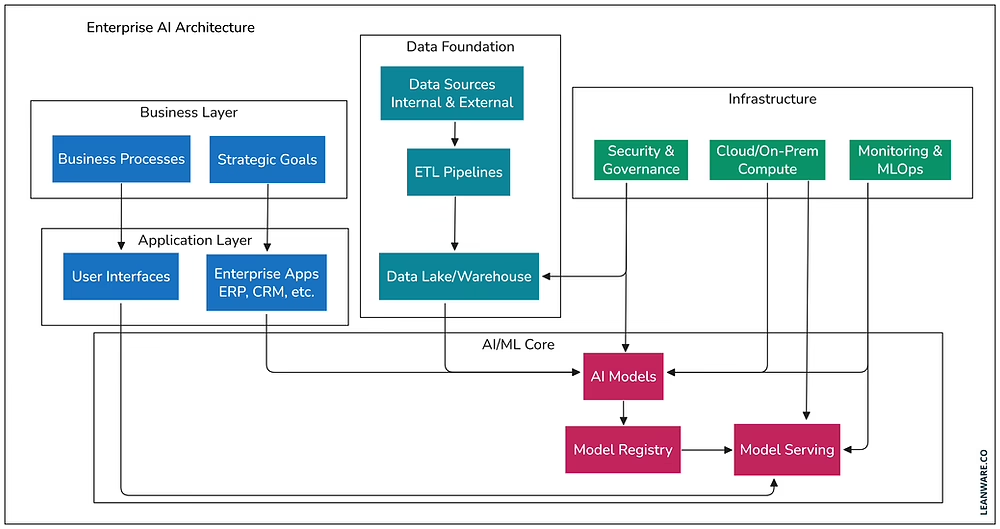
Why most AI projects fail before the model is chosen
Failures seldom have to do with a poor model. More often it is a case of a team running a polished pilot on some sample data they have put together. Then the real production data comes in and retrieval suffers. One user gets a hallucinated answer and tells the next; trust in the feature evaporates and adoption goes flat. Six months down the line there is no owner for it.
An engineer on Reddit was blunt about it: the model was easy to get working but the nightmare was wiring it to existing systems. In one survey 95% of respondents pointed to integration as the main hurdle to adoption. Vendors would sell them models while the buyer ran out of runway on the plumbing.
Then there is the mathematics of a multi-step process. An agent chaining ten tool calls at 85% accuracy each will have an end-to-end reliability of 19%. It is an unforgiving number. Serious builders will put constraints on what the model can do and insist on evaluation harnesses and human oversight for anything that writes to a system of record. Our guide on how to build an AI agent that survives production goes into the mechanics of those tradeoffs.
The failure signals to watch for in a vendor
Watch for these signs:
- They skip over what happens with your data after the clean demo
- They cannot put your problem in your own business language
- The conversation is all about the model and none about your source systems
- A fixed price is offered before discovery has run its course
- They have no answer for who is responsible for the feature 60 days out
One of these is a yellow flag. Three means you should be walking.
The pattern that separates working projects from pilot theatre
Look at the case studies and the successful ones have a common shape. Moveworks deflecting up to 60% of tier-1 tickets. Textron using an AI to pull from shared knowledge bases and trim service desk volume by 20%. Serco embedding AutogenAI in a reworked bid process to improve efficiency 85%, rather than tacking it on to the old way of doing things. Or AppForge, which saw code review turnaround drop 67% and license adoption hit 72%.
Sectors differ but the structure is the same:
- A single named workflow. Not a platform or some broad strategy. A job done often enough to be of consequence.
- A metric to measure against before you launch. Be it error rate, cost per case or deflection.
- Redesigning the workflow. Intake, approval and escalation are rebuilt around the AI.
- Time for human review. Expect 30 to 90 days where every output is vetted.
- An executive sponsor with skin in the game. The COO for cost, the CMO for revenue, the support head for CSAT.
Do without any of it and the project will drift. Do without two and you have an expensive proof of concept that no one wants. Practitioners call that pilot theatre.
Data readiness is a higher bar than analytics readiness
A dashboard will let you off the hook if a chart is a little amiss; an analyst will put it right. An AI system has a habit of amplifying such inconsistencies. When two systems have different takes on a customer record, the AI will put its faith in the one it has most recently seen. An undocumented schema and you can count on the retrieval to miss the mark, and with it the answer.
All of which means that in a real integration, data work is where the bulk of the budget is spent: on unification, identity resolution, consent at ingestion and the like. Teams that do not make the time for this end up with features that are unreliable in ways the user cannot quite put into words. They simply stop using them.
Curious whether your site is citable by AI assistants? We run a readiness check that shows what they can and cannot read. Run the check.
Where AI integration pays back fastest
There is a certain kind of project that is safest to start with, one that occupies the space between the fully manual and the fully deterministic. The work has a shape that repeats, so a model can be of assistance, but there is still human judgment involved. We are talking about drafting or summarizing, not approving or pricing.
A few patterns have a way of justifying their build cost:
- Support drafting for the 20 or so question types you see on repeat, with staff to give the final say
- Internal search assistants with a firm grounding in product docs or contracts
- Content classification for your intake queues or archives
- Lead triage to get things in front of a person
- Summarization of documents in a review queue that would otherwise be given a cursory look
You will notice there is nothing here that puts the model in charge of an expensive decision. That is something for later, once the guardrails are in place and have been vetted.
We had a case in point with the automated news pipeline we put together for a daily newsletter publisher. The editors were able to trust what came out because of the hygiene rules, deduplication and tagging we put in at the ingestion stage. That was the interesting part, not the intelligence layer. Without such a foundation the model would have churned out near-duplicates and the team would have been done with it by day three.
A four-question ROI filter before any build
One has to ask a few questions of any workflow:
- Is there enough volume for the time saved to matter?
- Can a person put a quick check on the output?
- Are there actual examples to test against as opposed to hypotheticals?
- Would some standard automation or a form solve the problem?
The last one is frequently overlooked. In many instances the plain truth is that AI is not the tool for the job. If the inputs are structured and the process is set, a rules-based approach is more predictable and less costly to maintain. We go into when that is the case in our guide to document workflow automation.
How to evaluate an AI integration partner
Do not be swayed by the vocabulary of a vendor. The best indicator is whether they will put a weak idea to the test before they put a number on it. A partner who will tell you a rules engine is better suited than a model is of more value than one who agrees to everything.
Before you put pen to paper, these are the sorts of questions to pose:
- How do you come to the conclusion that AI is a fit?
- What can we expect from the first couple of weeks in terms of deliverables?
- Who is setting the acceptance criteria and in what format?
- What is the plan if the use case does not hold up to validation?
- How do you deal with data that is at odds across our source systems?
- What is your evaluation harness to spot a regression?
- Once handed off, who is responsible for the code and prompts?
- How is human review handled in the first 60 days post-launch?
And ask for the specs. “Make it sound professional” is too open-ended and will yield the same in return. You want machine-readable specs with Given, When, Then criteria to head off ambiguity. Augment Code has a good write-up on their AI spec template.
Pricing models, and where each one breaks
| Model | Fits when | Watch for |
|---|---|---|
| Fixed price | Scope and spec are already tight | Change requests inflate the real cost |
| Time and materials | Discovery-heavy or evolving work | Budget drift when goals stay vague |
| Value-based | Narrow, high-value outcomes with a clean baseline | Hard to define fairly at the start |
If a partner is candid enough to say the scope is not yet firm for a fixed quote, that is a good sign. It will save you months down the road. For a broader view on outside help, our buyer’s guide to AI development services and the piece on enterprise workflow automation cover the operational details.
The pre-build checklist
A buyer should be in a position to answer all of the following before the kickoff. If not, the discovery phase is for building those answers.
- The workflow: One job, one user, an outcome you can measure.
- Source systems: Where the data is, how clean it is and who has it.
- Real inputs: Twenty to fifty examples, the messy ones included.
- Success and failure: Put in writing what a good output is, and what edge cases or wrong answers the model might encounter.
- Review model: The point at which a human steps in to approve or reject.
- The simpler way: Whether a template would do the job.
- Launch limits: Start with a narrow group or single workflow.
- Monitoring: Someone has to be on the hook for a weekly review of outputs.
- What comes next: Should the pilot be a success, how does it expand?
It is not glamorous work, but then again, most of the costly errors in AI projects are ordinary mistakes in technical garb.
When the honest answer is no
Then there are workflows that ought not to be an AI project. The data is too scattered, the volume is not there, or the task is too fluid. And if the price of a wrong output is steep, a form or a rules engine will handle it more cheaply and with less risk. Any competent integration partner will be the first to tell you as much before the contract is in place.
When it comes to AI, consistency will always trump novelty. You will find that the organizations reaping genuine value from their integration are not those with the most experiments on the books. Rather, they have taken a more measured approach: pick a single workflow and redesign it to fit the model, make sure there is a human in the loop and monitor adoption with the same rigour as accuracy.
Should you be in any doubt as to whether a given workflow warrants a build, Refact’s AI development work is meant to put that question to rest. We stand behind the discovery phase with a money-back guarantee, meaning if the answer is no, there is no cost to you for having made the call.
Trying to work out where AI actually fits in your stack? Let’s talk. Free 30-minute call, no pitch.

Saeedreza Abbaspour is the CEO of Refact, where he works across product, engineering, and sales. He sets the studio’s direction while staying closely involved in the work itself, from shaping product strategy and UX architecture to helping define the technical systems behind Refact’s projects. His role connects business thinking with hands-on product execution, giving him a practical view of how software should be planned, built, launched, and improved. At Refact, Saeedreza focuses on building a studio that can move quickly, solve real client problems, and turn ideas into reliable digital products.
More from Saeedreza Abbaspour

