Chatbot Integration Services: A Buyer’s Guide
A demo can conceal most problems.


This document is designed for operators and product managers deciding what to buy, what to build, and what to walk away from. It assumes you already know AI chatbots exist. What you need to understand is whether a given vendor can wire one into your stack without making your support team shift into full incident response mode.
Why the Model Is Rarely the Real Problem
By 2024, the Market Question started shifting from “does this work” to “does this work here.” A cross-industry survey of 1,840 organizations showed that 72% of enterprises with more than 500 employees have deployed at least one AI chatbot or conversational AI system, an increase from the 53% reported in 2024 (adoption survey). Deployment is the new baseline. What differentiates useful bots from expensive bots is what happens after the greeting.
Users of these frameworks tend to come to the same conclusion. The lack of a given model isn’t usually the problem. The real issues include the legacy CRM nobody wants to touch, pricing rules that were never written down, a missing escalation path, and metrics that reward deflection while the customer walks away angry. One founder articulated his struggles on X: enterprises “rush AI agents onto 15-year-old systems” and are surprised when the bot operates individually but fails to complete the transfer because “nothing talks to anything else.”
Consequently, the most insightful question during a vendor call isn’t “which model do you use?” The best question is, “what systems does this bot read and what does this bot write to, and what happens if these systems conflict with each other?”
If the vendor answers the first two questions with a slide and skips the third, that is not an integration plan. That is marketing.
What Chatbot Integration Services Actually Deliver
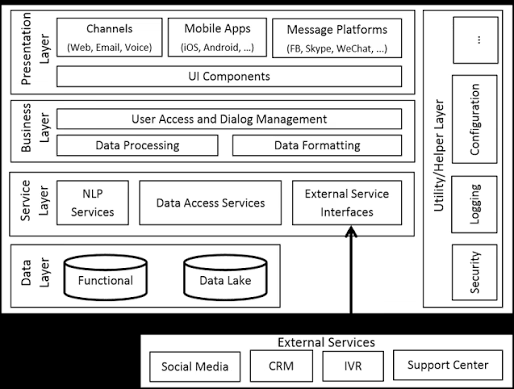
The three distinct layers of any working chatbot integration are the messaging channel, the logic of the conversation, and the underlying systems. The messaging channel layer includes resources such as web chat, WhatsApp, SMS, Instagram, or a phone line. The logic of the conversation layer usually has an LLM and retrieval layered on top. The systems layer includes your CRM, helpdesk, order systems, payment processor, and inventory.
Enterprise Guidance names this as intentional decoupling. Maintaining layers loosely joined means a slow CRM won’t freeze the front end, a model swap won’t require a rebuild of channel adapters, and governance can reside in one place instead of across vendors (enterprise integration guide). Ask any partner to illustrate this on a whiteboard before you discuss pricing. If they cannot, they are selling you a widget.
The two integration patterns you will actually pay for
Most integration work reduces to two patterns. Request and response is the lookup: the customer asks about an order, the bot queries a backend, and the bot provides the answer. Event-driven webhooks flip the lookup direction: failure of a payment, closing of a ticket, and movement of an appointment, among other events, trigger bot activity. Real deployments require both. The difficult part is not the coding, but rather determining the range of the bot’s activities that do not involve operator intervention vs. those that require it.
Where RAG belongs, and where it does not
The pattern most small and mid-sized teams should adopt is retrieval-augmented generation. A RAG agent coupled to a company’s documents, help center articles, or a Google Drive folder provides answers with references and reduces hallucinations. Several people running this pattern have reported that it cuts support time by more than half. This is credible for FAQ-heavy support. It is not credible as a real entry point into a transactional system. Answering “where is my order” requires a real-time query to the order table, not a paragraph retrieved from a policy PDF.
To understand the production of these components at a larger scale, we go into more detail about integration and governance in our chatbot for enterprises guide.
The Failure Patterns That Repeat Across Every Rollout
There are common, predictable ways chatbot projects break, and they’re the same ones you’ll see discussed by practitioners and posted in Stack Overflow and post-mortem threads.
The deflection trap. A shop owner running an AI support bot cut cost per ticket from about six dollars to fifty cents and watched volume drop sharply. Then a customer with a damaged shipment got a generic policy quote, then another, then a refusal to escalate. Reviews turned hostile. A human resolved the case in minutes, but the trust was already gone. The dashboard said success. The customer said otherwise. Optimizing only for deflection is how you destroy lifetime value in the name of savings.
Undocumented business rules. Many AI chatbot consultants spent months fine-tuning prompts, only to finish client project proposals by hand. The logic and exceptions in the company policies had never been documented. The bot cannot run a process that is in one person’s head.
Trust decay after a bad release. One founder described how he launched an AI feature. He followed that up with a broken release. After the bad release, he saw zero adoption. He created “permanent scar tissue” on adoption. The second release’s reliability is more important than the first release’s AI feature.
Pilots that break in minutes. One team shared that their first interaction with real users broke the product in ten minutes. Internal testing cannot cover the hundred and first case. Assume the pilot will find edge cases you missed, and build safe fallbacks before you direct traffic.
These are normal failures. They are not exotic. Any vendor who has shipped work will have seen them. A vendor who has not will describe their product like none of these apply.
Comparing the Three Vendor Paths
Skip the demo beauty contests. There are three real paths, each of which will fit a unique situation.
| Dimension | Custom Build | Boutique Studio | Platform Vendor |
|---|---|---|---|
| Best fit | Unusual workflows, strict data rules, long runway | Teams that want a working bot in one quarter with hands-on scoping | Standard use cases inside one existing ecosystem |
| Typical timeline | Four to six months | Six to twelve weeks | Two to six weeks to first launch |
| Typical cost | Often above $100K | $25K to $75K | Lower upfront, monthly fees compound |
| Flexibility | Highest | Medium to high | Constrained outside the vendor’s connectors |
| Question to ask | Who owns the code, data, and integration layer? | Which systems get wired first, and what’s out of scope? | What happens when I need a connector you don’t support? |
A no-code stack can solve problems. One practitioner claimed that a combination of Typebot, OpenAI Assistant, and Make for around $50 with some setup work handled approximately 80 percent of their service requests in a solo practice. This is real, but is unique to a solo practice and is not generalizable to a practice with a CRM and compliance policies.
For further information on how to evaluate a build partner, our article on hiring an AI chatbot development company gives more details on the distinction between serious teams and resellers.
Curious whether your site is citable by AI assistants? We run a readiness check that shows what they can and cannot read. Run the check.
A Timeline You Can Actually Defend
The best chatbot integrations still take real work. Two weeks is a demonstration. Ten to sixteen weeks is a deployment. The slides that follow cover what a responsible partner will walk you through.
Discovery and Integration Mapping (2 to 3 weeks). Systems that the bot must read from or write to are identified, as well as actions associated with each system when it is unavailable. During this task, a good partner will push back on scope. According to one practitioner, deals for chatbots collapse when vendors position their offering as a package. Deals close when the buyer is forced to understand the cost associated with the process and the risk it poses. The problem presented (“we need a chatbot”) is almost always a symptom of a different issue, such as long response times, understaffing, or missing triage.
Conversation Design and Prototyping (2 to 3 weeks). One channel. One or two flows. A working demo on actual data, not a sample data set. This is the time to define all the business rules the bot will be based on. If those rules do not exist, that becomes a separate work item.
Integration and Build (4 to 8 weeks). Authentication, data mapping, connector work, and escalation logic. This is where the deadlines begin to slip. This is also the area where the Model Context Protocol (MCP) is beginning to significantly decrease the amount of time required to get a project launched. The results reported by vendors suggesting a reduction in handle time by 1 minute and an improvement in routing accuracy should be read as directional as these results cannot be substantiated.
Testing and Soft Launch (1 to 2 weeks). A small portion of traffic, a kill switch, and a rollback plan. Any founder who has watched a launch go wrong will tell you a boring rollout beats a dramatic one every time.
Refact’s automation and integration practice follows the same general structure when we develop custom chatbots and workflow tools. Building an AI-powered pitch assistant for El Colectivo 506 was no different. The vast majority of the program schedule wasn’t model tuning. Rather, it was translating a complex editorial system into a formal workflow that the assistant could reliably follow, and then building connections to the training system with the least disruption to the way journalists worked.
Costs and the Line Items People Forget
There are four main cost centers, and buyers routinely underweight two of them. Build cost, plus the cost of the platform or license, the integration, and ongoing maintenance constitute the majority of the cost. But the real budgetary concern is the maintenance costs.
| Path | Typical Range | Biggest Cost Risk |
|---|---|---|
| Boutique studio build | $25K to $75K | Scope creep and hidden integration work |
| Custom build | Often above $100K | Maintenance and rework across systems |
| Platform rollout | Lower upfront | Monthly fees and connector limits |
Rules of thumb worth carrying into the vendor call. Scope creep accounts for roughly 30% of overruns. Integration surprises can add another 25%. Maintenance costs of CRM systems, on average, fall in the range of 15% to 20% of the cost of the build each year. Build a 30% to 50% buffer over the quoted amount. A vendor who reacts poorly to that buffer number is probably not being honest about the work.
Our AI integration services buyer’s playbook offers a more robust treatment of this topic and provides a wider perspective when considering the broader AI stack and the use cases for deployment.
The First Thirty Days After Launch
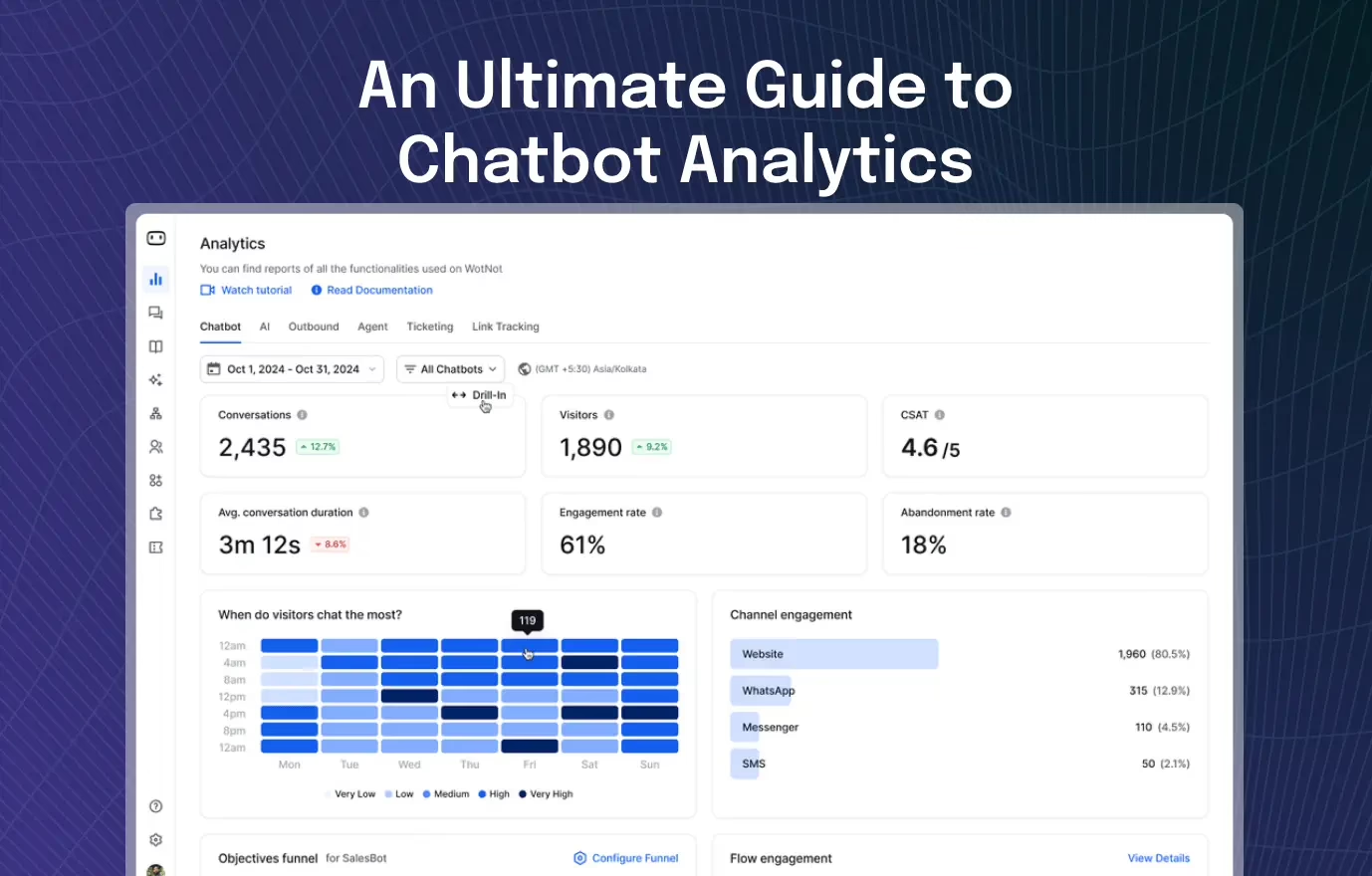
Just because you “launched” your bot does not mean it stops being a project. That is when you really start to learn all of the weak spots. The first month is where previously undocumented policies or poorly named CRM fields will show up. What you do with these problems will ultimately determine the adoption of your bot, and how long it takes people to lose trust in your bot.
The weekly numbers that actually matter
You should measure containment, handoff-to-human, resolution time, and customer satisfaction on the same reporting cadences, at least weekly. For support bots, healthy containment should be in the range of 60% to 75% (according to Rasa on chatbot metrics). Merely looking at containment will give you a false sense of health. Optimal containment should be looked at alongside customer satisfaction metrics to determine if the chatbot is optimized correctly. People running “resolution engine” designs, or first contact resolution systems, reported 31% increases in customer satisfaction over alternative designs. These are self-reported, but the pattern is consistent enough to trust that direction.
Feed failures back into the system
Once a month, read the top twenty failed conversations, and tag the bot’s intent misses. Push those gaps to the flows, training data, or escalation rules. Each quarter, check integration endpoints for health. CRMs change structures, APIs change versions, and the connector that worked in July can stop working by October. If there is no one to take ownership of this cadence, the bot slowly decays.
For more information on the mechanics of building production agents and the feedback loop, view our guide on how to build an AI agent that works. This guide is a helpful sanity check for anyone initiating a build.
What To Do This Week
Three items prior to the next vendor call. Write a one-page scope document listing every system the bot must read from and write to, while including the business rules for every action. Ask each vendor for two reference clients that will speak candidly about the challenges of integrating the solution, not just the results. Set aside an afternoon to map your current support volume by question type in order to contrast the real support requests from which you will measure the bot’s effectiveness against marketing requests.
A chatbot only pays off when it can safely touch the systems that already run your business. If you want a team that will map the real workflow before writing code, and tell you when the answer is not a chatbot at all, that is the work Refact’s chatbot development practice is built for.
Trying to work out where AI actually fits in your stack? Let’s talk. Free 30-minute call, no pitch.

Saeedreza Abbaspour is the CEO of Refact, where he works across product, engineering, and sales. He sets the studio’s direction while staying closely involved in the work itself, from shaping product strategy and UX architecture to helping define the technical systems behind Refact’s projects. His role connects business thinking with hands-on product execution, giving him a practical view of how software should be planned, built, launched, and improved. At Refact, Saeedreza focuses on building a studio that can move quickly, solve real client problems, and turn ideas into reliable digital products.
More from Saeedreza Abbaspour

