Hiring an AI Chatbot Development Company
The numbers are stark: some 60 per cent of enterprise AI outlays amount to nothing in terms of material value


This guide is written for the operator, the product lead, or the owner who is in the process of vetting chatbot vendors. We will not be reciting marketing copy. Instead we focus on the things that make a chatbot work rather than just look good in a demo: scope, data ownership, integrations and post-launch operations. Expect to find pricing bands, red flags and an examination of the RAG versus fine-tuning debate, along with the sort of questions your shortlist should answer without hesitation.
What You Are Actually Buying
A company in this space will try to sell you on their models and prompts. In truth, the work is quite different. A production chatbot is an exercise in data engineering, safety and change management with a language model tacked on. The Stanford AI Index puts it plainly: more than 60% of LLM users put them in a chatbot for some process, but the pattern is clear that the model itself is seldom what makes or breaks it. Success comes from retrieval quality and tool interfaces.
It changes how you view the vendor. GPT-4 and Claude are commodities; you are not really buying access to them. You are buying a team’s discipline over data pipelines, hybrid search and the kind of workflow redesign that renders a bot useful. If a vendor is all about model names, it says something about where they are weakest.
Think of the bot as 20% of the project. The other 80% is what it can and cannot do, what it reads from, and who is left holding the reins in six months’ time.
Get Scope Right Before Anyone Names a Model
There is a common thread to every documented success story. They zero in on a high-cost, high-volume workflow and have a baseline to measure against. Klarna’s bot took on routine service tickets. Barking & Dagenham Council turned in a 533% ROI in nine months by handling a specific set of citizen queries. Some dental clinics have halved no-shows with a bot limited to rescheduling. Failures tend to be the opposite: a “catch-all” that is expected to answer anything.
So put pen to paper before you sit down with a vendor. Three lines will do:
- The one workflow the bot is to own.
- Your current baseline (volume, time and cost per interaction).
- The figure you want to move and the margin for improvement.
You will see wins in support deflection, cart recovery, order status and the like. But an info-only bot that answers and stops will give you shallow returns. You want something action-capable that can book a slot or process a refund. Should a vendor be unable to show a live deployment where the bot writes to a system, consider it demo-ware. For smaller operations, our practical guide offers some advice on selecting a first workflow without over-complicating matters.
Pricing Bands and What They Actually Buy
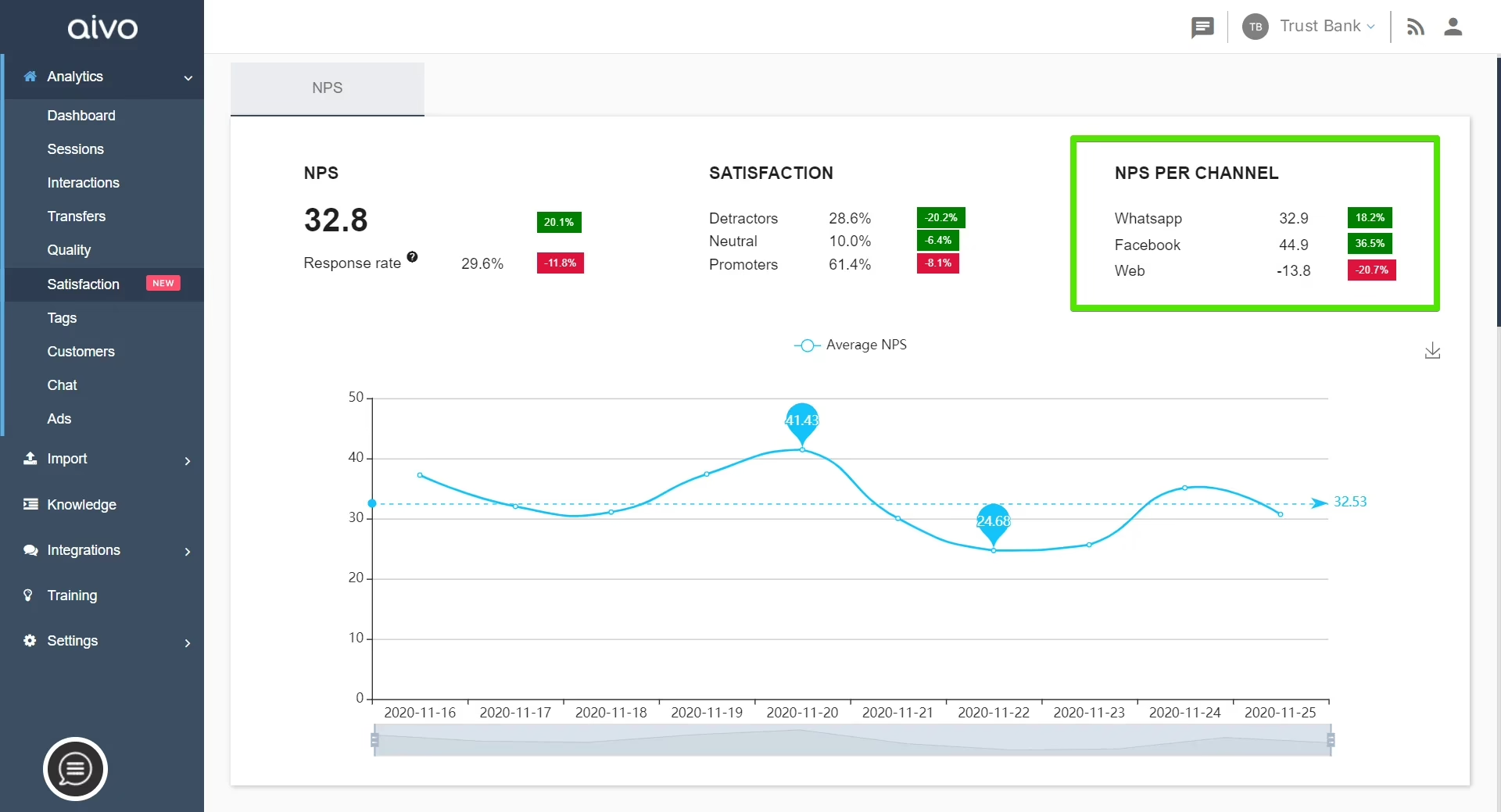
If you look at the figures from Master of Code, the market has coalesced into three tiers:
- Rule-based custom bot ($15k-$30k): Good for a narrow FAQ or to capture leads, but it falls apart when the language is not scripted. No LLM here.
- AI chatbot, non-generative ($75k-$150k+): You get intent classification and entity extraction. It is predictable if not up to open-ended questions.
- Generative AI ($150k and up): An LLM core with the necessary safety layers, evaluation infrastructure and tool use.
But those are build costs. The total cost of ownership is another matter entirely. Tying the bot into your CRM, ticketing and knowledge base will likely run you more than the bot did. Then there is the ongoing tuning and transcript review that can take 20 to 40 per cent of engineering resources in a serious rollout. And do not be surprised when model token costs mount; operators who priced a pilot on 500 conversations a month are often caught off guard when traffic hits 8,000.
Make them put a 12-month TCO on paper, including integration and a point person for tuning. A vendor who can only quote you for the build has not given much thought to what happens after launch.
The Architecture Questions That Separate Vendors
The diagrams in a blog post will have a user going to an LLM for an answer. Any real system has five or seven parts: an orchestration framework, a hybrid retrieval layer, function-calling, input and output filters and an analytics pipeline. If they cannot put that stack on a whiteboard and defend it, they are not building for production.
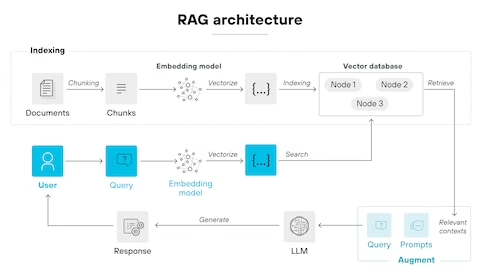
When it comes to architecture, three questions are paramount.
RAG or fine-tuning?
With enterprise knowledge like inventory or policies in constant flux, retrieval-augmented generation is the way to go. Fine-tuning is for brand voice or very contained tasks. The mistake is to assume RAG is a solved problem. How well the bot performs is dictated by the quality of the retrieval. It is the chunking strategy, the embedding freshness and the re-ranking of hybrid search that determine whether the bot hallucinates. Correcting that is a matter of the ingestion pipeline, not the prompt.
Do not settle for a vendor who claims to “plug in RAG” but cannot tell you how they refresh the index or keep the model from citing documents it should not. There is a reason we put together an AI terminology cheat sheet for product teams: to get at the meaning of these terms as they apply to the decisions on your desk.
One model or many?
Forget the old heuristic of always going with the most powerful model. It is no longer tenable. Yes, frontier models such as GPT-4 and Claude Opus are good at complex reasoning, but they come with a cost in speed and price. For high-volume work that is narrow in scope, a smaller distilled model will do it cheaper and faster. You will find multi-LLM routing to be the norm in any deployment worth its salt: simple queries go to a small model, the complicated ones to a frontier model, and anything sensitive to a self-hosted stack. The numbers back this up; platform share from 2024 to 2026 has ChatGPT falling from roughly 87 per cent to 65 as Gemini, Claude and Copilot make inroads. To put all your eggs in one provider’s basket is a risk, not a technical choice.
How does the bot fail?
Put it to them directly. What is the protocol when the model is at a loss? When a tool call throws an error? Or if a user attempts to jailbreak via a support ticket that is pulled in? A vendor of substance will talk about confidence thresholds, least-privilege permissions for tools, pre- and post-LLM filters, and human escalation with context transfer. They will have fallback phrases like “let me double-check that for you.” An inferior vendor will simply say “we handle that.”
Integration Is the Deliverable
A chatbot that is blind to open tickets, order history or loyalty status is little more than an ornament after a quarter. You can read the same grievance in practitioner threads on Reddit and Hacker News: bots that “know” but can’t “do” are decommissioned. If the answer to “what’s my order status?” is “please check your account,” you have essentially made a slower version of your own site.
Make a list before you sign anything. CRM, ERP, ecommerce checkout, analytics, auth and permissions, the knowledge base – what must the bot be able to read and write to? Get a live reference from the vendor and ask how they have gone about integrating those systems. Those who view integration as an afterthought will eat into your timeline.
It is where a full-service product team and a chatbot shop part ways. On our work with El Colectivo 506 on a solutions-journalism training assistant, the model was the easy part. We had to structure their methodology into a knowledge base the bot could reason over and design a bilingual conversation flow for reporters at every level of skill. The same holds for our automated news pipeline; it was the data hygiene and API integrations that made the AI layer useful, the model itself was almost incidental.
Curious whether your site is citable by AI assistants? We run a readiness check that shows what they can and cannot read. Run the check.
Data Ownership Is a Contract Question
In any discussion with a vendor, pose these three questions:
- Who has ownership of the training data, the fine-tuned models and conversation logs?
- Is customer data being fed to third-party models by default, and can you switch that off?
- What are the terms on residency and deletion? Do you cover SOC 2, ISO 27001, GDPR or HIPAA requirements?
Some chatbot vendors are happy to let the defaults stand so they can use your data to improve their model unless you are on an enterprise tier. If the answers here are vague or you need to send a follow-up, consider it a red flag rather than a matter of paperwork.
Red Flags on a Sales Call
You can predict failure by a few vendor habits that are a source of complaint in the community. Two or more of the following in a single call and you should leave.
- The polished demo. Demos are happy paths with clean data. Demand a pilot against your actual edge cases and transcripts before the contract is in place.
- “We will replace your support staff.” Klarna had to walk back some of that early FTE displacement messaging because of the operational and reputational drag. Good deployments redesign roles, they do not just wipe them out.
- No plan for after launch. Who is doing the tuning at month six? If the response is “we have a support package,” they see chatbots as a one-off IT project. That is the primary way things go wrong.
- Claims of zero hallucinations. There is no such thing. They can be mitigated with retrieval and escalation policy, but not done away with. Vendors making that claim are selling to the uninformed.
- Hazy on who is on the project. Ask for the ML engineers, the QA, the ops. Vendors who sidestep the question are likely to put juniors on the build while senior staff are tied up in sales.
- Leaderboards as proof. A spot on the Chatbot Arena does not mean much for an enterprise. If that is their evidence instead of a live deployment with hard metrics, you are looking at marketing.
Build, Buy, or Hybrid
If you have the in-house ML talent and need tight control over data, or a workflow too idiosyncratic for a vendor to have seen before, build it yourself. Otherwise, buy from an agency for the speed and the battle-tested architecture. We tend to see a hybrid approach: an agency for the initial build and integration, with an internal owner – a CX lead or product manager – to take charge of the tuning and iteration.
But the handoff has to be explicit. Make sure there is a runbook and evaluation harness in the contract, or the internal team will be left with a black box and the bot will degrade. Our buyer’s guide to AI development services and our piece on hiring a generative AI company go into the mechanics of it.
How to Measure Success Before You Sign
Set your terms with a primary metric and baseline in place prior to any vendor talks. Some of the more effective ones are:
- Containment or deflection rate – the share of inquiries a bot can put to rest on its own; this is the support standard.
- First-contact resolution – best used in tandem with CSAT to ferret out bots that “resolve” a ticket by wearing the user down until they quit.
- Conversion lift – for anything from cart-recovery to sales.
- Response time delta – we have seen a brokerage lead-response bot in our research go from 7 hours to 12 seconds, and follow-up rates go from 40% to 100% as a result.
- No-show reduction – when it comes to scheduling and reminders.
- Hours saved per person per week – for internal use. Lumen’s Copilot, for instance, put back about 4 hours for each of their sellers weekly.
Make sure the contract is tied to the metric rather than feature delivery. A feature-based contract pays for outputs; a metric-based one for outcomes. The distinction will tell you if the vendor is with you once you are live.
What a Working Engagement Looks Like
There is a certain rhythm to an engagement that is going to be successful. It starts with two or four weeks of discovery: you map the workflows, do a data audit and safety scoping, take stock of integrations and set a baseline. Then comes a pilot with a narrow scope and a clear threshold for success, run against real data. From there you move to production with an internal owner in charge and evaluation loops in place. Tuning is done on business KPIs and transcripts, not synthetic numbers.
That is how we approach the work at Refact’s chatbot development practice. It is also why our client relationships have a way of running 12 to 24 months. The value is in the tuning cycles, not the demo at launch; the bot you have on day 90 is not the one you had on day one.
Where to Start
You will find the vendors worth working with are those who will be frank enough to say the project is overreaching, the data is unprepared, or a workflow change would be better than a build. The rest are just peddling optimism. In cross-company studies, the best predictor of value is a willingness to redesign the workflow around the AI instead of bolting it on top of what you already have. High performers are three times as likely to do so.
Deciding on what to defer and what your first chatbot should handle, and scoping it so the pilot has a chance of making it to production, is where Refact’s AI development practice comes in. With chatbots especially, clarity must come before code. A focused, well-instrumented bot with an owner will beat a broad and ambitious one without fail.
Trying to work out where AI actually fits in your stack? Let’s talk. Free 30-minute call, no pitch.

Saeedreza Abbaspour is the CEO of Refact, where he works across product, engineering, and sales. He sets the studio’s direction while staying closely involved in the work itself, from shaping product strategy and UX architecture to helping define the technical systems behind Refact’s projects. His role connects business thinking with hands-on product execution, giving him a practical view of how software should be planned, built, launched, and improved. At Refact, Saeedreza focuses on building a studio that can move quickly, solve real client problems, and turn ideas into reliable digital products.
More from Saeedreza Abbaspour

