7 Membership Website Examples Worth Studying
You will find most write-ups on membership website examples are nothing but a showcase of sales pages.


The numbers bear this out. Of the membership sites with over a year under their belt, average revenue is in the neighborhood of $179,880, while the more established ones pull in $307,805 (see here: https://www.paidmembershipspro.com/do-membership-sites-work/). Yet you would be hard pressed to find much visual polish to account for the difference between those figures and the sites that quietly bleed out.
We have put together an article on seven sites worth your time. We read them for the things that count: the pricing logic, the onboarding, the promise made and the one kept. It is intended for operators of a recurring revenue product, not for those who like to collect screenshots. And if tooling is still up in the air, our best membership site platforms comparison is a better place to start than any design gallery.
What a Membership Site Actually Is
Think of a membership as a service business behind a paywall. The wall is the uninteresting part. The service is the promise you make good on, on a schedule, for a price members will tolerate so long as you hold to it.
That puts a different spin on what you should be studying. Do not ask if a site is impressive to look at. Ask what specific outcome the member is paying for and how the site gets a new user there in 30 days. Inquire as to why they renew and what the pricing reveals about the audience. The following examples are instructive because they each have their own answer to those questions.
1. MasterClass: When the Catalog Is the Moat
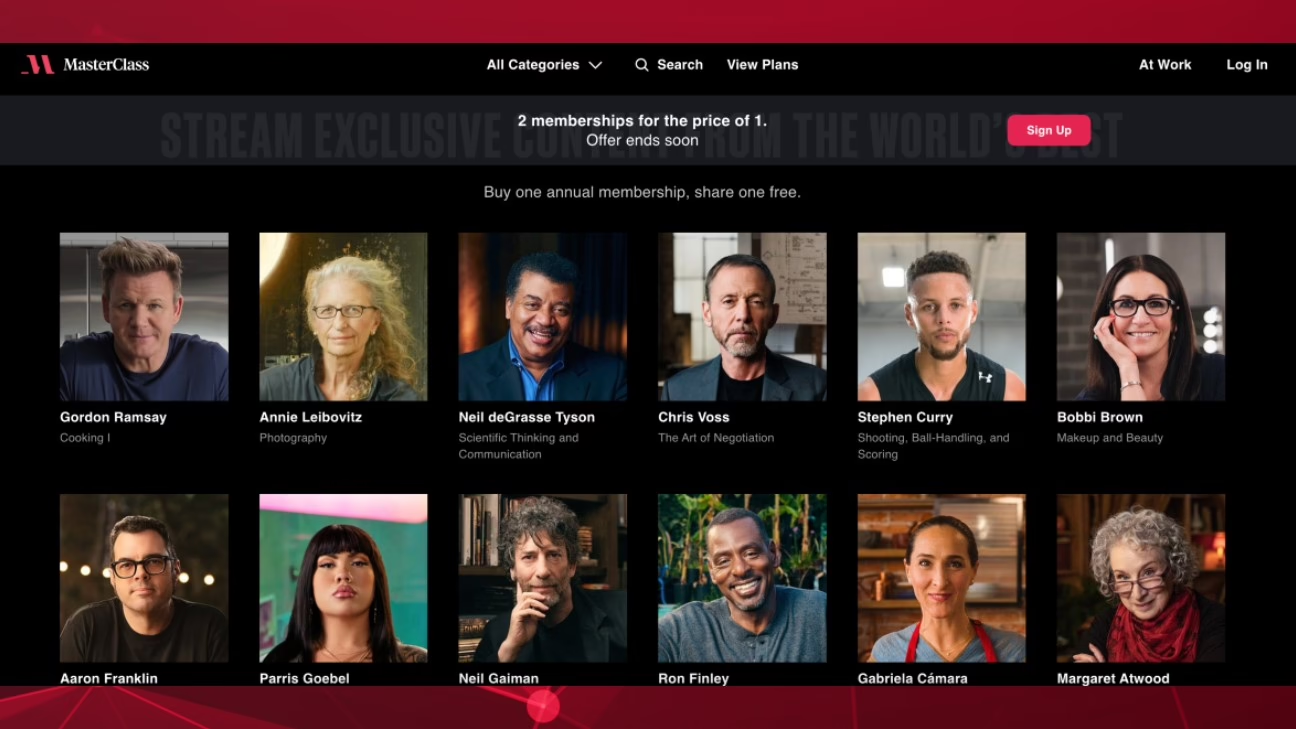
Take MasterClass. They put aspiration before curriculum. A famous instructor list is what brings people in; turning a viewer into a user is what holds them. A library is only of value if the member can locate the class for the moment.
All-access pricing makes sense when your catalog is the moat. A single price removes the friction of course-by-course decisions and prompts the kind of browsing you want from a member who does not have an urgent problem to solve. Mobile and TV apps open up more opportunities for consumption, while downloadable workbooks coax a little practice out of passive watching.
What to take from it
With a large library, discovery is the product. The member area homepage needs to tell you what to do next without delay. If it cannot, retention will be in the tank by week three and fresh content will not put it right. The lesson from MasterClass is not to hire celebrities but to engineer the path through the breadth you are selling.
2. Stratechery: A Membership With One Person and One Job
Stratechery is the antithesis of MasterClass and succeeds for the opposite reason. You have one writer and the value is in his interpretation. Ben Thompson puts out strategy analysis with a regularity that serious readers get used to. There is a free tier to weed out the casuals and a paid one for the podcasts, interviews and member-only updates.
For the domain expert whose insight is the product, a lean publishing operation is superior to a bloated platform. Your audience wants a mind, not a library. Three things stand out:
- Let the free tier do the filtering. You do not need a sales funnel to convince the serious reader to self-select into a paid subscription.
- Cadence is key. Predictable publishing makes the subscription a part of the workday rather than something to be re-evaluated.
- Match the format to the room. Executives and operators want depth in the background of a commute, which text and audio provide.
There is a temptation to add video or forums and in doing so dilute the promise. That is a trap. For expert content the paywall has to carry the weight of retention, making the paywall models for publishers far more relevant than the CMS.
3. Consumer Reports: Trust as the Product
Then there is Consumer Reports. They are charging you for an answer to “should I buy this?” Be it ratings, test results or buying guides, everything is in service of reducing uncertainty at the point of purchase. An ad-free environment is less of a feature and more of a signal that the incentives are in order.
This is the pattern for expensive decisions that recur – cars, home purchases, insurance. The category is secondary to the fact that the buyer is in a decision cycle. A utility-first site may be plain, but in this instance a search function that gives you a straight answer will always trump a hero animation.
Put your money into search and comparison tools before editorial polish if your member is there to make a quick decision.
It is a sound approach for professional associations and expert-led organizations. When the audience is after confidence and not noise, you are selling judgment, not volume.
4. Peloton App Membership: A Habit Product With Content Inventory
As for the Peloton App Membership, it may present itself as a content library but in truth it is a behavior loop. There is a method to the mix of programs, challenges and instructor loyalty. Add in a steady stream of new sessions and you have given your members every reason to fire up the app tomorrow. In this view, classes are merely inventory; the habit system is what constitutes the business.
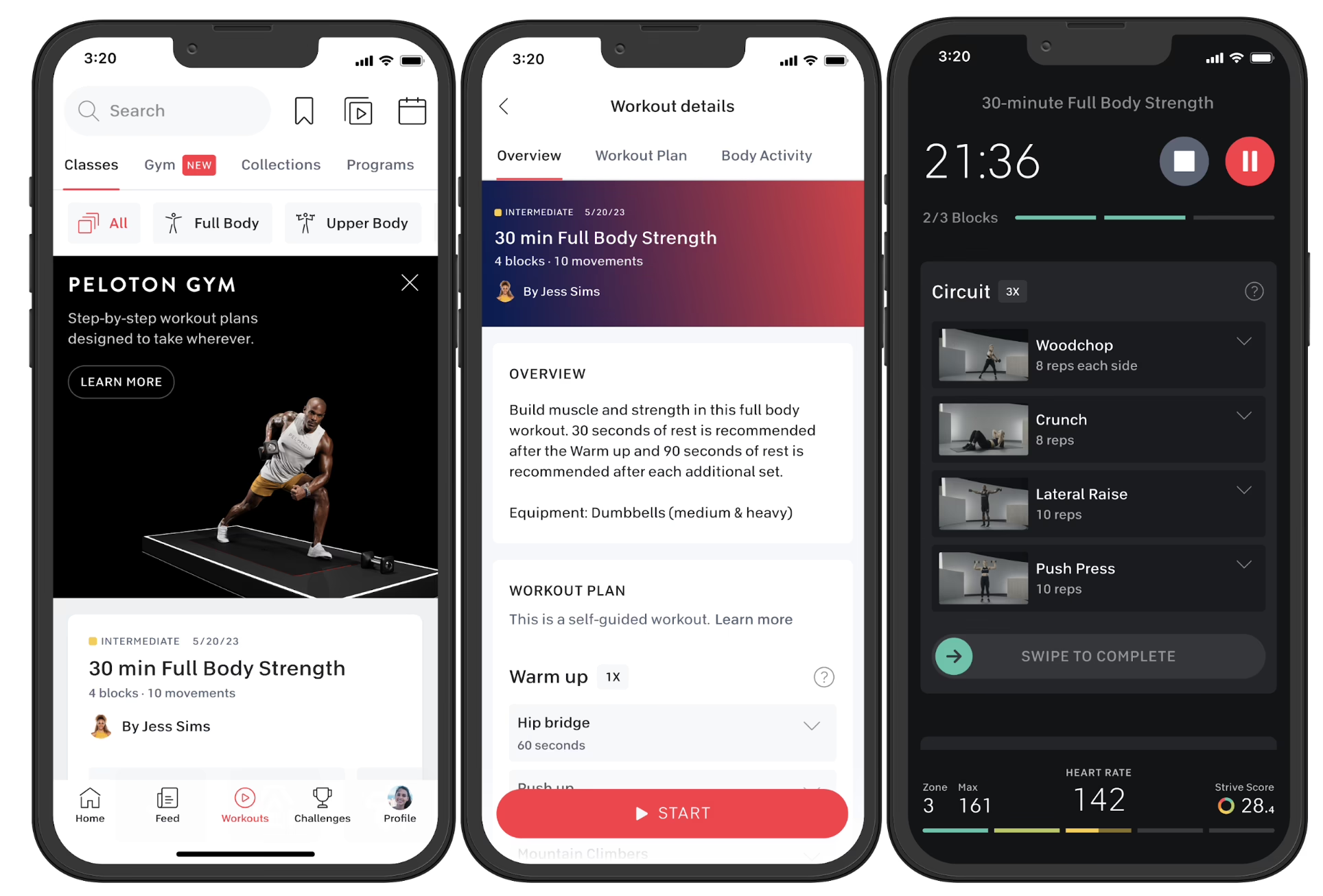
One should take note of the tiering. Peloton has an app-only membership for those who want to get started with little friction, while hardware-linked plans cater to the member already set in his routine and looking for something more substantial. It is a way to accommodate different levels of commitment without having to flatten the product into a single offer.
- Tiering broadens the funnel. You can lower the barrier to entry with an app tier and not devalue the flagship.
- Programs spare the member from decision fatigue. Why build your own workout logic when following a program is simpler than making a choice each day?
- Progress cues put a cost on absence. Streaks and milestones make it harder to skip.
But there is a warning here: complex tiers only create confusion if they do not translate to a tangible benefit for the member. We see it time and again when a subscription is tacked onto an existing product as an afterthought. For those at an earlier stage of that decision, how to create a subscription website will walk you through the choices that determine if the model is sound.
5. Skillshare: Exploration as the Value
Then you have Skillshare, which is all about creative momentum. The proposition to the buyer is straightforward: open a large project-based catalog with one membership, pick something and start today, then put out what you have made. The buyer is after motion, not accreditation, and the pitch is easy to follow.
The danger is inherent in the very thing that makes it work. A marketplace catalog is uneven in quality, so discovery is part of the deal. If a member cannot find a course to suit him in the first session he will not lodge a complaint. He will quietly churn and cancel two months down the line over some supposed change in lifestyle.
> A library of any size is not a value proposition. It is about putting the right thing in front of the right member at the right time.
For any education or creator-led business, this holds true provided you put the resources into curation and quality control so there is a clear path after lesson one. Lacking that, and you have overwhelm instead of exploration.
6. Crunchyroll: Niche Beats Broad
Crunchyroll succeeds by not trying to be all things to all people. It has a specific audience with an obvious incentive to subscribe for access to anime and simulcasts on the Japanese schedule. The higher tiers are for heavier users who want offline viewing or more streams; they are not random add-ons.
Most operators would do well to consider this approach. Founders will chase the largest possible audience and wind up with a product no one is talking about. Crunchyroll is worth paying for to its group and word-of-mouth does the rest.
Licensing is the tradeoff. When packaging changes, members are quick to compare “what I used to get.” Any niche membership reliant on licensed content will feel this tension. You build trust through transparent tier differences and open communication about plan changes, not with a promotional discount.
7. Ancestry: Discovery as the Retention Engine
Ancestry offers the best case for a retention mechanic that is not tied to new content. A member will log in to see what has turned up – a DNA connection, a record hint, a photograph in the database that was not there last month. Because these small personal outcomes are somewhat unpredictable, the product has a life of its own.
With tiered access to tools and record sets the product can scale to the member’s ambition. A casual user stays on the surface; a serious researcher goes deep. UX is paramount since you need to prompt the next step without requiring expertise.
This is a pattern that applies to anything with long-term personal import, from legal research to hobby collecting. It is better to build around discovery than simple content delivery. That puts a different spin on the engineering budget; search and progress tracking are what matter, not how many items you put out in a given month.
How These Seven Sites Compare
| Site | Primary value | Retention engine | Best-fit operator |
|---|---|---|---|
| MasterClass | Aspirational learning at scale | Broad catalog with strong discovery | Well-funded content brands with production budgets |
| Stratechery | Expert strategic analysis | Predictable cadence, trusted single voice | Domain experts with a strong point of view |
| Consumer Reports | Independent decision support | Repeat decisions and trusted judgment | Associations, research bodies, expert-led orgs |
| Peloton App | Habit and progress | Programs, streaks, instructor loyalty | Coaches, fitness brands, behavior-change products |
| Skillshare | Creative exploration | Project-based learning and community | Education marketplaces with strong curation |
| Crunchyroll | Niche entertainment access | Ongoing releases and passionate audience | Any operator serving a passionate subculture |
| Ancestry | Personal discovery | Data-driven surprises and progress | Products with long-term personal relevance |
What Practitioners Get Wrong
You will find the same errors in every niche. A founder will commit to a weekly cadence he cannot keep once month nine rolls around. Or a community is launched with no facilitator and becomes a paywalled Discord where the only posts come from the founder. Onboarding is treated as a content dump rather than a 30-day plan, and members leave because they never could find the door, not because the product is wanting.
Technical blunders are pricier and less obvious. Writing access control as a boolean on the user object seems adequate until a downgrade happens mid-cycle and the site is still showing premium material. And do not count on webhooks being reliable. Stripe and the like will tell you events are not guaranteed to arrive in order or even at all. A proper system has idempotent handlers keyed to event IDs and does periodic reconciliation with the provider. If you are laying out your infrastructure, our payment gateway integration guide details the failure modes you should be designing for.
There is an error in underpricing that does not get enough airtime. Put a $9 plan on the table and you will draw in the sort of member who complains and has no intention of renewing. The professional or B2B tier, at $49 to $199 a month, tends to hold its own better. Why? Because the cost is a filter for those seeking an outcome as opposed to a deal. And if one cannot justify the price with a tangible result, it is the offer that is at fault, not the number.
Where Refact Fits
Over the last 12 years we have put our expertise to work for operators in the form of SaaS, paid publishing, WordPress platforms and custom sites. Take The Hustle: they had an audience of more than a million and wanted to put a premium newsletter in front of them, but their current technology was an impediment. For the Trends premium newsletter build we put in two weeks to do away with a CMS, payment and email setup that was at odds with itself. A proper membership stack is one system where access, billing and publishing are in agreement on who a member is.
We see long running partnerships here at Refact, which is in line with the industry at large; the average client-agency relationship is now in the neighbourhood of seven years, or 87 months for integrated full-service outfits. With membership products you want to be working over years, not sprints. The decisions in the first half year are what will determine if there is a business left standing by year two.
How to Use These Examples
Look at these seven examples for their pricing logic, onboarding and information architecture rather than how they are dressed up. Outseta puts it at 54% of non-entertainment membership sites having trouble with drop-off after six months because the content has gone stale. The solution is rarely to churn out more material. You need a value loop your members can feel each week, and tiers that are well defined.
It is also instructive to look laterally at other recurring revenue models. The tiering logic a club uses for gym plans is a fair parallel. Or consider coaching software designed to get coaches out from under admin work; it reveals the operational drag that is often masked by “just add a subscription.”
Our discovery process is meant to iron out the hard questions before any code is written. One can begin with how to create a membership website with staying power or see our approach to platform development. Get the clarity first, then build a system that renews its members without fuss.
Building a product and unsure what to scope first? Let’s talk. Free 30-minute call, no pitch.

Saeedreza Abbaspour is the CEO of Refact, where he works across product, engineering, and sales. He sets the studio’s direction while staying closely involved in the work itself, from shaping product strategy and UX architecture to helping define the technical systems behind Refact’s projects. His role connects business thinking with hands-on product execution, giving him a practical view of how software should be planned, built, launched, and improved. At Refact, Saeedreza focuses on building a studio that can move quickly, solve real client problems, and turn ideas into reliable digital products.
More from Saeedreza Abbaspour
