

There is a common way software service buyers get burned, and it has nothing to do with the code itself. It is the decision to put pen to paper in the first place. Look at the post-mortems from CB Insights and you will see 42% of startup deaths are attributed to “no market need.” The NANDA study out of MIT puts the figure at 95% for enterprise AI pilots that fail to show an ROI. In both cases the product was built properly, but it was the wrong product. For those in the market for software companies at present, that is the risk to price before one starts haggling over hourly rates or feature lists.
What follows is an examination of what these firms are really selling, their pricing, where the costs are hidden, and how to find a partner who is mindful of your budget rather than billing against it.
The Real Work Sits Before the Build
You can read the success stories and see the tools on any vendor site, but the buyer’s experience tells a different story. MuleSoft’s 2025 Connectivity Benchmark and the reports from Deloitte and Gartner all come to the same conclusion: it is integration, governance and data quality that stand in the way of software initiatives, not some matter of UI polish or model selection. Take the PropTech CEO profiled in the 2026 Software Delivery Failure Index; he put in a year on a partner integration that saw no adoption. A technical problem in name only, it was a delivery failure.
At its core, that is a decision problem. If you cannot articulate the outcome that would be a win, or identify the recurring pain and the first user, no amount of service downstream is going to rescue the project. A good partner will put the brakes on until you can. At Refact we have a paid strategy phase that precedes development, complete with a money-back guarantee should the work not yield a clear, actionable roadmap. The logic is straightforward: you want to change your mind when it is still cheap to do so, before any code is written.
For a more thorough look at this, our product discovery process guide lays out what should and should not be part of it.
The Three Service Lines and What Each Actually Buys You
On a sales call it is easy for ten different labels to be conflated into a single quote. It is cleaner to view software services in three distinct categories: strategy, build and support. They each have their own way of failing.
Strategy and product design
Strategy is where you determine what is worth building. This entails everything from user research and problem validation to wireframes, UX flows and a delivery plan the team can stand behind. When handled correctly it trims the first version to something that can be tested within a defensible budget. Skip it and you are left with an impressive feature list that will take twelve months to disprove.
The numbers bear this out. Of 101 shutdowns we have documented, 42% were for lack of market need and 41% for strategic misalignment; poor product quality was only 17%. We offer a product design service because that is where the savings are.
Development and implementation
Then there is the build. Whether it is an MVP, a SaaS product, a client portal or a migration, development is about turning decisions into a working product. That includes the unglamorous side of things like QA, deployment pipelines and the integrations that do not make the demo.
What distinguishes a solid build? One team should be responsible for seeing the plan through. Trying to coordinate three vendors who point fingers at one another when a deadline is missed is an easy way to put three months on your launch date. And they should be shipping with enough regularity that progress is measured in weeks. High-performing teams release in days or hours, as software benchmarking research will tell you. Even without an engineering background, asking about Mean Time to Repair is a telling question for a partner. Our overview of the types of web development services goes into more detail on the overlap between them.
Maintenance and growth
Once the product is launched, maintenance is what makes it useful. Bug fixes, security, analytics, the odd design tweak and the new features that real usage demands. Weak work shows up here in spades: simple changes drag on, a minor fix breaks something else, and nobody is on top of the backlog.
If you go by the thousands of complaints on Reddit, the pattern is a big kickoff and then junior staff offering reactive support. The answer is not to sign a longer contract but to have a partner who applies the same discipline after the fact as during the build. That is how we have scoped our website maintenance service.
Buyers also tend to under-estimate application performance. Before putting pen to a support contract, it is worth reading this practical guide to monitoring application performance so you know the right questions to put to them.
How the Money Actually Works
As for the market as a whole, it is estimated to be around $494 billion in 2025 and on track for $815 billion by 2032, a CAGR of 7.42%. The SaaS market is on an 18.7% CAGR trajectory, with projections of $1.48 trillion by 2034 up from some $375 billion in 2026. You can read two things into those figures. For one, services revenue is outpacing product revenue at most software firms (70% to 62% growth respectively) and comes with a 72% gross margin. That is the margin you are being sold against. And as for supply, expect more teams vying to build for you with each passing year.
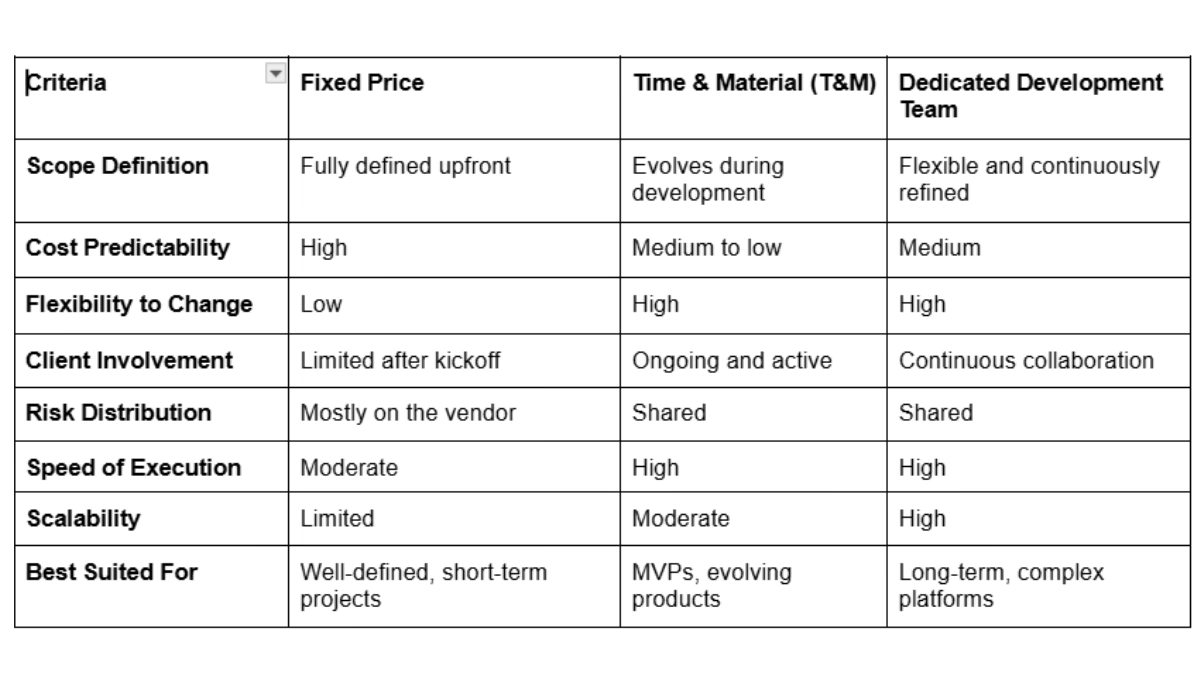
You will encounter three pricing models in nearly every proposal.
| Model | Best fit | Where it usually fails |
|---|---|---|
| Fixed price | Small, well-defined projects with stable scope | Rigid change process, thin scope, and pressure to declare “done” before it is |
| Time and materials | MVPs, evolving products, discovery-heavy work | Budget drift when priorities or communication weaken |
| Retainer | Live products needing ongoing releases, support, and iteration | Paying steadily without a clear list of what changed this month |
A fixed price has its appeal; it is safe when you have a tight spec for a brochure site rebuild. But if you are still figuring out what your users want for a new product, a fixed price will harden the scope too soon and relegate any discovery to a change order. In that case, time and materials with well defined checkpoints is the better fit. Then there are retainers, which become logical once the platform is in the wild and the focus is on monthly improvements rather than whether something will ship.
The costs the quote does not show
Do not be surprised by where TCO estimates fall apart. Reddit-scale analysis is uniform on this: implementation fees, integration engineering, third-party licenses and the consultant hours required to make “self-serve” tools work. Twilio’s 400% price hike was enough to drive customer migration. A Salesforce buyer will tell you he has put down $50k in consultant fees before the first bill even arrives. These are no edge cases. As US technology services cost benchmarking puts it, you have to strip the one-time fees and normalize to a per-user or per-transaction unit to compare vendors properly. The lowest quote is often just the most expensive set of assumptions in disguise.
For a more grounded view of how scope decisions affect the bottom line, we have an MVP development process guide.
Where Founders Should Actually Start
Most real world scenarios can be broken down into two types.
New idea, open questions. Strategy and validation should come first. The aim is not a full spec but to define the core workflow and the first user with precision. Refact put this in practice with Workform’s AI assistant for project managers. The concept was vague – an AI to do everything. Through our discovery process we whittled it down to a testable MVP that could answer specific questions by pulling from Slack, Asana and email. No production code was written until that reframing was done.
Existing product, weak results. An audit based on business outcomes is in order here. Be it onboarding or conversion paths. Broya, the DTC brand from Canada, had a live Shopify store but a conversion issue. We did not do a rebuild. We reworked the subscription flow and how the product pages were written. Our NudFud ecommerce build is another example of scoping the actual job instead of piling on features.
Questions That Reveal a Partner Before You Pay Them
Headcount and timeline are what buyers like to ask about, but judgment and communication are of far greater import. In fact, breakdowns in communication are the number one complaint in large-sample studies of software services, edging out quality and price.
We recommend a short list of questions to get at the truth:
- How do you arrive at clarity prior to building? If the answer is thin, so will the project be.
- What is the process when we cannot agree on priorities? You need a team that does not simply say yes to all.
- Who is going to be on my product? Put the salesperson aside and meet them.
- How are scope changes handled and priced? It reveals their thinking when reality intrudes.
- Give me concrete numbers on deployment and incident recovery, not adjectives.
- What does month three look like? Most partnerships falter after launch.
- When does the IP transfer? Who owns the code? Make sure it is in writing.
There is a consistency to the advice on Reddit from thousands of threads: treat sales behavior as a preview of delivery, put the tool to the test with the end user and run a pilot before signing a long contract. It is not cynicism, it is what every buyer wishes they had done. More on this in our piece on hiring a product development team, while the consulting and IT services guide breaks down vendor types.
The Filter That Saves the Most Money
Should you remember only one point, let it be this: the service that will put the most money back in your pocket is rarely the development itself. It is the decision making that precedes it. Determining what should wait and what is worth building. Because a spotless build of the wrong thing is still the wrong thing, and the priciest one you can put out there.
With the market expanding you will have no shortage of teams offering to build. Fewer will help you decide what is worthy of being built. When you need to separate a fundable idea from a good one, or find the true constraint in a live product, that is the sort of early clarity our discovery process at Refact is designed to provide.

Saeedreza Abbaspour is the CEO of Refact, where he works across product, engineering, and sales. He sets the studio’s direction while staying closely involved in the work itself, from shaping product strategy and UX architecture to helping define the technical systems behind Refact’s projects. His role connects business thinking with hands-on product execution, giving him a practical view of how software should be planned, built, launched, and improved. At Refact, Saeedreza focuses on building a studio that can move quickly, solve real client problems, and turn ideas into reliable digital products.
More from Saeedreza Abbaspour

