How to Sell Data: What Buyers Actually Pay For
Most companies that ask how to sell data start from the same assumption.
 Saeedreza AbbaspourOctober 17, 2026
This guide is for operators, publishers and business leaders who hold data that looks valuable. That includes the growing number of companies being approached by brokers who want their records for AI training. It covers what buyers pay for, the rights work that decides what you are allowed to sell, how to package and price a data product, and where the common sales channels fall short.
Selling Data Usually Means Licensing a Product, Not Handing Over a File
When you sell data, you almost never transfer ownership. You grant access under terms: a one-time extract, an ongoing feed, an API, or a packaged analysis. Each of those has different pricing, support costs and control over what the buyer does next. Settle which one you are selling before anything else.
Ritala and colleagues studied B2B firms in 2024 and found four distinct ways companies make money from data. The first is data as a product, which is raw or lightly processed licensing. The second is data-enhanced products, where data features make something you already sell more valuable. The third is data-driven services, and the fourth is performance outcomes, where you get paid for a result the data helps you deliver. Only the first is what most people picture when they say “sell data.” The other three pair data with software, service or responsibility for an outcome.
Software companies behave the same way in practice. Simon-Kucher’s 2025 Global Software Study surveyed 502 executives. Of those monetizing data, 73% used it to attract customers and 56% sold it as an upsell or add-on. Only 35% sold it directly to buyers outside their customer base.
| What you sell | What the buyer gets | Real example | When it fits |
|---|---|---|---|
| Data as a product | Licensed access to records or a feed | Reddit’s licensing deals with AI companies | The asset is rare and refreshed continuously |
| Data-enhanced product | An existing product with data features built in | Wolters Kluwer’s expert solutions | You already have customers and a product they use daily |
| Data-driven service | Analysis, benchmarks or research on a schedule | Walmart’s supplier insights, tied to ad activation | Buyers want an answer, not a table to clean |
| Performance outcome | A measured business result | TRIPBAM, which ensured clients saved at least 4x its cost | You can instrument and prove the result |
The big names in this table should be read for their operating model, not as revenue targets. Wolters Kluwer’s expert solutions made up 59% of its 2024 revenue, but that figure includes software and workflow tools, not just data. Mastercard’s $13.3 billion in value-added services and solutions revenue for fiscal 2025 is built on network data, and it is not a data-sales line either. In both cases the data is the raw material. The customer pays for the thing built from it.
We see the same pattern with publishers. When we built Trends for The Hustle, a paid tier of business intelligence and research reports, the product was analysis, not a dataset. Most of the work went into the system around it. The CMS, payments and email all had to function as one product before readers would pay for the insight. We launched it in two weeks.
Raw Licensing Works When Nobody Else Has the Asset
Direct licensing can be very large when the data is distinctive. Reddit’s SEC filings disclosed $203 million in aggregate licensing contracts with two-to-three-year terms. The company expected at least $66.4 million of that to be recognized in 2024. Its “other revenue” line, driven mainly by data licensing, reached $114.7 million for fiscal 2024.
Two caveats keep this from being a template. Contract value is not recognized revenue, and Reddit’s archive of human conversation is unusually hard to replicate. If a competitor or a scraper can put together something 80% as good, raw licensing turns into a price war.
Start With a Buyer’s Decision, Not Your Database
The most common failure in data selling is building supply before proving that anyone will pay. Brokers working the AI-data market say the same thing in different ways. One calls “we have access to tons of data” a red flag. Another describes outreach that produced thousands of emails and no deals that could close.
The clearest firsthand account is the post-mortem MonitorIntent’s operator published in October 2025. The lead-intelligence product ran for 10 months and generated more than 3,000 qualified leads, but it had only seven paying customers. Buyers preferred cheaper, higher-volume alternatives. Scraping sources became less dependable as platforms restricted access, and fixed costs grew faster than revenue. The operator’s own conclusion was that he should have sold earlier, through a waitlist, customer commitments or a semi-automated service run by hand.
That last option deserves more attention. If you can deliver the first version as a spreadsheet you update yourself, do that before you build a pipeline. A buyer who pays for the manual version has answered the only question that matters. Our guide to product discovery techniques that work covers how to run those tests without getting polite false positives.
What a Buyer Conversation Has to Answer
- Which decision does this data change? “Market insight” is not a decision. “Which 200 dealerships to call this quarter” is.
- What does the buyer use today? If a vendor already sells something close, you need a reason they would switch.
- How often do they need it refreshed? Weekly needs mean an ongoing feed and ongoing costs on your side.
- Will they pay, and how much? A free pilot helps only if it ends with a commercial answer.
Curation is usually where the defensible value sits. One seller on Reddit described spending about 4,000 hours compiling scattered public records on 3,000 companies, categorizing them and building software to access them. The product sells for $12,000 a year. The underlying records were public. The value was in finding, cleaning and organizing them so a buyer did not have to.
Some companies will find that nothing they hold has outside value. Simon-Kucher found that 41% of software executives said they had no monetizable data. That is a useful result. It points you back to the 51%: using the data to run your own business better.
Rights and Privacy Decide What You Are Allowed to Sell
Compliance is not paperwork you finish after the first deal. It is a product constraint that limits which fields you can ship, to whom, and for what use. Buyers already know this. One question practitioners report hearing early in diligence is simply “who signed off on the rights?”
Start with a source-rights register. For each dataset, record who collected it, under what notice or contract, any retention or territorial limits, and whether each field is personal, confidential, licensed from a third party or derived. Customer data, partner data and data bound by a platform’s terms of service often carry sharing restrictions that the people who want to sell it have never read.
For personal data in the EU, the legal basis for collecting information does not automatically cover selling it later. The EDPB’s data protection guide for small business explains that valid consent has to be freely given, specific, informed and unambiguous. A consent box ticked for “improving our service” will not stretch to a third-party license. The stakes are real. Serious GDPR violations can cost up to €20 million or 4% of worldwide annual turnover, whichever is higher, and CSIS’s analysis of GDPR enforcement shows fines increasing year after year.
US rules are more fragmented but tightening. California’s Delete Act generally treats a business as a data broker if it knowingly collects and sells personal information about consumers it has no direct relationship with, and it requires those brokers to register and pay a fee every year. In October 2024 the California Privacy Protection Agency announced an enforcement sweep of data broker registration. At the federal level, the FTC sent letters in February 2026 to 13 data brokers about their obligations under PADFAA, the 2024 law that restricts selling Americans’ sensitive data, such as health, financial, geolocation and biometric information, to foreign adversaries and entities they control.
The EU Data Act, applicable since 12 September 2025, is often misread. It governs specific mandated sharing obligations, not every voluntary sale. Where it applies, compensation must be reasonable and non-discriminatory. A margin is allowed, and there is a cap for certain small and not-for-profit recipients. Work out whether your deal is voluntary licensing or required sharing, because the pricing rules are different.
“Anonymized” Is a Test Result, Not a Label
Removing names does not make data anonymous. The EDPB’s 2025 guidance says pseudonymised data stays personal data if it can be attributed to a person using additional information, even when someone else holds that information. The UK ICO asks sellers to apply the “motivated intruder” test: could a reasonably competent person with outside data and some determination re-identify people in your release?
This puts sellers in conflict with buyers. Buyers, especially AI buyers, want rawer and richer data. Sellers want to limit their exposure to personal information. Some brokers say the buyer side usually handles de-identification. Regulators frame identifiability as depending on context, including what the recipient could link. Who carries liability if a buyer later re-identifies people is still an open question. Until the contract answers it, treat it as your risk.
Scraped data is murkier. Operators of crawlers worry about proving lawful acquisition, sensitive fields slipping into the dataset, ownership disputes and payment processors dropping them. None of the research gives a clean answer on reselling scraped “public” data, and that uncertainty should be reflected in your price and your contracts. For anything beyond your own first-party data, get legal review in the jurisdictions where you and your buyers operate.
Trust Can End the Business Outright
CartaX is not a data-licensing case, but it shows the risk clearly. Carta shut down its secondary trading business in early 2024 after a company representative contacted an investor using information tied to a customer’s cap table. CartaX brought in roughly $3 million a year, under 1% of Carta’s revenue. The damage to trust in the core business was far larger. If customers suspect their data is feeding your other revenue lines, the relationship breaks. Put permitted-use rules into the product itself, not just into a policy page.
Package the Data So a Buyer Can Evaluate It Quickly
A vague pitch slows down every deal. Buyers need to know what the data reflects, how many years it covers, its geographic and category coverage, the format, how often it updates, and its known limits. If a prospect still asks “what exactly am I buying?” after your one-pager, the spec is not finished.
You do not need to invent a documentation format. W3C’s DCAT 3 vocabulary separates a dataset from its distributions and records versions, coverage, licenses and checksums. It also lets you state rights for each distribution, so a free sample and a commercial feed can carry different terms without contradicting each other. Frictionless Table Schema adds field types and constraints that a buyer can validate automatically. Writing these is close to writing clear, testable product requirements, and the same discipline applies.
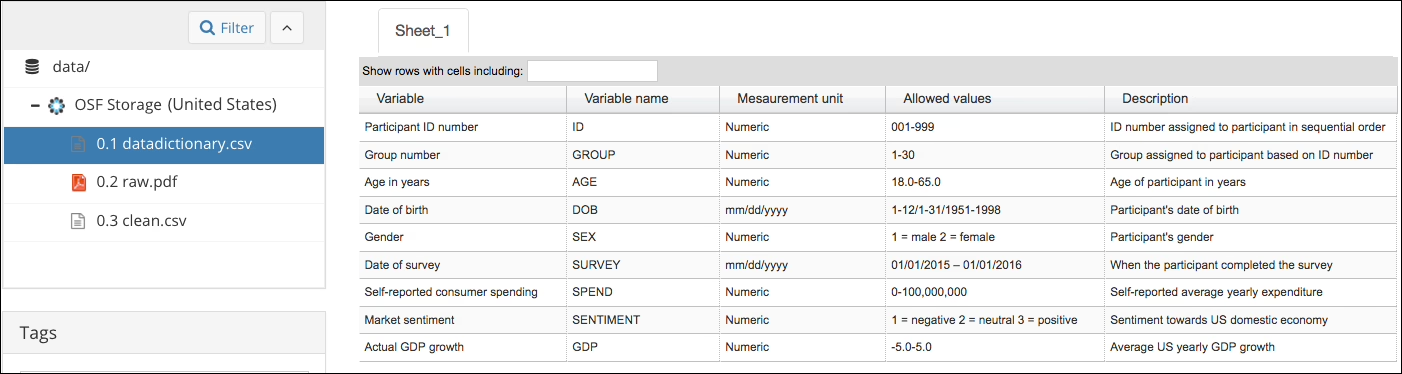
Then make the data easy to test. Publish a sample schema and offer a gated sample to people who already use similar data. Expect serious buyers to ask for extracts so they can check for tampering or cherry-picking. Practitioners on Reddit consistently recommend selling data “as a service with usage-based limits” over one-off file sales, because the buyer gets fresh data and you get a renewal.
Delivery format follows how the buyer works. Files suit occasional research. APIs suit data that has to flow into another system. Dashboards suit teams who want answers without handling the data, which is often a client portal or dashboard build rather than a file drop. Packaged reports suit buyers who want interpretation. Choose one format for one buyer first.
Cost the Full Service Before You Set a Price
A data product is an ongoing obligation. AWS Data Exchange requires sellers to pass a qualification process, keep a customer-support process in place, and publish regular updates free of vulnerabilities. It also charges for storage, active data grants and tiered fulfillment, plus API Gateway costs for API products. Some of those costs keep accruing for as long as access stays active.
A one-off dataset can still turn into a recurring burden once buyers start asking for corrections or newer records. Add up refresh, quality checks, security, support and platform fees before you quote anything. HCLTech’s telecom case, which is vendor-reported, says the program became profitable within two years after the team built reusable parts: recurring feeds, standard visualizations, proof-of-concept assets that could be used again, and a tool to standardize repeat analysis. If every new buyer means custom work, margins disappear quickly.
How to Price a Dataset When There Is No Standard Price
No formula exists for pricing data. The best reference set comes from Azcoitia, Iordanou and Laoutaris, who studied 215,075 marketplace products in 2023. Only 4,162 had clear prices. Among those, the median was about $1,400 a month for subscriptions and about $2,200 for one-off products, and prices ranged from a few dollars to hundreds of thousands. These are listed prices, not what buyers actually paid, and many listings were free or negotiated privately.
In practice, marketplaces mostly use cost-based pricing or leave pricing to the two parties, according to expert interviews by Radic and colleagues. Their recommendation is the most defensible method available. Set a cost-based floor that covers the full service, then let value drivers set the margin: freshness, coverage, exclusivity and how much the data changes the buyer’s results. Test that margin with real buyers. Academic tools such as DataPrice, which estimates prices from metadata, are prototypes whose output is a reference, not a quote. Contribution-scoring methods like Data Shapley measure how much each data point helps a model. They are not prices, and a 2025 preprint argues they can even encourage dishonest cost reporting.
Row count is a weak anchor. AI buyers in particular say continuous history and links across systems matter more than volume. Five years of tickets tied to the emails and outcomes around them are worth more than ten million disconnected rows. Price the reduction in buyer effort too. Clean, current, documented data saves the buyer weeks of work, and teams that sell it routinely charge too little for that reliability.
Value-based pricing is strongest when you can measure the result. TRIPBAM instrumented customer savings and made sure clients saved at least four times the cost of its service. That kind of proof ends arguments about price.
Choose the pricing unit carefully: subscription, fixed term, per query or per volume. Usage pricing matches payment to consumption, but only if buyers can predict their bill. Snowflake’s documentation notes that usage billing can trigger on queries that return no rows. That will surprise a buyer who was not told in advance.
Exclusivity Is Control, So Charge for It
Practitioners in the AI-data market describe 24-month exclusivity as common and perpetual exclusivity as risky. Perpetual terms come up in M&A diligence and can reduce what your company is worth later. If you grant exclusivity, put a time limit on it, define the market or use case it covers, and charge a premium. Watch indemnity clauses as well. Brokers report that demands for indemnity over a buyer’s later training use have ended deals.
Marketplaces Are a Channel, Not a Source of Buyers
Data marketplaces have grown into a market category of their own. Research firms now segment data marketplace platforms by data type, source and delivery mode. Listing on AWS Data Exchange, Snowflake Marketplace or RapidAPI gives you billing, delivery and some discovery. Practitioners who have tried them are consistent on one point: listings rarely bring in customers on their own.
The mechanics also carry costs. On Snowflake, each listing gets one pricing plan, public listings require trials, and some plan changes need approval or a new listing. Payouts arrive 30 days after the customer pays, net of fees and taxes, and the provider deals with nonpayment. AWS lets you bill API products per request, per successful request or per byte transferred, and each choice changes your revenue under real usage. RapidAPI is faster to set up but takes a reported 20% commission. AWS and Snowflake involve much heavier onboarding and compliance work.
There is a quieter cost too. A marketplace sits between you and the buyer, which cuts off the feedback you need to improve the product. The seller who built the $12,000-a-year database ended up selling directly on their own platform and used marketplaces only for extra subscriptions. That order is the right one. Prove demand directly, decide your commercial model, and then list as an additional channel.
If you are building a marketplace rather than selling on one, the problem flips. You have to recruit sellers and buyers at the same time. Builders who got past that went deep in one vertical first, for example 20 solid stock-market datasets in place of 2,000 thin listings across every category, and earned credibility in that community before expanding.
Selling Operational Data to AI Labs: Real Demand, Thin Evidence
Since late 2025, most of the noise about selling data has centered on AI labs buying company operational data. Brokers describe demand for Slack and email archives, CRM records, support tickets, call recordings and workflow logs linked across systems. The appeal is context: one event visible from the first complaint through the technician’s work to the outcome. Our piece on why fit beats size in AI training datasets explains why labs value that kind of coverage over volume.
Most of the evidence comes from posts on X, and many of those posts promote brokerage services, paid communities or referral programs. Few show closed, paid deals. Investors have pointed out that some AI-data companies are growing revenue very fast while their products have short lifetimes, since labs’ needs keep changing.
If you go ahead, the packaging standard is high. A poster with Scale and Anthropic experience listed what lab buyers expect:
- Evaluations with scaling plots and current model performance on the data
- Sample counts, failure-case analysis and easy, medium and hard splits
- Ground-truth audits, plus normal and expert human baselines
- A quality-control pipeline with known weekly throughput and a plan for scaling up
- A contact who knows the researchers inside the lab, because cold emails to procurement fail
There are two specific risks. The first is cash flow. Labs may promise large orders months away, while sellers pay full API rates to evaluate data on frontier models and staff up for production. Brokers report that labs often do not pay if the data underperforms. The second is strategic. Selling your proprietary workflow data could train models that later serve your competitors, and a one-time check does not compound the way your own data does once you use it in your own AI product builds. Workplace data also raises consent questions from employees and customers that a license does not settle.
Many companies with useful records have no team to run qualification, rights review, pricing, contracting, data preparation and delivery. That is the gap intermediaries fill. SourceX, for example, licenses approved business records such as tickets, emails, documents and chat for AI training and evaluation, and handles the transaction from qualification to payout. It also runs a company referral program for data licensing that pays advisors who introduce a qualifying company up to $100,000, and only after a paid transaction completes. Whatever route you take, inventory each system and how much continuous history it holds, put the linked workflows first, and read every exclusivity clause before signing.
Selling Your Own Personal Data Is Worth Very Little
A large share of people searching “how to sell data” mean their own. The evidence is blunt. One person who built a personal-data marketplace said “it just doesn’t work.” He listed his own Facebook data at $6.99 while admitting its real value was “less than a cent.” A lead buyer reported paying “2–3 cents” for a record with plenty of information attached. Buyers need hundreds of thousands of records, so one person’s data has little commercial weight.
Consumer surveys measure willingness to share, not earnings. Publicis Sapient found 44% of people were unwilling to share data with any company, and the ARF’s 2026 survey found nearly 60% would share for personalized shopping recommendations. The gap comes from what people get in return. Whether individuals should earn royalties when their data creates value is a fair question, but nobody has settled how to calculate or pay them.
Give the Data Product an Owner and a P&L
Data products die quietly when nobody owns them. In MIT CISR’s 2024 survey of 349 senior leaders, top performers attributed 11% of revenue to data monetization, compared with 2% for bottom performers. The top group was associated with data leadership at the CEO level, a focus on realizing value and measurement across the data lifecycle. That is an association, not proof of cause, but the operating pattern is consistent. At Wolters Kluwer, product owners carry P&Ls or shadow P&Ls, there are dedicated sales teams, and release decisions are tied to expected returns.
MIT’s 2026 work adds a useful distinction between creating a benefit and realizing it. A buyer saying your data saved them time is a benefit. A renewal at a higher price is a realized one. Trace each data product to a line on the income statement, review it on a schedule, and retire offerings that do not pay. The OECD’s work on the economic benefits of data sharing makes the broad case that sharing data creates value. Capturing that value inside a single company still takes someone accountable for it.
Data has commercial value only in relation to three things: a buyer’s specific use, your right to provide it, and your ability to deliver it safely and repeatedly. Most of the work in selling data happens before the first listing or contract. You are deciding which of the four value propositions fits, which buyer to test with, and what the product has to do from day one. If you are weighing whether your data belongs in a licensed feed, a dashboard or a feature inside your existing product, Refact’s product design and discovery work is built to settle that question before anyone writes a pipeline.
Building a product and unsure what to scope first? Let’s talk. Free 30-minute call, no pitch.

Saeedreza Abbaspour is the CEO of Refact, where he works across product, engineering, and sales. He sets the studio’s direction while staying closely involved in the work itself, from shaping product strategy and UX architecture to helping define the technical systems behind Refact’s projects. His role connects business thinking with hands-on product execution, giving him a practical view of how software should be planned, built, launched, and improved. At Refact, Saeedreza focuses on building a studio that can move quickly, solve real client problems, and turn ideas into reliable digital products.
More from Saeedreza Abbaspour

