Chicago Software Development Firms Compared
In September 2015, Cook County approved a contract of about $30 million to replace its property tax system.
 Saeedreza AbbaspourNovember 21, 2026

That shapes how this guide works. It covers 10 Chicago software development firms worth a first conversation: what each is built to do, what it publishes about pricing, and where it fits. It also gives you the questions that show whether a team will raise hard assumptions early or just agree to everything. It is written for business owners, product leads and operators choosing a partner for a new product, a modernization, or a project that has gone off track.
The question to carry into every call: Will this team help me decide what to build, or will it only build what I have already decided?
Chicago Is a Services Market, and a Chicago Address Proves Little
Chicago has no shortage of software vendors. According to Census County Business Patterns data for 2023, the Chicago-Naperville-Elgin metro had 6,852 tech establishments employing 130,852 people. Computer systems design and related services made up 79% of those establishments. That includes 2,552 custom programming shops, compared with only 535 software publishers. When Chicago developers on Reddit describe the local scene, they say it leans “strongly in tech consulting.” The data agrees.
The talent pool is large, and it is paid close to national rates. Bureau of Labor Statistics estimates for May 2025 put the metro at 40,370 software developer jobs with a median wage of $134,380, about 1% below the national median of $135,980. Most of those developers work at banks, insurers, hospitals and retailers, not at agencies. Chicago is not a discount market for engineering talent, and firms that quote far below these wages are usually delivering from somewhere else.
Directory counts tell you even less. Clutch lists roughly 375 to 383 Chicago software companies, and TechBehemoths lists 86. Those numbers measure different things, and neither one confirms that a firm has engineers in Illinois. A listing is a profile the firm filled out. Before you compare portfolios, ask each firm where the people who will write your code actually sit.
If you are still at the idea stage, the earlier question is whether the business case holds up at all. Chicago Brandstarters has useful local perspective on validating a technology company idea in the Midwest before you spend money on a build.
What Chicago’s Own Projects Teach About Picking a Firm
Look past the logos, and the public record from Chicago projects points to the same handful of practices. Some of these examples come from vendor case studies, so treat their numbers as claims, not audited results. The patterns still hold.
Settling the inputs before design saves money. TXI reports that on a project for Motorcity Systems, it pushed design back two weeks so the API contract could be refined first. By TXI’s account, that delay saved about two weeks overall and more than 10% of the total product budget. A firm that slows down at the start to pin down interfaces is spending your money well.
Headline metrics can mislead. The City’s CHI311 platform launched in December 2018 after a roughly nine-month build. Graffiti removal scheduling dropped from 45 to 60 minutes to 5 to 10 minutes, and the case closure rate rose from 82% to 94%. In February 2026, the City Inspector General’s audit of 311 found that labels like “completed” can be misleading and that data and service-level estimates are inconsistent across departments. A closed ticket is not the same as a fixed pothole. Agree with your partner on which numbers measure the real outcome before launch, not after.
Modern architecture still needs release discipline. In a supply-chain platform serving more than 500 clients, Chicago consultancy SPR split transport modes into separate services, each with its own repository and CI/CD pipeline. Releases still went through manual testing, automated regression tests, code review and two levels of approval. Microservices did not remove the controls. They multiplied them.
Put the Cook County findings next to these, and a working checklist comes out of the record:
- Requirements and a single product owner are settled before the build starts.
- Real users and subject-matter experts are involved from the first weeks.
- The team learns how the legacy system and its data actually behave before replacing them.
- Migration happens in phases, with the old system available as a fallback.
- Monitoring and release controls are written into scope, not added later.
- Success metrics, ownership and post-launch support are agreed in writing.
Most of that work happens in discovery. Our guide to what product discovery should decide covers how to keep that phase focused on decisions instead of documents.
10 Chicago Software Development Firms Worth a First Call
This is a publisher’s shortlist, not an independent ranking. Refact appears first because we wrote it, and we are not headquartered in Chicago. We serve Chicago clients as a distributed US team, and we would rather say so up front. The others were chosen for a visible approach to strategy before the build, a clear delivery model, and a recognizable fit for a particular kind of buyer. None of them is vouched for here as a quality guarantee. The questions in the sections that follow are how you check.
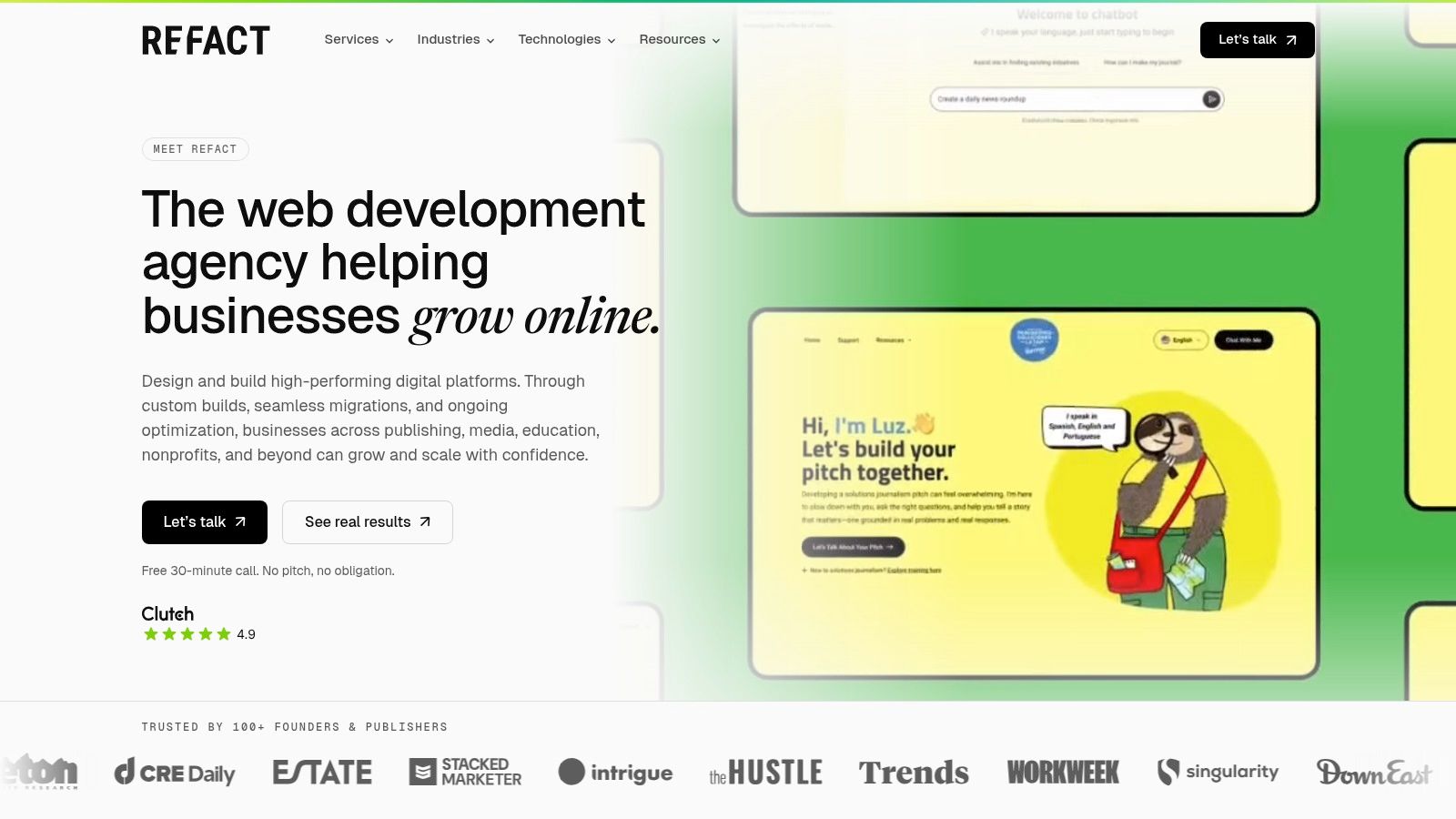
1. Refact
Refact is a product development studio that combines strategy, design and engineering in one team. It has been in business for more than 12 years and has delivered over 200 projects across SaaS, MVPs, WordPress and ecommerce, publishing platforms, portals, AI tools and migrations. Refact’s company background explains the focus on 12 to 24 month partnerships rather than one-off builds.
The work starts with deciding what to build. When Teton Gravity Research asked us for a redesign, 10,000 articles were stuck in an ExpressionEngine CMS that was barely staying online, and earlier migration attempts had stalled. Before quoting the redesign, we pushed on what the site needed to do, including whether its aging user-generated content features should survive at all. The Teton Gravity Research rebuild shows what that looks like in practice. In another project, a consultant came to us wanting an AI assistant that helped project managers with “everything.” Our blueprint process narrowed it into a focused MVP for an AI assistant called Workform, one that connects project data from Slack, email, Asana and meetings.
Best fit: You know your domain well and need help turning it into priorities, user journeys, a prototype and a build plan, or you need a long-term team for a platform that has outgrown its current setup. Weaker fit: a small, clearly specified task where a collaborative discovery process is more than the job needs. Refact does not publish standard project pricing. A paid discovery phase, backed by a money-back guarantee, sets scope and risk before a build estimate. Our guide to choosing a software development company has the scorecard we would apply to any partner, including us.
2. Atomic Object
Atomic Object’s Chicago office offers new product development, product enhancement, modernization and AI software development, with design and engineering under one contract. That breadth makes it a good fit when the real question is whether to improve an existing product or replace it.
Say you run an education business with an aging customer portal. The useful conversation is not whether to rebuild in React. It is which workflows stay, which change, and how customers move over without losing access. Ask Atomic Object to walk through how discovery has changed a client’s plan in the past. That answer tells you whether you are paying for a decision process or just capacity. The tradeoff: a full consultancy engagement can be heavier than a narrow prototype needs. Pricing is not published, so confirm the smallest useful engagement first.
3. Red Foundry
A mobile app rarely stands alone. It needs accounts, backend services, analytics, cloud infrastructure and connections to the systems your staff already use. Red Foundry’s Chicago consultancy has worked across mobile, web, cloud, data and AI since 2009 and is 100% employee-owned. It fits a product whose interface and back office need to be designed together.
A polished demo will not show you how the team handles a failed payment, missing data or a broken CRM connection. Bring those less glamorous scenarios to the first call and ask how the team would detect the problem and help your staff recover. Pricing is not published. Ask for a proposal that separates discovery, application development, infrastructure and ongoing support so you can see what each costs. A broad consultancy may be more than you need for an early experiment that could run on a form and an existing payment tool.
4. Neologic Custom Software
A guaranteed price is only useful if you understand what scope it guarantees. Neologic’s service description emphasizes owner-led delivery, discovery, requirements work, prototyping, and a written price for an agreed scope. Its services include custom business applications, SaaS platforms and AI solutions. It also describes documentation, handoff and code ownership as part of the standard approach.
That sequence works well if you want to look at a prototype before committing to the build. The risk sits at the edges of the scope. Ask how the team prices a new user role, an integration nobody planned for, or a workflow that changes during testing. Get written acceptance criteria and a change-approval process before you sign. If you are scoping a subscription product, this SaaS development partner guide helps separate the core product from billing, permissions and reporting so the fixed scope is honest.
5. Benmore Technologies
Picture a customer portal that has to talk to accounting software, a CRM and an internal order system. Benmore’s Chicago services cover custom applications, MVP development, systems and API integration, AI agents and AI strategy. The team is based at 35 E Wacker Dr and works on-site or closely embedded with clients. That makes it a stronger candidate for integration-heavy work than a studio focused on front-end presentation.
The discipline to bring: do not let every operational problem become part of the launch. Define the customer journey first, then sort integrations into what must work on day one and what can wait. For AI agents, insist on a fallback process, monitoring, and clear rules for when the agent hands off to a person. Pricing is not published. Ask for separate lines for the prototype, the launch product, the integrations and ongoing operations. Our guide to portal and dashboard development covers the identity and integration work these projects usually underestimate.
6. Dakic Online
If you are not ready to hire a team, buy a second opinion first. Dakic Online, which has been building in Chicago since 2006, is the only firm on this list that publishes prices. Dakic Online’s published offers include a CTO Deep Dive at $250 for up to two hours and Momentum Sprints starting at $3,000 per week, with work run in one-week cycles and code owned by the client from day one.
The advice option suits a technical review of a proposal, an architecture question, or a diagnosis of an existing system. Weekly development suits buyers who can review progress and make decisions every week. A weekly price tells you what one cycle costs. It does not tell you how many cycles your product needs. Ask how the team reports remaining work, who exactly is assigned, and where the repository and infrastructure accounts live.
7. LinkIT
LinkIT’s published offering covers custom software, SaaS platforms, dashboards, mobile apps, internal tools, AI, automation and integrations, plus managed IT for networks and devices across Chicagoland. It promises weekly build notes and client-owned code. The managed IT side is unusual for a product studio and can help a smaller business that wants one vendor for software and day-to-day systems.
Build notes are only useful if they say what changed, what you can test, what is blocked and which decision is waiting on you. Ask to see a real example. Pricing and independent client reviews are not established in public material, so request references from projects like yours. Also confirm which capabilities belong to the core team and which are handled by partners.
8. Developers of Chicago
Developers of Chicago’s service overview describes a senior engineering team embedded in a client’s product team. Its work spans web and mobile apps, MVPs, AI agents, cloud and DevOps, custom CRM, Shopify and enterprise software. This model works when someone on your side already owns the product decisions and the backlog simply needs more engineering capacity.
If nobody on your side can set priorities, the model gets weaker fast. Senior engineers add capacity. They do not decide on their own what belongs in the MVP. Before you sign, assign ownership of requirements, design approval, acceptance testing and release decisions. For regulated or high-stakes software, ask how the team will handle your specific security and privacy requirements, because general application experience does not cover them.
9. Geneca
A troubled project needs a different conversation from a new idea. Geneca’s published material focuses on custom software, technical architecture and project recovery, with industry work in healthcare, financial services, insurance and manufacturing. It is worth a call for a substantial custom system or a build that needs an honest reassessment.
Start with diagnosis, not a promise to finish what the last team began. A useful assessment says what can stay, what needs repair and what should be replaced, and it comes with a phased plan that protects current users. A rewrite should follow evidence, not frustration. Our piece on legacy system modernization strategies covers how to make that call system by system. If you are deciding between buying capacity and handing over delivery responsibility, our comparison of staff augmentation and managed services lays out the difference.
10. Miew
A firm that serves Chicago does not need an all-Chicago delivery team, as long as it is honest about where the work happens. Miew’s Chicago offering comes from a product studio founded in Porto in 2016, with presence in Chicago and Indianapolis. It covers product design, full-stack development, AI-assisted delivery using its own GenIX methodology, modernization and managed services.
Distributed delivery works when there is a named, accountable lead, reliable overlap with Central Time, and regular demos of working software. Set expectations for meeting overlap, written decisions and urgent support before the engagement starts. Nearshore capacity does not automatically mean a lower total cost. Our breakdown of how nearshore delivery actually works covers where the savings hold and where they disappear.
How the 10 Firms Compare on Pricing, Strategy and Fit
Only one firm publishes prices, so the more useful comparison is whether each one helps you decide what to build or mainly delivers a defined project.
| Firm | Published pricing | Strategy before build | Best for |
|---|---|---|---|
| Refact | Not published; paid discovery sets scope | Discovery, product strategy and design before development | Domain experts who need product guidance, a build and a long-term team |
| Atomic Object | Not published | Design and product development | Organizations building or modernizing custom software |
| Red Foundry | Not published | Product strategy and design included | Products that combine mobile, web, cloud, data or AI |
| Neologic Custom Software | No public rate card; written price per agreed scope | Discovery, requirements and prototyping before a scoped build | Buyers who want staged commitment and fixed scope boundaries |
| Benmore Technologies | Not published | MVP strategy and rapid prototyping | Products that depend on ERP, CRM or operational integrations |
| Dakic Online | $250 for a two-hour CTO Deep Dive; sprints from $3,000 per week | Paid technical advice before or alongside development | Second opinions and short weekly build cycles |
| LinkIT | Not published | Strategy and design included | Smaller businesses wanting software plus managed IT |
| Developers of Chicago | Not published | Limited; strongest when you own product decisions | Teams that need embedded senior engineering capacity |
| Geneca | Not published | Technical architecture and assessment | Large custom systems and project recovery |
| Miew | Not published | Product strategy and design included | Buyers comfortable with nearshore delivery from Porto |
What Chicago Pricing Data Can and Cannot Tell You
There is no single Chicago rate. Clutch’s benchmarks put senior talent at roughly $100 to $149 per hour and blended teams at $75 to $120. Profile bands on Chicago listings run from $25 to $49 per hour at the low end to $150 to $199 at the top. One 2026 analysis of Chicago listings that display rates, by Deepsel, found 29% below $50 per hour and 44% at $100 or more.
Those are self-reported bands, not invoices. Given a local median developer wage of about $134,000, a sub-$50 rate almost always means offshore delivery, which may be fine but should be stated plainly. In a 2023 Reddit thread, Chicago consultants said their firms often got called in to clean up after cheaper offshore contractors. That is anecdote, not a verdict on distributed teams. It is still a reason to ask about delivery location.
An hourly rate is also not a budget. The useful exercise is to send three firms the same brief and compare what each quote includes and leaves out: discovery, design, testing, data migration, infrastructure, post-launch support. Our breakdown of web application development cost shows which line items quotes most often leave out.
The contract model matters as much as the rate. Fixed price works when the scope is genuinely stable, but changes cause friction and the vendor usually prices in a risk buffer. Time and materials handles changing requirements, but it needs budget visibility and active oversight from you. A paid discovery phase or a capped arrangement sits between them. Our guide to fixed price vs time and materials walks through which risks each model puts on which side.
The Questions That Separate a Partner From a Vendor
A polished proposal is not evidence. These questions are, because the answers can be checked against references, contracts and the people on the call.
Who will actually build it, and where?
Ask for the named team, their roles, seniority and location, any subcontracting, and whether the people in the pitch stay on the project. Meet the technical lead before signing, not after. Developers who have worked at Chicago consultancies say much the same thing: the specific team and engagement matter more than the firm’s label.
Who owns the code and the accounts?
Your contract should make you the owner of the code, the repositories, the cloud accounts and the domains. Clarify which of the vendor’s own tools or libraries stay with the vendor, and what handover looks like if you part ways. Several firms on this list advertise client code ownership. Confirm it in writing anyway.
How will you handle the old system and its data?
Cook County’s rework came from migration and testing problems, not from the new code. Ask how the team will learn the legacy system’s hidden business rules, whether the old and new systems will run side by side, how data will be reconciled, and what the fallback is if cutover fails. Vin Chicago replaced five systems in under three months by migrating data in phases. Phased migrations take more effort to run, but they are much cheaper than a failed big-bang cutover.
If they propose microservices or Kubernetes, ask what that costs to run
A 2024 study of 53 microservices practitioners described the same recurring problems: unclear service boundaries, testing and monitoring difficulty, data consistency issues, and shared databases that keep services tightly coupled. The architecture is not wrong. It is expensive to run well, and a vendor proposing it should be able to explain the specifics.
The official documentation is precise here. Kubernetes uses separate startup, readiness and liveness probes, and each one must match how your app really behaves. Apache Kafka offers at-most-once, at-least-once and exactly-once delivery, and at-least-once can produce duplicates. AWS’s Well-Architected Framework has six pillars, so “cloud-native” alone is not a quality outcome. A good team can tell you how it handles retries, duplicates and rollbacks in plain language.

How do you review AI-generated code?
Nearly every firm uses AI coding tools now, and the evidence on results is mixed. Field experiments at Microsoft, Accenture and a Fortune 100 company found a 26.08% increase in completed tasks. Google’s DORA 2024 report, though, linked higher AI adoption to an estimated 1.5% drop in delivery throughput and a 7.2% drop in stability. In the Stack Overflow 2025 Developer Survey, 46% of developers said they distrust the accuracy of AI output and 33% said they trust it. The top frustration, named by 66%, was output that is “almost right.”

None of that is a verdict on any firm. It means AI-assisted code needs the same human review, automated tests and security checks as any other code, plus a named person who owns it. If the product itself includes an AI feature, that is a separate scope with its own evaluation examples, fallback behavior, data access rules and cost controls.
What happens after launch, and how involved do we need to be?
Before launch, settle who handles security patches, dependency updates, incident response and documentation, and confirm you keep access to everything. Plan for your own involvement too. Celeste Group’s Paylocity rollout worked partly because the client defined its own cost centers and workflows. SPR’s customs project named the lack of a single product owner as a core problem. Someone on your side needs time each week to make decisions.
One more test: watch for a proposal that accepts every feature, deadline and budget without pushing back. A firm that never challenges your plan has either not read it closely or is saving the hard conversation for the change orders.
Turn Your Shortlist Into One Good First Call
Pick three firms that match your stage, not the three with the best homepages. If you are testing demand, favor a team with a real discovery process. If you already have product leadership and a backlog, an embedded engineering team may fit better. For a migration or a troubled build, focus on assessment, continuity and a safe release plan.
Send each firm the same one-page summary: who the users are, what problem they have, how they handle it today, which systems are involved, and what business result you need. Then mark each response clear, partial or missing on five points:
- Discovery: Does the team explain how it will test assumptions, or does it repeat your feature list back to you?
- Named team: Do you know who will design, build, test and manage the work, and where they are?
- Price clarity: Can you see what is included, what is excluded, and what could add cost?
- Ownership and exit: Do you control the code, accounts and domains, with handover terms in writing?
- References: Can a comparable client describe how the team handled changes and post-launch problems?
A strong presentation does not make up for an unnamed delivery team or missing ownership terms. Close both gaps before you sign.
Hiring is the other route. It makes sense when someone in-house can lead the work and you can sustain the role over years, not months. This guide to finding software developers covers that path. A salary is easier to compare than a proposal, but it does not replace the time it takes to manage delivery.
The Cook County project did not go wrong because the county picked from the wrong list. It went wrong because questions about requirements, ownership and data were answered late or not at all. Ask any partner to price discovery first, and you will learn how they define your problem before they estimate the build. If you want that early work done with strategy, design and engineering in the same room, Refact’s product design and discovery is built for it. You can also bring your idea, current platform or migration problem straight to Refact.
Building a product and unsure what to scope first? Let’s talk. Free 30-minute call, no pitch.

Saeedreza Abbaspour is the CEO of Refact, where he works across product, engineering, and sales. He sets the studio’s direction while staying closely involved in the work itself, from shaping product strategy and UX architecture to helping define the technical systems behind Refact’s projects. His role connects business thinking with hands-on product execution, giving him a practical view of how software should be planned, built, launched, and improved. At Refact, Saeedreza focuses on building a studio that can move quickly, solve real client problems, and turn ideas into reliable digital products.
More from Saeedreza Abbaspour
