White Label WordPress Development: What Actually Works
The statistics are hard to argue with: some 73% of digital agencies have white-label services in their mix


There is a right way to do white label WordPress development and a wrong way. Most guides will not tell you that it only works when you put in place a managed delivery system with proper governance and ownership. It is no good if you are just passively outsourcing to the lowest bidder of the week. This is what separates the two.
What White Label WordPress Development Actually Means
In the industry the term is used for two things that are often conflated, though both are relevant.
Commercially speaking, it is an arrangement where a third-party studio puts your brand on its work – be it sites, plugins, integrations or maintenance – while your team handles the strategy, billing and the client relationship. The partner is invisible in any client-facing correspondence and does the implementation.
Then there is the technical side. Hardening the admin so a marketing manager cannot break the site by installing an incompatible plugin, or so vendor branding is not on display, is also part of the white label equation. You enforce this with the built-in role system, DISALLOW_FILE_EDIT in wp-config and something like the White Label CMS plugin.
A mature program will do both. It subcontracts the build in a clean manner and locks down the admin for the client’s safety. Do only the former and you have merely outsourced; do both and you have a productized service.
The Real Reason Agencies Move to This Model
Usually it comes down to capacity. A WordPress project comes in but the team is tied up and you cannot wait the months it would take to bring on a senior developer. At $85,000 a year before benefits and bench cost, a US-based hire is a fixed expense you can only justify if they are working every week.
White label is a variable cost that moves with your pipeline. It also allows you to be selective. If a client wants a WooCommerce store with multi-currency and subscriptions and you are in the publishing business, you can hand the execution to a partner who has done it ten times over. That protects your reputation and your margin better than trying to learn a new stack on the client’s dime.
The economics explain the trend. You will find partner costs in three bands: $2,500–$5,000 for a theme-based site, $6,000–$12,000 for custom, and up to $20,000 for WooCommerce. Hourly is $50–$150. Agencies put a 30 to 75 per cent markup on top, with 50 to 60 per cent being the norm. Delivery vendors put gross margins at 58–68 per cent on well-scoped work. Those are self-reported figures so take them as directional, but the pattern holds.
For the math to add up you need projects priced above $5,000 to cover account management overhead. And you want a quarter of your revenue to be recurring from retainers so cash flow is not dependent on the next close.
The Governance That Separates Success from Reputation Damage
You will hear a consistent line of reasoning from practitioners in agency circles and on Reddit as to why these engagements go sour. It is rarely a question of the vendor’s coding skills. More often it is because the agency has outsourced the work but is still managing the relationship as though it were a client rather than a delivery operation.
Typically a vague brief gets sent over with a Figma file and a note that it “needs to be fast and SEO friendly.” The partner makes a reasonable interpretation and puts it in staging. Then the agency reviews too late to see the responsive layout is off or the checkout is not what was asked for, and a week of unquoted rework is burned. After a couple of those the project is underwater.
Success is less exciting. It involves a precise brief with wireframes, sitemaps and acceptance criteria. QA happens before the client is allowed to look. There is a written clause in the agreement against direct contact and a single point of communication through the agency. You use standardized stacks and run a small pilot with any new partner.
A strong operating system can make do with an average partner; a good partner cannot make up for poor governance. That is why choosing a WordPress partner is of secondary importance to what you put in place around them.
The Admin Experience Is a Risk Surface Nobody Talks About
Once the site is live the client will log in and start making changes. Some of those will be problematic. An “SEO booster” is installed that is at odds with your caching. Permalink settings are altered and every backlink is broken. Or at 5pm on a Friday someone goes into Appearance > Theme File Editor to tinker with functions.php and the site goes down.
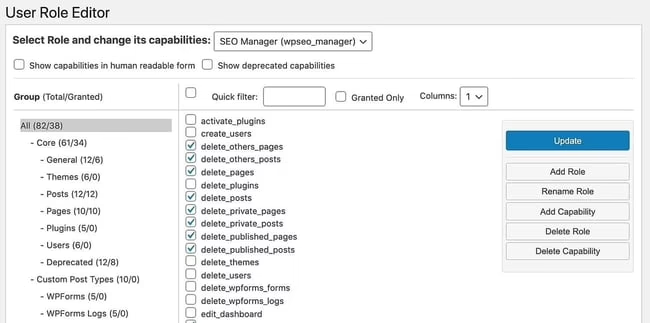
A hardened admin is the answer to most of that. Put DISALLOW_FILE_EDIT in your wp-config and the file editor is gone. There is no trickery in the way we present a site to a client. Hiding plugin and theme branding with a White Label CMS or the like, and putting some restrictions on the dashboard menus is simply what safe operations entail. The same goes for role configuration: an editor should be able to put content in place but have no business touching plugins, settings or users. Think of it as you would root access on a production server for a new hire; you do not hand that over lightly, and the logic is no different for a WordPress install that is driving revenue. Astra Pro and Elementor Pro have their own white-label options to keep their name off the client’s view.
Where the Model Breaks Down
That said, the white label pipeline is not for every engagement. It works well for the repeatable stuff: brochure sites, standard WooCommerce stores, performance tuning, care plans and the occasional landing page. But when the work is custom and calls for heavy discovery or complex integrations where judgment is more valuable than implementation, the model does not hold up.
Then there is the matter of custom themes versus page builders. With something like Elementor or Astra a partner can ship faster and the margin on the first project is better. But you are creating a dependency on the builder’s rendering and update cycle. You will pay to get out of it later. For a marketing site with a two-year run, a good builder is acceptable. For a high-value client in a long-term relationship, a custom theme is the wiser choice. Make the call consciously and put the dependency in the handoff documentation.
Vendor lock-in is a quiet way to fail. Some partners will deliver a ZIP file rather than Git access, or build on a proprietary framework only they can tend to. They may even hold the hosting or SaaS accounts in their own name. If things go south, you are left with an asset you cannot audit. This is why custom WordPress builds need firmer ownership terms than an off-the-shelf job. Do not just rely on the contract; enforce it technically. Have the repos on your GitHub or Bitbucket, put the hosting in your name and buy the premium licenses yourself. If the partner has the keys to the repo, any contract clause is a lagging indicator.
Not sure how exposed your own site is? We run a free WordPress vulnerability check that lists what needs patching first. Request the check.
How to Vet a Partner Without Burning a Client to Do It
One might be tempted to put a new partner to the test on a small project. A better approach is to try them on an internal or throwaway piece of work, or a pilot with a client where the stakes are lower. You want to see how they handle an ambiguous brief, what their code is like in the repo and how they deal with a scope change mid-stream.
Watch for these signals:
- When the brief is vague, do they ask the right questions or just nod and start building?
- Will they stand their ground on an unrealistic timeline or agree and then fall short?
- Is the code written to WordPress standards or is it a reflection of one person’s style?
- Do they provide staging access or make you wait until they say it is “ready”?
You will find the red flags are consistent in practitioner reports: an unwillingness to sign an NDA, talk of “a network of developers” without specifics, no staging environment, or prices that only make sense if they are re-outsourcing to someone cheaper. And then there is the direct outreach to your client for “clarification.”
Hear the other side as well. White-label developers will tell you agencies come at them with a $15,000 project and expect a $3,000 turn around in two weeks from a Figma file and a paragraph of text. That is not a problem with the vendor. It is a scoping issue the agency has failed to address.
Reporting, Handoff, and What Happens After Launch
The launch is where the operating model begins to prove itself, not the end of the road. A proper handoff means the client has documentation they can use, admin training for their content updates, and a support window of 14 to 30 days. On top of that is a maintenance plan for security, backups and uptime.
For a small site a care plan might be $150–$800 a month, running to $10,000 for a larger account. With the right markup this is the recurring revenue that underpins the agency. A one-off build is a transaction; a retainer is a relationship and those are what compound.
Do not let your team become report generators by copy-pasting from GA4 and Search Console into a PDF every month. There are white-label reporting stacks available that are worth looking at; comparisons of white-label SEO dashboards are a good place to start if you are doing SEO work. Without good visibility you have weak accountability and a monthly argument to win.
When Migration Enters the Picture
Much of the white label work is not a net-new build but a migration from an old WordPress setup, Drupal, Shopify or Squarespace. This is where the instinct to “just outsource it” does the most harm. Migration is largely a matter of judgment: the cutover plan, redirect strategy, serialized data and SEO continuity.
The Trends launch for The Hustle’s premium newsletter was not simply a matter of putting up a new site. In rebuilding the platform, Refact had to do as much work untangling the CMS, payment and email stacks as we did in shipping the Trends project. While the build was done in two weeks, the decisions underpinning it were what took time. You will find that is how most migrations go. Should you put a white label partner to the task, it is best to have the planning in-house or engage one with the know-how to steer WordPress migrations that don’t put revenue at risk when cutover comes around.
WooCommerce Deserves Its Own Judgment Call
With WooCommerce the margins are good but so is the risk of delivery going wrong. There is real upside: a custom build might run $8,000 to $20,000 in cost to the partner, the stack is standardised for speed, and care plans can be put in place for recurring income. Yet an ecommerce site does not forgive failure the way a brochure site does. A slow homepage is an irritation; a checkout that gives out at 2am is money on the table.
Take our WooCommerce work for NudFud. The hard part was not the checkout screens but the product structure and certification presentation, making sure commerce and content sat right so the shopper could see the difference in what they were buying. A partner accustomed to commodity stores would overlook that and you would end up with a health-food site that converts like all the others.
Merchandising strategy and catalog logic should be held in-house or by a partner who can lead the discovery side of things. For a more complete rundown on the vetting questions, our WooCommerce development agency guide goes into some detail.
The Honest Version of the Decision
There is a sound model to white label WordPress development provided three conditions are met: the work is of a defined and repetitive nature; there is the discipline to write a proper brief and do your own QA; and the pricing is such that the markup still puts you over the profitability line.
It is not a fit if you are using it to bid on unfamiliar work or selecting a partner on price alone. Such ventures come to grief not because outsourcing is flawed but because the management layer required to make it function has been left out.
The view from the field is straightforward. When volume is predictable, in-house hiring is less of an overhead than briefing an outside team week in and week out. White label is meant to be a pressure valve for flexibility and capacity while you determine what is truly repeatable. Use it for that and it will justify its place.
Refact’s discovery process is set up to resolve these kinds of questions – what to keep and what to give to a partner – before any code is written. Have a look at how we do WordPress development and we can talk through the rougher edges of your pipeline.
Running a WordPress site that has outgrown its build? Let’s talk. Free 30-minute call, no pitch.

Saeedreza Abbaspour is the CEO of Refact, where he works across product, engineering, and sales. He sets the studio’s direction while staying closely involved in the work itself, from shaping product strategy and UX architecture to helping define the technical systems behind Refact’s projects. His role connects business thinking with hands-on product execution, giving him a practical view of how software should be planned, built, launched, and improved. At Refact, Saeedreza focuses on building a studio that can move quickly, solve real client problems, and turn ideas into reliable digital products.
More from Saeedreza Abbaspour

