Shopify vs WooCommerce: Honest Guide
The Shopify vs WooCommerce debate almost never fails on the platform.


This guide is for operators picking or reconsidering a store platform. It compares Shopify and WooCommerce on the terms that actually decide the outcome: where risk concentrates, what the total cost looks like at your revenue tier, how checkout and performance affect conversion, and which type of failure each platform quietly produces once you scale.
The Real Question Behind Shopify vs WooCommerce
The framing “which is better” is misleading because the two platforms are optimized for different types of failure. Shopify absorbs infrastructure, security, and checkout complexity in exchange for platform boundaries and account risk. WooCommerce grants architectural freedom in exchange for operational and maintenance debt. Every serious tradeoff you will encounter descends from that split.
Shopify is a hosted SaaS platform. Hosting, updates, PCI compliance, and checkout live inside the plan. WooCommerce is an open-source WordPress plugin that inherits everything WordPress inherits: your hosting, your theme, your plugin choices, your update cadence, and your team’s discipline. That is why the same question sends two similar businesses to opposite platforms and both can be right.
A helpful way to think about it comes from our own ecommerce development work: the platform decision is really an ownership map. Write down who owns hosting, who owns updates, who owns checkout logic, who owns the plugin stack, and who fixes the store at 9pm on a Tuesday when a marketing test breaks it. If most of those columns point at “outside help we do not yet have,” Shopify is usually the safer answer. If they point at a team already fluent in WordPress, WooCommerce becomes a real option.
Market Share Is Not the Argument You Think It Is
Both camps quote market share numbers, and both are correct within their own methodology. Broad-web crawls consistently show WooCommerce ahead by raw store count: StoreLeads puts WooCommerce at roughly 4.34M live stores against Shopify’s 2.84M. That reflects the long tail of WordPress sites with a store bolted on.
Weight by commercial significance and the picture flips. Littledata’s 2026 data shows Shopify at 58% share among stores doing $500K to $10M in annual revenue, with WooCommerce at 19%. GravityKit’s top-1M-sites cohort shows Shopify at 6.08% and WooCommerce at 3.12%. GMV tells the same story more bluntly: Shopify’s gross merchandise volume runs in the $280B to $290B range annually, while WooCommerce sits closer to $30B to $35B.
The honest reading is that WooCommerce has more stores, Shopify processes far more money. Pick the platform your business tier actually maps to, not the platform with the biggest number in a headline.
Where the Money Actually Goes
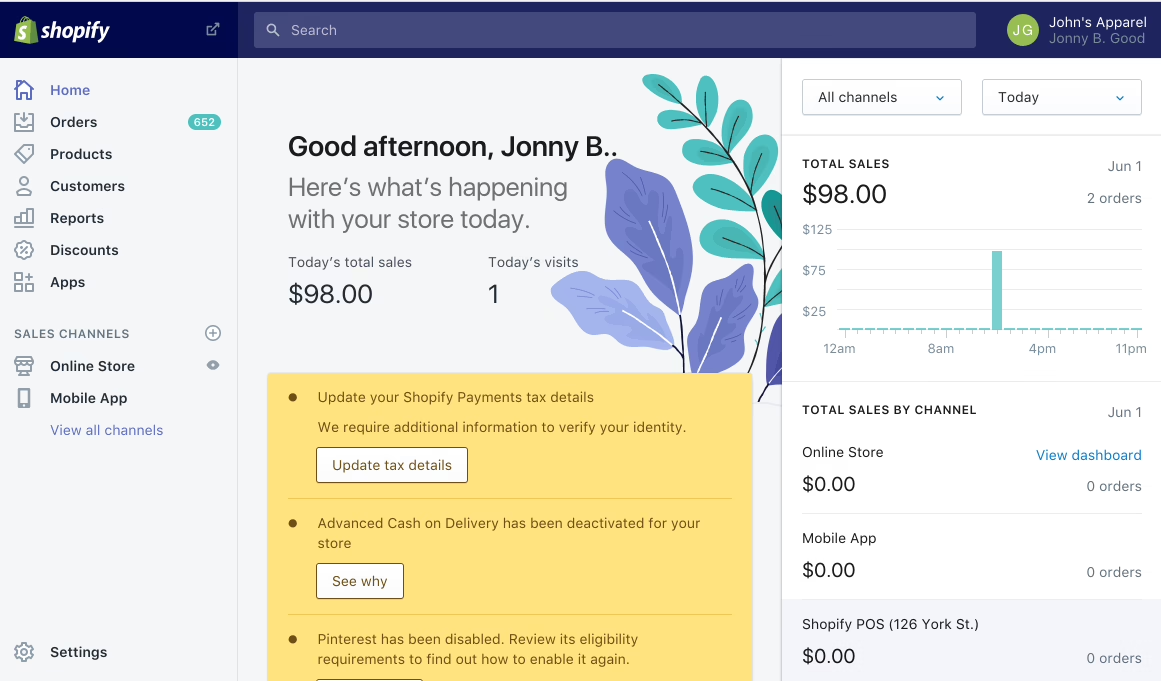
WooCommerce is cheaper to start. That much is not in dispute. A Reddit operator running a low-complexity store reports reliable hosting for $30 to $40 per year. The plugin itself is free. If your team is fluent in WordPress and your feature list is short, WooCommerce can stay cheaper for a long time.
The picture changes at scale. Once you add managed hosting, a paid theme, backup and security tooling, three to five paid extensions for shipping, reviews, subscriptions, and marketing, plus a developer on retainer for updates, the total often crosses what a Shopify plan would have cost. Shopify’s own comparison page claims WooCommerce stack costs run 32% higher on average once everything is counted. That number is vendor-narrated and should be treated as directional, but the underlying dynamic is real and shows up in practitioner discussions repeatedly.
The category most teams underestimate is developer time. On Shopify, most changes route through themes, apps, and a settings screen. On WooCommerce, changes often require someone who understands the plugin’s hooks, the theme’s overrides, and the current state of PHP and WordPress core. A useful discipline is to model total cost across three years, not one. Our ecommerce website cost guide breaks the categories down if you want to build the estimate before you commit.
A short cost worksheet worth filling in
- Platform or subscription. Monthly fee and what it covers.
- Hosting and domain. Inside the plan or a separate bill.
- Payments. Processor fees plus any platform surcharge if you use a third-party gateway on a lower Shopify tier.
- Apps or plugins. Every paid extension you would need for checkout, subscriptions, reviews, shipping, tax, and marketing.
- Security and backups. Who owns them and who pays for them.
- Developer retainer. Hours per month for updates, fixes, and small features.
Checkout Is Revenue Infrastructure
Checkout is where most of the daily revenue argument for Shopify lives. Shopify treats checkout as a proprietary product, tunes it aggressively, and gates deep modification. That is a constraint, but it is also why the checkout converts. An independent Littledata-style study cited across 2026 comparisons puts Shopify checkout at roughly 15% higher conversion on average than competing platforms. Shop Pay, its accelerated checkout, is reported to lift conversion up to 50% versus guest checkout.
WooCommerce checkout is more configurable and can be shaped to match unusual flows, but each customization is your team’s problem to maintain. Every WordPress update, theme update, and payment plugin update becomes a checkout regression risk. If your business runs on repeat purchases, subscriptions, or paid acquisition where every basis point of conversion matters, Shopify’s structural advantage is hard to overstate. If your checkout has requirements Shopify’s rails cannot bend to, that same rigidity turns into a wall.
We saw the checkout question decide the platform for Broya, a Canadian bone broth brand. The core problem was not traffic, it was conversion, especially for the subscription flows that made the business work. Shopify’s checkout plus Shop Pay gave us a reliable base to iterate against, and the ongoing conversion gains came from tightening product pages, collections, and the cart, not from fighting the platform.
Performance Depends on Who Carries the Load
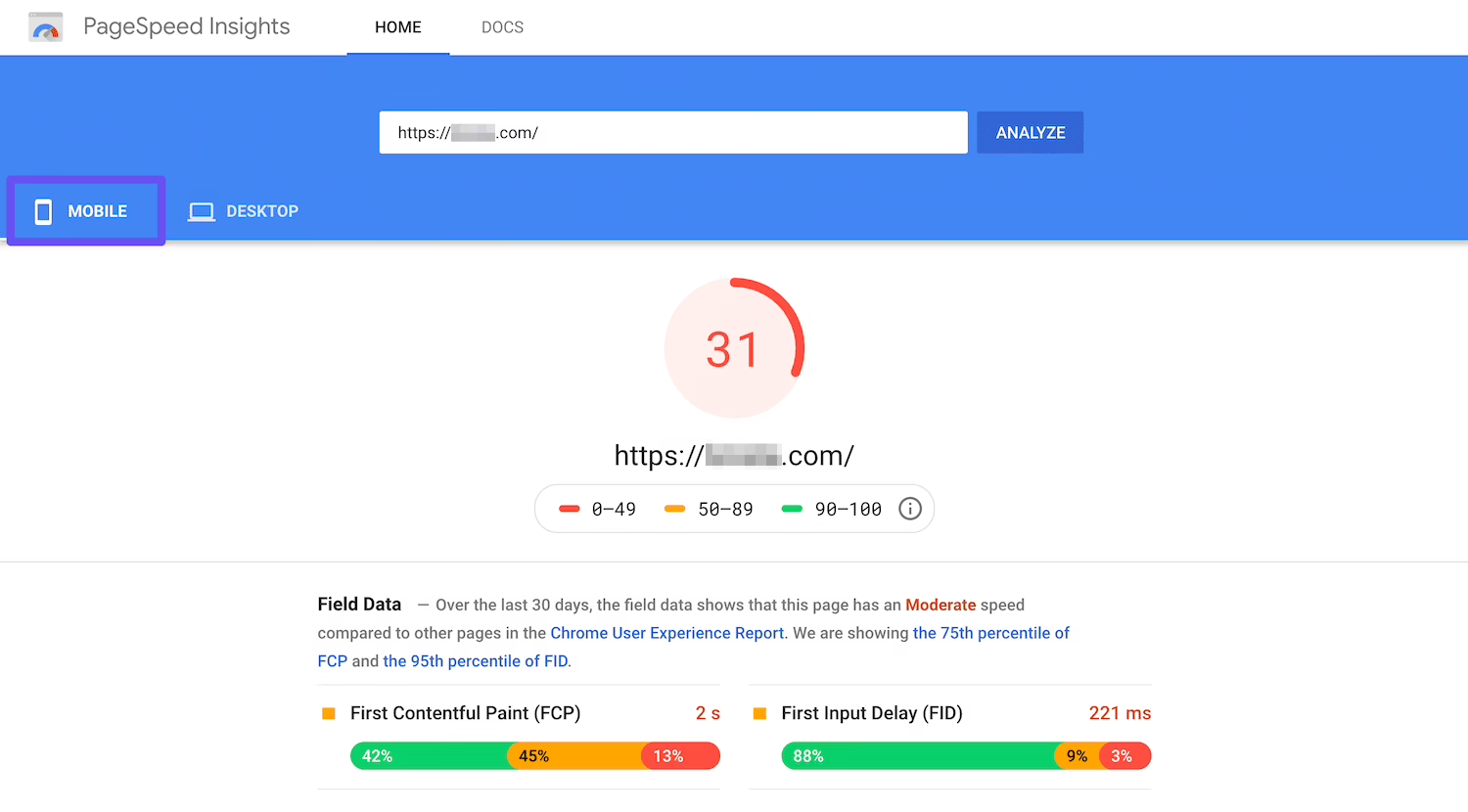
Shopify’s managed infrastructure narrows the range of speed outcomes. Independent testing from Thunder’s 2026 benchmark put a stock Shopify Dawn theme at 72 mobile PageSpeed, 320ms TTFB, 2.1s LCP, and 2.8s fully loaded. The same test on WooCommerce with shared hosting returned 38 mobile PageSpeed, 1,850ms TTFB, 5.8s LCP, and 7.2s fully loaded. Moving WooCommerce to Cloudways closed a large part of the gap, at 54 mobile PageSpeed, 680ms TTFB, and 3.4s LCP. The pattern is the point: WooCommerce can be fast, but only with hosting decisions and tuning that most small teams do not make.
Shopify’s enterprise comparison reports storefronts rendering roughly 2.4x faster than competitors in one CRUX-based sample and 1.9x faster in another. Read those with a vendor discount, but the direction matches the independent benchmarks.
Wondering how your store shows up in AI search? We put together a short visibility snapshot. Get the snapshot.
Customization, Catalogs, and the Ceiling Question
WooCommerce is more customizable, unambiguously. It is open source, code-accessible, and unconstrained by an app store’s review policies. The tradeoff is governance. Every plugin you add, every theme override you write, and every custom function is code your team now owns forever. Reddit operators describe “plugins breaking every 2 to 6 weeks” once the stack grows. On X, a recurring line is that WooCommerce “starts breaking things quietly around $500k revenue,” when the accumulated complexity finally exceeds the team’s capacity to maintain it.
Shopify’s ceiling shows up in different places. Its 100-variant-per-product limit is a real constraint if you sell configurable goods with many combinations. Checkout logic is limited on lower plans and only truly extensible on Shopify Plus. Regulated categories, including cannabis derivatives, kratom, kava, firearm-adjacent, and some nutraceuticals, run into acceptable-use restrictions that make WooCommerce the more sensible home. Always verify against the current Shopify AUP for your specific category.
For content-heavy brands, WooCommerce has a genuine advantage that no benchmark captures. When editorial, SEO, and product live in the same CMS, the workflow is simpler and the URL and schema control is deeper. This is where we saw WooCommerce fit clearly for NudFud, a plant-based snack brand. Their products need explanation, certification callouts, and nutritional depth, and WordPress content architecture let us build product pages that read like editorial without hacking around a commerce-first template.
The Two Failure Modes You Are Choosing Between
Shopify failures cluster around platform constraint and account risk. Reddit reports include $15,000 held for three months after a chargeback dispute, $10,000 held during a DMCA investigation, and support that feels “virtually nonexistent” when a real problem hits. App subscriptions accumulate quickly and create a sense of dependency on Shopify’s own pricing decisions.
WooCommerce failures cluster around plugin entropy, version drift, and maintenance debt. The GitHub issue tracker still shows unresolved architectural work on the Custom Order Table, which has been in progress for years. Once a store depends on ten to fifteen active plugins, every WordPress update becomes a regression event. Agency lock-in is a related pattern: the team that built the store is the only team that can safely change it.
Neither platform is safe from itself. The choice is which failure mode you are equipped to absorb.
Migration Is a One-Way Trend, and an Execution Problem
Practitioner data in 2025 and 2026 is lopsided. WooCommerce to Shopify migrations are reported up 42% year over year, driven mostly by operational fatigue and agency lock-in rather than any ideological preference for hosted software. Our WooCommerce to Shopify migration plan covers the concrete work involved, which is more than the CSV export most teams expect.
Migrations fail on execution, not destination. The Northeast Barrel Company case, a WooCommerce to Shopify move in late 2024, is the cleanest example in the public record: significant organic traffic loss after launch, driven by URL mismatches, deindexed pages, weak auto-generated meta, broken breadcrumbs, and sold-out product pages diluting the catalog. None of that is the destination platform’s fault. It is a missing redirect map, an unsigned SEO owner, and a launch plan that treated the cutover like a theme swap.
The pattern we see across engagements matches what our replatforming playbook lays out: the risk lives in URL handling, redirect coverage, canonical rules, and validating that every high-value page still returns the right response after cutover. Get those right and the platform choice is comparatively easy. Get them wrong and the strongest platform on paper still costs you a quarter of revenue.
How to Pick, Without Deferring the Real Decision
Choose Shopify when the dominant problem is running a reliable commerce business and you want the platform to absorb infrastructure and checkout. This is the right answer for lean teams, subscription businesses, DTC brands where conversion is the top lever, and any operator without in-house WordPress capacity.
There is a case for WooCommerce if you are dealing with idiosyncratic requirements and possess the technical wherewithal to manage the complexity that ensues. It is the sensible choice when your business is already entrenched in WordPress, or if your particular category chafes against Shopify’s AUP, provided you have the engineering resources to get value from an open stack and content is your main avenue for growth.
Then there is the matter of AI, which has become the most compelling point in 2026. Shopify is not shy about its agentic tooling, be it Claude in the admin or the Universal Commerce Protocol; they put forward numbers showing AI-driven orders up tenfold on a year over year basis. One can take those vendor figures with a grain of salt given how early they are, but they align with our observation that AI is a native part of the Shopify experience. With WooCommerce, it is just another set of plugins to look after.
Before any build is committed to, one should see to it that the migration path or catalog model is sound. Our Shopify development team will sort out such platform questions at the outset of an engagement. It is a small price to pay compared with the expense of having to reconstruct a store built on the wrong operating model. For an outside view on the matter, we would point you to Wise Web’s comparison, which makes much the same case from an Australian agency’s vantage point. In the end, the name on the platform is secondary to whether your people can run it without issue on a typical Tuesday.
Building or replatforming a store? Let’s talk. Free 30-minute call, no pitch.

Saeedreza Abbaspour is the CEO of Refact, where he works across product, engineering, and sales. He sets the studio’s direction while staying closely involved in the work itself, from shaping product strategy and UX architecture to helping define the technical systems behind Refact’s projects. His role connects business thinking with hands-on product execution, giving him a practical view of how software should be planned, built, launched, and improved. At Refact, Saeedreza focuses on building a studio that can move quickly, solve real client problems, and turn ideas into reliable digital products.
More from Saeedreza Abbaspour

