How to Choose an Ecommerce Development Company
When a store comes to grief after a replatform, it is rarely on account of the agency having made a poor choice in logo font.


The cutover for the launch itself is typically uneventful. But the revenue leaks are what get you four to twelve weeks down the line when Google re-indexes your URLs, a B2B pricing rule can not hold up under real traffic or a webhook quietly discards an order.
There is value in hiring an ecommerce development company if it mitigates that kind of risk; do not be swayed by a portfolio reel. This guide is intended for operators and merchants looking to put together a shortlist of genuine partners rather than amass some logos. We look at what the top firms are good at, where they are not, and the sort of questions that will tell a good vendor from a bad one.
What an Ecommerce Development Company Should Actually Do
Services, not licenses, make up some 44 per cent of IT outlay in retail and ecommerce. That is the cost of the work done around the platform: the data migration, checkout engineering, post-launch stabilization and the integrations with your PIM, warehouse and ERP systems that are necessary to keep a store in business.
You will find the same conclusion in any post-mortem of an enterprise or mid-market replatform: failure is a matter of behaviour. A platform is not to blame for scope creep, an underestimation of the ERP side of things, or a lack of rehearsal for the migration. Nor is it the cause of the damage done by siloed vendors who have no single owner of the outcome, or a 30 to 90 day hyper-care period left to chance. A partner worth having is one that keeps those boundaries in check.
One should remember that the value of an agency lies less in its construction work and more in the way it handles the data and integrations in the weeks after you have launched. Refact’s ecommerce development services are founded on this principle, and we apply the same standard in our evaluation of the other firms here.
Put it to any finalist: who is responsible for the fixes in weeks four through twelve, and what is the plan?
1. Refact
Merchants wanting a partner to help shape the decision as much as execute it tend to call Refact first. With a mix of full-stack engineering, UX and product strategy, the team is well placed to weigh up whether a headless approach, WooCommerce, Shopify or a phased migration is the right call. We guarantee the discovery phase with our money back, so the onus is on us to make the early calls defensible before any code is written.
Take Broya, the Canadian bone broth brand. They required a subscription-led Shopify operation where the focus was on conversion, not aesthetics. Five years on the relationship is still compounding because the work was put in place to drive recurring revenue. Or NudFud in Toronto, for whom the challenge in their WooCommerce build was not the checkout but the product structure and content model needed to explain the difference in a cracker to a shopper.

Best for
- Those who want clarity prior to making a platform commitment.
- Long-term projects where the outcome is determined by post-launch discipline and solid integrations.
- Teams requiring an accountable partner to align product, design and engineering.
Watch-outs
- The pricing is bespoke, so it is not for those after the lowest fixed quote.
- Our scope is web-first. More suited to SaaS, publishing and ecommerce than a broad native app programme.
2. Publicis Sapient (via Corra)
Having taken on Corra, Publicis Sapient’s commerce practice is built for the enterprise level, handling heavy headless and Adobe Commerce or Shopify Plus workloads along with the requisite CRM, PIM and ERP ties. Their strength is in the machinery of it all: managed evolution, data and engineering at a global scale from a single source.
What you are paying for is certainty on integration boundaries. If you have ten systems to reconcile, that is worth something. For a Shopify store with three integrations, not so much. Smaller merchants end up buying process they do not need. It is worth reading our ecommerce replatforming playbook to see where projects can go wrong in the catalog or with SEO drift before you start comparing the big agencies.
3. Bounteous
Then there is Bounteous digital commerce. They are among the few enterprise outfits that will offer a truly neutral view on composable, Salesforce, Adobe or Shopify stacks. It is an important distinction since too many platform choices are made on feature lists without regard for the realities of your WMS or ERP.
They are strong on omnichannel governance and keeping online and in-store systems in step. The downside is the premium price tag and a delivery apparatus designed for larger programmes. A mid-market merchant with a tight brief may find there is more agency here than the job calls for.
4. Americaneagle.com
Americaneagle.com is a US agency with a track record of delivery on BigCommerce, Adobe Commerce and the various flavours of Shopify. The draw is the range. You can put strategy, hosting, support and the build with one vendor, which reduces handoff risk for a merchant intent on a long-running relationship and multi-site management. Scope discipline is the fundamental risk. Leave a brief open to interpretation and large agencies will overbuild. One should come prepared with a firm business case, a catalog plan in hand and a written inventory of the systems that need to be talking on day one. And make sure to ask who is doing the work on a daily basis, not merely who has the account on paper. The consensus from Reddit on how to pick an agency is telling: the face on the sales call is seldom the one on your build.
Find out who will be putting in the hours and what their load looks like for the rest of the quarter.
5. Rightpoint
For merchants with a store that is more of a digital experience platform than a simple catalog, Rightpoint (now part of Genpact) is a good match. The team has particular strengths in governance, search, personalization and content. This comes in handy when a brand relies on storytelling as much as SKUs, or where a sizeable internal operation requires some guardrails to prevent the site from breaking in the course of weekly updates.
Then again, fit is the limitation. Rightpoint is enterprise work with the timelines and budgets to match. It is not the go-to for a lean merchant looking to validate demand or put up a quick Shopify storefront. Where there is pressure for brand consistency and controlled change, they are right for it. Where the imperative is to prove the store can sell, they are not.
6. Avex
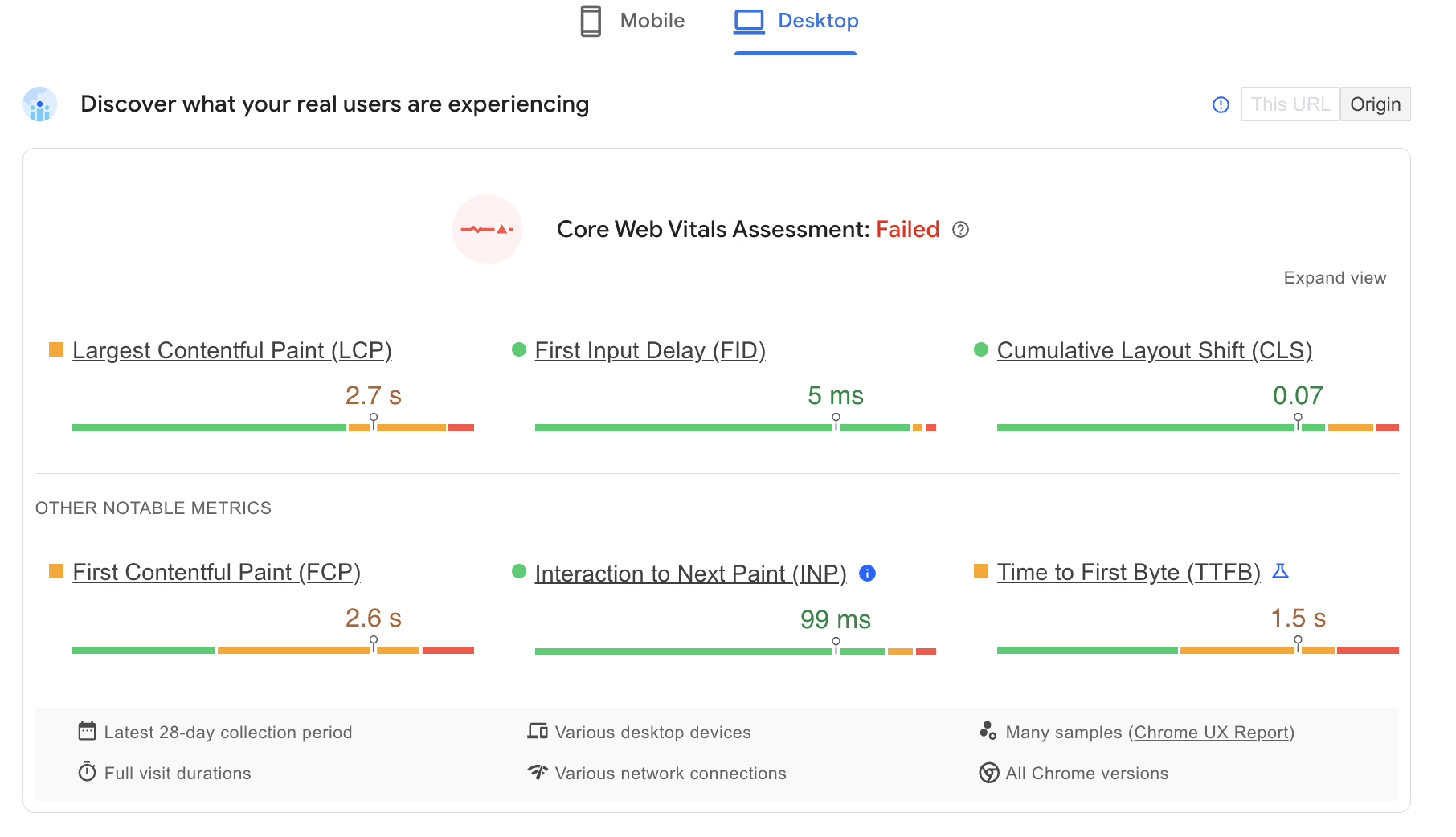
Avex is a Platinum Shopify Plus agency that puts design alongside conversion and performance. If the store has traction but the user experience is costing you, this is the team to look at. You only have to look at Shopify’s 2026 figures to see the kind of gains Avex can deliver: asynchronous checkout loading making pages respond a second or more sooner, a 58% speedup on Apple Pay buttons at product level, and a 50% improvement in cart load times.
The caveat is that Avex is a Shopify shop. That is an asset for a merchant set on Shopify Plus, but a constraint if the decision is still being made. Do not let theme work be confused for platform work; a proper Shopify vs WooCommerce comparison is worth a read before any shortlisting is done.
7. Absolute Web
Absolute Web brings real depth to the table from its Miami base, covering BigCommerce, Adobe Commerce and Shopify. Their Magento and Adobe Commerce pedigree is the strongest signal, and it counts when the B2B flow calls for contract pricing, the catalog is complicated or custom extensions are needed. The platform will bend further than Shopify but has its own breaking points, and Absolute Web knows them.
One needs to talk about migration up front. Eighty three per cent of data migration projects run over budget or fail, and the fallout is typically in the areas launch teams do not give enough weight to: search visibility, subscription tokens, content mapping and redirects. Our guide to Shopify migration services details the patterns that can quietly eat into revenue at cutover, and serves as a good way to measure a vendor with a heavy migration remit.
Wondering how your store shows up in AI search? We put together a short visibility snapshot. Get the snapshot.
Shortlist Comparison
| Provider | Complexity | Resource fit | Ideal use case | Key advantage |
|---|---|---|---|---|
| Refact | Moderate, discovery-led | Bespoke budgets; strategy, design, engineering in one team | Merchants who need clarity before platform commitment and a partner through hyper-care | Discovery money-back guarantee; long-term ownership past launch |
| Publicis Sapient (Corra) | High, enterprise replatforming and global rollouts | High budgets; long procurement cycles | Enterprise Adobe Commerce or Shopify Plus with heavy ERP/PIM/CRM integration | Enterprise scale with data and AI resources |
| Bounteous | High, enterprise migrations and omnichannel | High budgets; multidisciplinary teams | Organizations needing platform-neutral evaluation | Broad platform coverage with enterprise governance |
| Americaneagle.com | Moderate to high, multi-site and replatforms | Mid-market to enterprise budgets | Long-term single-vendor relationships and multi-site programs | End-to-end services including hosting and support |
| Rightpoint | High, DXP plus commerce with governance | Enterprise resources | Brands where content, personalization and governance drive commerce | Content-commerce integration; experience depth |
| Avex | Low to moderate, Shopify Plus focus | Shopify Plus budgets; CRO and retainer resources | Growth-stage brands optimizing or moving to Shopify Plus | Shopify Plus specialization; CRO and performance depth |
| Absolute Web | Moderate to high, Adobe Commerce depth | Mid-market to enterprise budgets | Complex catalog and B2B on Magento or Adobe Commerce | Balanced multi-platform experience |
The Questions That Separate Good Vendors From Bad Ones
Buyers tend to put questions of cost, timeline and support on the table and get the sales-friendly version of the truth. The following will tell you how a team really operates.
Integration and data
- How do syncs flow between systems, and which one is the source of truth for orders, customers, inventory and products?
- In the event an ERP webhook goes down mid-order, is order creation idempotent? How are you preventing duplicate charges?
- What does your rehearsal for data migration entail? A subset test and full staging environment, or are you making one attempt on cutover night?
Checkout and payments
- With marketing scripts being layered on over the next year, how is checkout speed preserved?
- Who has ownership of PCI scope and the handling of 3DS, chargebacks and payment retries?
- Describe your inventory reservation model and how ghost stock is avoided once a payment fails.
Scope and post-launch
- Put in writing what is in and out of scope and the pricing for change requests.
- Is the 30 to 90 day hyper-care period backed by named engineers and an SLA with defined KPIs, or is it a support inbox?
- After we go live, who holds the code, the domain, the third-party accounts and the data?
If a vendor can put those answers down on paper without equivocation, there is a conversation to be had. If the response is a pivot to case studies, move on.
Common Failure Patterns to Screen For
You will find failures in the same places every time. Take the Southeast Asian fashion house that burned through $1.2m in 14 months only to roll back three weeks in. A textbook case: the loyalty program that was responsible for 38 percent of repeat buys was descoped to make a date, 12 percent of ERP order updates were lost and Indonesia virtual account payments were absent. None of it was a failure of the platform, but of scope and integration decisions made prior to coding.
In a vendor meeting, screen for these patterns:
- An SEO strategy that amounts to nothing more than redirects, with no oversight of the 30 to 60 day re-index window where Google shows you the damage.
- Localization that is seen as translation, with no thought given to local tax logic or address formats.
- Several vendors being brought in for SEO, migration and design with no one person to answer for the result.
- Customization being sold as a selling point when standardisation would be more reliable. One enterprise team found that configuration-driven purchase pages could spare them 2.5 FTEs a year while maintaining 99.99% availability.
- Analytics and tracking as a box to tick at launch. A prominent operator once saw half their sales disappear for a while on account of a pixel error.
Turning the Shortlist Into a Hiring Decision
Before comparing vendors, write down the business problem. Catalog size, order volume, integrations, migration data quality, launch constraints, and who inside the company owns each decision. Then ask every finalist the same questions and compare their answers, not their pitch style.
Platform choice usually simplifies once the operating model is honest.
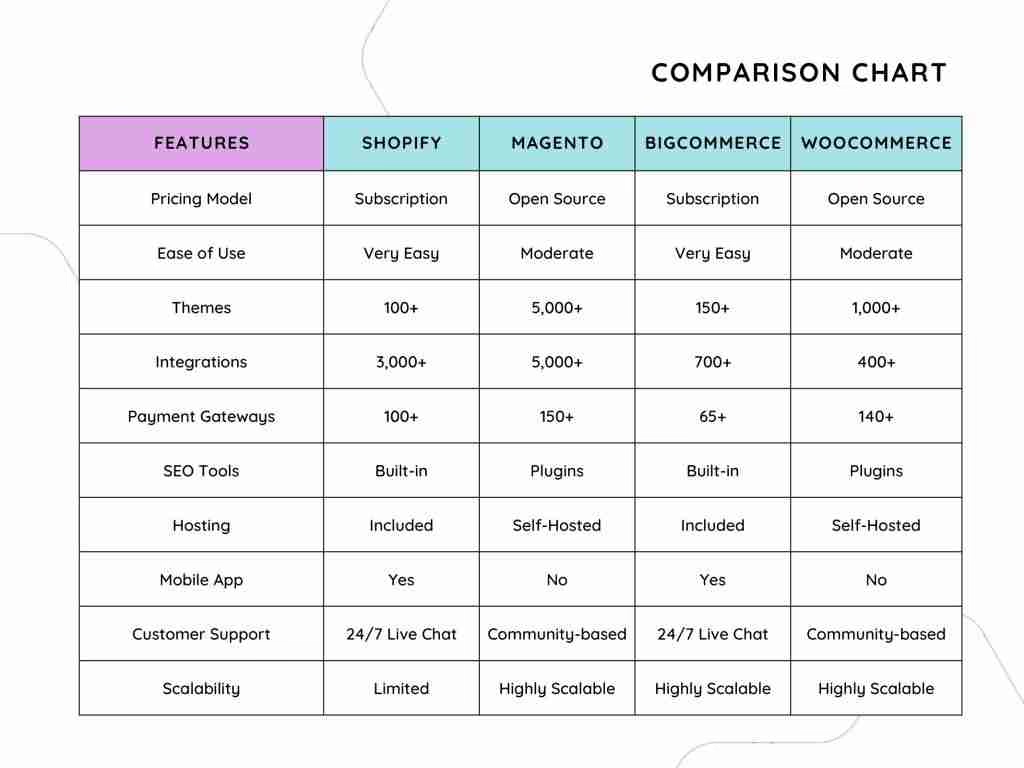
- Shopify fits merchants who want speed, low maintenance overhead, and a predictable operating model. It is also where checkout performance work compounds fastest.
- WooCommerce fits teams with real WordPress capability who need content-heavy publishing and open extensibility, but the ongoing hosting, plugin and security burden is real. Cost it over three years, not one.
- Headless or composable makes sense when custom front-end control, multiple channels sharing one backend, or specific performance targets justify the operational load. It also adds testing surface, incident risk and coordination cost that many teams underestimate.
Budget realism matters. A useful ecommerce website cost breakdown helps merchants pressure-test proposals against the drivers that actually move the number: integration count, catalog complexity, migration scope, and post-launch support depth.
Use this checklist on every proposal:
- Relevant work. Have they shipped stores or migrations with your integration profile, not just your industry?
- Named team. Who exactly designs, builds and maintains the work, and how many other clients are they on?
- Discovery discipline. Do they validate assumptions in writing before scoping the build?
- Migration rehearsal. Do they plan subset, staging and production dry runs?
- SEO continuity. Redirects, structured data, canonical strategy, and a plan for the re-index window.
- Hyper-care. A defined 30 to 90 day period with named engineers, KPIs and remediation budget.
- Ownership. Written clarity on who owns code, data, domains and third-party accounts.
Two useful outside reads if the buying process also has to cover strategy and acquisition planning: a broad 2026 ecommerce development services guide and a practical performance marketing agencies guide.
Consistency beats intensity in this decision. The merchants who protect revenue are the ones who spent the extra two weeks on the brief before the build began. If clarifying that brief is the current bottleneck, that is exactly the work Refact’s Shopify development and ecommerce discovery process is built to settle before code starts.
Building or replatforming a store? Let’s talk. Free 30-minute call, no pitch.

Saeedreza Abbaspour is the CEO of Refact, where he works across product, engineering, and sales. He sets the studio’s direction while staying closely involved in the work itself, from shaping product strategy and UX architecture to helping define the technical systems behind Refact’s projects. His role connects business thinking with hands-on product execution, giving him a practical view of how software should be planned, built, launched, and improved. At Refact, Saeedreza focuses on building a studio that can move quickly, solve real client problems, and turn ideas into reliable digital products.
More from Saeedreza Abbaspour

