Next.js Development Services: A Buyer’s Guide
It is rare for a team to be undone by Next.js on the grounds of having made a poor framework choice.


By the numbers, Next.js is mainstream. W3Techs has it at 3.7 per cent of all websites with a known JavaScript library (2.9 per cent overall) while GitNation counts some 18,000 verified companies running it in production. What is not mainstream is the discipline with which it is delivered. We put this guide together for those weighing Next.js development services and wanting to separate the studios that actually ship App Router work from the ones who have simply read the documentation.
What “Next.js Development Services” Actually Means in 2026
To call what you are buying in 2026 “Next.js services” is something of a misnomer; it is full-stack TypeScript engineering. create-next-app makes TypeScript the default now. On any project of consequence you will see the same stack: App Router, Tailwind and shadcn/ui, React Query, Zod, Drizzle or Prisma on top of Postgres, and either NextAuth or a managed provider for auth. Add in Stripe and Sentry and Vercel as the host and you have the standard. Anything else is a deviation.
How you scope a project should reflect that. When a studio touts their “Next.js expertise” but cannot make a case for the database layer or observability and offers nothing more than JWTs for authentication, do not be under the illusion you are hiring product engineers. You are getting React developers. The framework does some of the heavy lifting, but a good team brings the rest.
An engagement worth its salt has four parts: discovery to determine what needs building, an engineering plan for the infrastructure and rendering, weekly demos during the build, and post-launch support with an SLA. Without them you are paying for implementation labor, not a service.
When Next.js Is the Right Call, and When It Isn’t
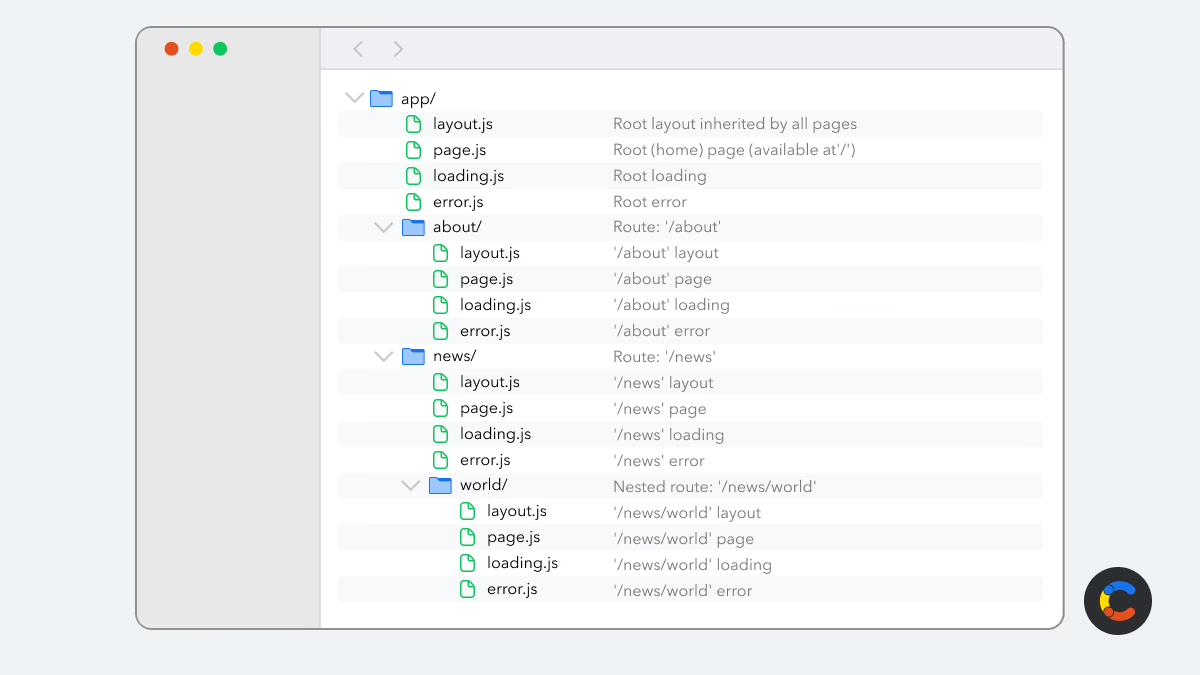
There is a time and place for the complexity Next.js brings. If you are dealing with server-rendered content for SEO, some form of logged-in state, and a front end that must interface with backend systems, then the App Router and Server Components are well worth it for the smaller bundles and faster first paints. That is the reality for most SaaS dashboards, headless commerce and editorial sites with a CMS.
For a five-page brochure with no dynamic data it is overkill. And if your people do not have the long-term capacity for React, it is the wrong path; the App Router demands attention when it comes to upgrades. One put it best by comparing the switch from Pages to App Router to moving apartments: risky and expensive, something you only do when you have to. Do not incur that cost unless the product calls for it.
The performance gains are there if you let them be. A Next.js site will load in 0.8 seconds on average compared to 3.4 for a WordPress equivalent, with Core Web Vitals pass rates of 68% to 34%. But these are conditional on the team knowing their craft. Render your SEO pages on the client, neglect your image and font optimisation and forgo a proper caching strategy, and you will have a slow site dressed up with a modern tool. The framework will not stop you from doing that.
The failure modes that keep showing up
You will hear practitioners cite the usual suspects. Routing sprawl from nested layouts that were not thought through. Caching errors from stale data or cross-request leakage, a hangover from when Next.js’s fetch was undocumented and too aggressive. Or Client Components being used where they should be Server Components, to the detriment of both bundle size and SEO. Then there is the matter of auth cobbled together from a tutorial rather than built to an OWASP ASVS standard, and observability left to chance so that an incident is only noticed when a user complains.
These are not bugs in the framework. They are a lack of discipline, which is why the vendor you choose is of more import than the framework.
What It Actually Costs
Do not expect pricing to be a commodity. A studio that gives you a fixed figure before it has a handle on your rendering strategy is taking a guess. Public reporting suggests regional rates in line with what you will find in the Next.js agency market survey from GitNation.
| Region | Typical hourly rate | What you usually get |
|---|---|---|
| US agencies | $75 to $180 | Senior-led delivery, US timezone, higher documentation and process overhead |
| Western Europe | $80 to $150 | Comparable seniority, EU timezone, often stronger design integration |
| Central Europe | $40 to $100 | Nearshore delivery, wider seniority spread, vet leads carefully |
Project sizes vary more than is often let on. An MVP with a database and a few features will run you $30,000 to $80,000. For mid-tier SaaS with billing and integrations you are looking at $80,000 to $150,000. Enterprise work involving compliance and complex models starts at $200,000. Migrations are pricier due to the work involved in protecting SEO and handling redirects. Our piece on web application development cost offers a benchmark for the drivers agencies tend to underprice.
And keep an eye on the hidden costs. Vercel Pro at scale is no small expense. There is Sentry, PostHog, CI and monitoring to add to the tab. If a proposal does not account for hosting and maintenance you are only seeing the attractive part of the budget. ZZBLOCK6ZZ
Vetting is about telling the difference between a team that has worked with Next.js and one that has put it in production long enough to have the scars to prove it. Six questions will do most of the heavy lifting.
- Put some numbers on it. We want to see a Next.js project with Core Web Vitals and conversion data from before and after. A case study by name with hard metrics is the best signal you can get. If they are bound by NDA, fine, but then we expect a technical write-up or a repo in lieu of that.
- Walk me through your use of Server as opposed to Client Components and the reasoning. You should be hearing about SEO, bundle size, streaming and where the interactive boundaries lie. Do not settle for an answer that makes them sound like one could be used in place of the other.
- What is your approach to caching and invalidation? Look for talk of explicit cache tags, a revalidation strategy and how they monitor for hits and misses. Any vagueness here is a surefire way to get stale-data issues down the road.
- Tell me about your observability stack and SLOs. Are you using Sentry for errors? OpenTelemetry or a hosted tracer for latency? Per-route dashboards? Saying “we keep an eye on Vercel logs” is not the same thing as having observability.
- Who is the tech lead and what is their track record with Next.js? The difference between success and failure comes down to senior-led delivery. Make sure you are speaking to the lead, not a salesperson who says he will “coordinate with engineering.”
- And after you launch? There should be an SLA and a maintenance model in place, someone whose job it is to be on the line at 2am when things go wrong. Without that, you are simply being handed off.
We put more into this in our guide to hiring a Next.js agency. Check the reviews, but give more weight to the named case studies. Better yet, ask to speak with a client you have been working with for eighteen months or more; that conversation is worth more than anything from the sales side.
Two Patterns From Our Own Work
The front end was never the problem when we did the rebuild for Teton Gravity Research. Picking the stack was the easy part. What made for hard work was the ten thousand articles sitting in a legacy CMS, old migration efforts that had come to nothing, and a business with critical functions bolted on to systems that were not communicating. We had to figure out what to retire and what to move over while keeping the editorial workflow intact. Most real Next.js work takes on that shape once you are done with the greenfield fantasy.
You see the same with SingularityHub. The site was not living up to its brand, the CMS was at odds with the editors and mobile readers were leaving. Our redesign let the editors have layout control without touching code, but the real effort was in the data models and API integrations so the team could ship faster post-launch. In the end, the framework was secondary to the discovery work.
Migration and Performance Questions Worth Putting on the Table
This is where SEO tends to go missing in a migration. Put a candidate studio on the spot: how are they going to manage URL parity, canonicalization, redirect maps and structured data at scale? What is the rollback plan if traffic nosedives in week one? And which pages get prebuilt with ISR versus server rendering, and why? “We will sort it during the build” is all the answer you need.
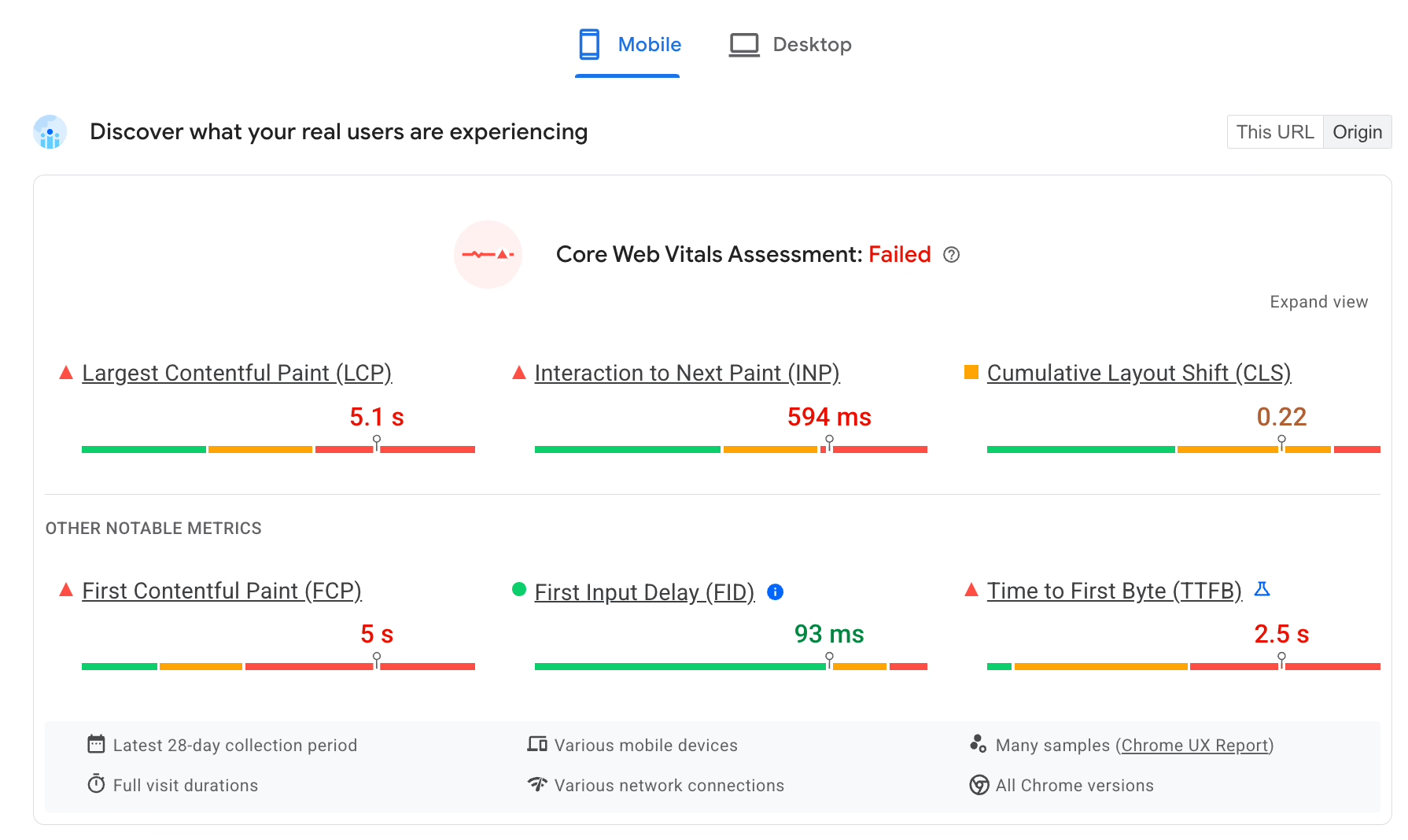
Be specific with performance. LCP under 2.5s, INP below 200ms, CLS under 0.1. And you want to see those Lighthouse scores on the actual production build, not a staging server devoid of content. Find out what tools are in the CI pipeline and what the pass criteria are for a release.
If accessibility is part of the brief, ask what WCAG level they are after and how they test for it. Running a candidate’s past work through a free WCAG checker before you put pen to paper will show you any obvious problems a good studio would have put right.
For a content-heavy build the CMS is everything downstream. Sanity, Contentful, Strapi or Payload all come with trade-offs in cost and lock-in. We have our take on headless CMS on React and where those setups make sense. Should there be commerce involved, you need to know how they plan to handle ecommerce platform integration with your PIM and ERP; that plumbing is what keeps product data consistent.
Vercel, Self-Hosting, and What Changed in 16.x
For most teams Vercel is the right call and the smoothest place to deploy. The fit between the platform and the framework is evident in how little friction there is with edge middleware, ISR and previews. It is not neutral advice, given Vercel is the steward of Next.js.
Self-hosting is less of a chore than it used to be, but not without pain. With the stable Adapter API in Next.js 16.2, putting things on AWS, Cloudflare or Netlify is far more viable. Version 16.3 has also seen a 90% drop in dev memory use and quicker local rendering. Those are material changes if compliance is pushing you away from Vercel or you want to be platform-agnostic. We cover when the platform is worth the price on our Vercel deployment page.
The rule of thumb: unless you have a compliance issue or the monthly bill is running into the tens of thousands, do not leave Vercel. If the situation changes, the Adapter API is something to look at, but factor in the engineering time to close the gaps on ISR and PPR.
The Next Step If You’re Evaluating a Studio
Start by asking “who can tell me whether Next.js is the right choice” rather than “who can build this in Next.js.” A studio you should be hiring will not shy away from making the case for the opposition and will put forward the circumstances in which an alternative stack would serve your product better.
Put them to the test with a request for a paid discovery phase that has a set budget, a written deliverable and a refund clause should it not work out. You will see right away which studios are sure of their scoping and which ones view discovery as a way to make a sale without charge. When a studio can lay out a data model, a rendering strategy or a plan for launch in terms you can use, they are a partner. If all they have to offer are some screens, move on. We have designed our approach to choosing a software development company to provide that sort of clarity before any code is put down.
Building a product and unsure what to scope first? Let’s talk. Free 30-minute call, no pitch.

Saeedreza Abbaspour is the CEO of Refact, where he works across product, engineering, and sales. He sets the studio’s direction while staying closely involved in the work itself, from shaping product strategy and UX architecture to helping define the technical systems behind Refact’s projects. His role connects business thinking with hands-on product execution, giving him a practical view of how software should be planned, built, launched, and improved. At Refact, Saeedreza focuses on building a studio that can move quickly, solve real client problems, and turn ideas into reliable digital products.
More from Saeedreza Abbaspour
