


Your SaaS is getting traction. Sign-ups are rising. Then you open Stripe (or your billing tool) and notice something painful, customers are leaving almost as fast as they arrive.
If you’ve been asking what is churn rate in SaaS, start here: churn rate is the percentage of customers or recurring revenue you lose over a set time period. It’s one of the clearest signals of whether your growth is real or just a treadmill.
Founders often celebrate new users while cancellations pile up in the background. Sustainable growth comes from keeping the customers you already worked hard to win.
What churn rate really means (and why it matters)
Think of your business like a bucket. New sign-ups are the water you pour in. Churn is the leak.
You can keep pouring money into acquisition, but if the leak is big enough, the bucket never fills. Tracking churn is not “just a metric.” It’s a basic health check on your product, pricing, onboarding, and support.
If you want a practical retention starting point, start with your first-week experience and improve your onboarding flow. Early confusion is one of the fastest paths to cancellation.
The two sides of churn
Churn is not one number. You need to watch it from two angles, because they tell different stories.
-
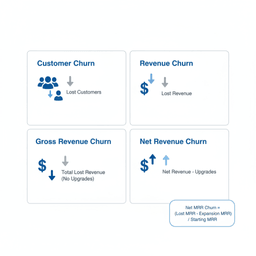
Customer churn: How many customers canceled during the period. This is a simple headcount.
-
Revenue churn: How much recurring revenue you lost from cancellations and downgrades. This shows the financial damage.
Losing ten customers paying $10/month is not the same as losing one customer paying $1,000/month. Customer churn treats them the same. Revenue churn does not.
Churn forces you to face what’s not working. It is often the most honest feedback you will get.
How to calculate churn rate (formulas you will actually use)
You can’t fix churn if you don’t measure it. The good news is you don’t need a fancy data stack to start. If you can count customers and track MRR, you can calculate the basics.
Pick a time window (monthly is standard), then measure what you lost during that period.
Customer churn rate formula
Customer churn rate is the percent of customers who canceled in a period.
Customer Churn Rate = (Customers Lost in Period / Customers at Start of Period) x 100
Example: You start the month with 1,000 customers and 50 cancel.
(50 / 1,000) x 100 = 5% monthly customer churn
Revenue churn (gross vs net)
Revenue churn is often the metric founders care about most because it maps to cash.
- Gross revenue churn: MRR lost from cancellations and downgrades (no offsets).
- Net revenue churn: Gross churn minus expansion revenue from existing customers (upgrades, added seats, add-ons).
If expansion revenue is higher than lost revenue, you can reach negative net revenue churn. That means your existing customers are growing faster than they are leaving.
Churn calculation examples (simple table)
Here’s a side-by-side view for a company that starts the month with 1,000 customers and $100,000 in MRR.
| Metric | Formula | Example Calculation | Result |
|---|---|---|---|
| Customer Churn Rate | (Lost Customers / Start Customers) x 100 | (50 / 1000) x 100 | 5% |
| Gross Revenue Churn | (MRR Lost to Churn & Downgrades / Start MRR) x 100 | ($8,000 / $100,000) x 100 | 8% |
| Net Revenue Churn | ([MRR Lost] – [Expansion MRR]) / Start MRR x 100 | ([$8,000] – [$3,000]) / $100,000 x 100 | 5% |
This company lost 5% of customers, but 8% of MRR before expansion. That suggests higher-value accounts churned. Expansion brought net revenue churn back down to 5%.
What is a good churn rate for SaaS?
You ran the numbers. Now you want to know if you should panic.
There is no universal “good churn rate.” It depends on your customers, your pricing, and your contract terms. A self-serve product with low monthly pricing will usually churn more than a high-touch enterprise product on annual contracts.
Benchmarks to use (with context)
Benchmarks are useful if you compare yourself to similar companies.
- SMB SaaS: Monthly churn is often higher because budgets are tighter and many customers are still experimenting. It’s common to see 3% to 7% monthly churn.
- Enterprise SaaS: Churn is often lower because switching costs are high and contracts are longer. Monthly churn around 1% to 2% is more typical.
Don’t ask, “What is a good churn rate?” Ask, “What is a good churn rate for our customers and pricing?”
Stage and model matter
Early-stage companies searching for product-market fit often see higher churn. As the product improves and the ideal customer profile gets clearer, churn tends to drop.
The long-term target many founders want is negative net revenue churn, where expansions outweigh losses. That’s how SaaS businesses compound.
Find the real reasons customers churn
Churn is a symptom. The work is finding the cause.
The fastest way to get clarity is to separate churn into two buckets. Each one needs a different fix.
Voluntary vs. involuntary churn
Voluntary churn is when someone chooses to cancel. This is the classic “I’m done” churn.
Common reasons include:
- They never got value: They signed up but never hit the “this is worth paying for” moment.
- Confusing product: The UI is hard to learn, or the workflow is unclear.
- Missing a must-have feature: A competitor covers a key need you don’t.
- Support breakdown: One bad interaction can end trust fast.
Involuntary churn is when someone leaves by accident, usually because a payment fails. Expired cards and bank declines create quiet revenue loss if you do not catch them.
Voluntary churn is about value. Involuntary churn is about billing and process.
If you want to move from guessing to knowing, it helps to identify what drove churn last month with a repeatable process. The goal is not more charts. The goal is clear answers you can act on.
Actionable ways to reduce churn rate
Measuring churn is step one. Step two is changing what causes it.
The best retention plans mix prevention (stop churn before it starts) and recovery (save accounts that are about to leave).
Proactive strategies (prevent churn early)
-
Fix onboarding first: Most churn happens early. Tighten your setup flow, remove extra steps, and guide people to the first win fast.
-
Use in-app help: Don’t assume users will “find” important features. Add short tooltips, checklists, and targeted messages tied to what they are trying to do.
-
Offer annual plans: Annual pricing improves cash flow and gives you more time to prove value. Even a small annual discount can shift behavior.
If the core product experience is the problem, the fix is usually a mix of UX, performance, and clarity. That’s the type of work our website development support and product builds focus on, making the product easier to use and easier to keep using.
Reactive strategies (save at-risk customers)
Every cancellation has a lesson inside it. Collect the lesson while it’s still fresh.
-
Run dunning for failed payments: Involuntary churn is often preventable. Use automatic retries plus clear emails that ask customers to update billing details.
-
Send smart lifecycle emails: The right message at the right time can bring users back before they cancel. This is where the benefits of email automation show up quickly.
-
Collect exit feedback: Add a one-question cancel survey. Keep it simple and make it required. You want clean data, not essays.
If you want more ideas on retention tactics, the guide from Groupos on how to reduce churn rate and boost retention is a helpful reference.
Also, if churn is tied to content cadence or expectation-setting (common in subscription products), this guide on preventing subscription churn has useful frameworks you can borrow.
Your churn reduction checklist (for the next 7 days)
Churn gets better when you build habits, not when you do a one-time audit. Use this checklist to build momentum.
Immediate next steps
-
Calculate the last 90 days: Track customer churn, gross MRR churn, and net MRR churn monthly for the last three months.
-
Start an exit survey today: Ask, “What’s the main reason you’re canceling?” Keep the answers in a spreadsheet you review weekly.
-
Walk through onboarding: Create a new account and follow your onboarding. Write down every moment you feel confused or delayed.
-
Audit payment failures: Count how many accounts are lost to failed payments. Set up retries and reminder emails.
If your churn work is blocked by messy tracking, unclear reporting, or scattered tools, getting a clear plan matters. This is where fractional CTO roadmap help can remove guesswork and give you a path you can execute.
Churn questions founders ask all the time
Can churn be negative?
Customer churn cannot be negative. You can’t “lose negative customers.”
But net revenue churn can be negative. That happens when expansion revenue from existing customers is higher than revenue lost from cancellations and downgrades.
Should I track customer churn or revenue churn?
Track both.
If you have to pick one for decision-making, net revenue churn usually tells the more accurate story. It reflects the business impact, not just the number of accounts.
How often should I measure churn?
Monthly is standard. It’s frequent enough to spot trends without reacting to noise.
Also use cohort tracking. Group users by the month they joined, then track how long they stick around. This is how you know if onboarding changes, pricing changes, or product updates are actually improving retention.
Conclusion: churn is a growth problem you can control
Churn isn’t “just what happens in SaaS.” It’s a signal that something in the product experience, expectations, or billing flow is breaking down.
If you want help tightening retention systems, improving conversion and onboarding, and building a product that people keep paying for, our website optimization services are designed for measurable improvements.
When you’re ready, talk with our team. We’ll help you find the biggest churn drivers, prioritize fixes, and turn retention into a strength.


