


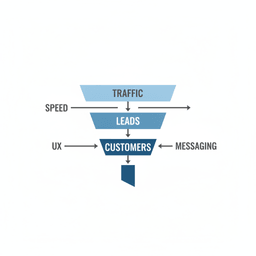
Be honest, is your website helping you grow, or is it getting in the way?
Most founders built their first site fast. It worked well enough to get moving. But as your business grows, that same site can turn into a quiet blocker, slow pages, confusing paths to buy, and a setup your team is scared to touch.
That is when website redesign services stop being “nice to have” and start being a business move. A real redesign is not a new theme. It is a strategic rebuild that makes your site match what your company needs right now.
When your website starts costing you money
Founders usually feel the pain before they can name it. The site looks dated. It loads slowly. Leads come in, but they are not the right ones. Small edits take days.
Those are not just annoyances. They hit revenue, team time, and trust.
The hidden costs of a “good enough” website
Small issues often point to bigger problems under the hood. Here is what those day-to-day headaches can cost you.
| What You Notice (The Symptom) | What It’s Costing Your Business (The Problem) |
|---|---|
| “Our site just looks old and unprofessional.” | You lose trust before you ever get a conversation. |
| “Visitors aren’t signing up or buying.” | You lose revenue because the path to action is confusing or broken. |
| “We get leads, but they’re not the right people.” | Sales wastes hours on prospects who were never a fit. |
| “The site is so slow to load.” | People leave. A slow site turns intent into exits. |
| “Our team can’t even update a blog post.” | Marketing slows down and your site goes stale. |
| “It looks terrible on my phone.” | You push away a huge share of your audience right away. |
If you see yourself in that table, doing nothing is already expensive. The longer you wait, the more you train buyers to pick a competitor that feels easier and more credible.
If you want to explore what “better” can look like, start with our web design services overview. It lays out the main ways we help founders turn a site into a real business asset.
Problems that signal it is time for a redesign
When visitors drop off without taking action, the cause is often poor user experience. In fact, 61.5% of redesigns start to fix bad UX, which shows how often usability is the real root problem.
Performance problems can be just as costly. Slow load times alone cost retailers an estimated $2.6 billion in lost sales every year.
Other common signs you are past “quick fixes”:
- You’re getting the wrong kind of leads. Your site attracts people who do not match your offer.
- Your team can’t update the site. Basic edits require a developer, and content starts to lag behind.
- The site does not reflect who you are now. Your business has changed, but the site still tells the old story.
- It’s not converting. If traffic does not turn into customers, the site is failing at its main job. This is where solid conversion rate optimization strategies can help.
Your website should sell for you all day and all night. If it is not doing that, it is not neutral. It is costing you money.
A redesign should tie your site to your real goals. That means learning what users need, then building an experience that supports them and supports your business.
If you are unsure where people get stuck, this guide on web usability testing is a practical starting point.
What are website redesign services, really?
Many founders hear “redesign” and think colors, fonts, and a new homepage. That is a visual refresh. It might help for a week. It rarely fixes the reasons your site is underperforming.
Website redesign services should include strategy, structure, content decisions, design, and development. The point is to build a site that supports growth, not just a site that looks newer.
It is more than a new look
A real redesign starts with hard questions. Who is the site for? What do they need to believe before they take action? What does your business need the site to produce?
This is also why the design market keeps growing. The US web design services industry generated $43.5 billion in revenue in 2024, and the global market is projected to hit $92.06 billion by 2030. That growth is not just about looks. It is about results. You can explore more about these web design statistics and market trends to see how central modern websites have become.
A true redesign starts with business goals. Design and code are there to support the goal, not lead it.
Core parts of a strategic redesign
A strong redesign partner will connect each step back to a clear outcome. In most projects, the work includes:
- Business goals and user research: Who you serve, what they want, and what “success” means for the new site.
- Content planning and site structure: What pages you need, what each page must do, and how people move through the site.
- UI and UX design: The interface people see and the flow that makes the site easy to use.
- Development: Building a fast, secure site that your team can maintain.
- SEO and content migration: Protecting rankings during the change, and setting up a clean structure going forward.
The platform depends on what you are building. Some teams use WordPress for marketing and publishing. Ecommerce brands often choose Shopify. Product-heavy sites might need custom builds with tools like React.
Our process: from discovery to relaunch
We do not start with mockups. We start with a simple question: what problem are we solving for your business?
From there, we work in clear steps. You always know what is happening, why it matters, and what decision we need from you next.
The product strategy and discovery phase
This phase sets the direction. We look at your audience, your offer, your current data, and your goals. Then we decide what the site must do to support the business.
A founder once came to us sure he needed a new membership feature. In discovery, we found members were not asking for more features. They were frustrated because they could not find content they already paid for. Fixing the structure and flows raised engagement and saved a big build that users did not want.
We believe in this step so much that we back it with a money-back guarantee. If you do not feel confident in the direction after discovery, we refund the cost of that phase.
From blueprint to build
Once the strategy is clear, we move into design and development. The goal stays the same: build the right thing, then build it well.
Our work typically moves through three stages:
- UI/UX design: We create wireframes and prototypes so you can see the structure and flow before development begins.
- Collaborative development: We build in short cycles, share progress often, and make decisions with you as we go.
- SEO-focused relaunch: We plan redirects, protect key pages, and make sure tracking and search basics are in place.
If your redesign also includes moving platforms or cleaning up old systems, this guide to website migration services explains how to reduce risk during launch.
The best work is done with founders. Not through handoffs, but through partnership.
We have built over 100 products for founders. Many clients stay with us for over two years because the site still needs to grow after launch, and the partnership keeps paying off.
How much does a website redesign cost?
Pricing depends on scope. A simple marketing site is not the same as a platform with subscriptions, ecommerce, and data integrations.
Think of it like a renovation. Costs depend on the plan, the condition of what you have now, and what you want the end result to do.
What your redesign budget actually buys
A $5,000 redesign and a $50,000 redesign are different products. One is mostly a visual update. The other is strategy, structure, design, development, and a safer launch plan.
What Your Redesign Budget Actually Buys
| Investment Level | What You Can Expect (Scope & Partner) | Best For… |
|---|---|---|
| $3,000 – $10,000 | Template-based redesign, often from a freelancer or small shop. Mostly visual changes and basic setup, often on a platform like WordPress.com. | Early-stage teams that need a solid brochure site fast. |
| $10,000 – $40,000 | Semi-custom design with better UX and stronger conversion focus. More thinking around structure and messaging. | Growing businesses that need the site to produce qualified leads or sales. |
| $40,000 – $100,000+ | Custom, strategy-led redesign from a studio or specialized agency. Includes deeper discovery, custom development, and more complex integrations. | Companies where the website is a core revenue and operations channel. |
Key factors that change the price
Budgets often run from $3,000 for simple sites to $160,000+ for complex platforms. Scope, tech, and the team you hire all matter. For a deeper benchmark view, you can read these detailed website redesign cost breakdowns.
Main pricing drivers include:
- Custom vs. template: Custom work costs more because it is built around your users and your goals.
- Ecommerce: Payments, product management, and checkout flows add complexity.
- Publishing needs: Content-heavy sites often need custom templates and editorial tools.
- Integrations: Connecting to a CRM, email platform, booking tool, or paywall increases build time.
The real question is not “What does a website cost?” It is “What value do we need the website to create?”
If you are weighing redesign vs. smaller fixes, our website optimization services page can help you compare options. Sometimes a few focused improvements can buy time before a full rebuild.
Choosing the right redesign partner
A redesign partner can save you months of confusion, or create months of it. This is not just a vendor choice. It is a business decision.
Portfolios matter, but process and thinking matter more.
Look beyond the portfolio
A nice-looking site is easy to sell. A site that produces results is harder. Ask how the team measures success. Ask what they do before they design anything.
A vendor builds what you ask for. A partner helps you make sure you are asking for the right thing.
If the first conversation is only about colors, pause. You want someone who asks about goals, buyers, offers, and the actions that matter.
Also ask who owns brand decisions. If your identity is outdated or inconsistent, a redesign might need more than web pages. In that case, it helps to look at branding and design services as part of the project.
Questions to ask a potential partner
- How do you define success? Look for answers tied to business outcomes, not only “launch day.”
- What does your discovery phase look like? If they skip it, the project often turns into guesswork.
- Tell me about a time you disagreed with a client. This shows if they can push back with good reasons.
- How do you handle scope changes? You want clarity, not surprise invoices.
A good partner can also support beyond the redesign, from integrations to custom builds. This is where a broader set of website development services matters.
Finding a team you can trust
Trust comes from clear communication, honest advice, and proof. Ask for examples that match your situation.
For instance, if you are a content-heavy business that cares about speed, UX, and editorial workflows, the SingularityHub redesign case study is a good example of what a rebuild can change.
In the end, you want a partner who understands your goals, tells you the truth, and can execute without drama.
Your next steps toward a better website
If you feel overwhelmed, that is normal. The goal is to get clear before you sign anything.
Get clear on your goals first
- Assess your readiness: Compare your site’s performance to your business goals. A simple checklist helps. If you want a template, this website redesign checklist offers a solid set of steps.
- Define what success means: Write three measurable outcomes. Examples: “Increase qualified demo requests by 25%” or “Cut support tickets about finding info by 50%.”
Let’s talk strategy, not sales
If you want an outside view, we can talk through your goals and your options. Sometimes the answer is a full redesign. Sometimes it is a smaller project.
Either way, clarity comes first.
Frequently asked questions about website redesign
How long does a typical redesign take?
It depends on scope. A straightforward marketing site might take 6 to 8 weeks. A complex build with custom features can take 4 to 6 months or longer.
The biggest factor is often not coding. It is agreeing on goals, structure, and content decisions early.
Will I lose SEO rankings during a redesign?
It can happen if the project is rushed. But with a solid migration plan, a redesign can improve SEO over time.
Key steps include mapping old URLs to new ones with 301 redirects, keeping valuable content, and improving speed and mobile experience.
A redesign should protect SEO. Better usability and performance often lead to better rankings over time.
What if I only need a few new features?
Then a full redesign may be too much. If the foundation is solid, you can often add a paywall, booking tool, or integrations as a focused project.
We can help you decide what your current setup can handle, and what will become expensive later if you keep patching it.
Do I need all my content ready before we start?
No. Content and design should be shaped together. If you finalize content too early, you often end up forcing it into a layout that does not fit.
We start by agreeing on key messages and site structure. Then you create content that fits the purpose of each page.
At Refact, we build websites that act like real business assets. If your site feels like a bottleneck, let’s talk through what fixing it would take.


