


Everyone says it like it’s simple, “Just find a technical co-founder.” If you are not a developer, that advice can feel like a dead end. You have the idea, the market, and the drive, but you are stuck on the build.
This is why many founders turn to virtual CTO services. You get senior tech leadership without giving up half the company, and you can start building with a clear plan.
Need a Tech Co-Founder But Can’t Find One?
You are a founder with a vision. You understand the problem and the audience. But a big piece is missing, the technology.
The default advice is still to find a technical co-founder to build it. If that was easy, you would not be reading this.
The search eats your best resource, time. Weeks, sometimes months, go into coffee chats, pitch practice, and “maybe” conversations. It can start to feel like a high-stakes dating process, and a bad match can sink the company.
If you need help getting an MVP to market without waiting on a unicorn, our website development help is built for founders who need strategy and execution in one place.
The Hidden Risks of a Co-Founder Search
The hard part is not only finding someone. It is what you give up to make it work.
Giving away 40-50% of your company before a single line of code is written is a huge bet. And it is hard to undo.
Early partnerships need a rare mix of skills, trust, and long-term commitment. Even if someone is a great engineer, they may not share your pace or your product instincts. If that relationship breaks six months in, you can end up with a fractured team and a cap table problem that scares off investors.
The “find a tech co-founder” model forces a permanent equity decision to solve what is often a short-term build problem.
Great co-founder partnerships do exist. But they are not the only path.
If what you need is technical leadership, not a lifelong business marriage, a virtual CTO can be a better fit. Virtual CTO services let you bring in senior guidance at the exact moment you need it, while keeping control of your equity and direction.
What Does a Virtual CTO Actually Do?
Most founders are asking a simple question, “What will you do for me?” That is the right question.
A virtual CTO is not there to “manage tech” in the abstract. They translate business goals into a build plan, then lead the work until the product is real.
Think of it like building a house. You bring the vision. A virtual CTO creates the blueprint, picks materials that will last, hires the right crew, and makes sure it is built correctly.
Creating Your Technical Blueprint
The first job is the roadmap. Not a deck that looks nice, a working plan that connects goals to features, timelines, and budget.
A good virtual CTO helps you make the early decisions that shape your product for years, including:
- Choosing the right stack: what to build now, what to save for later, and what will be painful to change later.
- Planning for scale and security: so success does not break the product.
- Making smart build vs buy calls: when to use proven tools, and when custom code is worth it.
- Preparing for AI or data features: if your roadmap includes recommendations, automation, or advanced workflows.
Getting these choices right early can save months of rebuilds and major budget waste. It also makes hiring easier because the team knows what “good” looks like.
From Blueprint to a Finished Product
Once the plan is clear, the focus shifts to delivery.
Your virtual CTO leads the build. That can mean guiding your in-house team, managing freelancers, or running a mixed team. The point is simple, you get one owner for the technical outcome.
That ownership usually includes:
- Defining sprints and milestones
- Reviewing work for quality and maintainability
- Keeping scope under control so the MVP ships
- Reducing tech debt before it becomes a trap
A virtual CTO is your technical partner and your single point of accountability for the build.
This also frees you up to do your job. Talk to customers. Test pricing. Build partnerships. Sell.
Comparing the Costs of Technical Leadership
Budget matters. Most founders are thinking, “This sounds helpful, but can I afford it?”
The real comparison is against a full-time CTO. The salary is only the start. When you add recruiting fees, benefits, and equity, it becomes one of the largest costs a startup can take on.
The True Cost of a Full-Time CTO
In the U.S., a senior CTO base salary can hit $250,000. Total compensation can climb toward $400,000 per year after benefits, bonuses, and equity.
Virtual CTO services usually run on a part-time model. Many providers charge $5,000 to $20,000 per month, based on scope and involvement. For early-stage teams, that often means 60-80% lower cash cost compared to a full-time executive.
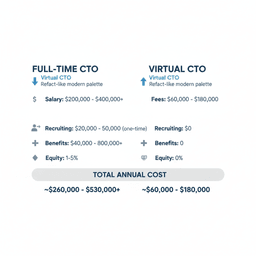
Cost Comparison: Full-Time CTO vs. Virtual CTO
This table shows a typical annual comparison.
| Cost Factor | Full-Time CTO (Annual Cost) | Virtual CTO (Annual Cost) |
|---|---|---|
| Base Salary | $250,000+ | N/A (Included in retainer) |
| Recruiting Fees | $50,000+ | $0 |
| Bonuses & Equity | $100,000+ | $0 |
| Benefits (Health, 401k) | $30,000+ | $0 |
| Total Annual Cost | ~$400,000 | $60,000 – $240,000 |
The point is not “cheap vs expensive.” It is timing. You can get senior guidance while you prove the product, then decide later if a full-time executive makes sense.
You do not need a full-time CTO on day one. You need the right level of leadership for the stage you are in.
How Virtual CTO Pricing Models Work
Virtual CTO services are usually structured one of three ways:
- Monthly retainer: a predictable monthly fee for ongoing leadership, planning, and team management.
- Project-based: a fixed scope, like an MVP build plan, an audit, or a migration.
- Hourly consulting: best for short questions or a second opinion, not for running a build.
If you are also planning for post-launch improvements like speed, conversion, analytics, or paywall tuning, pairing leadership with ongoing optimization support can keep the product improving after the first release.
The ROI of Preventing Costly Mistakes
The biggest value is often what you avoid.
A wrong stack can force a rebuild. A weak hiring process can leave you with code no one wants to touch. Poor scope control can burn through a budget before the product is even usable.
A virtual CTO exists to block those mistakes. They make sure you build the right thing first, on a foundation that can grow.
If you want help setting a realistic budget range before you commit, read our software cost estimation guide. It breaks down what drives cost and how founders can reduce surprises early.
Key Signs You Need a Virtual CTO Now
Timing is everything. Bring help in too early, and you waste cash. Bring help in too late, and you clean up messes that never should have happened.
Here are the signals that usually mean it is time.
You Just Secured Funding and Need to Build
Funding is exciting. It is also a countdown clock.
If you do not have a clear build plan, it is easy to spend that first check on the wrong hires or the wrong features. A virtual CTO can turn investor pressure into a focused roadmap and a ship date.
Your Freelance Developers Are Causing Chaos
Freelancers can be great. But without technical leadership, things can drift fast.
If deadlines keep slipping, communication is scattered, and you cannot judge code quality, you are carrying a risk you cannot see. A virtual CTO sets standards, runs delivery, and holds the team accountable.
If you feel like a project manager instead of a founder, you probably need technical leadership.
Your Current Product Is Hitting a Wall
Maybe you already launched. Now it is slow, buggy, and painful to change.
That is usually technical debt and weak architecture showing up as business pain. A virtual CTO can run a technical review, set priorities, and lead the cleanup so your product can grow again.
You Need to Integrate Complex Technology
Some features are simple. Others are high risk.
AI workflows, secure payments, and subscription paywalls can become expensive if they are built the wrong way. A virtual CTO helps you pick proven approaches and avoid building a science project.
If your next step is hiring and you want a clear process, our guide on how to hire developers for a startup lays out what to do first, how to vet talent, and how to set expectations in the first 90 days.
How to Choose the Right vCTO Partner
Choosing the wrong partner can cost you months and a lot of money. So you need more than a polished pitch.
You need proof, process, and fit.
Go Beyond the Resume
Titles and buzzwords do not ship products. Results do.
Ask for real examples. Have they built products like yours, SaaS, membership, marketplaces, internal tools, or content platforms? Ask what went wrong and what they did about it. Good partners are honest about trade-offs.
Prioritize Strategy Before Code
A red flag is a partner who wants to start coding in week one without discovery.
Successful builds start with clarity on users, scope, and constraints. Code should follow the plan, not replace it.
Anyone can write code. The right partner helps you decide what to build first.
Find a Great Communicator
Your virtual CTO should explain technical choices in plain English.
If you leave calls confused, that will only get worse once the build starts. You want a partner who makes trade-offs clear and puts decisions in writing.
If you want to see what a good roadmap process looks like, review our guide to a tech roadmap. It outlines how founders can go from idea to a build plan without guessing.
Look for Long-Term Commitment
Some partners disappear after launch. That is fine if you only need a short project.
But if you are building a real business, you want someone who can support hiring, scaling, and new releases over time. Ask about average client length and what “ongoing support” really includes.
How to Get Unstuck and Find Your Technical Partner
You do not need more generic advice. You need next steps.
Two Simple Steps to Get Unstuck
-
Do an honest gut-check: Take 30 minutes and write down where you are stuck. Is it hiring? Scope? Architecture? A messy freelancer setup? Be specific.
-
Talk to someone who can own the outcome: Whether it is us or another team, ask for a roadmap, a staffing plan, and a delivery process you can understand.
The first conversation should leave you with a clearer plan than you had before. If it does not, keep looking.
If you are comparing options, you can also review our services to see how we support strategy, builds, and improvements after launch.
Frequently Asked Questions About Virtual CTO Services
What Is the Difference Between a Virtual CTO and a Fractional CTO?
Most teams use the terms the same way.
In both cases, you get senior technical leadership on a part-time basis. The title matters less than the work, roadmap, hiring, delivery, and accountability.
Will a Virtual CTO Also Manage My Development Team?
Yes, and they should.
A virtual CTO who only hands you a strategy document is a consultant. A partner takes ownership of delivery. That means leading developers and setting a process that ships.
This often includes:
- Running sprints so work moves every week
- Reviewing code for quality and maintainability
- Keeping scope in check so the MVP launches
If no one owns the technical outcome, the founder ends up owning it by default.
How Much Involvement Should I Expect from a Virtual CTO?
It depends on the stage.
During strategy and planning, involvement is high. Expect workshops, frequent check-ins, and detailed decisions in writing.
Once development is running, many engagements shift to a few hours per week for leadership, reviews, and planning. The goal is to stay ahead of problems, not react to them late.
At Refact, we help non-technical founders go from idea to a clear plan, then to a shipped product. If you want to talk through your situation and see what a realistic path looks like, schedule a clarity call.


