


You are ready to build, but you are stuck on one decision: staff augmentation vs managed services. Pick the wrong model and you can burn months, spend more than planned, or ship something you cannot maintain.
The simple question is this: are you hiring a person to complete tasks, or are you hiring a team to deliver an outcome? That answer changes how you budget, how you communicate, and how much risk you carry.
You’ve got the idea, but who is going to build it?
You have a strong product idea. You know the market and you can explain the customer pain in plain language. The problem is execution.
If you are not a technical founder, you still have to get software built. And you have to do it without getting pulled into day-to-day engineering decisions you do not want to own.
After helping founders ship many products, I can tell you this choice is not only about price. It is about control, risk, and where your time goes each week.
Here is the difference in one line:
-
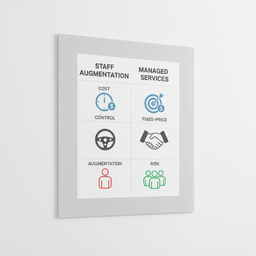
Staff augmentation: you “rent” a specific role. You manage the work, priorities, and output. You are still running the project.
-
Managed services: you buy a defined result, like “launch an MVP” or “run this platform at 99.9% uptime.” The provider runs the delivery.
If you want to see what a managed engagement can include, review Refact services before you start vendor calls. It helps you ask better questions.
Staff augmentation vs. managed services at a glance
This table covers the core differences founders feel right away.
| Factor | Staff Augmentation (Hire the person) | Managed Services (Hire the outcome) |
|---|---|---|
| Your role | You manage day-to-day tasks and priorities. | You set goals and review results. |
| Responsibility | You own delivery and quality. | Provider owns delivery against the agreement. |
| Cost model | Hourly or daily (pay for time). | Retainer or fixed scope (pay for result). |
| Team setup | Contractor joins your workflow. | Provider brings their own team and process. |
In short, staff augmentation gives you control of someone’s time. Managed services gives you a partner who is accountable for a defined outcome.
Understanding staff augmentation: filling a seat on your team
Staff augmentation is the most common option when you already have a plan and you need more capacity or a specific skill. You hire a contractor, they join your tools, and you assign work.
This can be a good fit when you have someone who can lead the build, even if that person is not you. Without clear technical leadership, contractors often end up waiting for direction.
When staff augmentation works best
Staff augmentation tends to work when the scope is already understood and the team can absorb another person quickly.
-
You have a real product lead: a CTO, tech lead, or hands-on senior engineer who can review code and set standards.
-
You need a short-term skill: mobile, data, QA, devops, or a specific integration.
-
You have a tight deadline: you need extra hands for a defined push.
The model is simple. You bring the direction, priorities, and management. The contractor brings the skill and hours.
The responsibilities you inherit with augmentation
The appeal is speed. You can add capacity fast. But it also means you take on the hard parts of delivery.
You own project planning, product decisions, acceptance criteria, QA, and release management. You also own communication. If the contractor is blocked, the project is blocked.
The rise of IT contractors shows why this model is popular. It is flexible. You can bring in specialists without a full-time hire.
Still, the founder cost is often hidden. If you spend 10 to 15 hours a week writing tickets, clarifying edge cases, reviewing output, and chasing updates, that time is part of the real price.
Understanding managed services: outsourcing the whole outcome
Managed services flips the structure. You are not hiring a role. You are hiring a result.
You define what “done” means. The provider defines how to get there and brings the team to do it. Instead of managing daily tasks, you manage the partnership.
From managing people to managing outcomes
As a founder, your job is to validate the product, talk to customers, and grow revenue. You may not want to run standups or decide how a backend should be structured.
Managed services helps when you want fewer moving parts. The provider handles staffing, delivery, and continuity. Agreements often include service levels for performance, response time, and support.
If your outcome includes building a real platform, not only a prototype, it helps to evaluate a partner’s website development services and what they include beyond writing code.
With managed services, you are buying a result. The provider is paid to deliver the outcome you agreed on, not to log more hours.
What you get in exchange for less control
You give up some day-to-day control over who does what. In return, you get less operational load and clearer accountability.
This model can be a strong fit when you need a full product team, not only one developer. It is also helpful when uptime, security, and support matter, because those responsibilities are part of the relationship, not an afterthought.
Many founders also want ongoing improvement after launch. That is where a partner’s ongoing optimization support can matter as much as the initial build.
A head-to-head comparison where the differences really matter
Definitions are easy. The real choice shows up when you look at how each model behaves under pressure. Late scope changes. A missed deadline. A contractor leaving. A production incident.
Below are the areas that tend to decide it for founders.
Cost structure: what are you really paying for?
With staff augmentation, you pay for time. The invoice is simple. But the total cost is not only the rate.
You also pay in management time, coordination, rework, and delays when requirements are unclear. If you are not ready to run delivery, you may end up paying for idle time while people wait for decisions.
With managed services, you usually pay a retainer or a fixed amount tied to a defined output. That shifts more delivery risk to the provider. It also makes budgeting easier.
Founders often compare hourly rates and stop there. A better question is, “What is the total cost to reach my goal, including my time and the cost of delays?”
If you need help thinking through budget ranges and tradeoffs, use this guide on software development cost estimation. It helps you plan around unknowns before you sign anything.
Control and responsibility: who owns the outcome?
This is the main difference that shows up in real life.
-
Staff augmentation: you control the day-to-day work. You also own delivery. If it goes wrong, you fix it.
-
Managed services: you control goals and constraints. The provider owns the delivery plan, team structure, and execution.
Ask yourself what you truly want. Do you want control, or do you want accountability? Most founders cannot maximize both.
Speed: fast hiring vs fast shipping
Staff augmentation can be fast to start. You can add a person in days or weeks.
But the person still needs context. They need access, documentation, codebase familiarity, and clear tickets. If you do not have those ready, speed-to-hire does not become speed-to-ship.
Managed services can have a longer first step because discovery and planning are part of the job. But the goal is faster delivery of the outcome. Teams that work together every day tend to move quicker once the plan is clear.
Detailed breakdown: staff augmentation vs. managed services
| Criteria | Staff Augmentation | Managed Services | What this means for you |
|---|---|---|---|
| Cost model | Hourly or daily | Retainer or fixed scope | Time-based billing can drift if scope is unclear. Outcome-based pricing is usually easier to forecast. |
| Your role | Task manager | Business owner setting goals | You spend more time in tickets and status updates vs more time with customers and strategy. |
| Risk | Mostly on you | Shared and defined in the agreement | Delays and rework are your problem vs handled within the provider’s plan and staffing. |
| Continuity | Depends on individuals | Retained by the team | If a contractor leaves, you may lose context vs the provider can replace without resetting progress. |
| Best use | Fill a clear gap | Deliver a defined product outcome | Short-term capacity boost vs long-term product delivery partner. |
A founder’s decision framework
Choosing a build model is a business decision. It helps to treat it like one.
Using simple decision-making frameworks can keep you from picking based on fear, urgency, or the lowest visible price.
Key questions to ask yourself
-
How many hours per week can I manage engineering work?
If you can commit 10 to 15 hours and you have a clear plan, augmentation can work. If your time should be on sales, partnerships, or fundraising, managed services is usually safer. -
Do I need a person or a result?
“I need a backend dev for 8 weeks” points to staff augmentation. “I need an MVP launched by a date” points to managed services. -
Do I have technical leadership?
If you do not have someone who can set architecture, review code, and make tradeoffs, consider adding leadership first. Virtual CTO services can help founders who are not ready to hire a full-time CTO.
If you keep thinking, “I need a person,” you are in augmentation mode. If you keep thinking, “I need this problem solved,” you are in managed services mode.
Scenario-based decision making
Scenario 1: You have a small tech team and a tight deadline
You have in-house engineers, but you need to ship a defined feature set this quarter.
-
Best fit: Staff augmentation.
-
Why: You already have leadership and context. Extra capacity gives you a short-term boost without changing your operating model.
Scenario 2: You are a non-technical founder building an MVP
You know the industry. You do not want to manage engineers. You need a version in market to test pricing and positioning.
-
Best fit: Managed services.
-
Why: You need a full team that can plan, design, build, and ship with clear accountability.
If you want to reduce risk before you build, a roadmap can help. This guide to fractional CTO services explains how founders can plan the work without hiring a full-time exec.
From decision to action
Once you choose a direction, your next step is simple: get clear on what “success” means. Vague goals create vague delivery, no matter the model.
Your next move if you are leaning toward staff augmentation
If you are hiring a contractor, your job is to reduce confusion and ramp-up time.
-
Define the role tightly: “Front-end dev” is vague. “React dev with payment integration experience” is clearer.
-
Set review standards: Decide how code is reviewed, tested, and approved before it ships.
-
Plan onboarding: Have access, docs, and a first task ready so the first week is productive.
Your next move if you are considering managed services
If you are hiring a team to deliver an outcome, you are preparing for a business discussion, not a coding interview.
The first conversation should be about your goals, constraints, and what “done” means. Code comes later.
-
Write down your outcome: Example: “Launch an MVP that supports onboarding, billing, and admin reporting.”
-
List constraints: Timeline, budget range, must-have integrations, and any compliance needs.
-
Bring what you have: Notes from customer calls, competitor screenshots, and early wireframes help a lot.
Frequently asked questions
Which model is more expensive over time?
It depends on how much management you need to add around the work. Staff augmentation can look cheaper by the hour, but it can cost more if you spend a lot of time managing, correcting, and re-planning.
Managed services can be a better long-term deal when you want predictable budgeting and clear ownership of delivery. The right partner prevents many expensive mistakes that happen when no one owns the full outcome.
Can I switch from one model to the other?
Yes. Many teams start with managed services to launch an MVP, then move to augmentation as they hire in-house and only need targeted specialists.
The best setups change with your stage. Early on, you usually want speed and accountability. Later, you may want more internal control.
What happens if an augmented contractor leaves?
This is a real risk. If a key person leaves mid-stream, you lose their context. Progress can pause while you hire and onboard a replacement.
In managed services, the provider should have documentation and team overlap so knowledge stays with the team, not one person. That continuity is part of what you are paying for.
If you want to stop managing technical tasks and focus on a clear product outcome, Refact can help. Book a strategy call and we will map the fastest path from idea to launch.


