


You have a startup idea you can’t stop thinking about. You’ve sketched screens, talked to a few customers, and you can already picture the first users signing up.
There’s one problem. You’re not an engineer, and hiring a full-time team feels expensive and risky.
If that’s you, you’re not alone. I’ve seen this same moment with more than 100 founders. And for many of them, the fastest path forward was to outsource software development for startups, but to do it with the right plan and the right partner.
You Have a Great Idea but Can’t Code. What Now?
Imagine we’re having coffee. You’d probably say you feel stuck. You know what the product should do, but turning it into a working app feels like a black box.
You might be worried about hiring the wrong people. Or wasting your limited budget. Or ending up with software that looks fine but doesn’t solve the real problem.
The good news is you don’t need to become a developer. You also don’t need to bet everything on an early in-house team.
If you want an option that gives you technical leadership without making a long-term hire, start by looking at Virtual CTO services. It can be a strong bridge for non-technical founders who need help making the big calls.
The Shift From Hiring to Partnering
This is why outsourcing is now a go-to strategy for many startups. It is not just about saving money. It is about building faster, with a team that has already done it before.
The global software outsourcing market is projected to reach nearly $977 billion by 2031. And with 78% of companies already using outsourcing providers, this is no longer unusual.
Here is the mindset shift that matters. You are not looking for a “vendor.” You are looking for a partner.
A real partner doesn’t just ask what to build. They help you confirm why it matters and who it is for.
A vendor takes your feature list and builds it. A partner helps you choose the smallest set of features that can win your first customers. That focus saves months of time and a lot of money.
Think Like a Business Owner First
Before you talk to any development team, get clear on the business. The tech choices come later.
Start with these questions:
- What exact problem are you solving? “Remote teams communicate better” is vague. “Product managers collect CEO feedback in one place” is clear.
- Who is the first customer? Pick a real persona. Job title, workflow, and what frustrates them today.
- What does success look like? Ten paying users, 100 weekly active users, or a single workflow completed daily. Decide now.
These answers become your north star in every planning session and sprint review. If you also want a deeper view on building an early team, our guide on how to hire developers for a startup breaks down roles, interviews, and a strong first 90 days.
Decoding Your Budget and What It Can Build
Most founders ask, “How much does it cost to build an app?” That question is fair, but it can also freeze you.
A better question is, “What can I build with the budget I have?” That turns pricing into planning.
The goal is not to build your dream roadmap. The goal is to build the smallest product that can prove your idea, collect feedback, and earn trust from real users.
Frame Your Budget and Scope
The cost to outsource development includes more than coding. You are paying for product thinking, design, project management, testing, and launch support.
A straightforward SaaS MVP often falls in the $50,000 to $80,000 range. A complex platform with integrations, multiple user roles, or heavy data work can go past $150,000.
These numbers are not meant to scare you. They set expectations and help you avoid a plan that is impossible from day one.
If you want a practical way to estimate and reduce unknowns, see our cost estimation guide. It explains the cost drivers founders miss most often.
The Trade-Offs Between Cost, Quality, and Location
Cost is a big reason companies outsource. About 70% of companies cite cost savings as their top driver, and some teams can be up to 60% cheaper than local hiring.
Rates vary by region. In broad strokes, you might see $20–$35/hr in South Asia, $120–$200/hr in North America, and $25–$45/hr in parts of Eastern Europe.
But chasing the lowest hourly rate is one of the most expensive mistakes founders make. Communication gaps and rework can wipe out the “savings” fast.
Pay for the thinking, not just the typing. A team that costs more but helps you avoid building the wrong thing is the better deal.
Pick the Right Engagement Model
The contract model you choose affects everything. It shapes flexibility, cost control, and how you work week to week.
Comparing Outsourcing Engagement Models for Startups
| Engagement Model | Best For | Pros for a Founder | Cons to Watch Out For |
|---|---|---|---|
| Fixed Price | Small projects with a fully defined scope. | Predictable cost: One agreed price upfront. | Low flexibility: Changes trigger renegotiation. Not great for an MVP. |
| Time and Materials (T&M) | MVPs and early products with changing requirements. | Flexible: You can adjust priorities based on feedback. | Requires trust: Needs strong reporting and clear weekly goals. |
| Dedicated Team | Long-term builds needing consistent capacity. | Feels in-house: A stable team that learns your product deeply. | Bigger commitment: You reserve a team’s time, even during slow weeks. |
For most startups building an MVP, Time and Materials is the best fit. It matches how startups actually work. You learn, you adjust, and you keep moving.
Find a Real Partner, Not Just a Vendor
This is the decision that can make or break your build. The wrong team can drain your budget while still leaving you without a usable product.
A vendor hears your feature list and says, “Yes, we can do that.” A partner hears the business idea and asks, “What should we build first, and what should wait?”
Listen for “Why” Before “How”
A strong team is focused on outcomes. They want to know your customer, your pricing plan, your risks, and how you will test your assumptions.
If a firm agrees with everything you say, be careful. Early product work needs debate. You want pushback when it protects your time and money.
A vendor is a set of hands. A partner is a set of brains you can trust.
If you are deciding between hiring extra hands versus outsourcing full ownership, our guide on staff augmentation vs managed product services will help you pick the right structure.
And if you need technical direction while still staying lean, fractional CTO services can help you set priorities, choose architecture, and avoid expensive early mistakes.
A Vetting Checklist to Find a True Partner
Portfolios matter, but the sales call matters more. You want to know how they think.
Questions to ask:
-
“Show me a product you built for a non-technical founder.”
Ask what decisions the founder struggled with, and how the team handled trade-offs. -
“My budget is $75,000. What’s the biggest risk you see?”
A vendor squeezes in features. A partner talks about risk, scope, and what to test first. -
“How will you help prioritize after the MVP launches?”
Look for a plan based on feedback, metrics, and iteration, not just a handoff. -
“What happens if I change my mind mid-sprint?”
You want clear steps: impact review, updated priorities, and written confirmation.
Red Flags to Watch Out For
Bad partnerships are easier to prevent than to fix. Watch for these signals:
- The “Yes” team: No pushback, no questions, no alternative ideas.
- Poor communication: Slow replies and fuzzy answers during sales usually get worse later.
- No access to the real team: You should meet the PM or tech lead, not only a salesperson.
- Hours over outcomes: If all they sell is rate and speed, expect shallow strategy.
A startup product is never really “done.” You want a team you can work with for the long haul.
Your First 90 Days: From Kickoff to First Features
Once you sign, most founders expect coding to start right away. A strong partner slows down first so you don’t waste money building the wrong thing.
The first 90 days should create clarity, then momentum. You want a plan you can explain in plain language, and a build process you can follow each week.
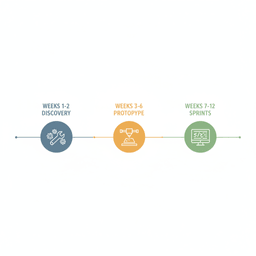
Weeks 1–2: Discovery and Strategy
This is the “get it out of your head” phase. Expect workshops that cover users, workflows, edge cases, and success metrics.
You will map user journeys. You will define what “done” means for the MVP. You will also agree on what not to build yet.
This phase can feel intense. It is also where most budget waste gets prevented.
Weeks 3–6: Wireframes and a Clickable Prototype
Next, your product becomes something you can see. The team starts with wireframes, then moves to a high-fidelity prototype.
A prototype is not code. It is a realistic model you can click through. You can show it to customers and get feedback before you spend money on development.
The prototype checkpoint is where founders save the most time. It is much cheaper to change a screen than to rewrite working software.
Weeks 7–12: Build the First Features
With a tested prototype and a clear backlog, the engineers start implementation. Most teams work in two-week sprints.
At the end of each sprint, you should see working software. Not a slide deck. Not a status update. Real progress you can touch.
Your role as a founder is not to manage code. It is to protect focus and represent the customer.
Your weekly responsibilities:
- Attend sprint demos: Give direct feedback on usability and value.
- Join a short check-in: Spend 30–60 minutes with the PM for status and decisions.
- Answer questions fast: Blocked developers burn budget. Quick decisions keep the pace.
A healthy weekly check-in covers:
- Demo: What shipped this sprint.
- Progress: Where you are versus the plan.
- Roadblocks: What is slowing things down.
- Next sprint priorities: What the team will build next.
By day 90, you usually won’t have a finished product. You should have something better. A clear process, a working relationship, and the first set of features solving a real user problem.
Common Mistakes to Avoid
After building more than 100 products with founders, I can tell you where outsourcing usually breaks down. It is rarely “bad code.” It is almost always strategy, communication, or expectations.
The “Throw It Over the Wall” Mentality
Some founders think they can write a spec, send it to a team, then check back in a few months for a finished app.
Product work does not function like that. The best results come from weekly feedback and small decisions made with context.
You don’t need to be technical, but you do need to be present. Your input is what keeps the product true to the customer.
Unchecked Scope Growth
“Can we add one more thing?” is how budgets quietly explode. Every extra feature adds edge cases, testing, and ongoing maintenance.
A good partner helps you make trade-offs. If you add something, something else has to move.
A simple change process looks like this:
- Document: Write down the request in plain language.
- Estimate: Get a time and cost impact from the team.
- Compare: Decide what gets bumped to make room.
- Confirm: Agree in writing before work starts.
Vague Success Criteria
If you cannot define success, you cannot manage the build. “Launch the app” is not a metric.
Pick measurable outcomes. Examples include:
- 100 users complete onboarding within 30 days
- 10 paying customers in 90 days
- 40% of trial users finish the core workflow in week one
Clear metrics guide what to build first and what to cut. They also keep everyone honest when trade-offs show up.
Frequently Asked Questions About Outsourcing
These are the questions founders ask most often before they sign a contract.
How Do I Protect My Intellectual Property (IP)?
Start with an NDA before you share sensitive details. Then make sure the contract states you own 100% of the IP, including source code, designs, and documentation.
Also confirm where the code lives. Your company should own the GitHub (or similar) repos and have admin access.
Be careful with any firm that avoids clear IP language or pushes a proprietary system that locks you in.
What’s the Difference Between a Freelancer, an Agency, and a Product Studio?
-
Freelancer: One person. Great for narrow tasks, risky for a full product if they disappear or get overloaded.
-
Agency: A team that executes a plan you bring. Strong if you already have clear requirements.
-
Product studio: A team that helps you decide what to build first, then designs and builds it. Best fit when you need product direction plus delivery.
How Involved Do I Need to Be as a Non-Technical Founder?
You should be involved weekly. Not in code reviews, but in decisions, priorities, and feedback.
Expect a few hours per week for demos, check-ins, and reviewing design and product choices.
When Should a Startup Bring Development In-House?
Usually after you have product-market fit and steady revenue. Many teams start building in-house around the 18–24 month mark, but it depends on growth and complexity.
A good partner helps you plan the transition. That includes documentation, handoff support, and sometimes help hiring your first engineering leader.
Next Steps
If you’re trying to outsource software development for startups, the most important step is getting clarity before you start spending serious money.
At Refact, we help founders go from idea to a buildable plan, then to a product that users can actually use and pay for. You can learn more about our product and technology services, and how we support builds that include development and integrations.
If you want an honest take on your scope, risks, and budget, book a free discovery call. In 30 minutes, you’ll leave with a clearer plan and the next best step.


