


You have a digital product idea that will not let you go.
That is the fun part. The hard part is the next question: what happens between the idea and a product people actually use and pay for?
This guide breaks down the digital product development process into clear phases. You will know what to do first, what to avoid, and what “good” looks like before you spend real money.
You Have a Great Idea. Now What?
I have had countless coffees with founders who are experts in their fields. They are lawyers, doctors, operators, and industry insiders. Then they hit the same wall when it comes to software.
It is tempting to hire a few developers and start listing features. That is also how many teams waste months and end up with the wrong product.
The problem is rarely the idea. It is the lack of a clear plan to test the problem, define the first version, and build in the right order.
If you want a quick overview of what Refact does across these phases, start with our services overview. It helps founders see what “strategy to launch” support can look like in real life.
The Questions That Keep Founders Up at Night
This is not a textbook. It is the conversation you wish you could have before you hire anyone.
We will focus on the questions that matter most:
- Is my idea any good? How do you know people will pay for it?
- What will this really cost? How do you set a budget you can trust?
- Where do I start? What is the first step that prevents expensive mistakes?
The goal is not to build a product. The goal is to build the right product for a specific group of people, with a clear path to revenue.
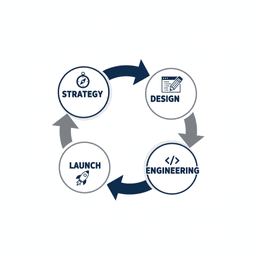
Now let’s walk through the phases.
Phase 1: Strategy, Your Product Blueprint
The choices you make before code starts will shape your budget and timeline. This first phase of the digital product development process is where you turn a vague idea into a buildable plan.
Think of it like a house. You would not start construction without drawings and a clear list of what the house must do.
Why Strategy Comes First
This is where you get clear on the basics:
- What problem are we solving?
- Who has this problem?
- How do they solve it today?
- Why would they pay for a new solution?
Skipping this step usually shows up later as scope creep, rewrites, and painful pivots.
Strategy Deliverables and Typical Timelines
| Deliverable | What It Is | Why It Matters | Typical Timeline |
|---|---|---|---|
| Problem Statement | One sentence that names the pain you solve. | Keeps the team focused on the real value. | 1 week |
| User Personas | Research-based profiles of your target users. | Stops you from building for “everyone,” which is the same as building for no one. | 1–2 weeks |
| Competitive Analysis | What alternatives exist, and where are the gaps? | Helps you position clearly and avoid copying weak patterns. | 1–2 weeks |
| MVP Feature Roadmap | A prioritized list of what to build first. | Protects your budget by limiting the first release to what matters most. | 1 week |
These are not “nice to have” documents. They are guardrails.
For example, a founder once came in with a broad idea for a wellness app. After focused strategy work, the product shifted to a tool for new mothers tracking postpartum recovery. That change cut a huge list of features that the real users did not care about.
The goal of strategy is not a perfect plan. It is a clear plan you can execute, test, and adjust.
If you want practical help with customer interviews and research, read our founder’s guide to user research. Once the blueprint is clear, design becomes faster and less risky.
Phase 2: Design, Make It Easy to Use
Strategy tells you what to build. Design shows how it will work for a real person.
This phase is not about trendy colors. It is about reducing confusion, speeding up key actions, and making the product feel simple.
Wireframes First, Then High-Fidelity Screens
Most teams should design in two steps.
Wireframes come first. These are simple layouts that show structure and flow. They help you answer questions like “What happens after signup?” and “Where does the user go next?” without wasting time on polish.
Then you move to high-fidelity mockups and an interactive prototype. This is the clickable version that looks close to the real product. It helps you test the experience before you pay for engineering time.
If you are unsure what to build first, a prototype or an MVP, this guide on MVP vs a prototype first will help you pick based on what you need to learn.
How AI Changes the Design Phase
AI tools are speeding up design iteration. The biggest win for founders is simple: you can explore more options earlier.
You can test a few variations of a core screen, review them with users, and choose a direction with less guessing.
Seeing a realistic version of your product early is one of the best ways to reduce risk. It is cheaper to change a design file than to rewrite a finished system.
If you want support that combines UX with brand and visual systems, our branding and design services page shows what that work includes.
Phase 3: Engineering, Build in Small, Visible Steps
Now the product becomes real. For many non-technical founders, this part of the digital product development process can feel mysterious.
It should not. You do not need to write code, but you do need a clear rhythm and frequent check-ins.
Agile Sprints, So You See Progress Every Two Weeks
Long builds with a “big reveal” often end in disappointment. Instead, we build in short sprints, usually two weeks.
Each sprint takes a small set of roadmap items, builds them, tests them, and shows you working software.
- You stay involved: You review progress on a schedule, not when the team feels ready.
- Feedback is fast: Small course corrections are cheaper than late rewrites.
- Priorities stay clear: You can adjust scope based on what you learn.
To keep everyone aligned, you need clear requirements. This product requirements document template is a strong starting point for founders.
Tech Stack Choices, Explained in Plain English
Founders often ask, “What technology will you use?” The honest answer is that it depends on the product.
What matters is the reason behind the choice. You want a stack that is stable, easy to hire for, and fits the features you need now.
For example:
- For content-heavy platforms, WordPress can be a strong fit because publishing tools are mature and flexible.
- For high-interaction SaaS apps, teams often choose frameworks like React and Next.js to support complex interfaces.
A good tech stack is not about trends. It is about picking tools that can support your business without forcing a rebuild next year.
If you are comparing build partners, our website development services page outlines how we approach builds, migrations, and integrations.
Proof It Works: An MVP Case Study
Want to see what “idea to MVP” looks like when done with tight scope and clear steps? The Workform AI MVP case study shows how an early concept was scoped, designed, and built into a working product that connected with real tools like Slack and Asana.
Phase 4: Launch, Then Improve What Matters
Launching feels like the finish line. In reality, it is the first real test.
Once users touch the product, you start getting answers you cannot get in planning meetings.
Switch From Building to Learning
After launch, your job is to learn fast. That means setting up a feedback loop that turns user behavior into clear next steps.
- Behavior analytics: See where users get stuck or drop off.
- User feedback: Collect support tickets, survey responses, and interview notes.
- Performance monitoring: Track speed, errors, and stability as usage grows.
This is also where you find out if your onboarding works, if your pricing makes sense, and which features create real value.
Post-Launch Iteration Is Where Revenue Grows
One of the most common patterns we see is this: the product gets signups, but retention is weak. The answer is rarely “add more features.”
More often, you need to tighten the core flow, reduce friction, and improve the parts that drive paid conversion.
A launch gives you answers, but it also gives you better questions. The best teams use those questions to guide the next release.
If you want help improving conversion, analytics, and performance after launch, our website optimization services page shows the types of work that fit this stage.
Your Next Step: Turn the Idea Into a Real Plan
At this point, you have the full map of the digital product development process. It can feel like a lot, because it is.
The good news is that you do not need to do everything at once. You need to take the next right step.
Three Questions to Answer Before You Spend on Code
- What problem am I really solving? Write it in one sentence.
- Who has that problem? Name a specific person, not a broad audience.
- What is the smallest version that solves it? That is your true MVP.
The path from idea to product is not one giant jump. It is a series of small steps that replace uncertainty with clarity.
If you want to talk it through, start with Refact’s main site at Refact, then reach out using our contact page. We will help you leave the first call with a clear set of next actions.
Frequently Asked Questions From Founders
These are the questions that come up in almost every early call. They are also where many founders lose time if they do not get straight answers.
How Much Does It Cost to Build an MVP?
It depends on complexity, but here is a useful range. For a well-defined SaaS or platform MVP, many founders should plan for $50,000 to $150,000.
The biggest cost driver is not the number of features. It is the complexity of roles, permissions, workflows, and edge cases.
The best way to control cost is to define scope early, then build only what you need to learn and earn.
How Long Does the Process Take From Idea to Launch?
A common timeline is 4 to 7 months from first conversation to launch. Faster is possible, but speed only helps if you are building the right thing.
- Strategy and discovery: 3 to 4 weeks
- UX and UI design: 4 to 6 weeks
- MVP development: 3 to 5 months
With sprint-based engineering, you should see working progress within weeks, not at the end.
What Is My Role as a Non-Technical Founder?
Your role is to own the “what” and the “why.” You bring the market knowledge, user insight, and business goals.
- You know the problem: what hurts, and why it matters.
- You know the user: what they do today, and what they will pay for.
Your time is most important in strategy and early design. After that, it often becomes a few hours every couple of weeks for reviews and decision-making.
At Refact, we build products with founders. If you are ready to turn your idea into a plan you can trust, let’s talk.


