


You wake up one day, pull up your website, and feel that stomach drop. It looks old. It’s hard to update. It does not match the business you run today.
Your next thought is often, “I should write a website design RFP.” It sounds responsible. It also sounds like a lot of work. And for many founders, it is.
This article will help you decide if an RFP is worth your time, or if a few focused conversations will get you to a better outcome faster.
If you are already sure you need a rebuild, start with our website redesign services guide to see what a strong redesign process looks like.
Is a formal RFP the right move?
I’ve watched founders spend weeks writing the “perfect” RFP, then get back proposals that miss the real problem. The doc looks tidy, but it can hide the messy truth: most website projects are not fully defined at the start.
An RFP can also slow you down. You write it. Agencies ask questions. You answer them. Then you compare proposals that look nothing alike. Before you know it, you burned a month and still have not started.
There is another issue people do not talk about enough. Many strong studios skip rigid RFPs. They want a real working session, not a 30-page checklist.
The goal is not a flawless document. The goal is the right partner and a site that drives results. Sometimes an RFP helps. Sometimes it blocks the very team you want.
When an RFP actually makes sense
An RFP is not “bad.” It is just a tool. It works best when the scope is fixed and the buying process is strict.
Consider an RFP if any of these are true:
- You have procurement rules. If your company requires competitive bids over a certain amount, you may not have a choice.
- The project is huge and tightly defined. Think hundreds of pages, hard technical requirements, and lots of stakeholders.
- You need a strict comparison. An RFP can force each vendor to answer the same set of questions, which can help you sort proposals faster.
RFP vs direct engagement: which path fits your project?
If you want a site that can change as you learn, direct engagement is often the better path. You can still be structured without running a full RFP process.
Here is the simplest way to think about it:
- RFP: Good for fixed scope, fixed rules, and formal bidding.
- Direct engagement: Good for speed, strategy, and collaboration.
| Consideration | Traditional RFP Process | Direct Engagement with a Product Studio |
|---|---|---|
| Best For | Large projects with strict rules and a fixed scope. | Startups and growing businesses that need strategy and iteration. |
| Process | Document-driven. Often focused on checklists and pricing. | Conversation-based. Focused on outcomes and tradeoffs. |
| Timeline | Slow. Often adds 1-3 months before work starts. | Fast. You can move to a strategy phase in days. |
| Flexibility | Low. Changes tend to require formal change orders. | High. The plan can adjust as you learn more. |
| Outcome | A vendor delivers a defined list of features. | A partner helps you choose the right features to hit goals. |
If you want the “partner” path but still need structure, a short written brief plus a working session often beats a full RFP.
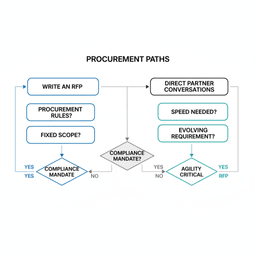
When to skip the RFP and start conversations
For most founders, the best first step is a call. Not a document. The reason is simple: early clarity usually comes from questions, not from writing.
Skip the RFP and talk to partners if:
- You want a strategic partner, not a vendor. You want someone who will push back and help set priorities.
- You care about outcomes more than features. You know the goal, like “more qualified leads,” but you are open on how to get there.
- You need to move fast. An RFP can add months before a build even starts.
If that sounds like you, our startup website development guide will help you get your thinking straight before you talk to agencies.
Define what success looks like before you write requirements
Most weak RFPs start with a feature list. “New design.” “Better CMS.” “Faster site.” That is not a plan. It is a wish list.
Start with the business problem. What is the website failing to do today? What will change after launch?
Think of it like this: asking for “a faster car” is vague. Saying “I need to get two kids to school through city traffic every day, safely and on time” is a real problem to solve.
Turn vague goals into measurable targets
Clear targets make better proposals. They also help you judge if the project worked.
Examples of useful website goals:
- Lead generation: Increase qualified leads by 30% this year.
- Support load: Reduce inbound support tickets by 20% with a help center people can use.
- Revenue: Launch a subscription offer and hit 500 paid members in the first quarter.
- Brand shift: Reposition to attract enterprise buyers, measured by a 25% lift in demo requests from large companies.
When you share goals like these, good agencies stop guessing and start making real recommendations.
What this looks like in real projects
A media company might ask for “a faster, mobile-friendly site.” That is a common request.
But the real issue is often deeper. Editors might be fighting a clunky CMS. Mobile load time might be hurting ad revenue. Those are the problems that should drive the work.
Clear objectives might look like:
- Cut the time it takes an editor to publish an article by 50%.
- Get “Good” Core Web Vitals on 90% of article pages to improve viewability and revenue.
If you want to see how those kinds of goals show up in real delivery, review our publisher redesign case study.
Your RFP should not be a list of demands. It should invite a partner to solve a business problem. The clearer the problem, the stronger the proposals.
Translate goals into clear requirements
This is the heart of any website design RFP. You turn goals into requirements that a team can estimate and build.
Many founders think they need a technical spec. You usually do not. Plain English works fine if it is specific.
For example, instead of guessing server details, describe real traffic. You can say, “We get 50,000 unique visitors a month, with spikes up to 20,000 in one day during launches. Pages should load in under two seconds.” That is useful.
Write down CMS needs in workflow terms
The CMS is where your team will live. If the CMS is painful, your marketing slows down, and your site gets stale.
Describe what your team needs to do:
- Who publishes? One person, or a team with writers and editors?
- How does approval work? Do you need roles like contributor, editor, admin?
- How often do you publish? Do you need scheduling and drafts?
- What content types exist? Blog posts only, or also landing pages, video, podcasts, tools?
If you can answer those questions, a good team can recommend the right setup and avoid surprises later.
Make analytics and UX review part of the plan
One big shift in website redesign work is that teams are expected to start with data. That means reviewing analytics, top pages, conversion paths, and user behavior before design starts.
This is also where ongoing improvement matters. If your goal is conversion lift, speed, or SEO stability, consider support after launch. Our website optimization services page outlines what that ongoing work can look like.
Describe user experience and functionality using simple journeys
Instead of listing “features,” write down what users need to do.
- E-commerce: “Customers can filter by size, color, and price. Checkout should not require an account and should finish in three steps or less.”
- Membership: “Members log in to access content, manage subscriptions, and update payment details in a dashboard.”
- Publishing: “Readers can search all archives. Article pages should support infinite scroll for related stories.”
If you want a clean format for documenting these needs, use a simple PRD template and keep it short.
Set a realistic budget and timeline
Founders often hide budget because they fear price anchoring. In practice, hiding it creates noisy proposals. Some will be far too cheap. Some will be far too expensive. Few will match reality.
A budget range helps the right partners propose the best plan inside your limits.
Why a budget range helps you get better proposals
- It filters poor fits. You will not waste time with teams outside your range.
- It improves solution quality. Teams can make smart tradeoffs instead of guessing.
- It shows you are ready. Budget clarity signals internal buy-in.
Hiding your budget rarely gets you a better price. It usually gets you proposals that are hard to compare and easy to ignore.
What a website redesign can cost
Pricing varies by scope and risk. A small marketing site refresh costs far less than a complex migration with custom tooling and integrations.
Here are rough ranges many teams will recognize:
- Small redesign ($20k–$50k): Smaller marketing site, refreshed design, improved UX, light custom work.
- Growing business / SaaS ($50k–$150k): Strategy phase, custom design, CMS setup, core integrations.
- Enterprise / complex ($150k+): Deep integrations, heavy migration, large scale content, complex workflows.
If you are not sure which range you fit, review our website development services page to see the kinds of work that push a project up or down in cost.
A realistic timeline, phase by phase
Good websites take time because there are many moving parts. Planning phases helps your team stay calm and aligned.
- Vendor selection (2–4 weeks): RFP or interviews, proposal review, final choice.
- Strategy and discovery (3–6 weeks): Goals, analytics, content review, user flows, requirements.
- UI/UX design (4–8 weeks): Wireframes, key page designs, revisions, handoff.
- Development (8–16+ weeks): Build, CMS setup, integrations, content migration.
- Testing and launch (2–4 weeks): QA, performance checks, redirects, go-live plan.
Most solid projects land in the 4–9 month range. For more detail on timelines and why estimates often fail, read our guide on estimating software development time.
Choose a partner, not just the lowest bid
Once proposals arrive, it is tempting to choose the cheapest option or the prettiest deck. Pause before you do.
A website rebuild is rarely “one and done.” You will need changes after launch. You will find new pages to add. Your product will change. Your message will change.
You want a team you trust, not a team you can “buy.”
How to spot a weak proposal fast
The biggest red flag is a copy-paste proposal. You can tell when a team did not listen.
Strong proposals tend to:
- Use your goals. They mention your actual targets, not generic “increase conversions.”
- Ask smart questions. They point out unknowns and risks, and suggest ways to reduce them.
- Suggest tradeoffs. They explain what they would do first, and what can wait.
What to compare across teams
- Process. Is there a clear plan for strategy, design, build, and launch?
- Team. Who will do the work day to day, and have they solved this type of problem before?
- Proof. Case studies and references matter, but so does evidence of long relationships.
The goal is not the cheapest bid or the flashiest portfolio. It is the team you can work with when the scope changes and the stakes get real.
What to do next
Now for the simplest next step. Decide which track you are on: formal RFP, or direct partner search.
If you are going to run an RFP
- Write goals first. Define what “success” means in numbers.
- Align on budget. Agree on a range before you send anything out.
- Work backward from launch. Add time for discovery, design, build, QA, and redirects.
If you want a direct partnership instead
- Pick 2–3 studios. Look for teams that show clear thinking and real proof.
- Book short calls. You are testing fit, not buying in the first meeting.
- Show up with context. Bring goals, constraints, and what is not working today.
Either way, the point is the same. You are trying to build a site that does its job and keeps doing it as you grow.
If you would rather talk through scope and options than spend weeks writing an RFP, talk with Refact.
Common questions about the website RFP process
How long should my RFP be?
Most solid RFPs are 10–20 pages. Clear beats long.
If it turns into a novel, you will not finish it, and strong agencies may not read it closely.
Should I include website analytics in the RFP?
Yes. Share high-level metrics like traffic, top pages, bounce rates, and conversion rates.
This helps agencies respond to reality, not guesses.
Analytics turn “build us a new site” into “help us fix these specific issues.” That is where strong work starts.
How many vendors should I send it to?
Do not send it to 12 agencies. You will burn out.
Shortlist 3–5 teams whose work fits your project, then send it to only those teams.


