


You have an idea. You can picture the product. Now you’re stuck on the next step. If you’re a non-technical founder, this is where most people freeze.
This guide shows you how to turn idea into product without wasting months (or your savings) on the wrong build. You don’t need to code. You need a simple plan that forces real learning before you pay for development.
The real risk is not your idea. The risk is building the wrong thing. That is how great concepts turn into expensive side projects.
The cost of jumping ahead
The most common mistake is hiring developers before you know if the idea has demand. It feels productive, but it is a big gamble.
About 90% of startups fail, and many fail because they build something people do not want or they run out of cash. When scope is unclear, founders pay for features that never get used.
Building a product without validation is like buying a non-refundable plane ticket before you confirm you can travel. You might love the destination, but you may not be able to get there.
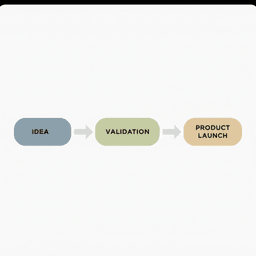
The simple flow is: idea, validation, then build and launch. The build is the result of learning, not the first step.
If you want a deeper look at the full process, see our guide on digital product development services and what to expect at each stage.
Find your first believers before building anything
Before you sketch screens or pick a tech stack, you need proof that real people care. This is the validation phase, and it is where you earn the right to build.
Do not ask friends and family if they like the idea. They will be polite. You need feedback from people who feel the problem in their day-to-day work.
Who are you building for?
Start by getting specific. “Small businesses” is not a target. Pick an industry, role, and situation.
Write a tight profile:
- Job title and experience level
- What they do each week that is frustrating or slow
- What they tried already, and why it failed
Then go find them where they already spend time:
- LinkedIn communities for their job or niche
- Forums like Reddit and industry groups
- Meetups and professional events
A good goal is 15 to 20 conversations. It sounds like a lot. It is still cheaper than guessing and paying for a build you have to redo.
Learn to listen, not sell
On these calls, do not pitch your solution. Ask about their current workflow and recent pain.
Helpful questions:
- “Walk me through the last time you did this.”
- “What was the hardest part?”
- “What did it cost you in time, money, or stress?”
- “What have you tried to fix it?”
The goal is not to validate your solution. The goal is to validate the problem. If the problem is not painful, the product will not matter.
If you want a step-by-step script and recruiting tips, use our founder’s guide to user research.
The smoke test
After interviews, run a simple “smoke test.” This checks if people will take a small action that signals real interest.
Create a basic landing page. Keep it simple:
- Clear headline: name the problem you solve
- Short promise: explain the benefit in plain language
- One call to action: email signup for early access
Signups are your first clean data point. If nobody opts in after you show it to the right audience, that is a signal to adjust the problem, the message, or the target user.
Define what to build and why
Once people confirm the problem is real, you will feel a rush of feature ideas. This is also when founders overspend.
Shipping a focused first version beats chasing the “perfect” product. Clarity keeps budget under control and makes your launch faster.
From big vision to MVP
Your next step is defining the Minimum Viable Product (MVP). An MVP is not a cheap or sloppy product. It is the smallest version that solves the core problem well for your first users.
Think of it like this: your MVP should do one job really well. Extra features can wait until you have real users and real data.
A strong MVP feels like a sharp tool. It does one main job well enough that the right user wants it again tomorrow.
If you are unsure whether you should prototype first or build an MVP first, this mvp vs prototype breakdown can help you decide.
Map the core user journey
A simple method that works is mapping the steps a user takes from start to finish. This turns your product into a clear flow you can build.
Example: an invoicing tool for freelance writers.
- Create client: add a client’s details
- Create invoice: make an invoice
- Send invoice: email it
- Track payment: mark it paid
That is the backbone of the MVP. Features like dashboards, time tracking, and project management may be useful later, but they are not required to prove demand.
The one-page strategy document
Capture your MVP plan in a single page. This is not a long business plan. It is a shared reference that keeps you, design, and engineering aligned.
Your one-pager should answer:
- The problem: what pain you solve
- The solution: what the MVP does, and what it does not do
- The user: your first ideal user profile
- Success metrics: how you will measure progress
To make this easier, use our free product requirements document template. It helps reduce confusion and prevents scope growth during the build.
Design it before you code it
After validation and MVP scope, make the product feel real. You still do not need production code yet.
Many founders think design is just colors and fonts. That is brand identity. Product design is mostly about how the product works, step by step.
Start with wireframes, then mockups
Begin with wireframes. These are basic layouts that show where information and actions go. They are simple on purpose, so you can focus on flow.
Next, create high-fidelity mockups. These are polished screens that show what the product will look like when built. They make the idea concrete and easier to test.
A beautiful screen is not enough. If users cannot find the next step, the product fails.
Test a clickable prototype
Link your screens into a clickable prototype. This lets users “use” the product without any backend, database, or real logic.
Then test it with the same people you interviewed. Give tasks and watch what happens:
- Can they complete the main workflow?
- Where do they hesitate?
- What do they misunderstand?
Fixing a prototype takes hours. Fixing the same issues after code can take weeks and cost far more.

Choose your path to build and launch
You now have three strong assets: proof the problem is real, a clear MVP scope, and a tested prototype. Next is choosing how to build.
There is no one right answer. The right choice depends on your budget, timeline, and how much day-to-day management you can take on.
Three common build options
- Freelancers: can work well for small, well-defined tasks. For a full MVP, you may end up managing multiple people and dealing with gaps in ownership.
- Technical co-founder: can be a great long-term partner. The hard part is finding the right fit and building trust. Rushing this choice often ends badly.
- Product studio or agency team: you get a full team that already works together. This is often faster and reduces hiring risk, but it can cost more upfront.
The real decision is not just who writes code. It is who helps you make good calls when trade-offs show up.
If you want to see what a structured build partnership looks like, our website development services page explains how we plan, build, and ship work in stages.
Understand tech choices at a strategic level
You do not need to code to ask smart questions. Your job is to connect tech choices to product goals.
If your product is mostly content with basic membership features, a mature CMS like WordPress can be a strong fit. If you need custom workflows, dashboards, and complex interactions, a custom app build may be better.
In either case, the plan should come first. Then you pick tools that match the plan.
For a clear overview of the build process from planning through release, read our guide on the software development life cycle.
Launch is the start of the next phase
Launching is not the finish line. It is when your assumptions meet reality.
Post-launch work is where you measure what users do, learn what to change, and decide what to build next. If you want ongoing help improving conversion, speed, and tracking, see our website optimization services.
Your top questions about building a product
At this point, most founders want numbers and timelines. Let’s cover the questions that come up most often.
How much does it cost to build the first version?
Cost depends on MVP scope and complexity. For a straightforward SaaS with accounts, a dashboard, and one main workflow, founders often land in the $50,000 to $90,000 range for strategy, design, and development.
If your product includes complex data work, custom algorithms, or advanced AI features, budgets can be $150,000+. The fastest way to control cost is to keep the MVP tight.
For a more detailed budget breakdown and common cost drivers, use our mvp development cost guide.
How long does it take to go from idea to launch?
For a well-scoped MVP, a typical timeline is 4 to 6 months. Complexity and decision speed can move it up or down.
A common structure looks like this:
- Discovery and validation (1 to 2 months): interviews and smoke tests
- Strategy and design (4 to 6 weeks): MVP scope, user journeys, prototype
- Development (3 to 4 months): build, QA, and release
Most delays come from unclear scope, not slow coding. If the plan is fuzzy, new ideas keep getting added mid-build.
What if someone steals my idea?
This fear is normal, but it is rarely the real risk. Execution is what wins. The bigger risk is building in private and learning too late that users do not care.
If you need peace of mind for detailed talks, you can use an NDA. Still, do not hide from customer conversations. That is where the product gets better.
What happens after launch?
After launch, you enter a loop of building, measuring, and improving. This is where products become businesses.
Track what matters:
- Engagement: are users completing the core workflow?
- Conversion: are signups turning into active use or paid plans?
- Feedback: what users say in support, surveys, and calls
Then you decide what to improve next. Some features will grow. Others will get cut. That is normal.
Conclusion: move from idea to real proof
If you remember one thing, make it this: your first job is learning, not building. Talk to users. Run a smoke test. Define a tight MVP. Prototype it. Then build with a clear plan.
If you want help with brand, product design, and a build plan that fits your budget, see our branding and design services.
Ready to talk through your idea and next steps? Talk with our team and we’ll help you map a clear path from concept to launch.


