


Your product can be brilliant and still fail in the first 30 seconds. If pages stall, buttons lag, or checkout hangs, people leave. That’s why testing response time belongs on every founder’s launch checklist, not just the engineering backlog.
Speed is not a vanity metric. It shapes trust, sign-ups, and revenue. If your app feels slow, it feels broken.
Is your new product already too slow for its first users?
You have a strong SaaS idea. You are planning features, onboarding, and launch. Then the quiet question shows up, what if it is too slow?
That is not a small technical issue. It is a business risk. People decide fast, and they bounce even faster.
I have helped build 100+ products for founders. I have seen great ideas lose momentum because the product felt sluggish on day one. A slow app looks untrusted and unfinished, even when the code is “correct.”
Testing response time is part of protecting conversion and retention. It is also part of protecting your marketing spend.
The real cost of a slow launch
The cost of slowness adds up quickly. Across the globe, slow sites cost retailers $2.6 billion in lost sales each year. SaaS teams feel the same pain through lower sign-ups and abandoned onboarding.
A one-second delay in mobile load times can cut conversions by up to 20%.
Mobile is where the gap gets painful. Many users expect a page in two seconds or less, yet average mobile sites take much longer. If you want the broader business context, this piece on why your technology is holding back business growth connects performance problems to stalled growth.
If you run a content-heavy site, speed can also hit SEO after Google updates. This is one reason the SingularityHub case study is worth skimming, it shows what happens when mobile performance and UX get fixed together.
Set the standard before you build
The easiest time to keep a product fast is before it grows. You need a clear definition of “fast enough” for your users and your core flows.
- Pick critical user journeys: registration, onboarding, dashboard load, checkout, search, or report generation.
- Set performance budgets: hard limits like “dashboard loads in under 2 seconds” or “search API responds in under 500ms.”
- Choose a stack that can keep up: your architecture choices show up later as latency, hosting cost, and incident risk.
If you want a simple way to find obvious problems early, this founder’s guide to a website audit is a solid starting point. It helps you spot issues that quietly drain conversions.
Fixing speed after a failed launch is expensive. It often means rewrites, hosting changes, and lost time in the market. If you want more data to back this up, these page load time statistics show how strongly speed ties to bounce rate and revenue.
The performance metrics that actually matter
Performance discussions can sound like jargon. Latency, p99, TTFB. The terms are real, but you only need a few to run a clear conversation with your team.
These metrics help you move from “it feels slow” to “this specific step is slow, and it is hurting sign-ups.”
Why average response time lies
Average response time is easy to report and easy to misuse. It hides the experience of the people who had the worst wait.
Example, three users hit your site. Two see a 1-second response. One waits 7 seconds. The average is 3 seconds, which can look fine on a dashboard.
But one out of three users just had a terrible first impression. That is why averages are not good goals.
Use percentiles to protect your unluckiest users
Percentiles show the “tail” of slow experiences. They tell you how bad it gets for the people who wait the longest.
- p95: 95% of requests were faster than this number. The slowest 5% were worse.
- p99: 99% of requests were faster than this number. The slowest 1% were worse.
If you improve the slowest 5%, most users will feel the product is consistently fast. That consistency builds trust.
This data lines up with real behavior, especially on mobile. Nearly half of users expect pages in under two seconds, and conversion drops fast when that expectation is missed.
TTFB is your server’s first response
Time to First Byte (TTFB) measures how long the browser waits before it gets the first byte back from your server.
High TTFB often points to backend issues. Common causes include slow database queries, slow third-party APIs, heavy server work, or servers that are under-sized.
Google often suggests keeping TTFB under 800ms. Many mobile sites are well above that. When TTFB is slow, the user waits before anything even starts to render.
Key response time metrics translated
| Metric | What it measures | Why it matters |
|---|---|---|
| Average response time | The mathematical average of all request times. | Often hides the worst user experiences. |
| p95 / p99 | The response time at the slow end of the distribution. | Shows consistency. Helps you reduce rage-clicks and drop-offs. |
| TTFB | Time until the first byte comes back from the server. | A strong signal of backend health and server delays. |
If you want more benchmarks, this collection of website speed statistics is useful when you need numbers for stakeholders.
When you track percentiles and TTFB, you stop guessing. You can set targets that map to a better user experience.
How to start testing your product’s speed
You do not need to be a performance engineer to get value from basic tests. As a founder, you can run quick checks, spot trends, and bring clear questions to your team.
Start with simple tools. Then build up to testing the flows that matter most to revenue and retention.
Get a baseline with browser-based tools
Baseline tests act like a first-time visitor. They give you a report card, plus a list of fixes you can hand to your team.
- Google PageSpeed Insights: measures Core Web Vitals and gives a simple score. Use it as a starting point, not a final grade. (PageSpeed Insights)
- GTmetrix: great for waterfall charts and detailed breakdowns. (GTmetrix)
Do not chase a perfect 100. Look for obvious wins, oversized images, blocking scripts, and third-party tools that slow everything down.
Know the main test types
Most performance testing falls into two buckets. They answer different questions.
Synthetic testing is a controlled, repeatable test. Think of it as a robot visiting your site from a chosen location and device type. It is great for consistent comparisons over time.
Synthetic tests answer, “How fast is the product in a clean, controlled setup?”
Load testing simulates many users at once. It helps you see what happens during a launch, a big newsletter drop, or a paid campaign spike.
Load tests tell you if p95 and p99 blow up under real pressure. They can also show if you have a database, caching, or queueing problem waiting to happen.
Test more than the homepage
Your homepage matters, but it is not where users spend most of their time. Test the actions that match your business model.
- Login and first post-login screen.
- Main dashboard load.
- Your most-used feature, like “run report,” “save project,” or “export.”
You can do quick checks with your browser dev tools. Open the Network tab, run a key action, and look for slow requests. Anything over a second is worth a closer look, especially for API calls.
This is also part of usability. Slow steps feel confusing, even when the UI is correct. This web usability testing guide shows how to connect speed issues to user friction.
Turn test results into clear decisions
After testing, you will have charts and scores. The goal is not to collect more numbers. The goal is to decide what to fix first.
Start by finding the bottleneck. A high p95 confirms users are waiting. It does not tell you why.
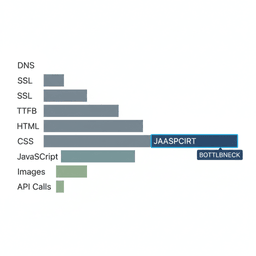
Common causes include heavy images, blocking JavaScript, slow API calls, slow database queries, or too many third-party scripts. Each one has a different fix.
Read the story your data is telling
Waterfall charts are one of the fastest ways to see what is happening. You can find them in GTmetrix and in browser tools.
If you see a long TTFB bar, the issue is likely backend. If you see many third-party scripts loading one after another, you may be paying a “tax” for every tool you added.
This is where founders can help a lot. Instead of “the page is slow,” you can say, “the user history request takes 1.2 seconds, and it blocks the dashboard.” That is a real task your team can tackle.
A performance report is not a grade. It is a map that points to the biggest sources of waiting.
One of the most common backend causes is database work that does not scale. If you suspect that, this guide on database indexing strategy explains what to check first.
Use a performance budget to prevent slow creep
A performance budget is a simple rule set. It sets non-negotiable limits for speed on your key flows.
- Set limits early: “Search API under 500ms” or “dashboard usable in under 2.5 seconds.”
- Make trade-offs visible: if a new script breaks the budget, the team must decide if it is worth it.
- Stop slow creep: most products get slow one small change at a time.
This is not about perfection. It is about staying fast while you ship.
When the underlying build is fighting you, the fix is sometimes bigger than “remove a script.” If your site is held back by old decisions, it may be time to address website redesign bottlenecks so performance is not a constant battle.
Make speed a habit, not a panic drill
Testing once before launch is not enough. Apps change every week. Each release can add a little latency, and that adds up over months.
The goal is to catch slowdowns when they are small. That means building performance checks into your normal workflow.
Build performance checks into shipping
Set up tests that run automatically when code changes. That way, speed regressions get flagged before they hit real users.
In many teams, this lives in a CI/CD pipeline. Every change runs through the same checks, including performance thresholds tied to your budget.
- A developer ships a feature.
- Automated checks run.
- If response times get worse, the build is flagged.
- The team fixes it while the change is still fresh.
This approach also ties into ongoing site health work. If you need help setting up tracking, budgets, and fixes, Refact’s website optimization services cover speed, UX, and conversion improvements as a repeatable process.
Choose the right test for the job
Not every test needs to be heavy. The smarter approach is to layer tests.
| Test type | What it’s for | When to use it | Example tool |
|---|---|---|---|
| Unit/component benchmark | Checks one function or component in isolation. | On every commit. Fast feedback. | pytest-benchmark |
| Synthetic journey test | Runs a full user flow in a controlled setup. | After builds, on staging. | Playwright |
| Load test | Simulates many users to test scalability. | Before big launches and on a schedule. | k6 |
| Production monitoring | Tracks real user experiences on the live app. | All the time in production. | Datadog |
If you are still making core stack choices, this is also where build decisions matter. Good tooling, caching, and architecture choices reduce the amount of “performance tax” you pay later. If you need hands-on help, website development support is often the difference between a product that stays fast and one that fights latency every sprint.
Your next steps for a faster product
You now know what to measure, how to test, and how to turn results into action. The next step is to do a small set of moves that create clarity fast.
Define your starting line
Run a baseline test on your product, or even on a close competitor. Use PageSpeed Insights or GTmetrix and save the report.
Then pick three key user actions and measure them:
- Login and dashboard load
- Your main search or core feature
- A money step, like checkout, upgrade, or request demo
Set an initial performance budget for each. Keep it simple. You can tighten targets over time as you learn.
If you want a checklist of fixes teams usually tackle first, this list of performance improvement techniques is a useful reference.
Small steps beat endless planning. A baseline and three tracked flows can change how your team ships next week.
Frequently asked questions
How often should I be testing response time?
Think in two rhythms. First, continuous checks on key flows, run automatically as code changes. Second, bigger load tests on a schedule and before major launches.
That mix helps you catch small slowdowns early, and also prevents “surprise” failures during spikes.
Can a non-technical founder really do this?
Yes. Tools like PageSpeed Insights and GTmetrix only need a URL. Your job is to spot risk, ask clear questions, and protect the user experience.
You do not need to find the exact line of code. You just need enough evidence to make speed a priority.
A founder does not need to fix code to lead on speed. You only need to set the bar and keep it visible.
What is a realistic goal for a new MVP?
Skip the perfect score. For most MVPs, a good starting target is TTFB under 800ms and LCP under 2.5 seconds on mobile for key pages and flows.
Then focus on consistency. Users forgive a lot, but they do not forgive waiting on every click.
Build fast from day one. Refact helps founders ship products that feel quick, stay stable under traffic, and support growth. If you want help setting budgets, choosing the right approach, and fixing what is slowing you down, talk to Refact.


