


You can have a great app idea and still lose months, or a lot of money, by building it in the wrong order. Most founders do not fail because they lack effort. They fail because they start building before they have a clear plan.
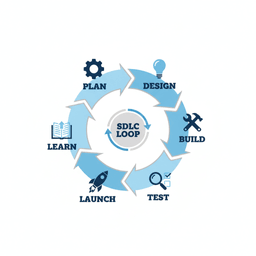
The map that keeps you focused is the Software Development Life Cycle (SDLC). This guide explains software development life cycle best practices in plain English, so you can plan, build, and launch without guessing.
If you are trying to set a realistic schedule, start with our guide to estimate your build timeline. Getting the timeline right early helps every other decision.
Why building your product feels so hard
Turning a vision into working software can feel confusing fast. You have an outcome in your head, but the steps to get there are not obvious. That gap is where budgets blow up and timelines slip.
It is like baking a layered cake without a recipe. You might know the ingredients, but not the order, the amounts, or the temperature. Software works the same way. Clear steps beat hope.
Without a process, these problems show up early:
- Blown budgets: Costs grow because the scope was never locked.
- Wasted time: Teams build the wrong thing, then rebuild it.
- A weak launch: The product ships, but users do not care.
Over the past decade, we have built more than 100 products. The pattern is consistent. When founders follow a disciplined SDLC, the work becomes more predictable and less stressful. It does not kill creativity. It gives creativity guardrails.
The point of a good process is clarity. You should spend your time making decisions, not fixing avoidable fires.
A structured SDLC gives you a repeatable way to go from strategy to launch, then improve based on real feedback. That is how you protect your time and your money.
The seven stages of your product’s journey
SDLC sounds technical, but the idea is simple. Software moves through a set of stages. Each stage answers a different set of questions. When you skip a stage, you pay for it later.
Think about building a house. You would not tell a crew, “Build something nice,” and walk away. You would define goals, draw plans, choose materials, build, inspect, then maintain it. Software follows the same logic.
A simple process also helps with the emotional side of building. Many founders go from excitement, to chaos, to relief once the steps are clear.
The seven SDLC stages and their purpose
| Stage | What happens | Founder’s goal |
|---|---|---|
| 1. Strategy | Define the problem, the user, and the business goal. | Confirm the product is worth building. |
| 2. Requirements | Turn the vision into features, flows, and rules. | Create a clear build plan with boundaries. |
| 3. Design | Create UX, UI, and system structure. | Make it easy to use and realistic to build. |
| 4. Development | Write code and connect systems. | Track progress and protect scope. |
| 5. Testing | Find bugs, security gaps, and performance issues. | Ship something stable and safe. |
| 6. Deployment | Release the product to real users. | Launch smoothly and capture feedback. |
| 7. Maintenance | Fix issues, improve features, keep it secure. | Keep users happy and the product healthy. |
From blueprint to live product
These seven stages usually group into three phases. Most founder problems come from rushing into phase two before phase one is done.
Phase 1: Planning and definition (Strategy, Requirements)
This is where you prove the “why.” Strategy defines the problem and the user. Requirements define the “what,” in enough detail that a team can build it without guessing.
Skipping requirements is the fastest path to scope creep. It also creates expensive rework. Fixing a mistake after development can cost far more than fixing it while it is still a sentence in a doc.
Phase 2: Building and creating (Design, Development)
Design is not just aesthetics. It is how the product works, screen by screen, and how the system should be put together. Development is where the team builds what the plan describes.
If you need a partner for the build stage, Refact’s Website Development Services cover architecture, integrations, and delivery, with a clear process and predictable checkpoints.
Phase 3: Launch and evolution (Testing, Deployment, Maintenance)
Testing is the product inspection. Deployment is the release. Maintenance is the ongoing work that keeps everything stable, secure, and improving.
Many founders underestimate this phase. It is also where growth happens. A good partner stays with you post-launch. That is one reason our average client relationship lasts over 2+ years.
You do not need to be an engineer to lead SDLC well. You need a clear plan, clear checkpoints, and the confidence to ask the right questions.
If you want a second perspective on the stages from idea to launch, this founder’s guide to product development stages is a helpful read.
Best practices that prevent project failure
Knowing the stages is not enough. The best results come from how you run each stage. After building more than 100 products, a few practices show up again and again on successful launches.
Use Agile, ship in small pieces
Agile sounds like jargon, but it is simple. You build in short cycles called sprints. Most teams run two-week sprints.
At the end of each sprint, you should see working software. Not a slide deck. Not promises. Something you can click, review, and react to.
It is like reviewing a house in steps. You check the foundation, then the framing, then the electrical. You catch issues early, when fixes are still cheap.
This reduces the risk of spending months only to learn the product is wrong. Teams that work this way also tend to deliver faster than rigid, long-plan approaches. For more on modern SDLC practices, see this analysis of SDLC best practices.
Prioritize hard, define scope, protect it
The biggest threat to budget and timeline is scope creep. It starts small. “Just add one more thing.” Then the product becomes a moving target.
Protecting scope does not mean you never build extra features. It means version one has a clear boundary.
- Stick to the core problem: If a feature does not solve the main pain, it goes to later.
- Write user stories: “As a new user, I want to sign up with Google so I can start fast.”
- Keep one source of truth: A PRD that everyone uses to confirm what is in and out.
If you need a PRD that a dev team can actually build from, use our Product Requirements Document template. It is written for founders, not product teams inside big companies.
Keep communication frequent and visible
Founders should never feel blind. If you do, the process is broken.
- Daily stand-ups: A quick 15-minute sync on progress and blockers.
- Shared project board: You can see “To Do,” “In Progress,” and “Done.”
- Sprint demos: The team shows working software at the end of each sprint.
This is not micromanagement. It is basic visibility. You cannot make good decisions without current information.
Building your first MVP the right way
Many founders think an MVP is a low-quality version of their dream product. That leads to a weak launch and confusing feedback.
A real MVP is the smallest product that solves one core problem for one target user. It should still be reliable. “Minimum” does not mean “messy.” It means focused.
Getting there starts with strategy and requirements. You define the problem, choose the user, and then commit to the minimum set of features that proves value.
Define the problem, then pick only the essential features
Your first job is not a feature list. It is a problem statement. Who is hurting, what are they trying to do, and what outcome do they want?
Example: You are building a SaaS membership platform. The core problem might be, “Experts struggle to monetize knowledge through a community.” Your MVP might need:
- Expert content posting.
- User signup and subscription.
- Secure payments behind a paywall.
- Simple onboarding that gets members started fast.
Notice what is not required for version one: a forum, messaging, a mobile app, advanced analytics. Those can come later if the MVP proves demand.
An MVP is not about building less. It is about learning faster, with less risk.
How the SDLC stages apply to an MVP
Here is how we apply the SDLC to keep an MVP lean and on track:
1. MVP strategy and requirements
Define the user, the core job-to-be-done, and the smallest set of features that proves value. Lock scope before development starts.
2. MVP design
Design only the flows that support the core features. The goal is clarity. You want users to reach the “this helps me” moment quickly.
3. MVP development and testing
Build in sprints. Test throughout the sprint, not just at the end. The MVP should be stable enough to trust feedback.
4. MVP deployment and maintenance
Launch to early users first. Treat maintenance as weekly learning. Fix issues, measure usage, then decide what to build next.
If you plan to grow after launch, Refact’s Website Optimization Services can help with performance, conversion, and measurement, so iteration is based on real data.
How founders stay in control without coding
Non-technical founders often worry they will lose control once development starts. That happens when the process is hidden.
You stay in control through visibility, documentation, and clear decision points. You do not need to write code. You need a system that shows you what is happening, every week.
A simple rhythm that gives you visibility
- Daily stand-ups: A short call or a structured Slack update.
- Shared project board: Tasks are visible, with owners and clear status.
- Shared docs: Strategy notes, user stories, and designs live in one place.
This removes surprises. It also makes trade-offs easier. When you can see what is in motion, you can decide what to keep, cut, or move.
Give feedback early, not after it is built
Design review is where founders can make the biggest impact. You do not need design vocabulary to help. You just need to speak for your users.
Tools like Figma let you comment right on a screen design. It works like adding sticky notes to a blueprint.
The key is timing. Feedback during design is cheap. Feedback after development is expensive.
Bring in technical leadership when you need it
Some founders need help judging architecture, security, scaling, or build decisions. If that sounds like you, a part-time technical leader can help you ask the right questions and avoid costly detours.
Refact offers Virtual CTO services for founders who want strong technical direction without hiring a full-time CTO or giving away co-founder equity.
Your next steps to a successful product launch
You now have a clear structure. The next step is to act on it, starting with clarity.
Take 30 minutes and write one sentence: the single most important problem your product solves, and who it solves it for. Be specific. “Help businesses make more money” is not specific. “Help freelance designers get paid on time without chasing invoices” is specific.
If you cannot explain the value in one or two sentences, you are not ready to build yet.
Turn your plan into a buildable project
Once your problem statement is clear, pressure-test it. Talk to users. Then turn it into requirements a team can build from.
If you want a full view of what a strong partner should provide from idea to launch, see our digital product development services guide. It breaks down what “good” looks like at each step.
FAQ
What is the most important SDLC phase for a non-technical founder?
Strategy and requirements. This is where your idea becomes a clear plan. Mistakes here are easy to fix. Mistakes after development are expensive.
How long does a typical SDLC take for an MVP?
Most well-scoped MVPs launch in 3 to 6 months. The range depends on scope, integrations, and how quickly decisions are made. Working in 2 to 4 week sprints keeps progress visible and reduces surprises.
How can I stop my budget from spiraling out of control?
Lock a tight MVP scope, then build in fixed-length sprints. That makes cost more predictable. Strong documentation and frequent demos also reduce rework.
If you are thinking about funding options for your first build, this guide on crowdfunding an app is a useful starting point.
Ready to stop guessing and start building with a clear process? Talk with Refact about your plan, scope, and timeline, then decide the next step.


