


Product development for startups can feel like a maze, especially if you are a non-technical founder. You have an idea, a market you care about, and a sense that “this should exist.” The hard part is turning that into a real product that users want, without wasting months and burning your budget.
This guide breaks the process into clear steps you can follow. You will learn how to validate demand, choose what to build first, work with a team, and launch with a plan to improve fast.
So You Have a Brilliant Product Idea, Now What?
Every great startup starts with an “aha” moment. The excitement is real, and then a quieter question shows up right behind it: “What do I do first?”
The path from idea to product can feel like fog. This is where many good ideas stall, not because the founder lacked vision, but because they did not have a next step that felt safe and practical.
You will hear “validate your idea” everywhere. That advice is correct, but it is also vague. Let’s make it concrete.
From Idea to a Solvable Problem
Before features, designs, or code, shift your focus. Your idea is a guess about a solution. The first job is to prove there is a painful problem that real people want solved.
At Refact, we have helped build 100+ products. The early “de-risking” work is not optional. It is how you avoid spending a lot of money building the wrong thing. If you want a deeper walkthrough of how founders define and build the first version, read our MVP development steps for founders.
The goal is evidence, with as little effort as possible. Here are lightweight ways to test your assumptions without building software:
- Problem interviews: Talk to at least 10-15 people in your target market. These are not sales calls. You are listening for pain, not pitching.
- A “smoke test” landing page: Put up a one-page site that explains the outcome your product will deliver. Collect emails from people who want it. A 5-10% conversion rate is a strong early signal.
- Online community research: Read Reddit threads, Slack groups, and Facebook communities where your users hang out. Look for repeated complaints and workarounds.
The order matters. Confirm the problem first, then test solutions.
Startups face a daunting 90% failure rate. Around 42% fail because they built something with “no market need.” Early validation is how you avoid becoming that statistic.

The Mindset Shift
Founders think in vision. Customers think in pain. Strong products connect the two.
Here is what changes after you do real discovery work:
| Thinking Like a Founder (Initial Idea) | Thinking Like a Customer (Validated Problem) |
|---|---|
| “I have a great idea for a mobile app!” | “My target users struggle with X and Y.” |
| “My app will have these amazing features.” | “Users use tools A and B, but they hate them because…” |
| “I know people will love this.” | “People I interviewed said they would pay for a solution that…” |
| “Let’s start building it.” | “Let’s test this problem with a simple prototype.” |
Ultimately, this phase is not about a simple “yes” or “no.” It is about turning your idea into a clear, testable problem statement that is grounded in real user pain.
What Do We Actually Build? Finding Focus in the Fog
Once you confirm the problem exists, the next question shows up fast: “What do we build first?”
This is the discovery phase. It should not be months of reports. It should be fast, focused learning that helps you choose the smallest product that can deliver value.
This is also where many founders get stuck between two fears. Fear of building the wrong thing, and fear of staying in research forever.
Talking to Humans the Right Way
User interviews are the heart of discovery. A good interview gives you clarity. A bad interview gives you false confidence.
Avoid questions like, “Would you use an app that does X?” Most people will say yes to be nice.
Ask about real past behavior instead:
- “Tell me about the last time you tried to [accomplish a goal]…”
- “What was the hardest part?”
- “What have you tried to do about it? Did you pay for anything?”
- “If you could change one thing about that experience, what would it be?”
If you want a step-by-step system for running interviews, recruiting participants, and turning notes into decisions, use our user research for founders’ guide.
From Conversations to a Concrete Plan
After a handful of interviews, patterns start to repeat. The same frustrations. The same ugly workarounds. The same “I wish I could…” moments.
This is not about finding random feature ideas. It is about finding the core “job” your product must do. Once you know the job, the best first features become much easier to spot.
From there, map the current experience. A simple customer journey map lays out what a person does today, step by step, including where they get stuck. It makes the problem real, and it helps you pick the point where your product can help the most.
This is how you avoid bloated first versions. It keeps the product tight, and it keeps your timeline realistic.
A Real-World Example
We worked with a founder building a membership platform. Her first feature list was huge: forums, events, libraries, and more.
After ten interviews, we learned something surprising. The biggest pain was not “lack of community.” It was how hard it was to find and book one-on-one time with experts. Existing tools were clunky and expensive.
So we cut scope hard. The MVP became a simple expert booking system. It launched in three months, brought in revenue, and later funded the rest of her longer-term vision.
The Tightrope Walk: Building Your First Version (the Right Way)
You did the discovery work. You have a real problem for a specific group of users. Now comes the hardest part: deciding what to build first.
The temptation is to build the full vision. That is also one of the fastest ways to run out of cash and time.
People often say “build an MVP.” Many founders hear that as “build a smaller, cheaper version.” That is not the point.
A true MVP is the smallest, well-made solution that solves the single most critical problem for your first users. It does one job well.
From Feature List to Focused Value
Feature lists are normal. They show you care. The goal is not to delete your ideas. The goal is to sort them into “now” and “later.”
A simple method that works well is MoSCoW:
- Must-have: Without it, the product fails at its main job.
- Should-have: Important, but not required for launch.
- Could-have: Nice to have, only if time and budget allow.
- Won’t-have (for now): Good idea, but intentionally postponed.
This helps you protect the launch. It also prevents the “just one more feature” trap that kills timelines.
If you are still unsure whether you should test with a prototype first or go straight to an MVP, use our guide on understanding the differences between an MVP and a prototype.
A Real-World MVP in Action
A founder came to us with a vision for a platform for creative freelancers. It included portfolio hosting, project management, invoicing, and community features.
Using MoSCoW, we boiled it down to one must-have: a clean profile page for each freelancer, plus a clear way for clients to contact them.
The MVP was a simple directory. It launched fast. It made money by solving one clear problem. That early traction funded the rest of the roadmap.
Budget questions come up here, for good reason. If you want realistic ranges and what drives cost up or down, read MVP budget and cost drivers.
Building in Partnership: How We Bring Your Product to Life
Once the MVP scope is clear, building becomes much less scary. Even as a non-technical founder, you can stay in control if the process is transparent.
Good product teams do not disappear for months. They build in small chunks, show progress often, and adjust based on feedback.
From Mockups to Working Code
Most teams start by making the user experience visible. Designers turn user stories into wireframes, then high-fidelity mockups. This is where your product starts to feel real.
You review an interactive prototype, give feedback, and sign off before engineering begins. This is important because changing designs is cheaper than changing code.
Then engineers break the work into small tasks and build sprint by sprint.
How We Choose Tech (Without the Jargon)
Founders often worry about picking the “right” tech. The best teams choose tools that help you ship, maintain quality, and grow later.
The details matter less than the outcomes: fast development, stable foundations, and a codebase your next hire can understand.
If you need senior technical leadership without hiring a full-time CTO, fractional CTO guidance can help you make confident decisions without getting stuck in jargon.
Your Role in the Build
This should not be a “see you in three months” setup. Your input is required because you know the customer best.
Most teams work in weekly or bi-weekly sprints. At the end of each sprint, you get a demo. You test new features on a private link, and you give feedback while changes are still easy.
To keep the work clear, document what “done” means. A simple PRD keeps everyone aligned and prevents scope creep. If you want a template you can copy, see our guide on creating a solid product requirements document.
If you are looking for hands-on build support, our website development services cover the design and engineering work needed to ship a first version that is ready for real users.
Launching, Learning, and What Comes Next
Your MVP is live. That is a big milestone. But launch is not the finish line. It is the starting point for learning.
Before launch, you had smart guesses based on interviews. After launch, you get truth based on behavior.
Measuring What Actually Matters
It is easy to obsess over sign-ups and page views. Those numbers can look great and still hide a product that no one really uses.
Instead, track metrics tied to value:
- User activation: What percent of new users complete the key action that delivers value?
- User retention: Do users come back and use it again next week?
- Feature adoption: Are people using the features you assumed were most important?
If you want help setting up analytics, dashboards, and conversion tracking, our product analytics and optimization support is built for exactly this stage.
The Build-Measure-Learn Loop in Action
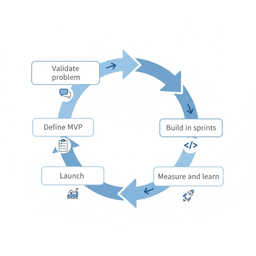
Great products improve through small cycles. You build a small change, measure results, learn what happened, and plan the next change.
Launching is the start of a feedback cycle. The best teams treat the roadmap as flexible, because user behavior is the real source of truth.
A SaaS founder launched a tool for content creators. The MVP included a complex analytics dashboard. After launch, almost no one used it.
But a small feature, a simple text-snippet generator, got heavy usage. So the team redesigned the product around that behavior. Within three months, retention doubled.
Your next step after launch is simple. Review the first week of data, find the biggest friction point or the biggest surprise win, then plan one update around that insight.
Common Questions About Product Development for Startups
These are the questions that come up in almost every founder conversation.
How Much Does It Cost to Build the First Version?
The honest answer is: it depends on complexity. A simple MVP can be closer to the cost of a used car. A complex platform may require seed funding.
The fastest way to get a real number is to define scope and risks early. If you want a practical breakdown of price ranges and hidden costs, review MVP budget and cost drivers.
I’m Not Technical. How Can I Manage a Development Team?
You do not need to manage engineering details. You need to lead the product direction.
Your job is to understand the customer and make business decisions. A good partner handles technical execution and keeps you informed in plain language.
If you want to stay hands-on without becoming a technical project manager, working with a product and technology partner can keep you moving fast while you stay in control.
How Long Does the Product Development Process Take?
For many startups, a well-scoped MVP takes 3 to 6 months to design, build, and launch.
The biggest variable is complexity. A focused SaaS tool can be closer to three months. A marketplace with multiple user roles can be closer to six.
The better you protect scope, the faster you get to real feedback.
Ready to Build Your First Version?
If you want to turn an idea into a product with a clear plan, fast execution, and real learning after launch, we can help.
Refact works with non-technical founders to define the MVP, design it, build it, and keep improving it after launch. Start with a short intro and we will help you map the next steps. Talk with Refact.


