


You have a strong business idea. You know your audience, your pricing, and what “success” looks like. But when it comes to building the product, the plan suddenly feels like a steep climb.
If you are a non-technical founder, this is a common moment. The tech roadmap looks like a mountain, and you are not sure where the trail starts. This is exactly the problem fractional CTO services are meant to solve.
Before you write code or hire a team, it also helps to decide what you should build first. Our guide on the MVP vs prototype decision can help you pick the right starting point.
You’re Not the Only Founder Stuck Here
Many founders can explain their market in perfect detail. Then they hit the technical questions, and every answer feels expensive.
The list often sounds like this:
- Which stack should we pick, React or Next.js?
- How do we set up data so the product does not break when users show up?
- What’s the best way to build a custom paywall on WordPress?
These are not small details. They shape your timeline, your budget, and the team you need.
The “simple” fix is to hire a full-time CTO. But for many early-stage companies, that can mean a $250,000+ salary plus equity. Most teams cannot take that on while still trying to prove the product.
This stress is often a sign that your process is not set up for good product delivery. Understanding the signs your product development cycle is broken can help explain why things feel slower and harder than they should.
You can be an expert in your industry without being a software architect. Trying to be both usually leads to delays and expensive mistakes.
A fractional CTO gives you senior tech leadership without hiring a full-time executive. You get direction, clear decisions, and support that matches your stage.
If you are trying to set realistic dates, our guide on estimating software development time is a helpful companion. A fractional CTO often uses the same kind of thinking to pressure-test timelines.
What Fractional CTO Services Actually Include
Founders ask, “Is this just consulting?” Not really. A good fractional CTO is a part-time member of your leadership team. They help you make decisions, then they help you execute them.
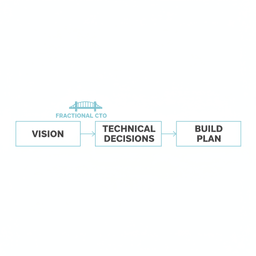
They turn your business goals into a build plan your developers can follow.
Here is what that can look like in a normal week:
- Early week: roadmap talks. Build on WordPress, go headless, or build custom? What is the trade-off?
- Midweek: calls with developers. Turning goals into specs, reviewing architecture, checking quality.
- End of week: budget planning, investor materials, vendor review, tool selection.
Many founders face the same dilemma: you have vision and business skill, but a gap in technical leadership. A fractional CTO fills that gap without forcing a full-time hire.
A strong engagement also includes work that is not glamorous, but saves you money later. Things like security basics, deployment practices, and planning for support after launch.
Strategy and Execution, Not Just Advice
A fractional CTO should not hand you a deck and disappear. The value comes from getting decisions made, then making sure the work is done well.
In practice, most responsibilities fall into a few buckets:
- Technical roadmapping: aligning features to a timeline and budget so the team builds the right things first.
- Architecture and stack decisions: choosing tools that fit your product today and still work a year from now.
- Team and vendor oversight: reviewing agencies, managing developers, and preventing avoidable rework.
The goal is to move you from “I’m not sure” to “we have a plan.” Clarity is what makes execution possible.
When you need a team to design and build, pairing leadership with delivery matters. This is where a partner that provides website development services can help carry strategy into working software, especially for WordPress builds, migrations, and custom features.
When Hiring a Fractional CTO Makes Sense
Fractional CTO services are not the answer for every company. But they are a strong fit when the technical decisions are high-stakes and you do not yet need a full-time CTO.
Think of it like having an experienced pilot on call. You might not need them every hour of every day. You do want them when the weather turns.
You Need a Plan Before You Build
The best time to bring in senior tech leadership is often before development starts. That is when you can avoid false starts.
A common example is a growing media brand running a high-traffic WordPress site. The site feels slow, the editing workflow feels messy, and new revenue ideas feel hard to ship.
A fractional CTO can map a modernization plan. That can include:
- what to keep in WordPress and what to replace
- how to protect SEO during changes
- how to reduce risk in the launch plan
If a migration is on the table, use a checklist first. Our website migration services guide breaks down how to move platforms without losing traffic or revenue.
Turning Expertise Into a Real Product
Another common case is an established business, often 10–150 employees, that wants to build a new product line. The company knows the problem. The team does not have senior technical leadership to build the solution the right way.
Examples:
- A direct-to-consumer brand whose Shopify store has stalled. They need better performance, better tracking, and better conversion flow, and they need someone senior to guide the work.
- A membership organization building a paywall with tiered access, recurring payments, and email sync.
- A consulting firm productizing its knowledge into an AI-powered tool, starting with a clear MVP and a realistic build plan.
The pattern is simple. You have a valuable business problem, and technology can solve it. You just need the senior person who can connect the dots.
In monetization-heavy businesses, paywalls are often the make-or-break feature. If you are weighing models, Refact’s breakdown of three paywall types can help you pick the approach that matches your audience.
How Much Fractional CTO Services Cost
Cost is usually the first founder question. The answer depends on how much time you need and how deep the role goes.
Some companies want a few hours a month to sanity-check major decisions. Others need active leadership across planning, hiring, and delivery.
Common Pricing Models
- Monthly retainers: often $2,000 to $5,000 per month for high-level strategy, reviews, and decision support.
- Deeper build oversight: often $5,000 to $20,000 monthly when the fractional CTO is leading execution with your team or agency.
Compared to a full-time CTO, the difference is clear. A full-time hire can cost $300,000 to $400,000 per year when you include benefits and equity. That burn rate is too high for many teams before product-market fit.
The win is not “cheaper leadership.” The win is avoiding expensive mistakes that come from guessing at technical decisions.
If you want a better way to budget the full build, read our software development cost estimation guide. It explains what drives cost, what is hard to estimate early, and how to reduce unknowns.
How to Choose the Right Fractional CTO Partner
This decision is not only about tools. A good fractional CTO can explain trade-offs in plain language and tie every decision back to business goals.
The wrong fit can waste time and increase cost. You want judgment, communication, and follow-through.
Questions That Reveal Strategic Fit
Try questions that force real examples, not buzzwords:
- “Tell me about a founder you helped go from idea to launch. What went wrong, and what did you change?”
- “How would you approach modernizing our WordPress platform without losing SEO?”
- “What technical decision did you make that hurt in the short term but paid off later?”
Pay attention to how they explain. If you leave the conversation more confused than when you started, do not move forward.
Look for a Force Multiplier
A strong fractional CTO brings more than personal skill. They bring processes, templates, and trusted people. That can shorten hiring cycles and reduce risk.
They should also know when to say “no.” Not every feature belongs in v1. Not every shiny tool is worth the cost.
You are betting on their judgment. Look for proof they have made good calls for teams like yours.
What to Do Next
Knowing the model is helpful. Taking action is what changes your roadmap.
Here is a simple plan you can do this week.
Write Down Your Three Biggest Technical Problems
Open a note and list the top three tech issues slowing you down.
Examples:
- “I do not know what stack we should build on.”
- “I do not trust the timeline we were given.”
- “We need a paywall and I do not know the best approach.”
This turns anxiety into a list of real problems you can solve.
Talk to a Partner About Those Problems
The goal of a first call is not to sign a long contract. It is to see if someone can bring clarity fast.
If you want help mapping your roadmap and reducing risk before you build, you can schedule a call with Refact. We start engagements with a Product Strategy phase so you have a plan before you spend heavily on development.
Common Questions From Founders
What’s the Difference Between a Fractional CTO and a Technical Advisor?
A technical advisor is usually a light-touch role. They give input now and then, often for small equity, and they are not accountable for delivery.
A fractional CTO is closer to a part-time executive. They guide decisions, set standards, and help manage execution.
Can a Fractional CTO Manage My Developers or Agency?
Yes. This is often the highest value part for non-technical founders.
They translate business goals into technical requirements, review the work, and keep delivery aligned with budget and timeline.
This oversight reduces miscommunication and rework. It helps make sure your development spend turns into a product that supports the business.
When Should I Move to a Full-Time CTO?
Usually when your team and system complexity require a dedicated leader.
Common signs include:
- you raised a major round, like Series A
- you have an in-house engineering team of 10+
- you need full-time ownership of security and operations
Ready to remove the guesswork and start building with a plan? Refact can help you define the roadmap, validate the approach, and improve results over time with website optimization services once you are live.


